What a 53-Day Decision Window Does to a Commission Structur
The demo usually starts the same way. A customer walks in with a shortlist open on her phone. The salesperson opens with “let me walk you through the range.” For the next twenty minutes, two people talk past each other: she is checking one thing, he is delivering eleven.
Everyone in this industry has watched it happen. Fewer have asked why it survives a decade of investment in retail technology — apps, configurators, CRM dashboards, now AI. The answer isn’t training, and it isn’t culture. It’s four incentives, and all four point the same way.
The pay plan pays for the pitch. Commission is still calculated on margin and volume. Someone who earns from the discount has no financial reason to spend forty minutes learning what the customer already believes. J.D. Power’s data puts same-day follow-up at 25.6% higher conversion — but follow-up is unpaid work in most plans.
The lot is a clock. Floorplan financing means every car costs money every day it sits. In a market where 81.9% of dealers sell below invoice, the fastest way to stop the clock is a discount, not a better conversation. The showroom becomes a warehouse with a coffee machine.
The scorecard counts the wrong unit. Franchise agreements measure units, CSI, sometimes lead response time. None of them measure whether the store knew what the customer had read. What isn’t scored isn’t staffed, and what isn’t staffed doesn’t happen.
The blind spot is profitable. The customer’s online trail — the three cars she rejected, the finance ceiling she entered, the objection she typed into a chatbot — never reaches the floor. Re-asking is cheaper than integrating. So the store re-asks, and looks unprepared at the exact moment it needs to look certain.
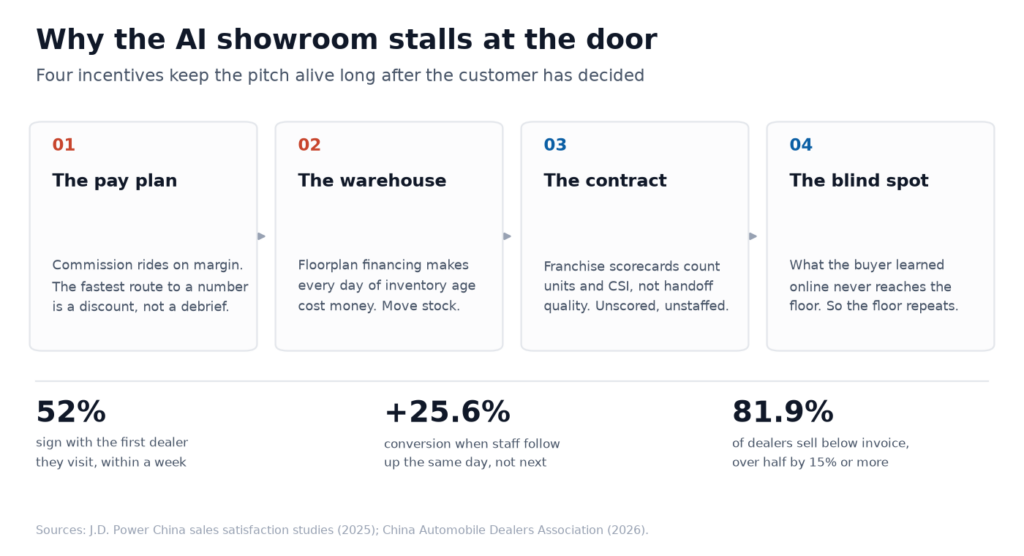
Individually, each is rational. Together they form a loop: pitch, discount, inversion, eroded price trust, longer close, more pressure to pitch. Retail technology lands on top of this loop and gets absorbed by it. That is why a brand can buy a configurator, an AI assistant and a rebuilt showroom, and still lose volume — the stack is optimizing a behavior the pay plan is actively punishing.
What breaks the loop isn’t another screen. Three moves, in order. Pay for the handoff: make same-day follow-up a scored, compensated behavior rather than a virtue. Shrink the lot and speed up the data: fewer configurations, live inventory, honest pricing, so nobody needs the discount to stop the clock. And hand the floor a one-screen brief of what the buyer already knows — the shortlist, the trade-in, the objection.
None of that is a technology project. It is a compensation project with a technology budget.
The AI showroom isn’t blocked at the door by bad software. It’s blocked by an incentive system that was never told the decision moved upstream. Fix the pay plan and the room starts working; leave it, and every new screen becomes another thing the customer walks past on the way to the car she already chose.