Why Advertising Makes Chinese Seniors Trust You Less
Walk into the senior section of any Chinese department store and you will find no shortage of product: massage chairs, blood-pressure monitors, walking frames, orthopaedic shoes, supplement boxes stacked to eye level. Ask the floor manager which brand leads in any of it and the answer is usually a shrug. A market of 323 million people and roughly ¥9 trillion a year, and almost nothing you could call a brand. Chinese researchers have a phrase for it — categories without brands.
That gap is usually read as a marketing failure. It is better read as a mechanism.
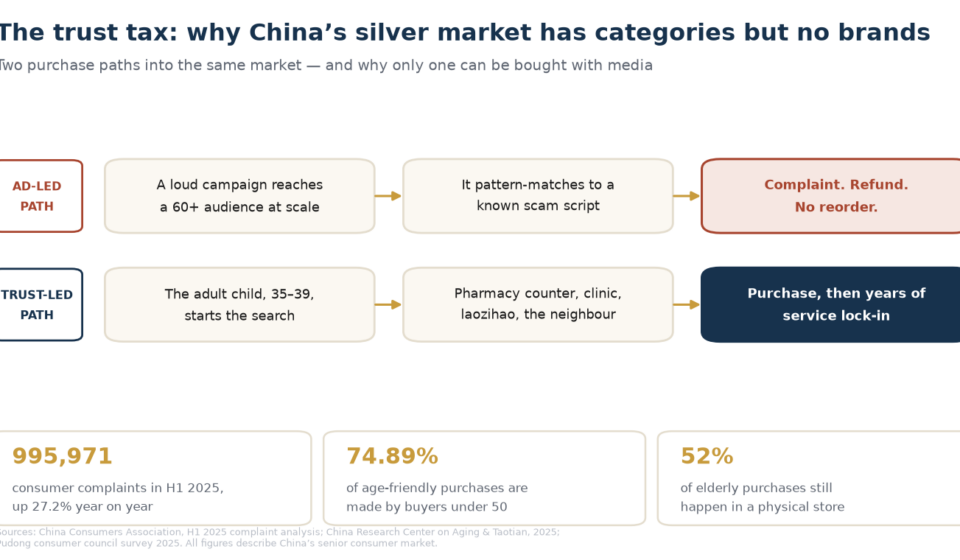
Start with the product. A senior purchase is a credence good: you cannot verify quality, even after you have used it. A hearing aid either helps or it does not, but no buyer can tell whether it helps as much as it should. Now add the second layer, the one the data keeps surfacing — the buyer is usually not the user. On Taotian, 74.89% of spending in age-friendly categories comes from accounts held by people under 50. So two people, parent and adult child, sit on either side of a transaction, and neither of them can judge the thing being bought.
When information asymmetry is that severe, the usual signals stop working. Price stops telling you about quality, because the cheap option and the expensive option are equally opaque. And advertising stops telling you about commitment, because in this category aggressive advertising has historically been the fraudster’s signature. The China Consumers Association’s 2025 complaint analysis named three dominant traps: clickbait that triggers silent auto-renewals, hotel-ballroom sales events in rural counties, and livestream hosts selling ordinary food as medicine. Nearly a million complaints in the first half of the year alone. A senior looking at a loud, discount-heavy campaign does not read confidence. They read the same script they were warned about at the community centre.
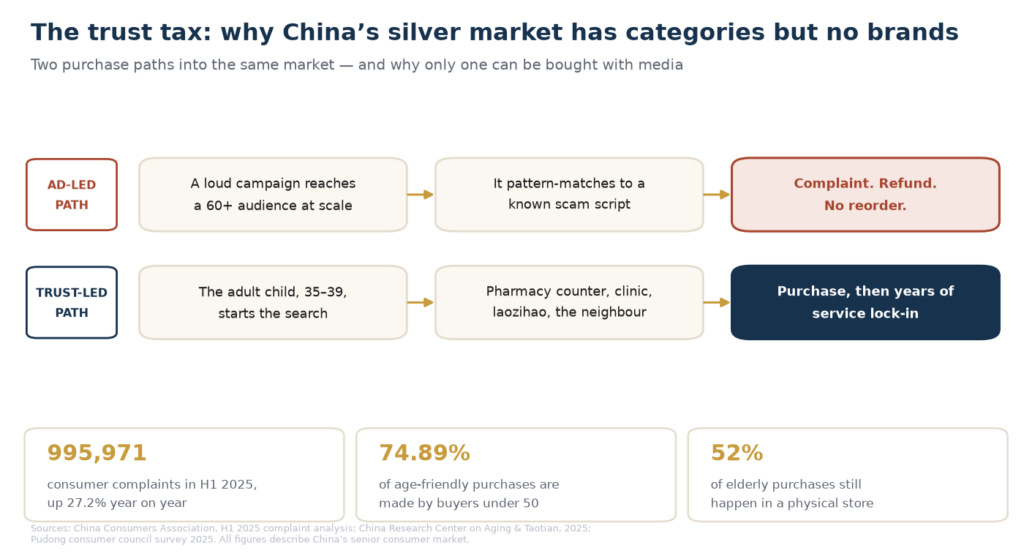
So trust does not come from media. It is manufactured somewhere else: a pharmacy counter, a community clinic, a laozihao with a name older than the buyer’s parents, a neighbour who already owns one. That is why 52% of elderly purchases in a Shanghai survey still happen in a physical store. It is also why the market stays fragmented. Trust at this resolution does not scale through media buying; it scales through premises, staff and time, which is expensive and slow and never fits a three-year payback window.
The brands quietly winning — in mobility, home safety, hearing, sleep — are not winning with campaigns. They are buying distribution and then making service the product: installation crews, ten-year repair promises, a phone number that a human answers. Their moat is the one thing a scammer cannot counterfeit, which is a place you can walk into.
That inverts the standard playbook. In most categories, brand is the promise and service is the proof. Here, service is the brand, and media is only the reminder.