The Avatar Is Cheap. The Compliance Is Not.
China has industrialized the synthetic spokesperson faster than anyone else. The brand-safety pitch is real — and so is the risk it quietly relocates.
In the third week of July 2021, brand teams across China did something they had rehearsed but never enjoyed: they opened their endorsement contracts and went looking for the morality clause. Kris Wu, until then one of the country’s most bankable celebrity endorsers, had stopped being an asset overnight. Of the fifteen brands attached to him, eight cut ties within days. Four discovered their contracts had already lapsed — a piece of luck nobody had planned for.
That fortnight became the reference case for an entire industry’s anxieties. Celebrity endorsement in China is not merely expensive. It is structurally fragile: one human being, with a private life nobody can audit, sits at the center of a nine-figure marketing program.
So when the pitch arrived — an ambassador with no private life, no late-night posts, no renegotiation, no morality clause — it sounded less like a gimmick and more like an answer.
It is an answer. It just isn’t the whole answer.
What China actually built
Let’s get the nouns right, because most English coverage doesn’t.
virtual idol — is a fandom-facing performer. Luo Tianyi is one. She sings, she tours, she has fans who write for her and argue about her. The technology underneath is a voice synthesizer, a 3D model, motion capture, and usually a human performer driving the whole thing in real time.
virtual digital human — is the wider category: brand avatars, customer service agents, newsreaders, exhibition guides, livestream hosts. Some are photoreal. Many are not.
digital human host — is the commercial workhorse. This is the one that shows up at three in the morning selling laundry detergent, and the one regulators have now decided to care about.
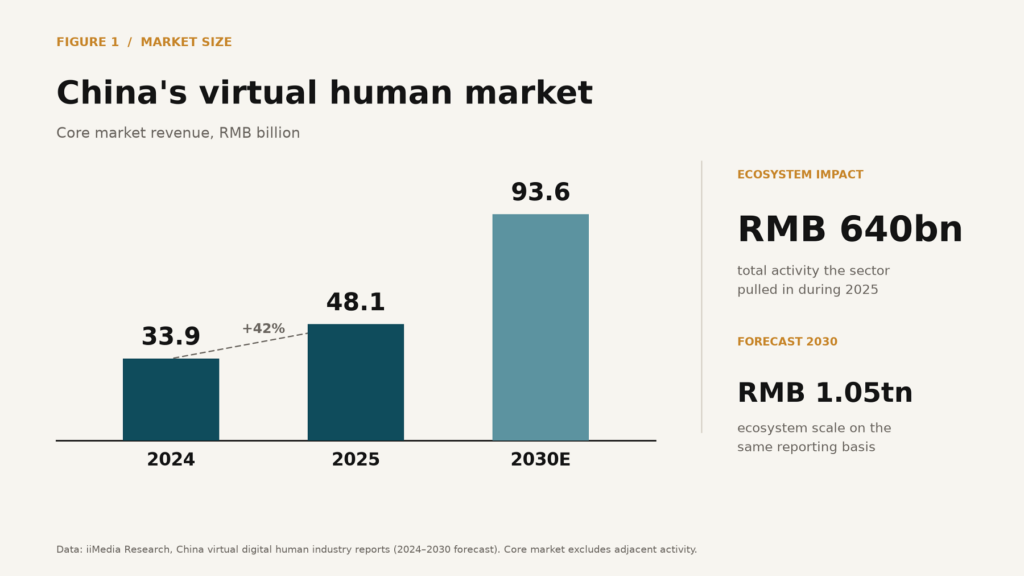
iiMedia Research puts China’s core virtual digital human market at RMB 33.9 billion in 2024, rising to RMB 48.1 billion in 2025 — roughly 42% growth in a single year — and forecasts RMB 93.6 billion by 2030. Widen the lens to everything the sector pulls along and the 2025 figure reaches RMB 640 billion, on course to pass RMB 1 trillion by the end of the decade. IDC, measuring a narrower slice, sizes the AI digital human segment at around RMB 10 billion for 2026. The numbers disagree because the definitions do. The direction does not.
The arithmetic nobody puts in the deck
Here is the part that actually changed.
In September 2024, Baidu’s cloud unit pushed the price of a 3D hyper-realistic digital human to a floor of RMB 199 on its Xiling platform. By mid-2025 the same platform was generating a 3D avatar from text in about ten minutes, cloning a 2D presenter in hours, and quoting 98.5% lip-sync accuracy. One aside for anyone recycling old decks: Xiling is the digital human platform. Xirang is Baidu’s metaverse app. They are not the same product, and mixing them up in a client document is embarrassing.
Ten minutes. RMB 199. Whatever else that means, it means the marginal cost of your second spokesperson is approaching zero.
Compare that with a human. A-list endorsement fees in China run into the tens of millions of yuan. When Luo Tianyi did a KFC collaboration in 2017, reporting at the time put the deal in the low millions — a rounding error next to what a comparable human celebrity commanded, and she arrived with a fanbase that wrote its own content.
That gap is the whole story. Not realism. Not novelty. Unit economics.
Case one: Luo Tianyi and the long game
Luo Tianyi debuted in 2012 as a Chinese-language vocal synthesizer with a character design attached. She was, by most accounts, the first virtual singer in China to turn a genuine profit.
The reason is worth sitting with. She was never really a spokesperson. She was a platform. Fans wrote her songs. Fans tuned her voice. Fans decided what she meant. Brands that hired her were not renting an endorsement; they were buying access to a community that had already done the emotional work.
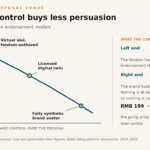
That is a very different product from “a face we control completely.” It also explains what the AI-spokesperson pitch tends to miss: the endorsement value came from the fandom’s ownership, not from the brand’s control. Swap in a fully synthetic persona with no fan authorship and you keep the face while losing the engine.
Case two: Liu Yexi and the cost of realism
In October 2021, a production company called Chuangyi Technology released a short video featuring a hyper-realistic virtual woman named Liu Yexi. It was, by short-video standards, cinema: expensive, immaculate, and obviously not shot on a phone.
It worked. The character became one of the most discussed virtual humans in China almost immediately.
It also demonstrated the ceiling. Photorealistic virtual humans are a content business, not an endorsement business. Attention decays. A character built on craft needs craft every single time, and audiences can tell the instant it drops. The economics of a virtual idol are the economics of a production studio, not those of a logo.
Case three: A-SOUL and the scandal nobody modeled
Now the case that should be printed on the wall of every brand team considering this.
A-SOUL launched in November 2020, a five-member virtual girl group from ByteDance and Yuehua Entertainment. They were, briefly, the biggest thing in Chinese virtual entertainment: a real fandom with its own vocabulary, its own conflicts, its own internal politics.
In May 2022, one member, Carol announced she was going into hibernation. Fans did what fans do: they investigated. What they concluded was that the human performer behind the avatar, the Of the world, had been overworked and underpaid. Personal information about the performers began circulating. The fandom turned on the companies. The group never fully recovered its standing.
Read that again, because it dismantles the central promise.
A virtual idol cannot have a scandal. She has no private life to expose, no opinions to apologize for, no contracts to breach. But the person wearing the avatar can have a labor dispute — and in a fandom economy, a labor dispute is a scandal. The risk did not vanish. It changed address.
The labor question is a brand question
This is the structural flaw in the zero-scandal argument, and it has two branches.
Branch one: you use a human performer under the avatar. Your brand exposure now includes employment practices you probably do not control, in front of an audience that will investigate them. If the performer is a supplier’s contractor, you have bought a risk you cannot see.
Branch two: you use a fully synthetic persona with nobody underneath. Now you have traded talent risk for model risk, which is stranger, because it is unbounded. A generative presenter that can converse is a presenter that can improvise. Improvisation is the feature. It is also the failure mode.
Either way, the clean story — code cannot embarrass us — is doing a lot of unearned work.
Where the money actually is
Forget the brand campaign. The volume sits in livestream commerce, and the reason is brutally simple: the clock.
A human host works a shift. A digital host works the night. On Taobao, Douyin, JD and Kuaishou, a meaningful share of overnight inventory is now moved by synthetic presenters reading from a script, answering the same eleven questions, and never getting tired or expensive at four in the morning.
JD is the clearest signal of how far this has gone. Heading into the 2026 mid-year shopping festival, the company said around 80 million users had used its Jingyan AI shopping agent in the first quarter alone — more than triple the prior year — and that it was upgrading digital human livestreaming so AI hosts could plan, sell and review a session on their own.
Look at what that sentence does. It moves the digital human from presenter to operator. That is a bigger claim, and a much bigger liability.
What synthetic hosts do well: specification-heavy categories, repetitive Q&A, time zones nobody wants to staff, coupon mechanics, and the long tail of SKUs that will never justify a human.
What they do badly: scarcity, urgency, negotiation, and the specific moment when a viewer is deciding whether to trust the person rather than the product. You cannot fake that with a face. It is the one thing the technology has not commoditized.
The compliance layer nobody budgeted for
This is where the Chinese market gets genuinely interesting, and where most Western commentary runs about two years behind.
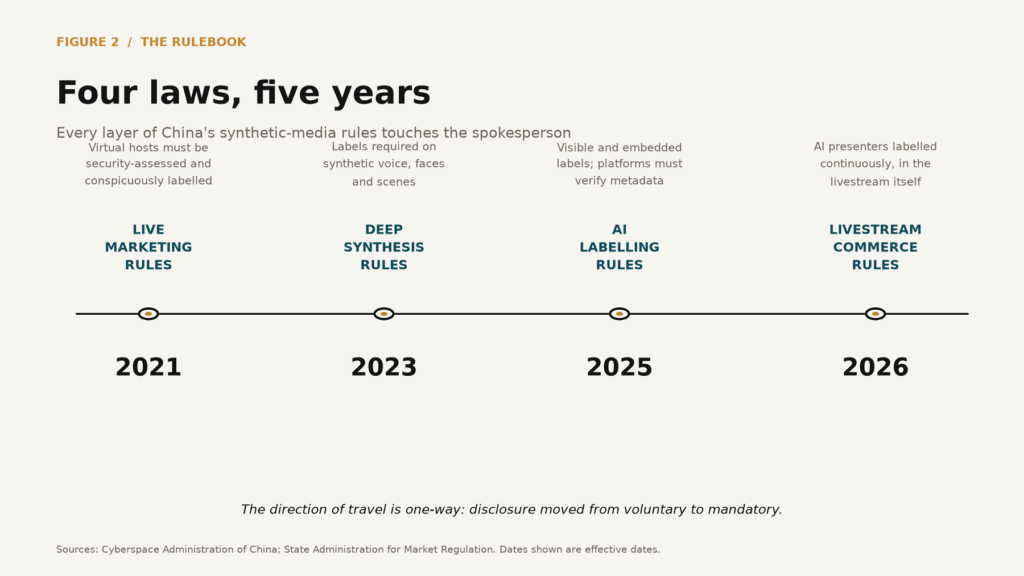
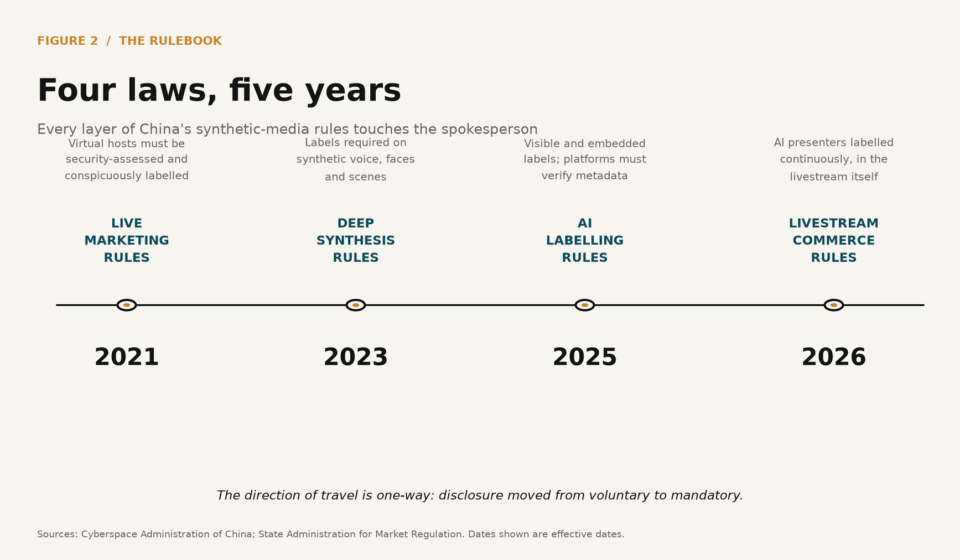
China has spent five years building a disclosure stack around synthetic media, and every layer lands on the spokesperson.
In 2021, the interim measures on online livestream marketing required virtual figures — AI, digital visual, VR, voice synthesis — to be security-assessed and conspicuously labeled.
From January 10, 2023, the deep synthesis provisions required labels on synthetic content, with conspicuous marking for synthetic voices, generated faces and immersive simulated scenes.
From September 1, 2025, the AI-generated content labeling measures went further. Issued by four ministries under document number Guo Xin ban Tong Zi [2025] No. 2, they require two kinds of label: a visible one a user can perceive, and an embedded one in file metadata carrying the provider’s identity and a content number. Platforms must verify that metadata before publishing, and must flag content as suspected AI-generated when they detect traces but no declaration. Stripping or tampering with a label is itself prohibited. Providers that hand over unlabeled copies on request must keep logs for at least six months.
Then, on February 1, 2026, the livestream e-commerce regulation took effect, jointly issued by the market regulator and the cyberspace administration. Article 37 addresses AI-generated persons directly: where a livestream uses an AI-generated human image or video to sell, it must be labeled, and the label must be shown continuously, so viewers are reminded throughout that the person is not real. Officials were blunt about why. AI must not become a shield for false information.
The word doing the work is continuously. Not a disclosure card at the start of a session. Not a line in the terms. A persistent, in-frame admission.
What disclosure does to the economics
Here is the part most strategy decks still haven’t absorbed.
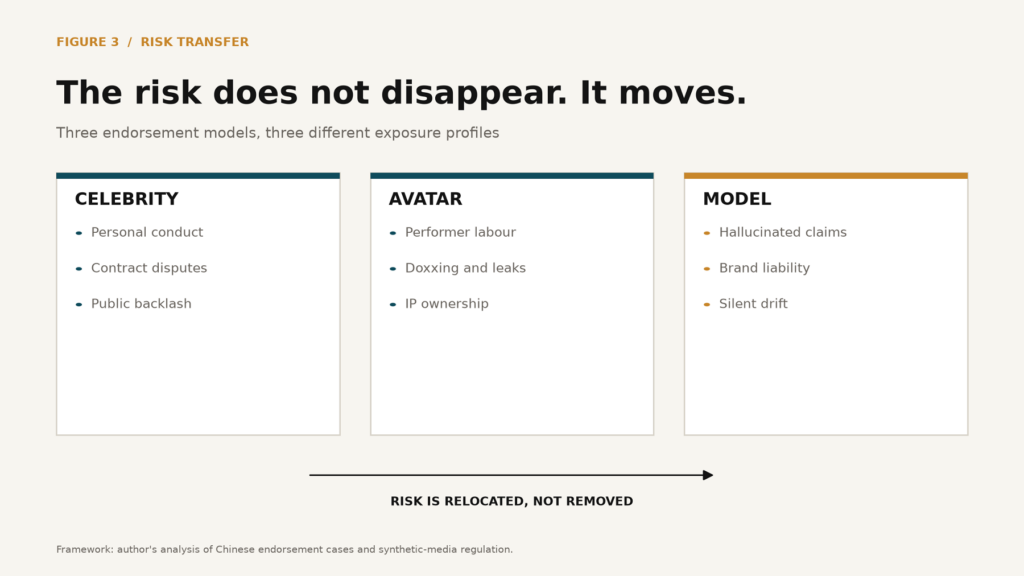
Figure 3 lays out the three exposure profiles side by side. What disclosure changes is not whether they exist, but what they cost.
The classic pitch for synthetic spokespeople was message control: every word, gesture and expression programmable, no off-script risk. Disclosure does not remove that. It reprices it. You can still control the message, but you must now advertise that the control exists — and once an audience knows the ambassador is generated, the ambassador stops behaving like a person and starts behaving like a product feature.
Three consequences follow.
First, the we-never-said-she-was-human defense is gone. It was never a good defense. Now it is an unlawful one.
Second, liability concentrates instead of diffusing. If a synthetic host overpromises a refund, invents a certification or repeats a competitor’s claim, the brand is the operator. There is no model vendor to blame in the consumer’s mind, and increasingly none in the regulator’s either.
Third, the reputational asymmetry flips. A human scandal is legible — the public knows how to process a celebrity behaving badly. An AI scandal is not. “The avatar said something untrue for six hours overnight” reads as incompetence, not misfortune. Because it is.
Where they win, honestly
Livestream operations at scale. Categories where the purchase is specification-driven and the customer wants answers, not companionship. Youth-facing brands, where a synthetic persona is not a deception but a native format. High-risk categories, where a human scandal would be existential and a disclosed avatar is the lower-variance bet. Cross-border selling, where one persona can work four languages and three time zones without a visa.
Where they lose, equally honestly
Luxury. The product is the human: the atelier, the ambassador, the borrowed prestige. A disclosed avatar says “we optimized,” which is the precise opposite of what a four-thousand-euro handbag is selling.
Trust-heavy categories — financial advice, insurance, medical devices. Disclosed synthetic presenters here do not merely underperform. They raise a compliance question the brand has to answer in writing.
Care work: parenting, therapy, hospice, early childhood education. Here the human presence is not a delivery mechanism for the message. It is the message.
And any category where the celebrity is the story. You cannot generate a comeback narrative.
The uncanny valley is a budget line
Worth saying plainly: below a quality threshold, a synthetic spokesperson is worse than no spokesperson at all. A slightly wrong mouth, a dead gaze, a voice landing half a beat late — audiences in China have been watching digital humans for five years, and they are no longer impressed by competence. They notice failure.
The floor has dropped. The ceiling has not. RMB 199 buys a template. It does not buy a character anyone will remember.
The model that actually works
The durable structure is not avatar versus celebrity. It is both.
A human celebrity under contract with a licensed digital twin: the human does the trust-building, the interviews, the moments that require a body; the twin does the pre-dawn shift, the four-language product explainer, the regional variant. Disclosure makes this work rather than undermining it, because the audience’s trust is anchored in a real person who consented to the copy.
It also fixes the labor problem. The performer is not hidden. They are the licensor. That is a different relationship, and a far more defensible one.
Six things to do on Monday
Audit every endorsement contract for digital twin rights: likeness, voice, term, termination, and what happens to the model when the deal ends.
Decide your category honestly, in writing. If you are in luxury, trust or care, the answer may simply be no.
Budget the compliance layer as a line item, not an afterthought: labeling, metadata, platform verification workflows, and the internal review that stops an autonomous presenter from improvising.
Write a hallucination containment protocol. What the avatar may never say, who checks, how fast you can pull a livestream, who signs off on a rollback.
Change the metric. Impressions are easy and meaningless here. Track recall, trust and complaint rate — the three numbers that actually move when a synthetic face goes wrong.
Price the labor, even when there is no labor. If a performer exists, pay them properly and say so. If none does, say that too.
The takeaway
China did not build a cheaper celebrity. It built a different instrument, and then wrote rules for it faster than anyone else.
The instrument is genuinely powerful: infinitely replicable, endlessly patient, immune to the specific catastrophe that ends endorsement deals overnight. But immune to one kind of risk is not safe. A-SOUL made that point in 2022, before any labeling rule applied to it, and the labeling rules make it again in a different register: the state has decided a synthetic ambassador must always be visible as synthetic. That is not a restriction on the technology. It is a statement about what the technology is for.
Use it where the clock matters more than the face. Disclose early, because you will have to. And remember what the pitch keeps skipping: a virtual idol can sell a product, but only a brand that has earned trust can sell itself.