Why Chinese B2B Attention Shrinks as Buyers Get Serious
The audience that decides is a hundred times smaller than the audience that discovers. Nobody buys media for it.
Media plans get built where rate cards exist. That one sentence explains most of the misallocation in Chinese B2B marketing.
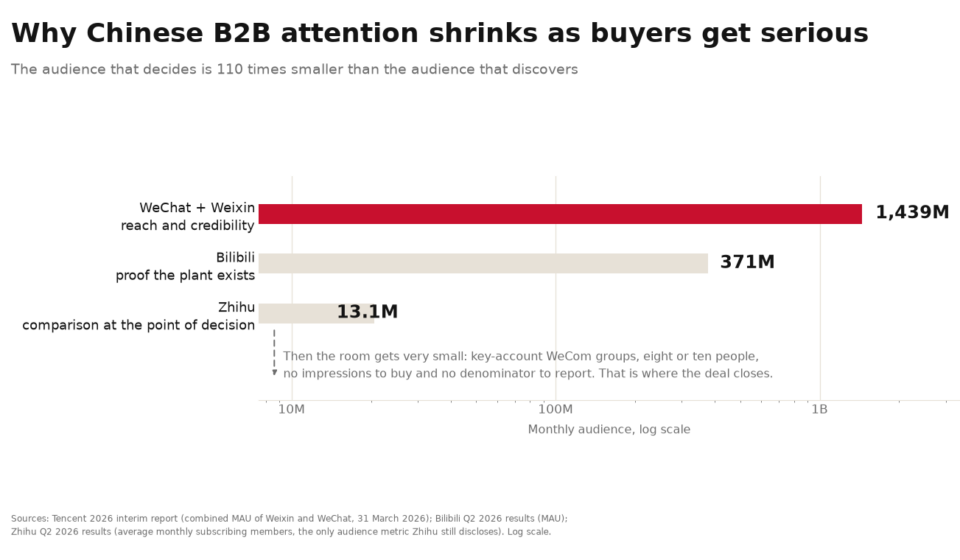
Consider three numbers from this year’s filings. Weixin and WeChat together report 1.44 billion monthly users. Bilibili reports 371 million. Zhihu, which stopped disclosing monthly actives, reports 13.1 million average monthly subscribing members. Read as a media menu, that looks like one platform with the other listed as minor options. Read as a buyer journey, it is a collapse of 110 to one — and the collapse is the point.
Why? Because the question changes at every step, and each new question costs more to answer.
At the top, the buyer is asking who you are. Reach answers that, crudely but adequately. In the middle, the buyer is asking whether the factory is real — whether the line exists, whether the QC station has a light booth, whether anyone actually welds that thickness. A twenty-minute video answers that. At the bottom, the buyer has a spec, a deadline, and a colleague who will check the number. The question is now narrow enough to be embarrassing: what is your tolerance on this part, and what happens in month fourteen.
Content that answers the first question can be produced by an agency in a week. Content that answers the third requires an engineer, a test method and a date. That asymmetry — not attention, not algorithm — is what shrinks the audience. Every step down the funnel removes people and adds a constraint, and constraints are expensive.
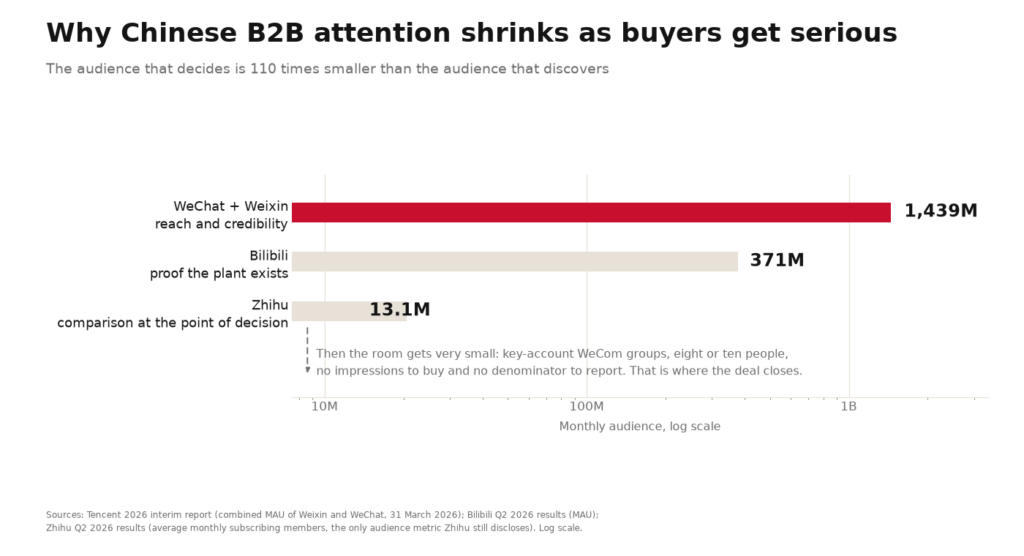
Then there is the reason this stays unfixed. The small end has no denominator. Your key accounts live in WeCom groups of eight or ten people. There are no impressions to buy, no reach to report, no monthly active anything. Finance sees a cost with no corresponding number beside it, so the budget migrates upward — to the place that can be counted, which is also the place furthest from the decision.
The 2025 compliance regime sharpened this. Proof that used to be delivered across a dinner table — the plant visit, the sample handover, the informal assurance that a delivery date would hold — now has to exist as a document, because after October the informal channel carries legal risk. And documents do not travel by media buy. They travel by forward, from one engineer to another, into a room of eight people.
Which suggests a different allocation rule: fund the small end in proportion to deal value rather than audience size. If a contract is worth seven figures, the asset that decides it should carry a named author, a date and a test method, since it will be read by someone paid to doubt it. A single comparison table that survives a technical review is worth more than a quarter of brand reach.
You cannot buy a room of eight. You can only be worth forwarding into it.