What Actually Broke the 4S Store (It Wasn’t the Livestream)
Something kept nagging me while pulling the 2026 numbers together. Everyone describes China’s auto shift as a marketing story — livestreams, apps, configurators, KOLs. But Marketing tactics don’t usually rewrite an entire distribution system this fast. Tactics get copied. Distribution gets rebuilt when the money underneath it stops working.
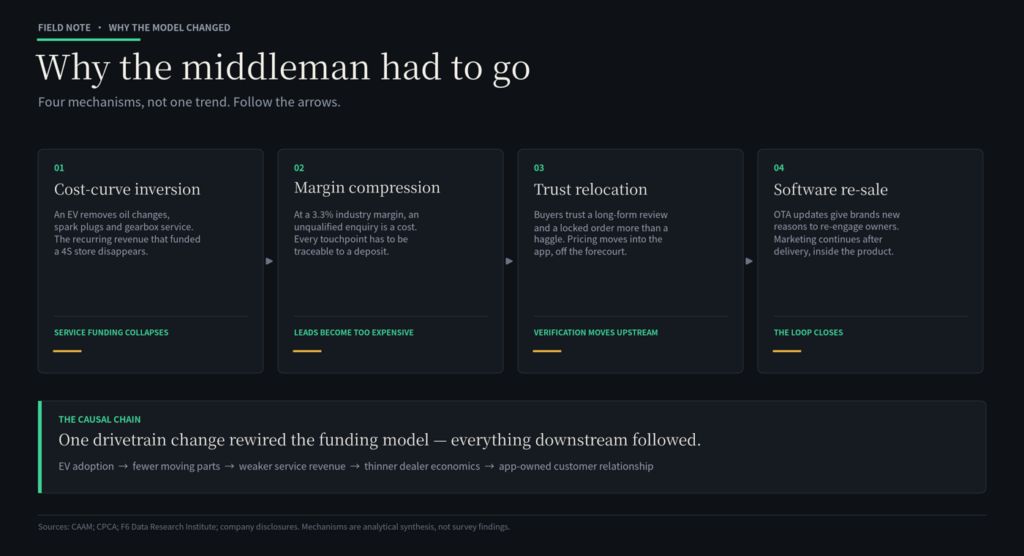
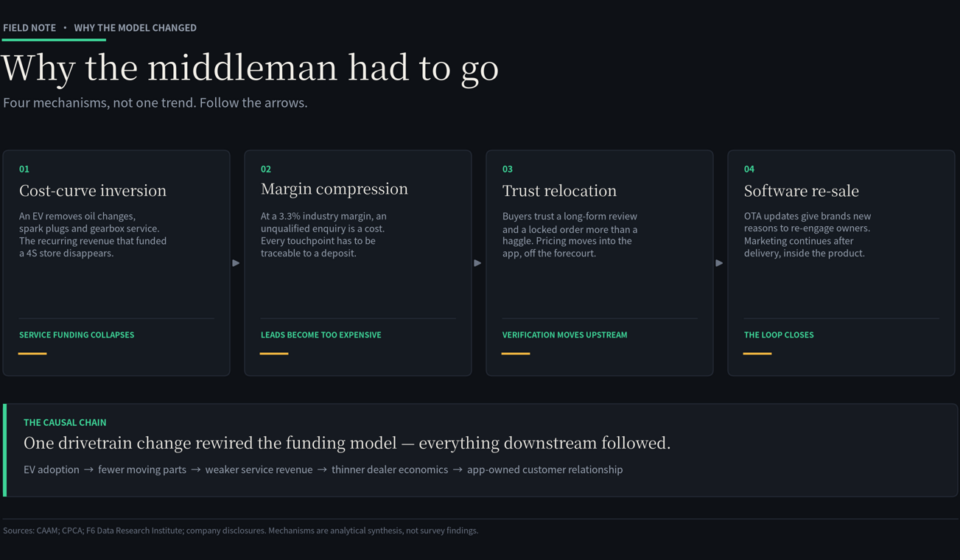
So I went looking for the funding model instead of the funnel. What I found was a four-step causal chain, and it starts somewhere nobody in marketing talks about: the oil change.
The first domino is mechanical, not digital. A battery-electric drivetrain has a fraction of the moving parts of a combustion one. No oil, no spark plugs, no gearbox service, no timing belt. That isn’t a product feature — it’s the deletion of a revenue stream. For two decades, the 4S dealership survived on the back end: sell the car thin, earn the margin on service, parts, finance and insurance for the next five years. Electrification quietly removed the annuity. The aftermarket data makes it visible in a way no press release will: 382,000 independent repair shops at the start of 2026, 345,000 by mid-year, 170,000 gone in five years. A building that used to own a customer for five years suddenly had nothing to sell them.
That explains why the closures came before the apps, not after. Dealers didn’t lose a fight to Tesla or Xiaomi. They were made redundant by a motor with fewer parts.
The second domino is arithmetic. Once volume stops growing — passenger-car retail down 22% through October — and the industry margin compresses to 3.3%, an unqualified enquiry stops being an asset and becomes a cost. Western CRM was built to nurture leads. At 11,000 yuan of gross profit per vehicle, you cannot afford to nurture anything. This is the part I didn’t expect: the locked order isn’t a clever growth hack. It’s a survival adaptation. A deposit is the only marketing outcome a factory can plan production against, and a finance team can reconcile. Every yuan spent upstream of that deposit is now suspect by default.
The third domino is trust. Here’s the discovery that reframed the whole piece for me. Buyers didn’t move online because it was convenient. They moved because the offline price was unverifiable. The traditional forecourt runs on negotiated pricing, which means every buyer suspects everyone else got a better deal. Fixed pricing in an app removes the suspicion — but only if someone independent has already validated the product. That is the real job of the forty-minute Bilibili teardown. It isn’t awareness. It’s an audit the buyer outsources to a stranger with an engineering-literate audience. Once verification happens upstream, the showroom has no information left to sell. It becomes a handover desk.
The fourth domino closes the loop. An OTA update is a re-sale opportunity with no salesperson attached. That’s why the relationship can be owned by an app rather than a building: the product keeps generating reasons to talk to its owner. Marketing stops being a pre-purchase campaign and becomes a release schedule.
Put the four together and the story inverts. Most coverage says digital marketing killed the dealership. The data says the opposite: a change in drivetrain economics killed the dealership’s funding model, and digital marketing is what rushed in to fill the hole. The configurator, the locked order, the review video — each one is a repair for a specific broken link, not a trend.
For global brands, that’s the uncomfortable part. You can copy the livestream in a quarter. You cannot copy a cost structure. If your dealer network still earns its keep on service and negotiated margin, your app will always be a brochure, never a store — because nothing in your P&L is asking it to be one.