China’s Pet Owners Spend Like Parents. Most Brands Still Sell Like Vendors.
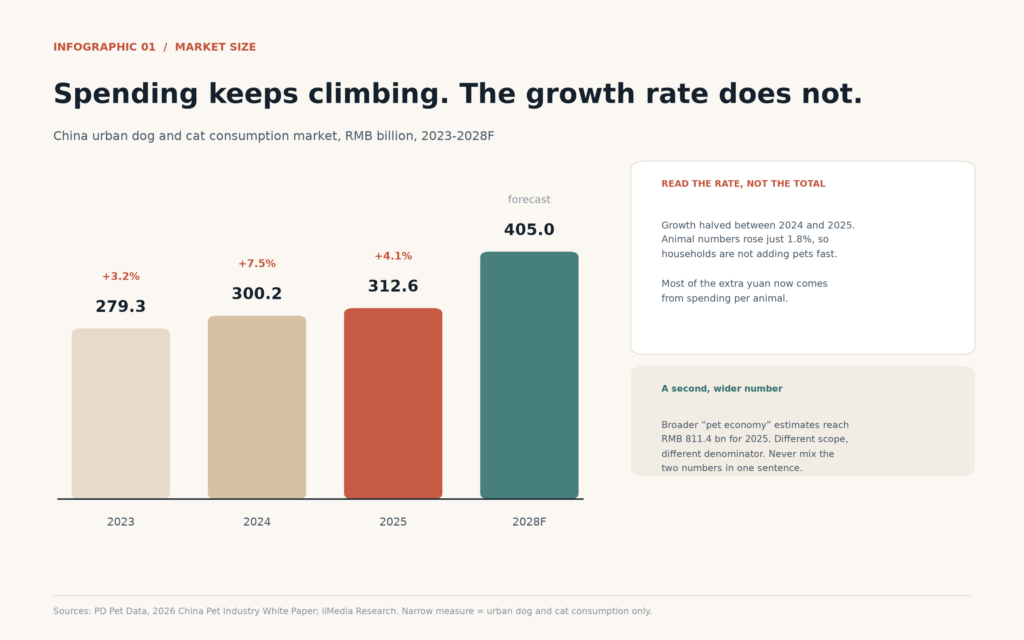
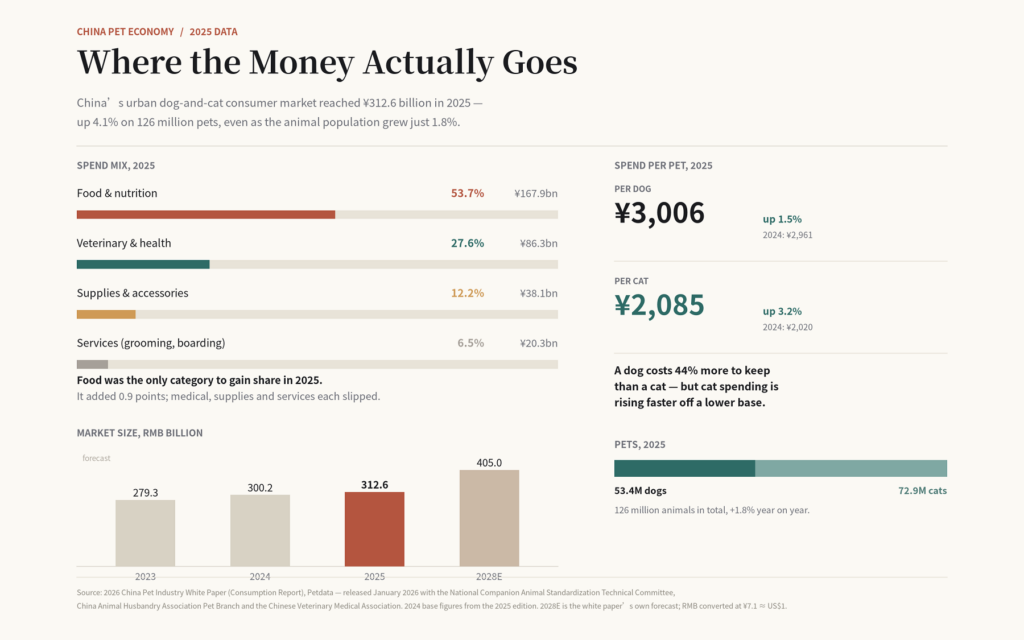
Every January, China’s pet industry gets a fresh set of numbers. Every January, most people read them the wrong way. The 2026 white paper — published by PD Pet Data, with guidance from the national companion-animal standardisation committee, the China Animal Agriculture Association’s pet branch and the China Veterinary Medical Association — put urban dog and cat spending at RMB 312.6 billion for 2025.
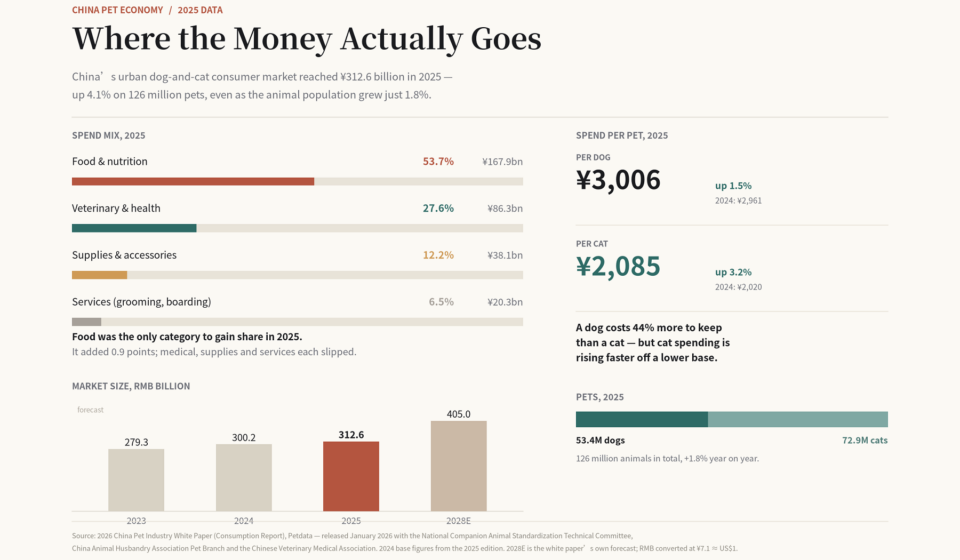
Headlines treated it as a milestone. The line underneath mattered more: growth slowed to 4.1%, from 7.5% a year earlier. Dog spending rose 3.2% to RMB 160.6 billion; cat spending rose 5.2% to RMB 152.0 billion. The number of urban dogs and cats climbed just 1.8%, to 126 million animals: 53.43 million dogs and 72.89 million cats.
So the market is still growing. It is no longer exploding. That distinction should change how a brand spends its money.
What RMB 312.6 billion actually counts
Read the number carefully. It measures household spending on urban dogs and cats: food, medical care, supplies, grooming and services. It excludes live-animal sales, breeding, most pet funerals and the grey market that still exists around them.
A different research house, iiMedia, puts China’s wider “pet economy” at RMB 811.4 billion in 2025, up 15.7%. The two figures aren’t in conflict; they cover different market boundaries. Put them in the same sentence without explaining that distinction, and you have the makings of a very bad deck.
The international comparison is more useful. The American Pet Products Association reported US$158 billion in U.S. pet spending in 2025. At roughly RMB 7.1 to the dollar, China’s urban dog and cat market comes to about US$44 billion — a little over a quarter of the U.S. figure, in a country with more than four times the population. That gap is an opportunity. It is also a warning: Chinese households own far fewer pets, not because they love animals less, but because the ownership base is smaller.
The cat is quietly rewriting the P&L
Look at the animal count and you get a glimpse of the future. China has 72.89 million urban cats, compared with 53.43 million dogs. The white paper projects cat spending to reach RMB 218.4 billion by 2028, overtaking dog spending at RMB 192.3 billion.
Cats are cheaper to keep and easier to leave alone, which suits a country of small flats and long working hours. They also behave differently as customers. A dog owner might buy leads, shampoo, boarding, training and supplies from a shop near the park. A cat owner might order litter on subscription, buy food in bulk and add enrichment toys to a cart from a phone at 11 p.m.
That shift moves more revenue from in-person services and stores toward e-commerce and repeat-order mechanics. If your China plan was built around dog parks and grooming salons, you may be optimising for the slower-growing side of the market.
Three demographic curves, one demand curve
You can’t explain this market with “young people love pets”. You need three numbers, and they point in the same direction.
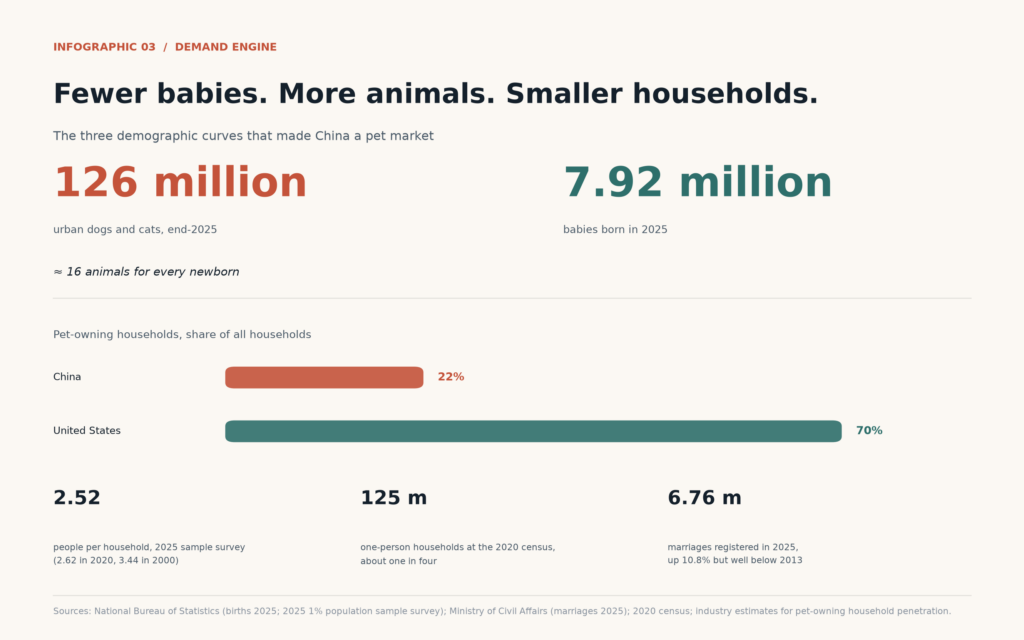
Births fell to 7.92 million in 2025, a record low, with a birth rate of 5.63 per thousand. Marriage registrations rose 10.8% to 6.76 million couples, but that was a rebound from a very low base, and the total remains far below the levels of a decade ago. Meanwhile, the average household shrank to 2.52 people, from 2.62 at the 2020 census and 3.44 in 2000. The 2020 census counted 125 million one-person households — roughly one in four.
Put those numbers together and you get a country where the emotional work of caregiving has more room to flow elsewhere. Research from Goldman Sachs, widely reported in 2024, argued that China’s pet population had overtaken the number of children under four. Take the exact comparison with a grain of salt or not; the direction of travel is hard to miss.
Pet ownership still stands at roughly 22–23% of households, compared with about 70% in the United States. Even if no new pet lovers appear, the demographic pressures behind demand have years of runway left.
Where the money actually goes
Food takes 53.7% of spending, medical care 27.6%, and everything else — supplies, grooming, boarding and insurance — splits the rest.
Those two big blocks behave very differently. Food is a commodity with a brand label. Buyers compare prices, respond to promotions and increasingly turn to domestic factories that can match imported quality at two-thirds of the price. Medical care is the opposite: it’s purchased in a moment of anxiety, by appointment, from someone the owner trusts.
That’s why the most durable loyalty in this market isn’t built on kibble. It’s built on the vet, the groomer, the trainer — the person who answers a panicked 9 p.m. message about a cat that won’t eat. Products get compared. Relationships get renewed.
Why repeat purchase is the whole ballgame
Here’s the arithmetic that shapes every pet business in China. A bag of cat food lasts a few weeks. A grooming appointment comes around every four to six weeks. Dental care, vaccinations and senior-pet blood panels all return on a schedule.
That means the first order is almost never profitable. Acquisition costs hit upfront; margin arrives on orders three, four and five. A brand that can’t predict when a customer will run out of food is running a slot machine, not a business.
This is also why pet retail in China can look odd to outsiders. You see huge, well-funded brands with thin profits alongside small regional chains with loyal members and healthy cash flow. The difference is rarely product quality. It’s whether the brand owns the calendar.
The flywheel, without the fairy tale
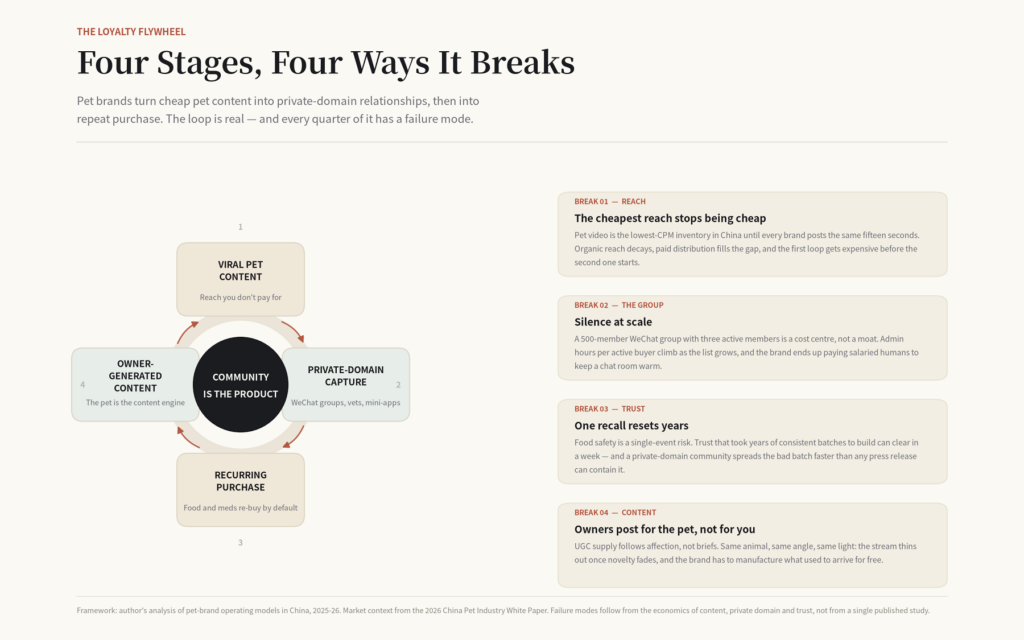
The loyalty model that works here has four moving parts. Each is easy to describe and hard to run.
Attract: the cheapest content in China
Pet content is some of the cheapest content to produce, because the animal does the work. A phone, a cat and a cardboard box. Douyin and Xiaohongshu reward exactly this kind of material: short, wordless, emotionally legible clips that can travel without translation.
The catch? Everyone has the same asset. Your competitor’s cat is just as cute as yours. Content gets you a first look; it doesn’t guarantee a second purchase. Brands that treat Douyin as a sales channel rather than a casting call can burn through budget fast.
Gather: WeChat is the living room
Chinese brands don’t usually send customers to a website. They bring them into WeChat — group chats, mini-programs, service accounts and a staff member’s contact card. It’s one of the closest things to owning your audience outright. Tencent disclosed that mini-program transaction volume passed RMB 2 trillion in a single quarter in 2024. That gives you a sense of how much commerce already happens inside the app.
The pet version is unusually personal. Owners share photos, ask about a limp, complain about food that caused vomiting and recommend a clinic down the road. The brand becomes a host, not a broadcaster. When a store’s groomer runs the group, the relationship has a face.
Contract: what 100,000 paying members prove
One of the most interesting experiments in Chinese pet retail right now is a chain called Pet’em. It runs more than 150 company-owned stores across Beijing, Shanghai and Shenzhen. On 1 April 2025, it stopped selling prepaid stored-value cards and switched to paid membership.
By September, it had passed 100,000 paying members. At the entry-tier price of RMB 199, that represents close to RMB 19.9 million of membership revenue over five months — before members buy a single bag of food.
Think about what that switch means. Prepaid cards were the industry’s quiet liability: cash today, service promised later, and a trust problem when a store closes. A membership fee turns that model around. The customer pays for access and pricing; the brand is accountable for service quality. Both sides have a reason to keep the relationship alive.
Amplify: the pet is the review
Chinese pet owners photograph their animals constantly. That can mean free creative, free social proof and free distribution — but only if the brand gives those moments a stage. Birthday portraits, weight-loss diaries, “first day home” posts and senior-pet check-ins: the content that converts isn’t the product shot. It’s the animal’s life.
The risk is just as obvious. Handle the channel badly and it becomes a complaints desk with photographic evidence. Community work is moderation work, and moderation is a cost line, not a growth hack.
The membership switch nobody expected
For a decade, Chinese service businesses ran on prepaid cards: gyms, salons, pet stores and English schools. Customers paid upfront for a promise. Then promises started breaking, and regulators started paying attention.
Pet’em’s move wasn’t altruism. It was a bet that a transparently priced recurring fee beats a discount that hides a liability. The early membership numbers suggest the bet is working, at least at the top of the funnel.
For foreign brands, the lesson is uncomfortable. The loyalty asset in this market isn’t your logo. It’s the appointment book, the group chat and the staff member who remembers the pet’s name. If a local chain owns those, your product is just a line item in someone else’s relationship.
Who is actually making money
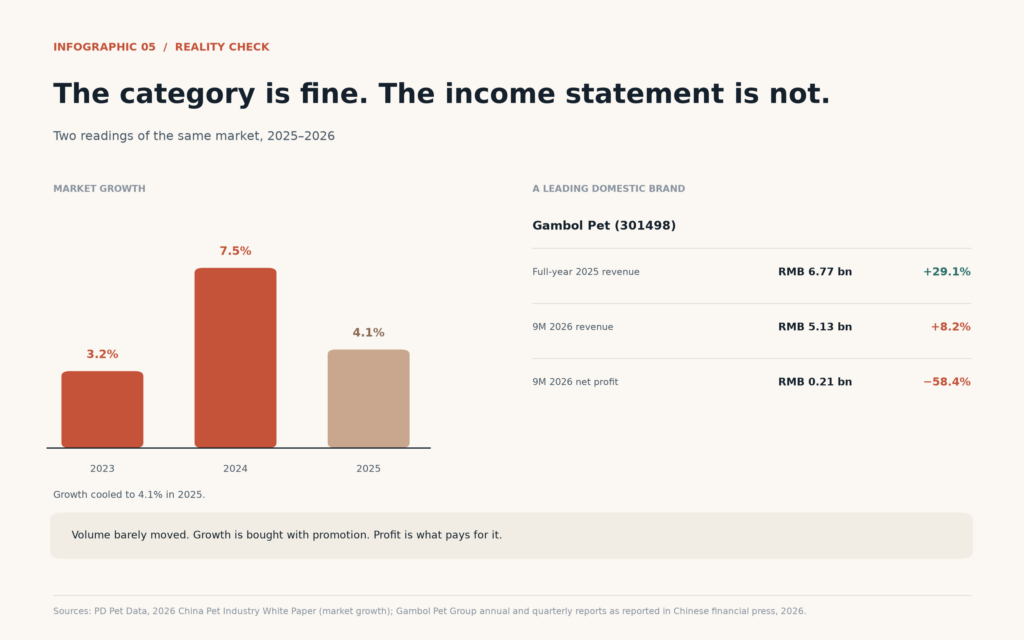
The clearest window into the industry is Gambol Pet, the listed group behind the Myfoodie brand. Revenue reached RMB 6.77 billion in 2025, up 29.1%. Then the music changed. In the first nine months of 2026, revenue grew 8.2% to RMB 5.13 billion, while net profit fell 58.4% to RMB 214 million.
Read that again: the top line kept moving; the bottom line collapsed. Growth is being bought with promotions. Discounting works until everyone does it — and in pet food, everyone seems to be doing it.
Imports tell a similar story from the other direction. China brought in about RMB 3.56 billion of pet food in 2024 — roughly 75,200 tonnes — compared with domestic output of about 1.6 million tonnes. Imports are a rounding error by volume, but a meaningful premium segment by value. “Imported” still sells. It no longer explains an entire business.
Four categories that will decide the next five years
Senior pets
About 20 million Chinese dogs and cats are now elderly — roughly one in five — and around 60% live with a chronic condition. By 2040, half the pet population will be senior. Prescription diets, mobility supplements, dental care, in-home nursing and end-of-life services are all underbuilt. This is where premium pricing can hold, because it’s tied to a medical need rather than a lifestyle claim.
Insurance
Pet insurance premiums are estimated at RMB 3–3.5 billion in 2025, with penetration still in the low single digits. ZhongAn alone wrote RMB 1.296 billion in pet premiums, up 88.2%. The bottleneck isn’t demand; it’s claims. Without standardised diagnosis codes and transparent clinic pricing, every claim becomes a negotiation, and every negotiation risks becoming a social-media review. Whoever fixes the data plumbing has a shot at owning the category.
Smart devices
Automatic feeders, fountains, litter boxes and trackers are the fastest-moving hardware niche. Hardware margins are thin, and the products are easy to copy. The interesting part is the data: weight trends, feeding frequency and litter-box visits. If that data powers a subscription — food replenishment, vet reminders or insurance pricing — the device becomes a retention layer rather than a gadget.
Clinics and services
China has more than 22,000 animal clinics, and chain penetration is still around one in five. Consolidation is coming, along with standardised pricing, membership plans and corporate marketing. That could be the moment when a foreign nutrition brand can buy distribution at scale — by partnering rather than opening stores.
Five things that could break the story
Growth halved in a single year, from 7.5% to 4.1%. That’s not a blip; it may be the shape of a maturing market.
Profit is compressing at the top of the industry, as the Gambol numbers suggest, and promotional intensity is rising rather than easing.
Regulation is tightening. A revised national standard for pet food is being phased in through 2026, with stricter requirements for labelling, ingredients and claims. Compliance costs fall hardest on small brands and importers that have been vague about sourcing.
Platform dependency is real. WeChat is a superb place to build a relationship and a terrible single point of failure. Douyin gives you reach, but every view comes at a cost.
And trust is still fragile. Memories of past domestic food scandals have shaped a generation of buying behaviour. Imported brands aren’t automatically trusted; they’re scrutinised, sometimes more closely.
What foreign brands keep getting wrong
The default playbook — “we’re imported, therefore we’re premium” — is expiring. A 26-year-old in Chengdu with a cat called Afternoon Tea doesn’t care where the bag was made. She cares whether the food stopped the vomiting, whether the clinic answered and whether the community she posts in approves.
So the order of operations is inverted. Build the service relationship first: partner with clinics and groomers, put your nutritionist in the group chat and sponsor a senior-pet screening day. Then sell the product into a relationship that already exists.
Price the subscription, not just the bag. A monthly delivery that arrives before the food runs out can be worth more than 15% off a one-off purchase. It also tells you when the customer may be about to churn.
Hire for community operations, not just sales. The person who runs 40 WeChat groups is doing revenue work in this market, whatever the org chart says.
Instrument everything: pet profile, breed, age, weight, purchase cadence and clinic visits. Without a cohort view, you’re guessing at lifetime value in a market where lifetime value is the metric that matters.
And stop trying to outspend local leaders on content. You’ll lose. Out-retain them instead.
What to watch in 2027
Four indicators will tell you whether the loyalty thesis is holding: whether cat spending overtakes dog spending earlier than the 2028 forecast; whether spending per pet keeps rising while animal numbers grow slowly; whether insurance penetration crosses 6–7%, a possible sign that claims are finally working; and whether any food brand makes auto-replenishment a default rather than a promotion.
If all four move in the right direction, the next phase of this market belongs to operators. If they stall, the industry may keep buying growth with discounts until the balance sheet says stop.
The takeaway
China’s pet economy isn’t a growth story anymore. It’s a retention story wearing a growth story’s clothes. The companies winning right now aren’t necessarily the ones with the best advertising. They’re the ones that know when your cat will run out of food, answer when it stops eating and are still there when it turns twelve.
That’s a harder business to build than a viral campaign. It’s also the only one with a moat.
Frequently asked questions
Is China’s pet market still growing?
Yes, but more slowly. Urban dog and cat spending reached RMB 312.6 billion in 2025, up 4.1%, after growing 7.5% in 2024. Animal numbers rose just 1.8%. Growth now depends more on spending per pet than on adding more pets.
Why are cats more important than dogs in China now?
There are 72.89 million urban cats, compared with 53.43 million dogs. Cat spending is projected to overtake dog spending by 2028 — RMB 218.4 billion versus RMB 192.3 billion. Cats fit small flats and long working hours, and their owners are well suited to subscription buying and online ordering.
How do Chinese pet brands actually build loyalty?
Through four linked mechanisms: short-video discovery on Douyin and Xiaohongshu, community-building inside WeChat, repeat purchase through membership or subscription, and user-generated content that turns owners into advocates and distributors.
Do Chinese consumers still prefer imported pet food?
The advantage is less decisive than it used to be. Imports totalled about 75,200 tonnes in 2024, against domestic output of about 1.6 million tonnes. That makes imports a small share by volume and a premium niche by value. Domestic brands have closed much of the quality gap and can compete on price, speed and service.
What is the biggest risk for a foreign pet brand entering China?
Assuming the product is the business. The loyalty asset sits with whoever owns the appointment, the group chat and the data. Without a service layer, an imported brand is a line item that can be replaced on price within a week.