Baidu Now Counts Citations. Every Brand in China Should Be Nervous.
For a decade, the job of a brand in Chinese search was simple and slightly dull. Rank the page. Buy the ads around it. Watch the click arrive.
That job is being dismantled — not by a rival search engine, but by the answer.
On September 16, 2026, Baidu confirmed a small, easily missed addition to its webmaster tools: a section called AI Traffic Analysis. Chinese SEO practitioners had spotted the menu item a day earlier. It carries four columns — AI citations, AI impressions, AI clicks, AI CTR — plus a citation trend line and tables of the keywords and pages that trigger AI answers.
Read that list again. Baidu is not counting rankings. It is counting how often your page gets used as a source. What a company chooses to measure is usually a decent map of where it thinks the money went. This one is unusually candid: it measures the moment before the click, and increasingly the moment that replaces it.
What actually changed on the results page
Open Baidu on a phone and ask something commercially loaded — which stroller is worth the money, whether a supplement actually works, which B2B supplier ships to Europe. Increasingly, the top of the page is not a list. It is an answer: a few paragraphs assembled from several pages, with links to some of them folded underneath or behind a sources tab.
The list of links still exists. It has simply stopped being the first thing a user meets.
This is the same structural move Google made with AI Overviews, executed under different constraints. Baidu serves a mobile-first audience, a smaller and more fragile ad market than Google’s, and a set of domestic AI rivals that never signed up for the rules of search. The company is not experimenting with an answer layer. It is staking its core product on one.
Baidu is not hiding the trade-off
The financials say it plainly. Full-year 2025 revenue was RMB 129.1 billion, down 3% — a modest number that hides a blunt fact: the decline is entirely a story about the old business.
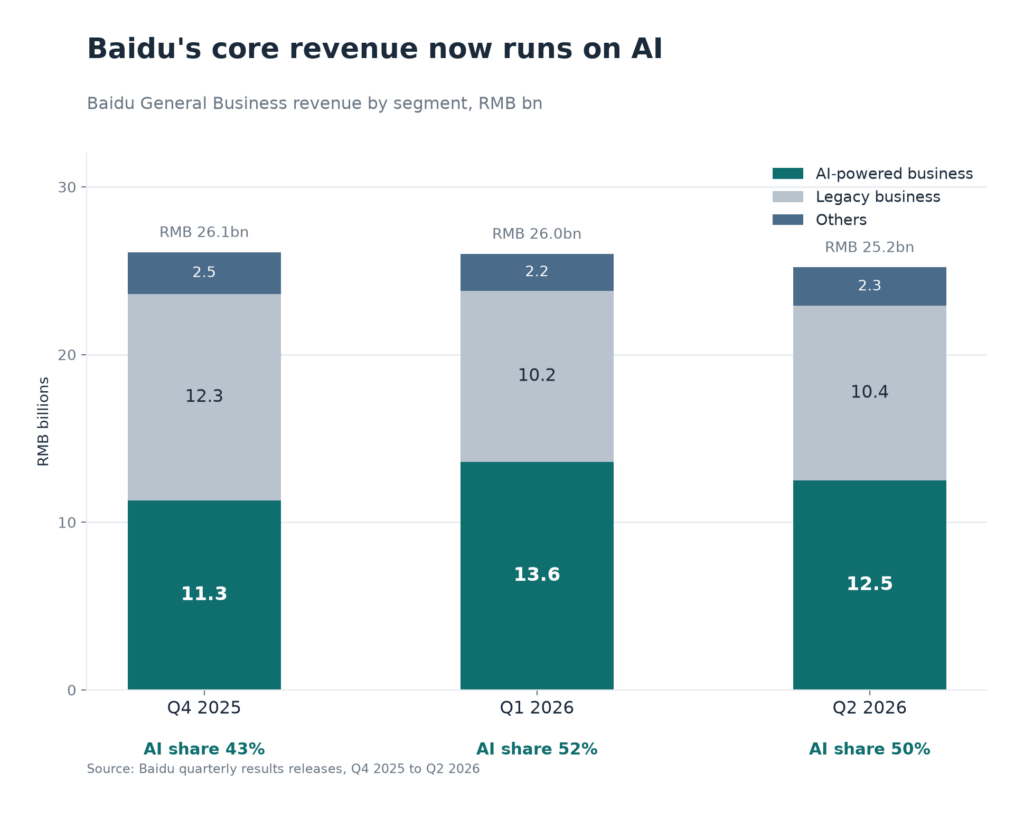
Baidu now splits its core into three buckets. The AI-powered business — cloud infrastructure, AI applications, and AI-native marketing services — reached RMB 40.0 billion in 2025, up 48%, and 39% of Baidu General Business revenue. Legacy Business, which the company defines as traditional advertising across search, feed, and other properties, keeps contracting. Everything else is small.
By the first quarter of 2026 the crossover had happened. AI-powered revenue hit RMB 13.6 billion, up 49%, and passed half of General Business for the first time. In the same quarter, online marketing services fell 22% to RMB 12.6 billion and legacy business fell 29% to RMB 10.2 billion. In the second quarter, total revenue slipped 4% to RMB 31.3 billion, online marketing dropped 19%, and the AI share held at 50%.
One detail worth noticing: Baidu only introduced the Legacy Business line in the fourth quarter of 2025, replacing the older Baidu Core framing. Accounting changes are rarely neutral. When a company invents a category, it is usually because the old one has stopped telling a flattering story — and because it wants the shrinking part visible, but quarantined.
The ad business split in two
Here is the number that should interest marketers more than any other: AI-native marketing services.
In 2024, that line was worth RMB 2.4 billion. In 2025, it was RMB 9.8 billion, up 301%. Then look at the quarterly run rate: RMB 2.8 billion in Q3 2025, RMB 2.7 billion in Q4, RMB 2.3 billion in Q1 2026, RMB 2.6 billion in Q2. The growth story flattens into a plateau of roughly RMB 2.5 billion a quarter, with a dip in the first quarter of 2026.
That is the most honest reading of Baidu’s position. The legacy line is falling faster than the AI line is rising. AI-native formats are real, and they are growing fast off a small base, but they have not yet become a compounding engine. What Baidu is doing, in public, is repricing attention: charging for a different unit of it while the old unit decays.
For a brand, that repricing has a concrete consequence. The inventory you can buy is changing shape — fewer slots around a list of results, more placements inside or beside generated answers, more agent-mediated touchpoints. Your media plan for China will need to be rebuilt around formats that did not exist three years ago, and the pricing benchmarks will be whatever Baidu decides they are.
Where the audience went
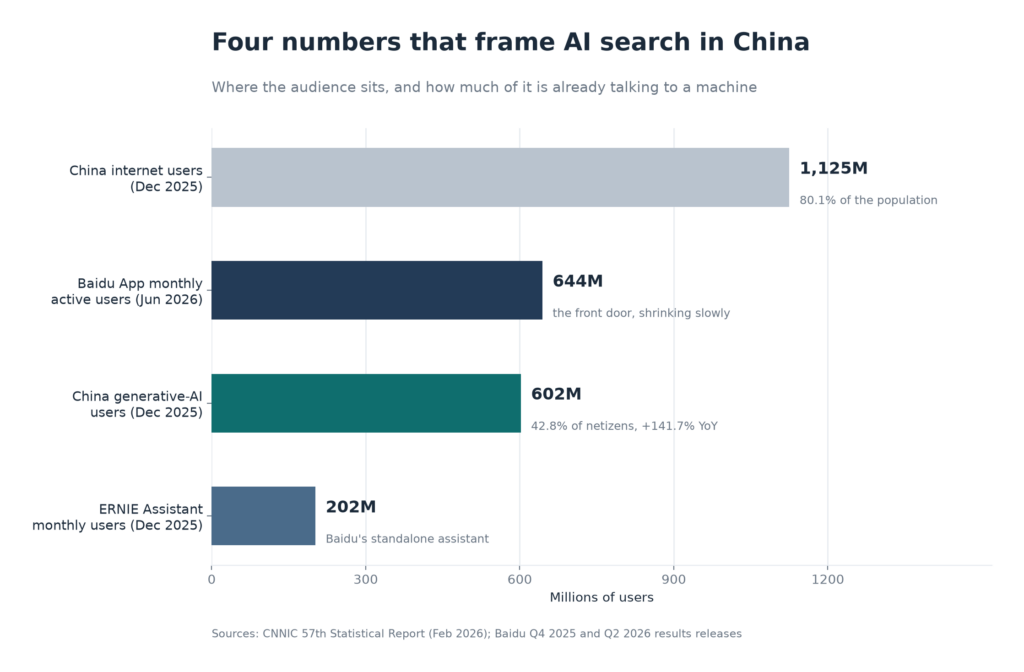
Baidu App monthly active users were 679 million in December 2025, 655 million in March 2026, and 644 million in June 2026. That is roughly 5% in six months. Not a collapse. A slow leak, in the direction of everything else on a Chinese phone.
Meanwhile ERNIE Assistant, Baidu’s standalone AI assistant, reached 202 million monthly users by December 2025 — a second front door, run by the same company, that does not depend on a results page at all.
Now widen the frame. CNNIC’s 57th Statistical Report, published in February 2026, put China at 1.125 billion internet users, or 80.1% of the population. Generative AI users reached 602 million by December 2025: 42.8% of all netizens, up 141.7% in a year. Nearly half of China’s internet users have now handed a question to a machine and read the reply.
That is the demand side of the answer economy. The supply side is a search box that increasingly answers instead of listing, and a set of rival apps that were built to answer from day one.
Why an answer costs more than a list
A page of links is cheap to serve. It costs a crawl, an index, and a ranking function that was amortized years ago. An answer costs inference — every single time, for every single user. The more answers Baidu generates, the more compute it buys.
You can watch that bill in the cloud numbers. AI Cloud Infra brought in RMB 19.8 billion in 2025, up 34%; RMB 8.8 billion in Q1 2026, up 79%; RMB 7.3 billion in Q2, up 50%. GPU cloud revenue grew 184% and then 283% year over year. It is lumpy, enterprise-driven, and expensive — and it is where the marginal yuan of the AI transition is being spent.
Which is why the monetization question is not whether but how. Sponsored citations. Answer-level placements. Agent inventory sold by outcome rather than impression. When those arrive — and the financial pressure suggests they will — being cited stops being purely an editorial outcome and becomes, at least in part, an auction. Organic citation logic and paid citation logic will start to blur, exactly as they did on the old results page.
Plan for that now, while the answer layer is still mostly earned.
The four numbers that decide whether you exist
Baidu’s new panel is built on four definitions, and they reward a close read.
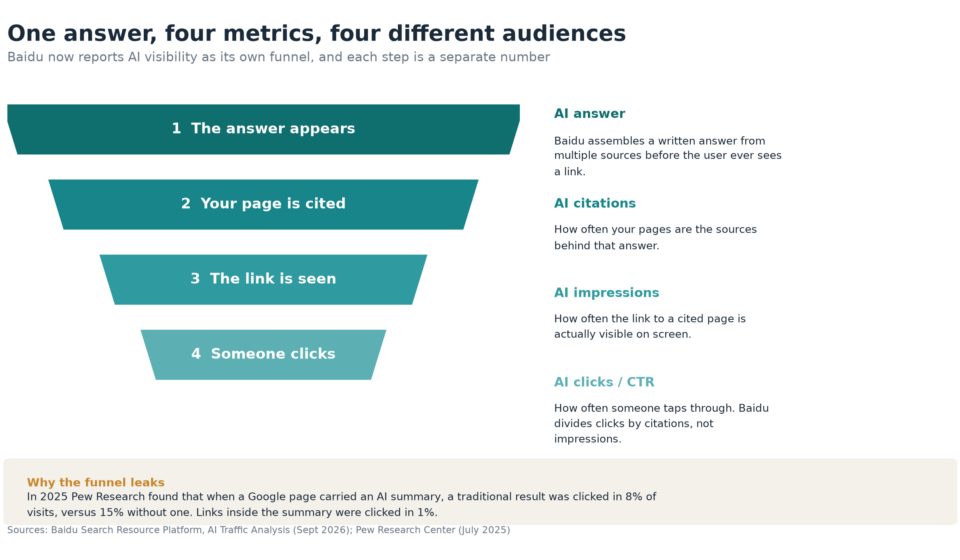
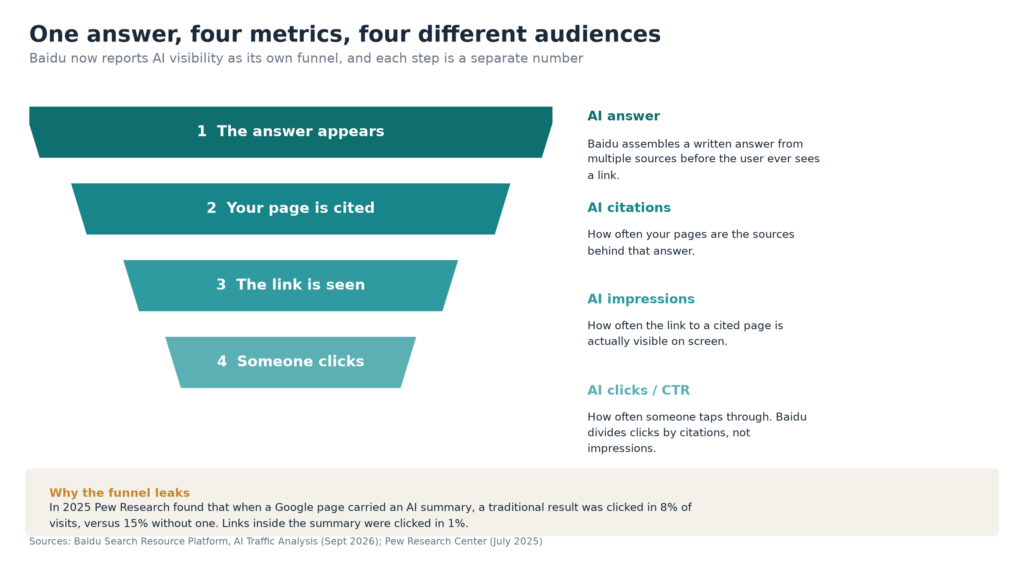
AI citations: how often your pages are used as a source in an AI answer. AI impressions: how often the link to a cited page is actually seen. AI clicks: how often someone taps through. AI CTR: clicks divided by citations.
That last one is not the formula you are used to. Standard click-through rate divides clicks by impressions. Baidu divides by citations, which implies a page can be cited while its link stays hidden — collapsed source lists, for instance. The practical lesson is not that Baidu got it wrong. It is that you should compute clicks divided by impressions yourself, and read the gap between citations and impressions as a signal in its own right. A citation nobody sees is a mention. A citation with a visible link is a referral.
Four metrics, four audiences: citations are the machine trusting you, impressions are the interface showing you, clicks are the human choosing you. CTR is what happens when the first turns into the last.
The measurement trap
Three caveats before anyone rebuilds a dashboard around this.
First, scope. Baidu says the data covers the traditional search scenario — AI answers that appear inside regular Baidu results. It does not cover the company’s standalone AI products, and it certainly does not cover anyone else’s.
Second, timing. At launch the data service had not officially started. The menu existed, the definitions were published, the dashboards were empty, and the rollout was phased. Early numbers will be a baseline, not a benchmark.
Third, causality. Some Chinese commentary has suggested that AI citations will lift a site’s Baidu weight, the rough equivalent of link authority. Baidu has said nothing of the kind. Building a strategy on an unconfirmed mechanism, with a metric attached to make it feel scientific, is how agencies end up selling astrology with a dashboard.
China’s search market is a fork, not a road
Baidu’s AI answers are one surface among several, and the others do not share data.
Doubao, DeepSeek, Qwen and Quark, and Kimi: each runs its own model, its own index behavior, and its own citation habits. A brand can be the cited source inside Baidu’s answer and be entirely absent from four other systems its customers also use. There is no unified AI visibility number for China, and anyone selling you one is selling you a guess.
The practical consequence is a change in how you use the data you do get. Baidu’s keyword table — the queries that trigger AI answers citing your pages — is the most valuable part of the launch, because it is demand data you cannot buy anywhere else. Treat it as a hypothesis about what people ask. Then test whether each other platform cites you for the same question. Do not assume the answer travels.
What actually moves you into the answer
The industry has settled on a name for this work: generative engine optimization, or GEO. The name is new. The work is mostly unglamorous, and it comes down to four moves that survive contact with how these systems behave.
Be a thing, not a keyword. These systems synthesize across sources and resolve contradictions by dropping the inconsistent party. Same entity name, same descriptors, same founding facts, same product claims — on your site, in Baidu Baike, in verified accounts, in third-party coverage. Consistency is not branding hygiene anymore. It is retrieval hygiene.
Write the sentence you want quoted. A page that states a definition, a number with a unit and a date, and a one-line verdict is extractable. A page that opens with a paragraph about the evolving landscape is not. If you cannot point to the sentence an AI should lift, you have not written the page yet.
Answer the question before it is asked. FAQ blocks, comparison tables, plainly titled explainers, cost pages with real ranges. These mirror query shape, which is what an answer engine matches against. The format is the optimization.
Keep the door unlocked. Crawl access, current dates, clean structure, canonical facts. Unglamorous, and still most of the outcome.
What stopped working
Ranking as the goal. A number one position that does not get cited is a page nobody reads. The old KPI measured proximity to the answer; the new one measures inclusion in it.
Keyword density. Stuffing does not survive summarization. It survives only long enough to make your page look like the thing a summarizer should skip.
Buying your way in. In March 2026, Chinese state media’s annual consumer-rights program highlighted the manipulation of AI search results, and the months since have produced a steady drip of reporting on services that pump invented claims into AI answers. The platforms have responded, and not gently: Xiaohongshu announced bans for accounts registered, operated, or entirely written by AI agents, describing a gray supply chain of account creation, account nurturing, and resale. Being the brand that got caught gaming the answer is a worse outcome than being absent from it.
Treating the answer as free reach. It is a compression layer. If your differentiator lives in the nuance, build pages that carry the nuance into the summary — or accept that the summary will describe you as generic.
The uncomfortable part
None of this is a clean success story, and brands should not plan as if it were.
Revenue is shrinking. The legacy line is contracting at 20% to 30% year over year. In August 2026, after second-quarter results, Baidu’s US depositary shares fell 12.73% in a single session. In September 2026 a securities class action was filed alleging that Baidu misled investors about the ability of its AI business to offset the rapid decline in legacy online marketing — an allegation, not a finding, but a signal of how contested the narrative has become.
For marketers, the asymmetry matters more than the litigation. Your visibility risk front-runs Baidu’s revenue risk. The answer layer compresses clicks before it monetizes them, so a brand can lose a large share of its organic referrals while the platform’s income statement still looks roughly intact. The damage lands on your traffic first, and on their P&L later.
What to watch in the next two quarters
The Q3 2026 results on November 16, and whether AI-native marketing services hold above RMB 2.5 billion a quarter or resume growing.
Whether citations become a sellable surface — sponsored sourcing, answer-level placements, agent inventory — and how Baidu discloses it.
Whether the AI Traffic Analysis data actually goes live at scale, and whether the scope widens beyond the traditional search scenario.
Whether Baidu publishes any citation guidance at all. The day a search engine tells you how to be quoted is the day the discipline becomes real.
The takeaway
Baidu did not kill the link. It demoted it. The link is now evidence attached to an answer: a footnote with a click sometimes attached.
So the question is no longer how to rank in Baidu. It is whether, when the machine writes the answer, your name is in the sentence and your page is in the sources.
One of those is a metric now. The other is still the business.
FAQ
Is Baidu still the Google of China?
Functionally it is still the default place Chinese users type a question, with 644 million monthly users on its main app in June 2026. But the analogy has stopped being useful. Google’s AI Overviews sit on top of a much larger and more resilient ad business. Baidu’s answer layer sits on top of a legacy ad business contracting at 20% to 30% year over year, with AI now supplying half of core revenue. Same interface idea, very different economics.
What does Baidu’s new AI report actually measure?
Four things: AI citations (how often your pages are used as a source), AI impressions (how often the link is seen), AI clicks, and AI CTR (clicks divided by citations, not impressions). It covers AI answers inside regular Baidu results only, and at launch the data service had not officially started.
Does AI search really reduce clicks?
In the US data we have, yes. Pew Research found that when a Google page carried an AI summary, users clicked a traditional result in 8% of visits, against 15% without a summary, and clicked a link inside the summary in 1%. That is US behavior from March 2025, not Chinese behavior in 2026 — but the mechanism is the same, because the interface is the same.
What should a brand do first, this month?
Verify the site in Baidu’s Search Resource Platform so the AI data starts accumulating for you. Record a baseline. Then fix entity consistency and rewrite three commercially important pages so each contains a quotable definition, a dated number, and a one-line verdict. That is two weeks of work with more upside than another keyword audit.
Is GEO in China regulated?
The answer layer is regulated even when the optimization is not. Chinese platforms have been tightening rules on AI-generated content and automated accounts through 2026, with regulators pushing in the same direction, and several have started banning AI-operated accounts outright. Buying fabricated citations is not a gray-area growth tactic; it is a compliance risk with a public example attached.