Zhihu Stopped Counting Users. It Started Counting Answers.
China’s oldest question-and-answer platform spent fifteen years learning how to write the one thing AI models cannot manufacture. Then it started selling it.
Ask a Chinese AI assistant something that requires judgment — which laptop survives four years of video editing, whether a fund’s fee structure justifies its lock-up, why a supplier keeps missing deadlines — and a decent share of the answer will trace back to a question-and-answer site that launched in January 2011.
You have probably heard of it. Zhihu, the one everyone introduces as China’s Quora.
Here is the tension I want to sit with. Zhihu’s revenue fell 23.6% in 2025, to RMB 2.749 billion, or about US$393 million. Its advertising business has lost nearly half its value in two years. Its paying base has stopped growing. On the numbers a chief financial officer puts on a slide, this reads as a platform in retreat.
And yet the same company is now selling something China’s model builders cannot easily manufacture: fifteen years of long-form, signed, edited, argued Chinese answers. Not posts. Not dance clips. Answers, with sources, caveats and a point of view.
Both things are true at once, and the contradiction is the story. Zhihu did not simply get worse or better this year. It changed what it sells.
What Zhihu Is, and Why Its Size Is the Least Interesting Thing About It
Zhihu launched in January 2011, founded by Zhou Yuan, and grew into the largest question-and-answer-inspired content community in China. It is dual-listed — NYSE under ZH, Hong Kong under 2390 — which matters for a boring but useful reason. Its numbers are audited, filed with regulators, and comparable across years. You do not have to take a pitch deck’s word for any of what follows.
The Quora comparison gets you about two-thirds of the way there. The missing third is the commercially interesting part. Zhihu trained its users to write the way analysts write: frame the question, show the working, name the trade-offs, admit what you cannot verify. A strong Zhihu answer on whether to lease or buy industrial equipment reads less like a forum thread and more like a memo.
That habit produced an odd kind of asset. Search engines loved it, because the pages are long, structured, and dense with the exact phrases buyers type at eleven at night. Professionals loved it, because thoroughness was rewarded instead of mocked. And AI labs, it turns out, love it for precisely the reasons the search engines did.
A Revenue Chart That Looks Like a Collapse
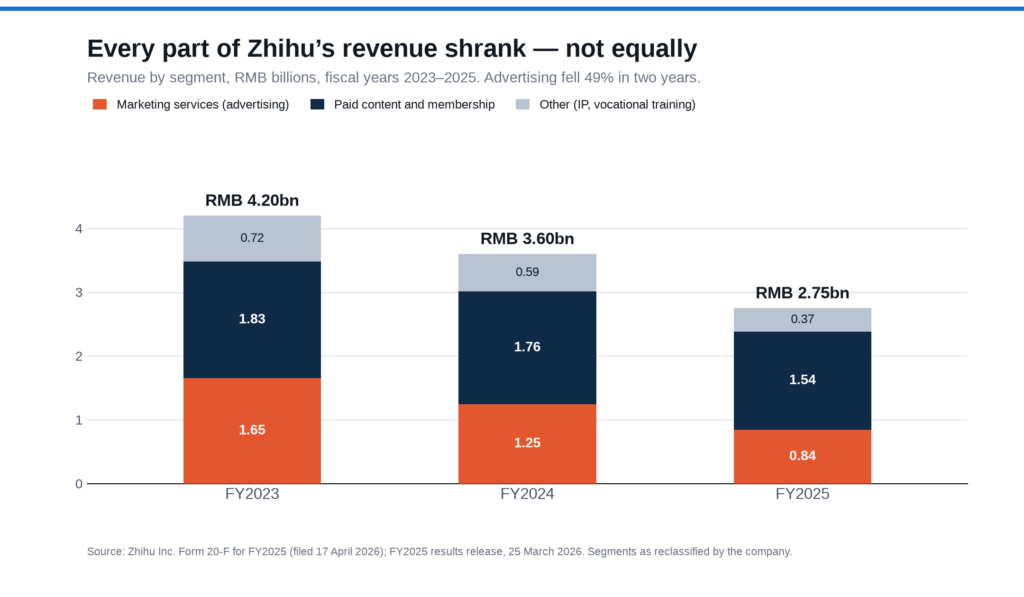
Start with the number that gets quoted in every headline. Zhihu’s total revenue for the 2025 fiscal year was RMB 2.749 billion, down 23.6% from RMB 3.599 billion in 2024. Go back one more year and the picture sharpens: 2023 revenue was RMB 4.199 billion. In twenty-four months, the top line lost roughly a third of itself.
This is not a rounding error or a bad quarter. It is a structural contraction, and it happened while the company was publicly congratulating itself on becoming leaner.
The quarterly line tells you where the floor might be, if there is one. Revenue was RMB 658.9 million in the third quarter of 2025, RMB 643.5 million in the fourth, RMB 651.6 million in the first quarter of 2026, and RMB 690.1 million in the second. That last figure was still down 3.7% year over year, but up 5.9% from the previous quarter. Small comfort. Also the first comfort in a while.
Read the Mix, Not the Total
Here is where most coverage stops, and where it becomes interesting.
Zhihu’s advertising line — the company calls it marketing services — brought in RMB 843.9 million in 2025. In 2023 the same line produced RMB 1.653 billion. Advertising halved in two years, and it did so while the rest of the business shrank far more gently.
Paid content and membership generated RMB 1.539 billion, down 12.7%. That is a trim, not a collapse, and it now accounts for 56% of total revenue. Advertising is down to 30.7%, from 39.4% in 2023.
Put differently: the part of Zhihu that was always going to be commoditized by short video has largely been commoditized. The part that persuades thirteen million people a month to pay for long reads has held.
You can read this two ways. The pessimist says both engines are shrinking, so the mix shift is meaningless. The operator says the company has quietly stopped depending on the most fragile revenue in the Chinese internet — brand budgets that migrate to Douyin the moment a campaign underperforms — and is now mostly funded by subscriptions and intellectual property. One of those readings is more useful for anyone planning a budget.
The Profit That Is Real, and the One That Isn’t
In 2025, Zhihu reported adjusted net income of RMB 37.9 million. It was the company’s first full year of non-GAAP profitability, after a RMB 96.3 million adjusted loss in 2024.
That is a genuine milestone, and it deserves to be stated plainly. It is also the least durable kind of milestone, because of how it was produced.
On a GAAP basis — the accounting that includes share-based compensation, amortization of intangibles and goodwill write-downs — Zhihu lost RMB 195.2 million in 2025, wider than the RMB 169.0 million loss a year earlier. Research and development spending fell 28.3% to RMB 525.0 million. Sales and marketing fell 21.7% to RMB 1.252 billion. The fourth quarter alone carried a RMB 126.3 million goodwill impairment tied to earlier acquisitions.
So the profit came from subtraction: fewer people, less promotion, quieter product development. That works for a while. It does not compound.
The second quarter of 2026 makes the point. Zhihu slipped back to an adjusted net loss of RMB 10.3 million, and gross margin fell to 57.0% from 62.5% a year earlier, because management started spending again — on content breadth, and on the AI experiments described below. Call that a setback or an investment. Either way, it tells you the 2025 profit was a plateau, not a launchpad.
Nearly a Billion Pieces of Something
Now the part that never makes it into the revenue discussion.
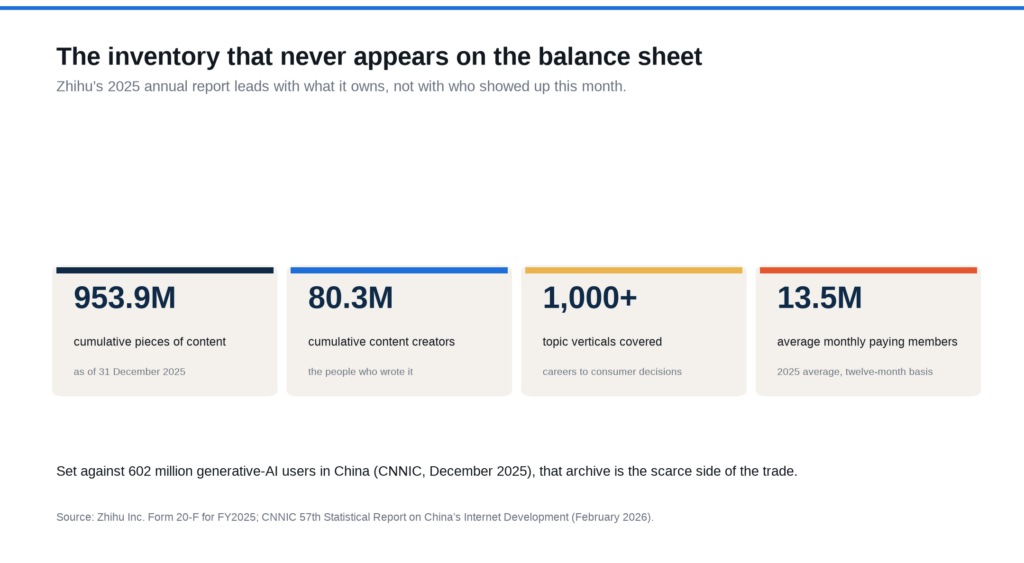
Open Zhihu’s 2025 annual report to the business description and you find three figures, none of them a monthly user count: 13.5 million average monthly paying members, 80.3 million cumulative content creators, and 953.9 million cumulative pieces of content across more than 1,000 topic verticals, as of December 31, 2025.
Read that again. Nine hundred and fifty-four million pieces of content. Written by eighty million people, over fifteen years, in Chinese, at memo length, on subjects that range from career decisions to consumer durables to artificial intelligence itself.
For context, China had 602 million generative-AI users at the end of 2025, according to the China Internet Network Information Center — a 141.7% jump in twelve months, spread across a population of 1.125 billion internet users, with adoption at 42.8%.
The demand side of Chinese AI is enormous and growing fast. The supply side of trustworthy Chinese training text is neither. That asymmetry is the entire strategic position of a company most analysts still model as a small advertising business.
Six Minutes Versus Thirty-Nine
There is a number in the earnings materials that explains more than any strategy slide.
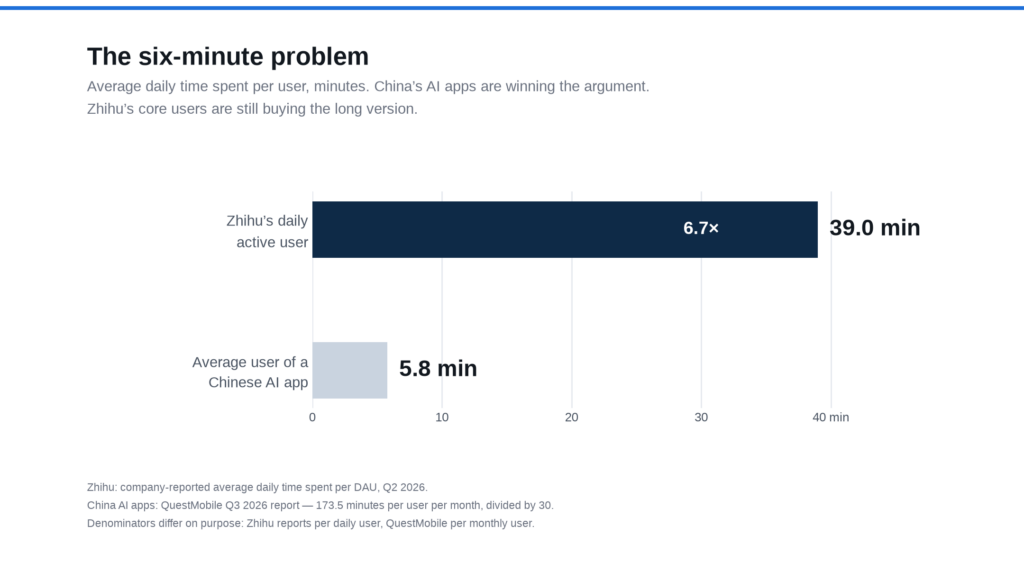
Zhihu’s daily active users spend about 39 minutes a day inside the app. In the fourth quarter of 2025 the figure was over 41 minutes. For a text-first product in a short-video country, that is remarkable.
Compare it with the market that is supposedly replacing it. QuestMobile puts China’s AI-native app audience at 546 million monthly users in September 2026, up 82.1% year over year, with 173.5 minutes of usage per user per month. Divide that out and the average AI app user spends roughly six minutes a day talking to a model.
Yes, the denominators differ — Zhihu reports per daily user, QuestMobile per monthly user — and yes, that flatters Zhihu. Take the caveat seriously and the direction still holds. The people who still open Zhihu are not scrolling. They are reading, for half an hour, on purpose.
That is not a mass market. It is something more valuable to a certain kind of advertiser and, as it happens, to a certain kind of model trainer: a population that shows up with a real decision to make.
The Pivot Nobody Announced
Zhihu has been building toward this for years, in public, without calling it a pivot.
In 2023 it launched its own large language model, Zhihaitu AI, which cleared regulatory registration that November. In June 2024 it shipped Zhihu Zhida, an AI search product that answers from the community’s own material instead of the open web, initially on desktop. Cautious, incremental, easy to overlook.
Then watch the language change. In March 2026, announcing full-year results, chief executive Zhou Yuan said the company was building a moat from its “vast expert network, trusted content assets, and diverse real-user scenarios,” and was accelerating “commercialization explorations related to AI.”
By August 2026 the chief operating officer had a sharper phrase for it: Zhihu is positioning itself as a “research-driven data lab.” Not a media company. Not a community. A lab that helps models perform better, using training data, evaluation design and professional judgment.
Notice what the reframing does. It converts the thing Zhihu has spent years apologizing for — an expensive archive maintained by people who write too much — into an input with a buyer.
Four Doors, None of Them Advertising
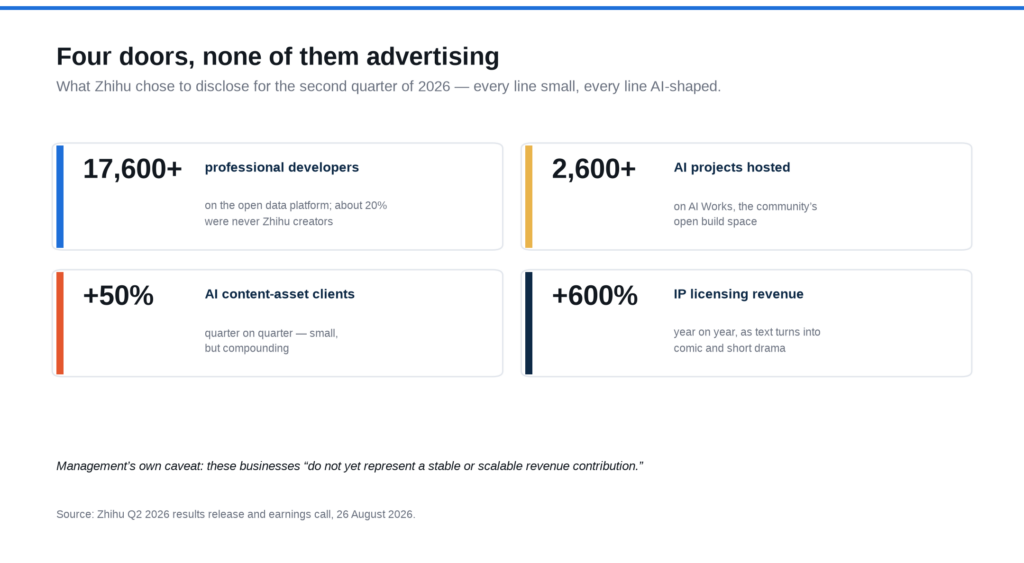
The second-quarter 2026 call disclosed four numbers that, read together, describe the new business better than any narrative.
First, the open data platform: more than 17,600 professional developers now use Zhihu’s API, and roughly 20% of them were never Zhihu creators. That is the start of a distribution channel which does not require anyone to visit the app.
Second, AI Works: more than 2,600 AI projects hosted on the community’s open build space. Tiny next to GitHub. Not tiny next to anything a Chinese content platform has tried before.
Third, AI content assets: the number of clients buying them rose 50% quarter over quarter. The product is what it sounds like — professional, sourced content a brand owns, built so models can retrieve and quote it.
Fourth, IP licensing: revenue up 600% year over year and 105% sequentially, as Zhihu pushed its text library into comic drama and short drama. Same archive, different container.
Management was careful to puncture its own balloon. These initiatives, it said, “do not yet represent a stable or scalable revenue contribution.” Fair. But four doors opening in the same quarter, all of them leading away from banner ads, is not an accident.
The Sentence Marketers Should Read Twice
Buried in the second-quarter remarks is one line that deserves its own paragraph:
“As more information discovery happens through AI, brands increasingly care not only about visibility, but also whether the professional information can be accurately understood and cited by AI.”
That is generative engine optimization, described by the company’s founder as a product rather than a tactic. Zhihu is selling brands the thing Western agencies have spent two years explaining in decks: content built so that a model retrieves it, understands it, and names you.
Why Zhihu and not someone else? Because the retrieval layer favors text that behaves like evidence. Structured. Attributed. Specific. Written by someone with a name. A brand’s WeChat post full of adjectives is invisible to that filter. A Zhihu answer comparing three suppliers on lead time, failure rate and three-year cost of ownership is not.
It is a genuinely new ad product in a market that has not had one in years, and it is being sold by a company whose ad business just halved. Both facts belong in the same sentence.
Where This Breaks
I have made the bull case. Here is the bear case, which is stronger than it sounds.
The first risk is cannibalization. If AI search answers the question, fewer people open Zhihu. Management insists the opposite is happening — that Zhida is becoming “a gateway to community content rather than a substitute for it,” with early tests showing better retention. Believe that only as far as the data goes, and the data is early.
The second is scale. AI content assets growing 50% quarter over quarter sounds explosive until you remember it started near zero and the company itself declines to call it scalable. Expert data projects are bespoke work: model evaluation, rubric design, red-teaming. That is a consultancy, not a platform. Consultancies do not compound the way software does.
The third is the archive’s legal and commercial status. Zhihu has not publicly named any model developer licensing its corpus. What it discloses is expert data services and API access, not headline content deals. Whether the 953.9 million pieces can be monetized repeatedly, or only once, is unresolved.
The fourth is competition for the same buyers. Xiaohongshu owns consumer-decision content. WeChat’s ecosystem owns professional publishing. A dozen data-annotation firms own the model-training relationships. Zhihu’s edge is quality and provenance. Quality is expensive to defend.
If You Sell Things in China, the Play Changes Shape
Enough analysis. What do you do on Monday?
Stop treating Zhihu as a traffic source and start treating it as a citation surface. Those are different KPIs. One is impressions. The other is whether an assistant repeats your framing when nobody is looking at your ad.
Write answer-shaped assets, not campaign-shaped ones. Lead time. Failure modes. Three-year cost. Regulatory approval. The questions buyers actually type are boring and specific, and Zhihu’s 1,000-plus verticals mean your category almost certainly has a shelf already.
Put sources in your own content. Zhihu is now explicitly selling the idea that models reward provenance. Publish claims with no traceable origin and you have written something a careful system should decline to quote.
Measure what your dashboard cannot see. Ask the assistants yourself, monthly, with a fixed question set. Log whether you are mentioned, whether you are described accurately, and which competitor gets named instead. Nobody’s analytics package shows this yet. That is precisely why it is worth doing now.
And move early. The reason to build now is not that Zhihu is cheap. It is that citation authority compounds, and the systems deciding what gets quoted are being trained on today’s corpus, not next year’s.
Four Signals to Watch
If the thesis is right, four things should become visible over the next few quarters.
A named licensing deal. The moment Zhihu announces a content or evaluation contract with a named model developer, the data-asset story stops being a narrative and becomes a line item.
A new reporting segment. Watch whether AI-related revenue gets broken out instead of folded into “other.” Companies disclose segments when they want credit for them.
Developer growth past 17,600. If the API and command-line tool attract outsiders — people who were never creators — the platform is becoming infrastructure. If the number stalls, it is a side project.
The paying base. Flat at 13.1 million is fine. Falling below 12 million while AI usage rises would suggest the archive is being consumed without being paid for, which is the nightmare scenario in one sentence.
The Uncomfortable Question
So which is it? A media company that happens to own a valuable archive, or a data company that happens to run a question-and-answer site?
The financial statements have already voted. Advertising is under a third of revenue and falling. Paid content is more than half. Licensing is growing at triple-digit rates off a small base. The archive is the asset. The app is the storefront.
Whether the market agrees is a different question, and not one I can settle for you. But here is what I would tell any marketer who asks whether Zhihu still matters: it matters in a way that never shows up in a referral report. It matters because it is one of the few places in China where the answer to a hard question was written down by someone who had actually done the thing.
That was always the product. Zhihu just stopped giving it away for free.
The Takeaway
Zhihu’s decline is real. So is the thing it has been quietly accumulating while declining.
For fifteen years the platform’s pitch to the world was attention: come read, stay longer, see an ad. That business is now worth less than half of what it was in 2023, and no amount of execution fixes a market that moved to short video.
What remains is stranger and more durable. A structured, attributed, human-written record of how Chinese professionals think through decisions — 953.9 million pieces of it — at the exact moment 602 million Chinese consumers started asking machines for advice.
That is why the most interesting sentence in Zhihu’s 2026 filings is not about revenue. It is about what a model can accurately cite.