Pinduoduo’s Group-Buy Psychology: The Social Mechanic Behind the Price
Somewhere in China right now, someone is dropping a link into a family WeChat group. The link says, more or less: I am two people away from a price you cannot get on your own.
That is the product. Not the warehouses. Not the logistics. Not even the discount.
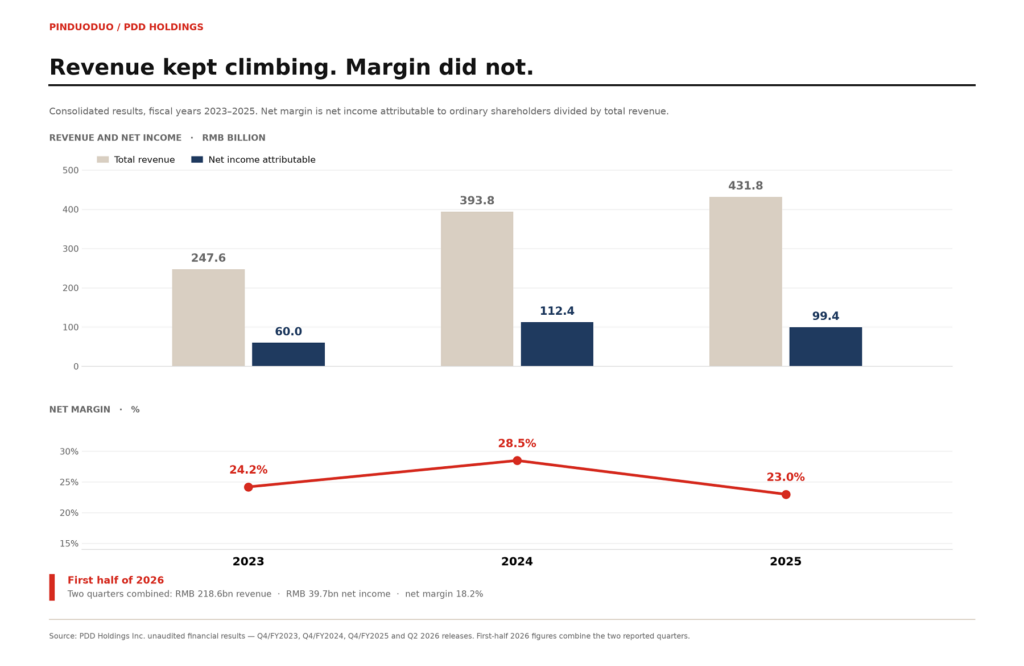
Pinduoduo — 拼多多, roughly “pool together, more and more” — has spent a decade turning shopping into recruiting. The company booked RMB 431.8 billion (US$61.8 billion) in revenue in 2025 and ended the year holding US$60.4 billion in cash and short-term investments. Net profit fell 12% that year, and fell again in both quarters reported so far in 2026, even as revenue growth slowed each time.
Both halves of that sentence matter. The psychology still works. The economics around it have changed.
Why “a cheaper shopping app” is the wrong description
Pinduoduo launched in 2015, founded by Colin Huang, a former Google engineer. It listed on Nasdaq in 2018, under three years later, and now trades as PDD Holdings. At the end of 2023 it briefly passed Alibaba by market value — a moment that said less about Pinduoduo’s profits than about how completely it had captured Chinese consumption at the bottom of the price ladder.
The distinction that matters is this: Alibaba built a mall and JD built a delivery network. Pinduoduo built a social ritual and hung a checkout page off the end of it.
Its 2025 annual report describes the mechanism in unusually plain language. The platform “pioneered an innovative team purchase model,” in which buyers “are encouraged to share product information on social networks, and invite their friends, family and social contacts to form shopping teams to enjoy the more attractive prices available.” Read that again and notice what is doing the work. The discount is the reward. The sharing is the business.
That single sentence explains the company’s cost structure, its regulatory problems, its cultural friction with the West, and the reason its margins are now shrinking.
The numbers as they actually stand in late 2026
Here is where the popular version of the Pinduoduo story goes stale. The numbers most cited — US$54 billion in revenue, US$15.4 billion in net income, a 28.5% net margin — are fiscal 2024. Tidy, impressive, and almost two years out of date.
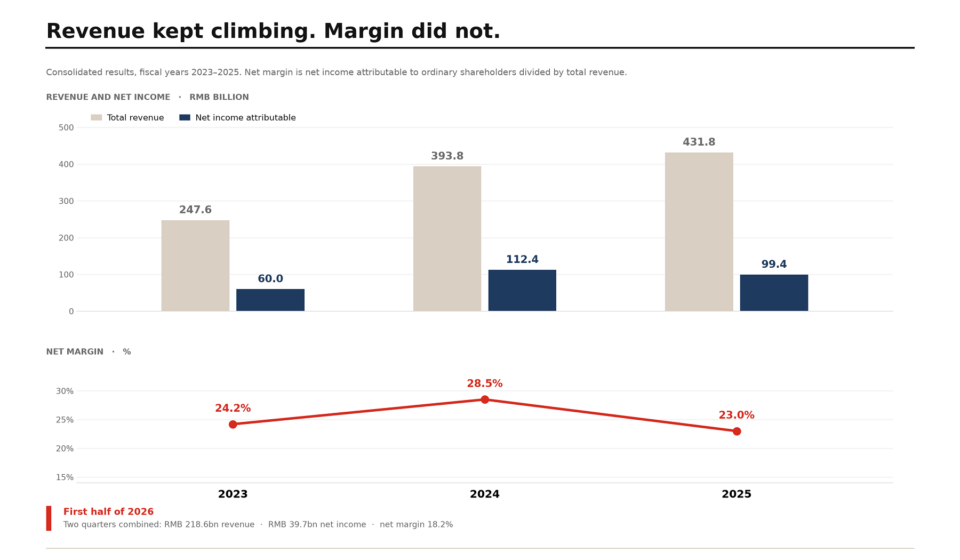
Fiscal 2025 told a different story. Revenue grew 10% to RMB 431.8 billion. Operating profit fell 13%. Net income fell 12% to RMB 99.4 billion, which works out to a 23.0% net margin — still extraordinary for a retailer, but nearly six points below the year before. Cost of revenue jumped 23%, sales and marketing rose 13% to RMB 125.3 billion, and research spending climbed 30%.
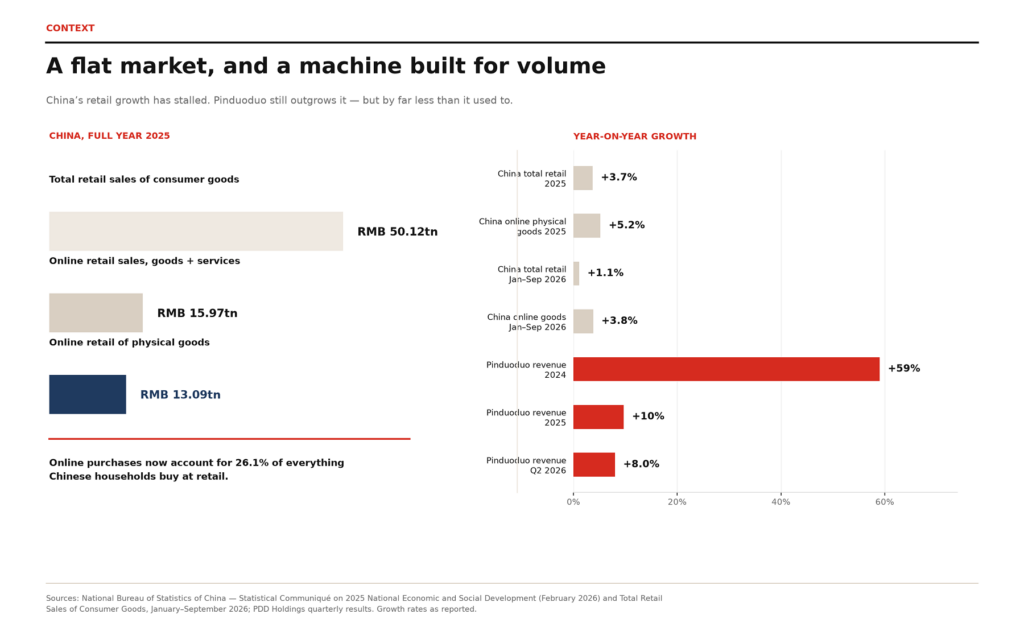
Then 2026 got harder. Revenue rose 11% in the first quarter and 8% in the second — against 10% for all of 2025 and 59% in 2024. Net income fell 15% and 12% respectively. Across the first half, the company kept roughly 18 cents of every revenue dollar, against 28.5 cents in fiscal 2024.
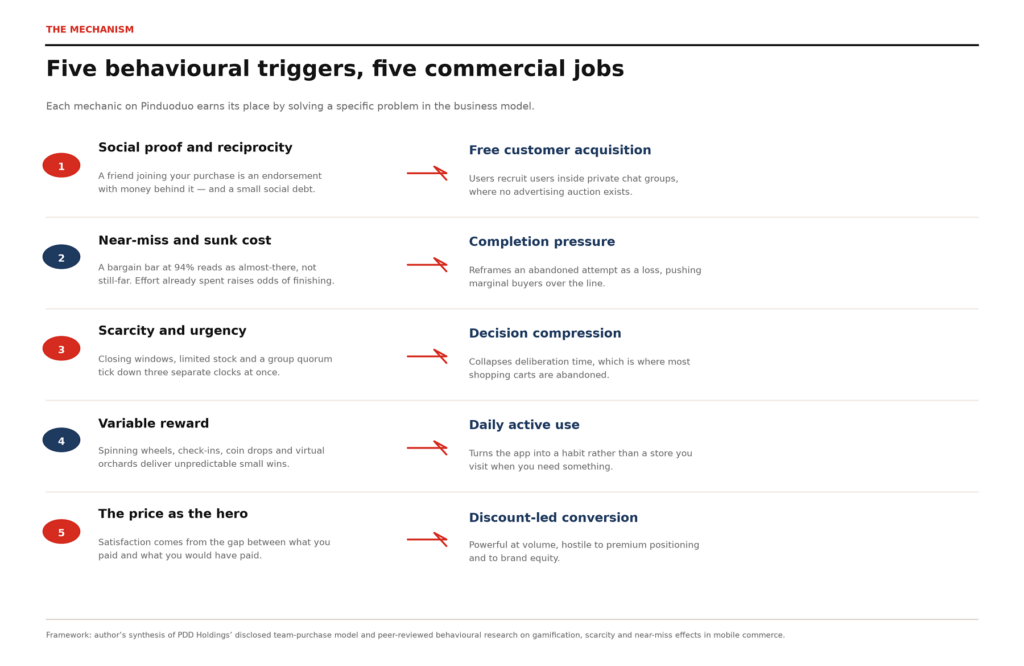
Mechanic one: the team purchase is a referral engine in a discount costume
Every e-commerce platform pays to acquire a customer. Most pay for it on search, on social, on short video. Pinduoduo asked customers to acquire each other, and paid them in the only currency it had: a lower price.
This is social proof with a transaction attached, which is a different animal from social proof alone. A five-star review is cheap to leave and easy to ignore. A friend who has already joined your purchase has spent something on you — their price depends on you completing the deal. Reciprocity does the rest. You finish the purchase partly because you want the item and partly because you do not want to be the person who wasted their discount.
For the platform, the accounting looks beautiful. Customer acquisition cost should collapse toward zero, because the acquisition is performed by users, in private chat groups where no ad auction exists. It is one of the few major consumer internet models in which the growth loop and the marketing budget are the same line item.
Mechanic two: the near-miss loop, and the arithmetic of one more person
The mechanic the West knows best is 砍一刀 — “one chop of the knife” — in which users whittle a price down by recruiting helpers. Each helper takes a bite. The price falls. A progress bar fills.
The bar is the trick, and it is an old one. A bar that is 94% full is far more motivating than a bar that is 40% full, even when the work left is identical, because the near-miss reads as “almost there” rather than “still far.” Add sunk cost — I have already asked four people, so the fifth is cheaper than quitting — and you have a machine that manufactures persistence out of arithmetic.
It is also, unavoidably, a machine that manufactures annoyance. Every completed bargain leaves a small social debt in a real relationship. Pinduoduo’s model has always run on the willingness of Chinese users to treat family and friend groups as distribution channels, which is a cultural asset as much as a design choice.
Mechanic three: scarcity and urgency, stacked on one screen
Group-buy windows close. Quantities run out. Countdown timers tick.
Individually, these are the oldest tricks in direct response. Stacked, they interact: a limited-time group price creates urgency about the clock and scarcity about the stock at the same moment, and the group requirement adds a third, social deadline — the deal only exists if enough people commit before time runs out. Three clocks, one decision.
Mechanic four: the app as a slot machine
Pinduoduo does not really have a checkout flow so much as a circuit of small games. Spinning wheels, daily check-ins, bonus coins, orchard games that ship real fruit. None of these are shopping. All of them are reasons to open the app on a day when you have nothing to buy.
The behavioral logic is intermittent reinforcement: unpredictable, variable rewards produce more persistent engagement than predictable ones. And peer-reviewed work on Chinese mobile commerce has consistently found that gamified elements raise engagement and purchase intention; they are not decoration on the funnel. The app is not a store you visit. It is a habit you maintain.
Mechanic five: on Pinduoduo, the price is the product
This is the mechanic Western marketers find hardest to accept, and the one that explains the platform’s commercial ceiling.
On a brand-led platform, the product is the hero and the price is the cost of admission. On Pinduoduo, the deal is the hero. Users describe the pleasure of the platform in the language of winning: “I got it for this much.” The satisfaction is not ownership; it is the margin between what you paid and what you would have paid.
That reframing is enormously powerful at scale and structurally hostile to premium positioning, because a brand that trains its customers to feel victorious about a discount has trained them to leave the moment the discount ends.
So where does the psychology show up in the P&L?
Three places, and only three.
Acquisition. If users recruit users, paid marketing should stay small as a share of revenue. It did not. Sales and marketing reached RMB 125.3 billion in 2025 — 29% of revenue, up from 28.3% the year before, roughly the share a conventional ad-dependent retailer spends.
Supply. Team purchases aggregate demand into single large orders, which hands the platform negotiating power over merchants and factories. This is the real source of the price gap, and it is a procurement advantage, not a psychological one.
Optionality. Because the mechanism is cheap to copy and expensive to defend, Pinduoduo has always needed a second act. It now has one: Temu.
The bill for virality
Here is the part of the story that 2024’s numbers concealed and 2026’s numbers expose.
A viral mechanic does not abolish customer acquisition cost. It postpones it. Once you have invited your mother, your cousin and the three colleagues who actually like you, the loop has no more fuel. Growth then has to be bought the ordinary way, with advertising, which is why a company famous for free distribution now spends 29% of revenue on sales and marketing.
Three things made that bill come due at once. The obvious one is saturation: China has 1.125 billion internet users and 80.1% penetration, so there is no untapped population left to invite. The second is competitive copying — every major Chinese platform now runs a subsidized low-price channel and a game layer, which means Pinduoduo’s differentiation has been generalized into an industry standard. The third is exhaustion: the social cost of being the friend who keeps sending bargain links rises every year, and the returns fall.
Four things that broke in 2026
Growth decelerated. Regulation hardened. The export route got more expensive. And the company changed its own strategy, which is the loudest signal of all.
The regulatory file
April 2026 brought a penalty of RMB 1.52 billion, roughly US$220 million — part of a RMB 3.6 billion enforcement action across major platforms over “ghost” food-delivery storefronts, unlicensed kitchens operating behind listings. It was a food-safety case, not a pricing case, but it landed on a company already under scrutiny for how hard it pushes merchants and users.
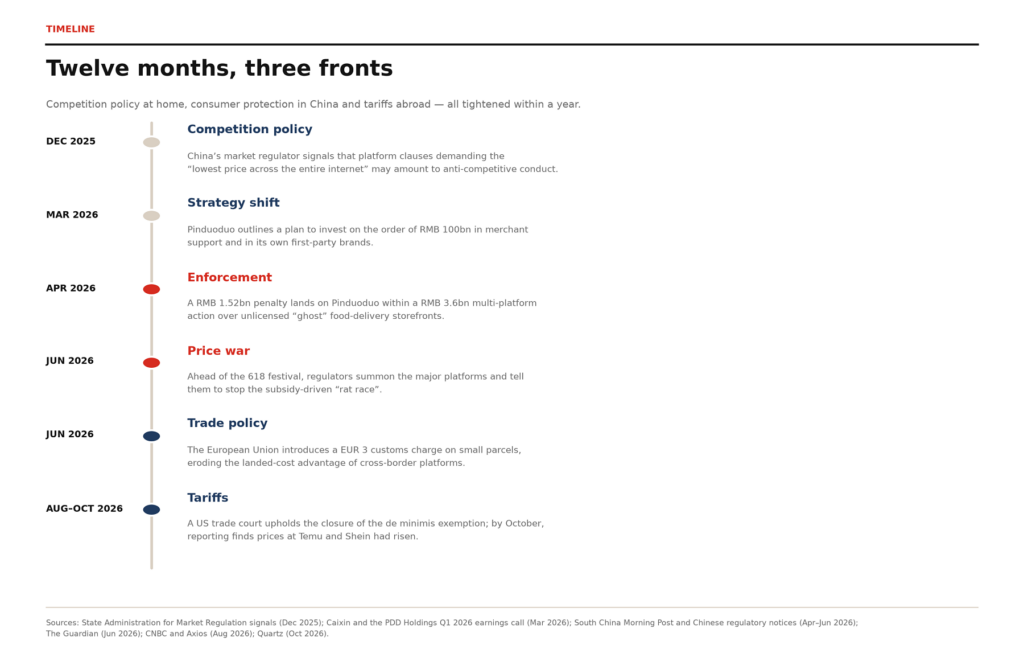
The pricing scrutiny is the more consequential thread. In December 2025, China’s market regulator signaled that platform clauses requiring merchants to guarantee the “lowest price across the entire internet” could amount to anti-competitive conduct — a direct hit at the core of the price-as-product model. In June 2026, ahead of the 618 shopping festival, regulators summoned the major platforms and told them to stop the “rat race” of subsidy-driven price wars.
Read those two moves together and a pattern appears. Beijing is not objecting to discounts. It is objecting to a market structure in which platform scale is used to force suppliers into permanent deflation. That is precisely the structure that makes Pinduoduo work.
Then there is the strategy shift. In March 2026 the company outlined a plan to invest on the order of RMB 100 billion in merchant support and, notably, in its own first-party brands. On the Q1 2026 call, co-CEO Jiazhen Zhao described supply-chain investment as the company’s “core strategic priority” and named “building the first-party brand business” as a goal. Finance VP Jun Liu was more explicit: the investments are “firm and long-term, and will inevitably affect our financial performance.”
Sit with that for a second. A platform that built its identity on being the place where brands are not the point is now building brands. That is not a side project. It is an admission that a pure price mechanic has a ceiling — and that the next decade of margin has to come from products someone actually wants, not just from a price someone else can undercut.
Why global brands keep misreading it
Western marketers tend to analyze Pinduoduo in the wrong unit. They look at the customer — is this person my customer? — when the more useful question is about the mechanic: does my category have a price gap wide enough to power a social loop?
If it does, Pinduoduo and Temu are distribution. You will move volume, you will learn things about price elasticity that your brand team will find uncomfortable, and you will not build equity.
If it does not — if your margin lives in design, service, or meaning — the platform is a hostile environment, and no amount of clever creative work fixes that. A discount-led feed flattens the differences you spent money creating.
The mistake is assuming this is a China-specific quirk. It is not. The mechanic is being copied everywhere, usually badly: progress bars that reward nothing, referral schemes with no reciprocity, gamified checkouts with no game. The reason they underperform is that the copyists borrowed the interface and skipped the social contract underneath it.
Temu is the test of whether a mechanic can travel
Temu launched in Boston in September 2022 and expanded across North America, then Oceania and Europe, then further afield. PDD’s own annual report makes an unusually candid admission about it: despite “their differentiated geographical coverage, Pinduoduo and Temu have the same value propositions and operational model.”
That sentence is the whole export thesis. Same psychology, new postcodes.
But a price mechanic is only as strong as the price gap it protects, and that gap was created by a policy, not by design. For years, low-value parcels entering the United States escaped duty under the de minimis exemption. That exemption has now been closed, and in August 2026 a US trade court upheld the closure. By October, reporting in the United States and Europe found that prices at Temu and Shein had risen. Europe moved in the same direction in June 2026 with a EUR 3 customs charge on small parcels.
So the psychology travels. The economics that made the psychology feel like a gift do not.
This is the least-discussed risk in the whole Pinduoduo story, and it is not a China risk at all. It is a business-model risk: when your value proposition is “cheaper than here,” and the “cheaper” was supplied by a tariff loophole, you are one policy decision away from having to compete on something other than price.
The moat nobody puts in the deck: agriculture
Buried under the gamification is a genuinely durable asset. Pinduoduo’s original category was agricultural produce, sold direct from farms in team purchases — a use case that fit the mechanic perfectly, because a bulk order of oranges is exactly the kind of thing a group of neighbors can organize.
That business has compounded quietly. China’s rural online retail sales passed RMB 3 trillion in 2025, up 6.7%, and the platform’s farm-to-table supply chain is the one part of its model that does not depend on anyone feeling excited. It depends on logistics, cold chain and procurement — the boring things competitors cannot copy with a progress bar.
If you want to know what Pinduoduo looks like in 2030, watch the supply chain, not the wheel.
What to watch over the next four quarters
Three numbers, in order of importance. First, the net margin: does it stabilize near 20%, or keep sliding toward the low teens as first-party brands and merchant subsidies absorb the difference? Second, the growth rate of transaction services revenue versus online marketing revenue — the first tracks orders, the second tracks merchants buying ads, and a widening gap tells you who is really paying. Third, any disclosure at all about Temu. PDD’s 2025 annual report contains no GMV figure, no annual active buyer count and no separate Temu revenue line. The company has stopped publishing the metrics that made its growth legible, and that silence is itself information.
The short version
Pinduoduo is the most psychologically sophisticated shopping platform ever built, and its central insight is not about discounts. It is that a discount can be converted into labor — that a customer will happily do the work of customer acquisition if the reward is framed as a win rather than a job.
That insight produced a US$62 billion revenue business in a decade. It also produced a mechanic that is socially exhausting, easy to copy, structurally hostile to brands, and increasingly unwelcome to regulators in China and in the West.
The company’s answer, so far, is to buy its way up the value chain: merchant support, supply-chain investment, its own brands. In other words, to become slightly more like the companies it beat.
That is the most interesting thing about Pinduoduo in 2026. The disruptor has started building the thing it once disrupted. Whether that is maturity or retreat depends entirely on whether the psychology can survive the margin.
FAQ
Q1. Why does Pinduoduo require you to bring other people in order to get the lowest price?
Because the discount is doing the job advertising would otherwise do. A team purchase converts a customer into a distribution channel: the buyer recruits the next buyer inside a private chat group where no ad auction runs. The price gap is the payment for that labor, which is why the platform can undercut rivals without spending proportionally more on media.
Q2. What is 砍一刀, and why is it controversial?
砍一刀 (“one chop of the knife”) lets users grind a price down by recruiting helpers, with a progress bar showing how close they are. It works because near-miss states are more motivating than neutral ones, and because effort already spent raises the odds of finishing. It is controversial because each attempt spends social capital in a real relationship, and because the bar’s remaining gap can feel engineered rather than earned.
Q3. If Pinduoduo’s revenue is still growing, why is profit falling?
Because the company is deliberately trading margin for position. Revenue rose 10% to RMB 431.8 billion in 2025 while net income fell 12% to RMB 99.4 billion, taking net margin from 28.5% to 23.0%, and to roughly 18% in the first half of 2026. Cost of revenue rose 23%, sales and marketing 13% and R&D 30%, alongside a merchant-support program and a push into first-party brands.
Q4. Is Temu the same business as Pinduoduo?
Same model, different map. PDD Holdings’ own annual report states that despite differentiated geographical coverage, the two platforms share “the same value propositions and operational model.” The difference is that Temu’s price advantage depended heavily on the US de minimis exemption, now closed, and on low parcel costs that the EU has begun to tax.
Q5. Should a Western brand sell on Pinduoduo or Temu?
Only if price is genuinely your competitive weapon. Both platforms are volume and reach channels where the deal, not the brand, is the hero; they are poor places to build equity. If your margin sits in design, service or meaning, the environment works against you. The useful test is not “are my customers there?” but “does my category have a price gap wide enough to power a social loop?”