Tmall’s Luxury Ladder: How Premium Brands Still Climb in China
Ask a luxury brand director in Milan what Tmall is, and you will usually get a shrug and two words: China’s Amazon. That answer is wrong in a way that costs money.
Amazon is a search bar with a warehouse behind it. Tmall is a landlord with a guest list. It does not buy inventory, it does not set your prices, and it will not let just anyone in. What it sells is stranger and more valuable: a verified place in the Chinese consumer’s mental map, with a doorman, a dress code and, if you behave, an upstairs room.
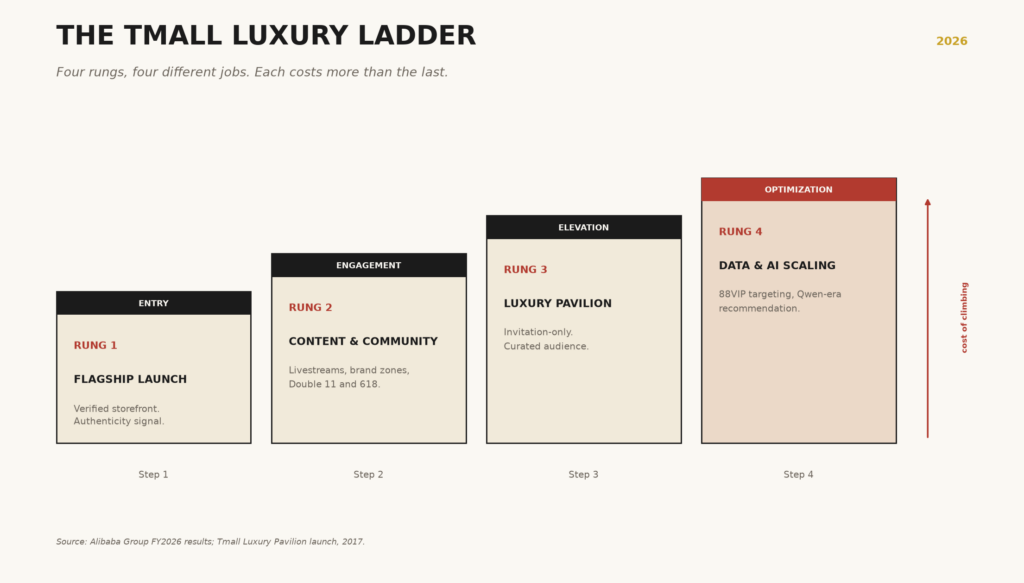
That upstairs room is what this piece is about. Call it the luxury ladder — a four-rung structure that global premium brands climb in China, from the day they open a flagship store to the day they run personalized, AI-assisted retail against a pool of more than 60 million high-spending members. Almost every serious luxury house is somewhere on it. Very few talk about it in public.
The Misread: Tmall Is Not China’s Amazon
First, the plumbing. Tmall started life in April 2008 as Taobao Mall, a business-to-consumer layer bolted onto Taobao, which was and remains a consumer-to-consumer marketplace of astonishing scale. It got its own domain in November 2010 and became a standalone business inside Alibaba Group in June 2011.
The distinction matters more than it sounds. On Taobao, anyone can sell anything, which is precisely why it feels alive and why it makes luxury executives nervous. On Tmall, you need a business license, a trademark, a deposit and the platform’s approval. Every storefront is a brand’s own shop, not a stall in a bazaar. Alibaba’s own description of Tmall is telling: not a marketplace, but the “preferred partner for brands”. Measured by GMV for the 12 months to March 2024, Taobao and Tmall together formed the world’s largest digital retail business, and Double 11 — arguably the biggest commercial event on earth — was invented there, not imported.
So when a luxury brand says it is going on Tmall, it is not listing products. It is applying for an address.
Why a Flagship Is a Statement, Not a Store
Chinese luxury consumers grew up in a market where authenticity was a live problem, not a hypothetical one. That history explains a behavior Western brands consistently underestimate: shoppers actively look for the official store. They check the badge, the follower count, the return policy, whether the page looks like the brand or like a reseller.
A Tmall flagship answers that question before it is asked. It is the digital equivalent of a corner site on a famous street: expensive, visible, impossible to fake. Which is why the opening of a flagship is read locally as a commitment signal, not a channel decision. Brands that hedge, with a pop-up here and a distributor there, get treated as tourists. Brands that open a flagship get treated as residents.
That is rung one.
The Luxury Ladder, Rung by Rung
Rung One: The Flagship Launch
This is entry, and it is mostly about legitimacy. You establish a verified storefront, you get access to Alibaba’s consumer base, and you accept a set of platform rules on pricing display, returns and service response times. The work is operational: catalogue, logistics, customer service in Mandarin, payment, after-sales. Most brands underestimate the service load here and overestimate how much of luxury is about product. In China, a slow answer on a Tuesday afternoon is a brand problem.
Rung Two: Content and Community
Once the shop exists, the job changes from being found to being watched. Tmall is not a shelf; it is a media environment — livestreams, short video, brand-zone pages, member programs, and the two great calendar spikes in November and June. This is where luxury brands meet an uncomfortable truth: the tools that sell lipstick are the same tools that sell handbags, and using them well requires a tone that survives the format. The brands that manage it treat livestreaming as a magazine shoot that happens to be shoppable, not as a teleshopping channel.
Rung Three: The Pavilion
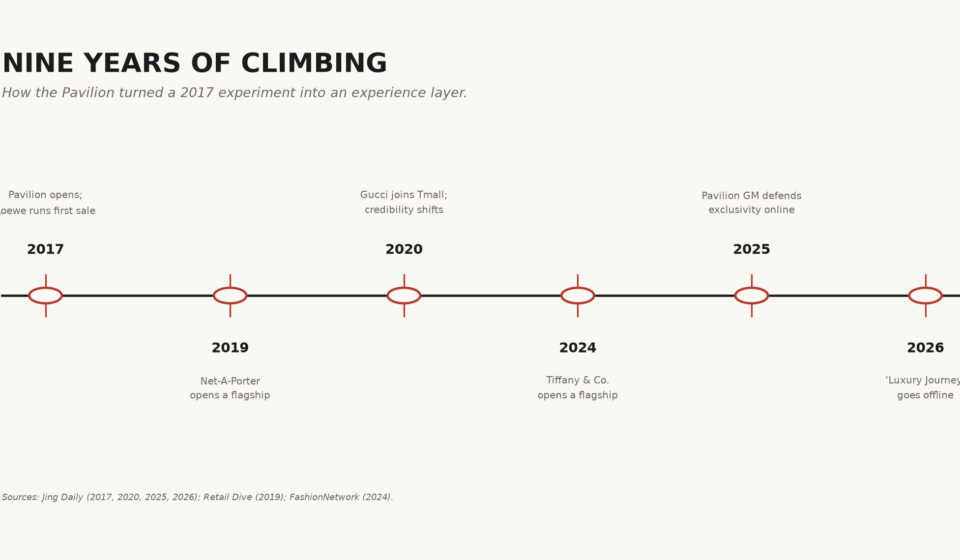
In 2017 Tmall opened a room upstairs. Tmall Luxury Pavilion is invitation-only, curated, and built for brands that want the traffic without the bazaar. It came with premium page design, tighter brand adjacency and access to the platform’s highest-spending shoppers. Loewe ran one of the first special sales there in August 2017. Net-A-Porter opened a Pavilion flagship in October 2019. Gucci arrived on Tmall in December 2020, a moment the trade press read as Alibaba’s luxury argument finally landing. Tiffany & Co. opened a Pavilion flagship in January 2024.
The Pavilion is the rung most brands aspire to and the one that is hardest to earn, because it is not purchased. It is granted, and it can be quietly withdrawn.
Rung Four: Data and AI Scaling
The top rung is not a place; it is a capability. It means using the platform’s audience data and tooling to decide who sees what, when, at which price architecture, and through which creative. In practice this is unglamorous: segment hygiene, test-and-learn on page modules, member tiering, and increasingly, feeding clean product data into AI systems that decide relevance. Brands that reach this rung stop treating Tmall as a channel and start treating it as their China operating system.
Nine Years of Climbing
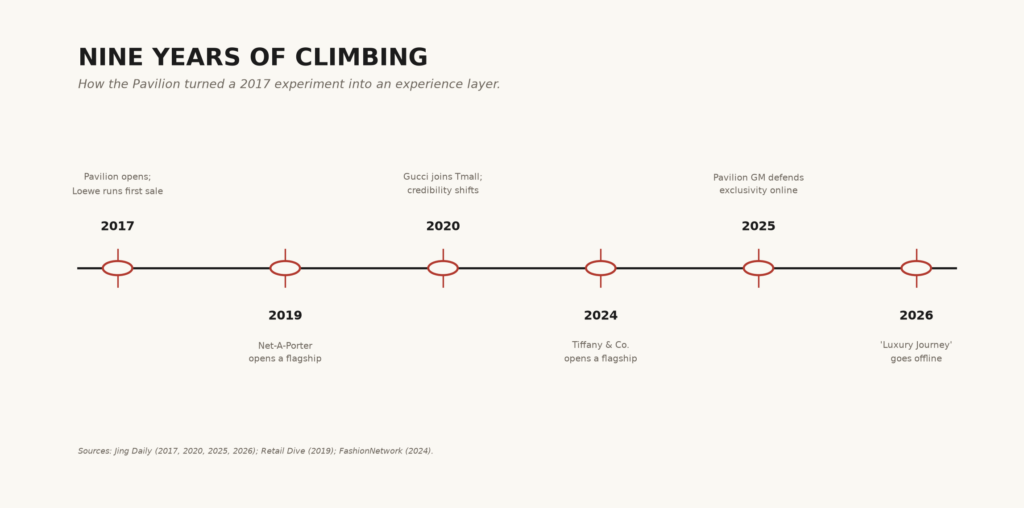
The pattern in that timeline is worth pausing on. The early years were about credibility: who would deign to be there. The middle years were about scale: who else could be persuaded. The last two are about something else entirely, namely experience. In late April 2026 the Pavilion took Burberry and Wedgwood to Songtsam Linka in Kunming for an event it called “Luxury Journey”, turning an online storefront into a host for real-world, high-net-worth gatherings. When a platform starts organizing your clients’ weekends, it is no longer a marketplace. It is a channel with ambitions.
The Structural Advantages Nobody Puts in the Deck
Trust as infrastructure
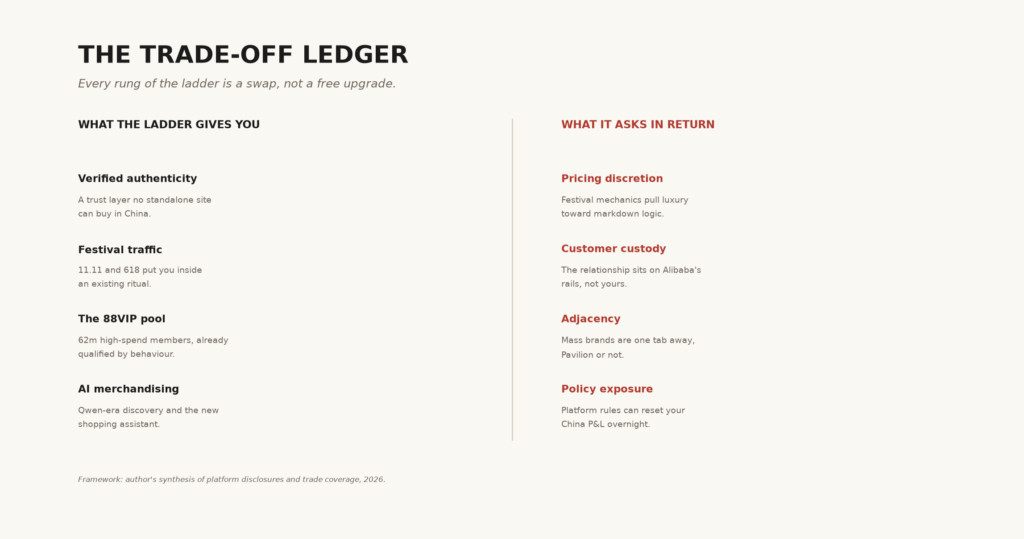
A standalone brand site in China has to buy trust from scratch: payment credibility, logistics credibility, dispute resolution, the vague but decisive feeling that this is a real shop. Tmall hands you all of it on day one. That is not a small convenience. It is the difference between a launch and a slow bleed.
Festival economics
Double 11 and 618 are not marketing campaigns; they are national rituals with their own vocabulary, countdowns and social pressure. Joining them means renting a place inside a moment you could never manufacture. The trade-off arrives later, in the pricing conversation.
The 88VIP shortcut
Alibaba’s paid membership program, 88VIP, stood above 62 million members at the end of March 2026 and kept growing at a double-digit rate. These are the platform’s highest-spending consumers, pre-qualified by behavior rather than by a media plan. For a luxury brand, that is the most valuable audience definition in Chinese e-commerce, and it is available only inside the ecosystem.
What the Platform Actually Earns
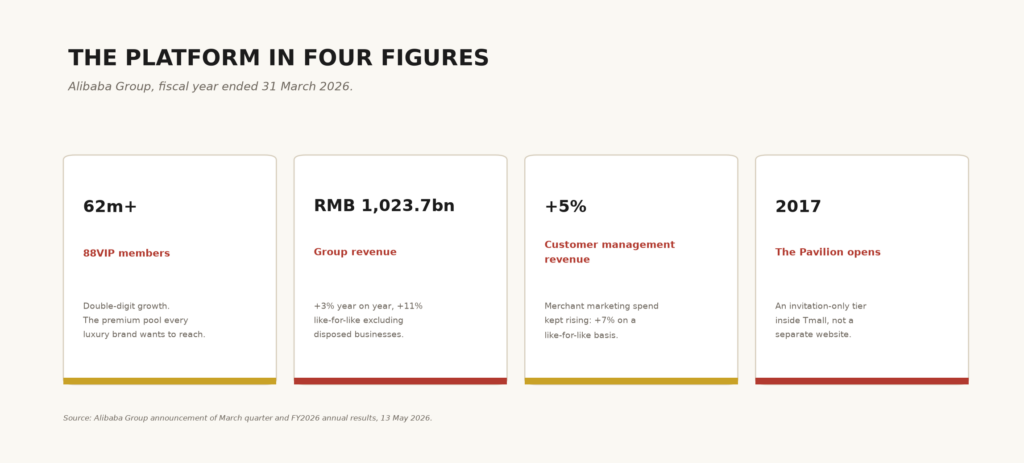
Look past the headline revenue number. Group revenue growth of 3% is a conglomerate figure, distorted by divestments and by heavy spending on quick commerce and AI infrastructure. Customer management revenue — what merchants pay for visibility, traffic and tools — grew 5%, and 7% on a like-for-like basis. That is the line that matters to a luxury brand, because it proxies how much brands collectively are willing to pay to be seen here. It kept rising in a year when China’s personal luxury market did not.
One detail in that filing is worth understanding. Alibaba changed how it accounts for subsidies to certain merchants, tying platform support to how much those merchants spend on marketing, and began recording the subsidies as a reduction of customer management revenue. Read plainly, the platform is now explicitly trading traffic for ad spend. For brands, that is a pricing signal about the cost of visibility going forward.
The Bill Nobody Sends: Four Risks
Pricing discretion
Luxury is a pricing story before it is a product story. Festival mechanics are built on urgency and deals, and even careful brands find themselves engineering entry-price items, gift-with-purchase mechanics and limited “festival editions” to avoid discounting the core. It works, until it becomes the reason people wait.
Customer custody
You will know your buyers’ order data. You will not own the relationship the way a boutique owns it. The platform sits between you and the person who just spent four figures, and that intermediation is the price of the traffic. Brands building parallel private-domain channels — WeChat service accounts, member communities, offline clienteling — are not being paranoid. They are hedging.
Adjacency
Curated or not, the Pavilion lives inside a mall. A shopper can leave your page and land on a mass-market competitor in one tap. Ultra-premium houses solve this by under-investing in the platform, a strategy with its own cost: invisibility in the place where discovery happens.
Policy exposure
Platform rules on fees, ranking, data access and campaign participation change on the platform’s timetable, not yours. A brand that has built 60% of its China revenue on one ecosystem has effectively outsourced a chunk of its P&L to a counterparty it does not control. That is not an argument against the ladder. It is an argument for knowing where the ladder is bolted to the wall.
2026 Reality Check: A Shrinking Market Rewrites the Rules
Here is the uncomfortable context. China’s personal luxury market contracted for a second consecutive year in 2025, and Bain expects a return to growth in 2026. Two down years change the psychology of the climb. In a growing market, brands ascend because the next rung is obviously worth it. In a flat or falling one, every rung has to justify itself against a shrinking pool of willing spenders.
Bain has also been blunt about why the pool shrank: repeated price increases left a meaningful share of shoppers feeling betrayed by brands they once loved. That is a demand problem created upstream, not on the platform. But it explains a behavior you can see in the numbers — consumers concentrating spend on fewer, more considered purchases, and rewarding brands that make buying feel like something rather than a transaction. Which is exactly why the Pavilion’s pivot toward experiences in 2026 is not a marketing stunt. It is a response to a market where the transaction is no longer the interesting part.
When the Storefront Learns to Talk
The other structural change is quieter. In its fiscal 2026 disclosures, Alibaba describes folding Taobao and Tmall shopping into the Qwen app, launching a Qwen Shopping Assistant inside the Taobao app that covers everything from idea generation to post-purchase service, and rolling out Wukong, an AI agent for merchants that automates workflow.
Read that as a luxury brand and the implications stack up fast. Discovery moves from browsing grids to describing intentions in sentences. Product data quality becomes a merchandising function, because a model that cannot parse your material composition cannot recommend you. And the storefront stops being a place people visit and becomes something that answers back.
None of this makes the ladder obsolete. It changes what the top rung is made of. Data and AI scaling used to mean better targeting; soon it will mean being legible to an assistant that is doing the shortlisting.
The Playbook: Deciding How High to Climb
Four questions are worth answering honestly before committing budget.
How concentrated is your Chinese demand? If buyers cluster in a handful of cities and categories, a flagship plus clienteling may beat a full ladder climb.
Can your price architecture survive a festival? If the only way to participate is to discount the thing that makes you luxury, keep the core collection off the festival floor and compete on service instead.
Do you have the service muscle? Response times, returns and Mandarin-language after-sales are not back-office details in China. They are the brand.
What is your exit cost? Model the scenario where platform economics turn against you. If the answer is “we would be stranded”, you climbed too fast without building an alternative.
The Honest Bottom Line
Tmall built something no Western platform has: a brand-safe environment with a guest list, a festival calendar and an upstairs room. For a luxury house entering China, the ladder is real, it works, and it has become the default route rather than an experimental one.
But the ladder is not a lift. Each rung asks for something — pricing room, customer custody, strategic independence — and the bill arrives later than the benefit. The brands that climb well know, before they start, how high they actually need to go. The rest spend years discovering that the view from the top is lovely and the lease is expensive.
FAQ
Is Tmall the same as Taobao?
No. Taobao is Alibaba’s consumer-to-consumer marketplace, where individual sellers operate. Tmall is the business-to-consumer platform for licensed brands and authorized retailers. For a luxury or premium brand, Tmall is the relevant venue; Taobao is where its products get resold, sometimes genuine, sometimes not.
What exactly is Tmall Luxury Pavilion?
An invitation-only tier inside Tmall, opened in 2017, with curated brand adjacency, premium storefront design and access to the platform’s highest-spending consumers. It is granted rather than bought, which is why its roster functions as a signaling device.
Why not just build our own Chinese e-commerce site?
You can, and some hard-luxury houses do. But you would be buying trust, traffic and festival participation from zero, in a market where shoppers are conditioned to look for the verified badge. Most brands run both: the flagship for reach, the private channel for relationship.
Does participating in Double 11 damage a luxury brand?
It can. The mechanics reward urgency and price. Brands that avoid damage treat the festival as a distribution moment for entry-price categories, gifting and limited editions, and keep the core collection out of the discount logic.
How is AI changing the ladder?
It is changing the top rung. Alibaba has folded Taobao and Tmall shopping into its Qwen app, launched a Qwen Shopping Assistant inside Taobao, and given merchants an AI agent called Wukong. As discovery shifts from search grids to conversational shortlists, clean product data and machine-readable brand assets become a competitive advantage rather than a hygiene factor.