New York’s Lawyers Just Killed Hourly Billing for AI Work. Agencies Are Next.
A state bar committee did in four sentences what a decade of procurement reviews could not: it made the billable hour negotiable again.
On Saturday, October 31, the New York State Bar Association’s House of Delegates adopted a report titled Legal Ethics Guidelines for Lawyers’ Use of Artificial Intelligence. On Monday, Law360 compressed one of its provisions into a headline every agency finance director should tape to their monitor: lawyers cannot bill clients for the time AI saves them.
That is a narrow rule about one profession in one state. It is also the first time a serious professional body has answered in writing a question the entire professional services industry is currently pretending not to hear. When a machine does in twenty minutes what used to take six hours, who keeps the difference?
Lawyers have an answer now. Agencies are about to be asked for theirs.
What New York actually decided
Three provisions matter. Everything else in the report is housekeeping.
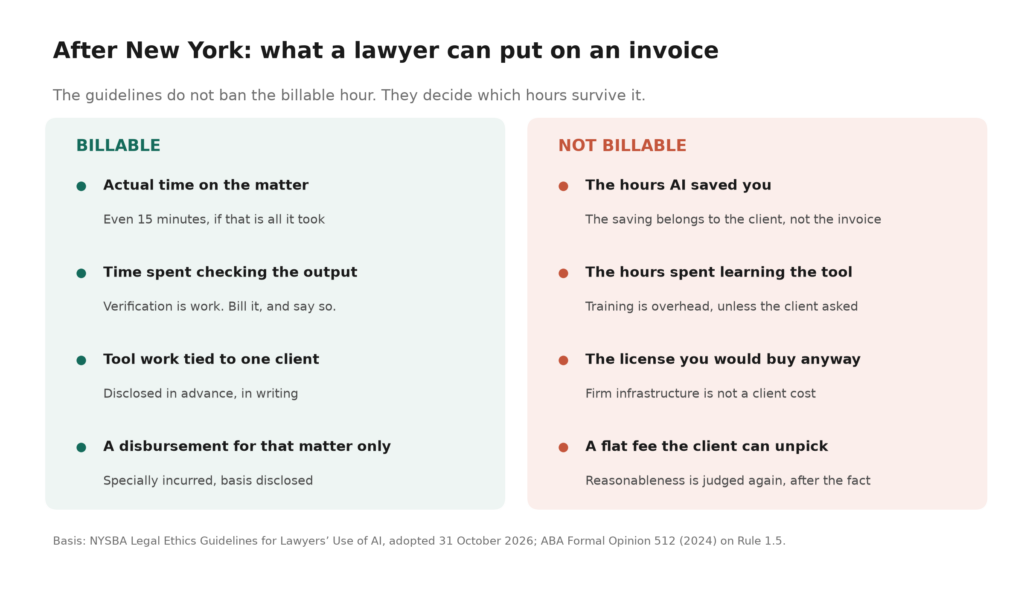
The hours AI removes are not billable. The guidelines bar charging clients for time saved.
The hours spent learning the tool are not billable either. The association’s own announcement is blunt: a lawyer may charge for time spent verifying an AI tool’s output, but not for time spent learning how to use it.
The software is overhead. Buying and maintaining AI tools is a firm expense, not a client cost — passable as a disbursement only when it is specially incurred for a particular matter, and only when the basis for the charge has been disclosed.
The committee also drew a line that will matter more than it looks: routine uses — word processing, spelling and grammar checks, calendaring, timekeeping — need not be disclosed at all, provided the use does not move the fee.
Read those four sentences as a business model rather than an ethics note. What survives is the work a human being actually did: the drafting, the judgment, the checking, the call. What dies is the meter.
This was not new. It was late.
Anyone who read ABA Formal Opinion 512 in the summer of 2024 already knew where this was heading. The American Bar Association’s ethics committee held that a lawyer billing by the hour “must bill for their actual time,” and it offered the example that has since appeared in every continuing-education deck in the country: if AI drafts a pleading in fifteen minutes, you charge fifteen minutes, plus whatever time you spend reviewing the draft.
New York goes further in the one direction that matters commercially. Opinion 512 had already warned that a flat fee could become unreasonable if AI lets a lawyer finish the same work much faster — a point that unsettles every fixed-price arrangement in professional services. New York’s committee adds the operating detail: verification is billable, training is not, and the license is your problem, not the client’s.
Put the two documents together and you get a pricing regime with an odd shape. The clock is capped at what actually happened. The price is not capped at the clock. You may charge more than the hours suggest. You may not charge for hours that no longer exist.
That is a more sophisticated position than either side of the debate expected, and it is going to travel.
Why agencies should read this twice
Strip the lawyers out and the rule is about a single ratio: what a client pays, divided by what it cost you to deliver.
Every professional services firm lives on that ratio. Law firms happen to publish theirs. Agencies bury theirs inside rate cards, scopes of work and a headcount-based fee that is, functionally, an hourly rate in a suit. The retainer is a prepaid block of hours. The full-service fee is a bundle of them. The annual review is an argument about how many.
So this is not a legal story. It is a pricing story that just acquired a legal alibi.
The number nobody says out loud
Start with the size of the prize. Thomson Reuters’ Future of Professionals research found that the average lawyer expects to save 190 working hours a year through AI. Across the United States legal market, that works out to roughly $20 billion of work that no longer needs to be done by a person.
Nearly a tenth of a working year, per professional. And 80% of law firm respondents in that research said they expect AI to fundamentally change how they price, staff and deliver.
Then the awkward part. In 2026, almost none of it reached the invoice line.
Thomson Reuters’ autumn rates report found the largest US firms pushing through their biggest increases on record. Worked rates at Am Law 100 firms rose 9.7% in the first half of 2026 — the fourth consecutive year above a threshold no other segment has crossed. The average standard rate reached $800 an hour before discounts, $720 after. Demand grew 2.8%. Client resistance barely registered.
The report’s own conclusion explains why, and it is the most honest sentence written about AI economics this year: “AI is reaching law firms as demand, not yet as efficiency.”
The boom is generating legal work — financings, licensing fights, privacy questions, regulatory scrambles — faster than it removes it. Firms are adding junior lawyers, not shedding them. Almost none can measure what AI has actually saved them, and most are still using it experimentally.
The billable hour survived 2026 not because it works, but because demand arrived first.
That is the whole argument. It transfers to agencies with one cruel difference: in marketing, the cost base is already moving while the price is not.
The agency version is further along
Clients have started moving, and they have stopped being polite about it.
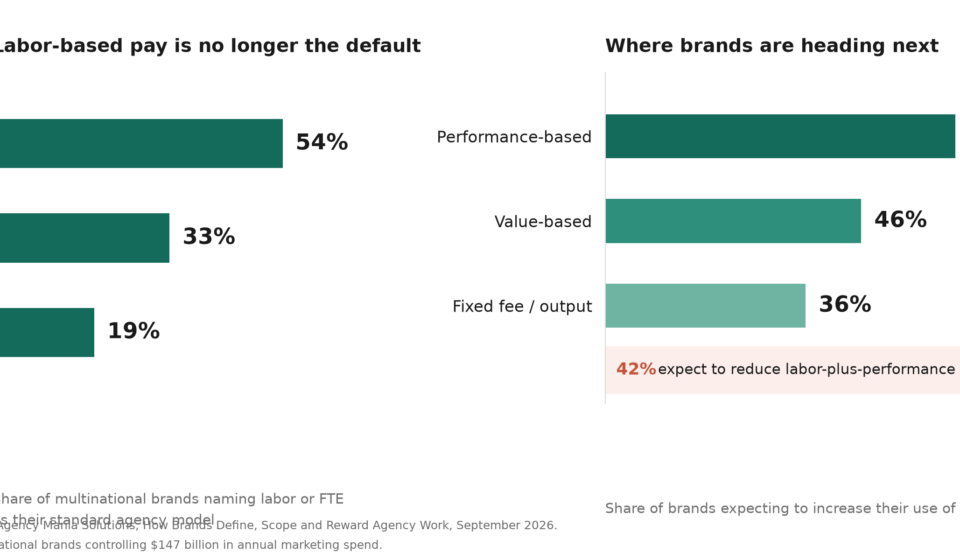
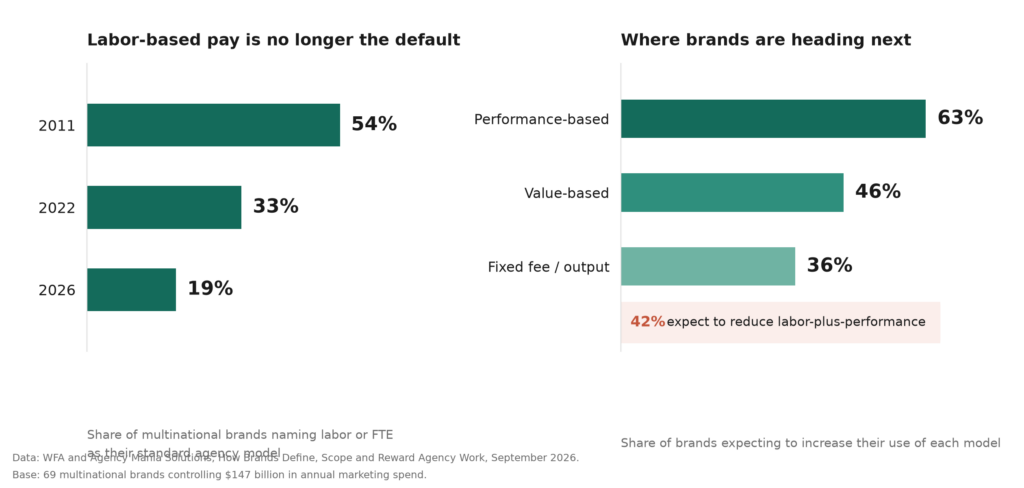
The World Federation of Advertisers, with Agency Mania Solutions, surveyed 69 multinationals controlling $147 billion in annual marketing spend. The finding that matters is a fifteen-year slide finally crossing a threshold. Labor-based pay is the standard model for 19% of brands, down from 33% in 2022 and 54% in 2011. Fixed-fee and output-based models climbed from 20% to 33%. Labor-plus-performance more than doubled, from 9% to 21%.
Ask where they are going and the answers all point the same way. 63% expect to use performance-based fees more. 46% expect more value-based pricing. 42% expect to cut labor-plus-performance further. Only 36% expect growth in fixed-fee or output models — which tells you something subtle. The destination is not “fixed fee.” It is “a fee tied to something the client can see.”
AI is doing the pushing. Only 20% of those brands have already changed their commercial models in response to AI. 61% intend to. That is not a trend. It is a queue. When it clears, a number of agencies will discover that their rate card was the product.
The WFA’s own framing deserves to be stolen outright: AI lets agencies do more, faster, which makes time an increasingly weak proxy for value.
The transparency problem is the whole problem
Here is the number that should worry agency leaders more than any fee benchmark. In the same study, 89% of brands say they get value for money from their agencies. Only 48% say they have sufficient transparency into agency costing and profitability.
Read that as a negotiation, not a satisfaction score. Clients are not unhappy. They are unaudited. And unaudited suppliers do not get to bank efficiency gains quietly. They get asked to explain them.
The contracts have not caught up. In the UK, ISBA’s remuneration research found just 8% of advertisers had amended agency contracts to include terms covering AI use, with a further 42% in progress. Two years into the AI era, roughly one advertiser in twelve has written down who owns the hours.
So the first serious dispute is already being drafted. It will not be about whether AI was used. Everyone will concede that. It will be about who was supposed to benefit.
Accounting got there first, and said it out loud
If you want to hear what this argument sounds like when it is not being managed by a communications department, listen to accountants.
Bloomberg Tax reported US accounting firms rebuilding their pricing models around AI, and one exchange has stuck with me. A report that used to take a tax advisory team twenty hours, an advisory leader said, now takes ten with generative AI plus output checks. It raises the only question that matters: is that difference margin, or is it a price cut?
No ethics committee will settle it for accounting. None will settle it for agencies either. It gets settled in the contract, or it gets settled by attrition.
The American Institute of CPAs’ 2025 survey of more than 1,000 firms put the median net hourly rate at $170, up nearly 7% in two years, and recommended that firms accelerate the shift away from hourly billing. More than 90% planned to increase technology spending. Notice the pattern: rates rising, hours falling, and an explicit recommendation to stop selling hours.
The saving is real, and smaller than the demo
One reason this transition is messier than the pitch decks suggest: the productivity evidence is genuinely mixed, and the best study of it is unusually careful.
A field experiment run with Boston Consulting Group, now published in Organization Science, put 758 knowledge workers through 18 realistic tasks. Those using AI completed 12.2% more tasks, finished 25.1% faster, and produced better work. On a complex task deliberately placed outside the model’s competence, they were 19% less likely to be right.
That last number is the one to build a business on. It explains why New York permits billing for verification: somebody still has to catch the failure. It also explains why the saving is never the full hour. Ten hours of production becomes three hours of production, two hours of checking, and the occasional expensive miss.
The honest arithmetic for an agency is therefore not “we cut 60% of the hours.” It is “we cut some hours, and we bought some risk.”
The strongest case for keeping the hour
There is a good argument on the other side, and it deserves a fair hearing.
Clients do not buy time. They buy certainty. An hourly invoice is easy to audit, easy to benchmark, easy to defend to a CFO who has never met the work. Fixed fees move risk onto the agency, and agencies price risk. Outcome fees move risk onto both parties and require measurement infrastructure that most marketing organizations do not have. Performance pay is already a small slice of reality: across most disciplines, 67% to 80% of brands say it accounts for less than 20% of total agency compensation.
All true. None of it is a defense of the hour — it is a defense of predictability. Those are different things, and only the second is in trouble.
The mistake is treating predictability as an argument for billing inputs. A client can get predictability from a fixed price, a capped scope, a retainer with a defined output list, or a quarterly true-up. What they cannot get from an hourly model is a share of the saving that AI itself produces. Every hour you remove reduces your own revenue. That is not a pricing model. It is a penalty for competence.
What actually gets measured
Here is the operational crux, and it is unglamorous. Agencies cannot prove AI savings because they do not measure work at the level where AI operates.
“Creative” is not a task. “Ten social variants, three rounds of revision, one legal review, two localizations” is a task. Until the second sentence exists in a spreadsheet, no one can say whether a deliverable now costs 40% less or 4% less to produce. Thomson Reuters found the same blindness in law: almost no firms measure AI’s impact formally, which is precisely why rates could rise while efficiency claims went unexamined.
Whoever builds the task-level cost model first wins the negotiation. It is not a technology project. It is a costing project, and it is boring, and almost nobody has done it.
The clause that will decide it
If the fight is contractual, the contract needs a sentence. Three, in practice.
Scope: which deliverables are priced as output, and what counts as a revision versus new work.
Efficiency: what happens to the fee when a model improvement or workflow change cuts the cost of a defined deliverable. Shared on a formula, retained until the next review, or reinvested in added scope — pick one and write it down.
Evidence: who gets to see the cost build, how often, and what the remedy is if the numbers do not hold. Without the third clause the first two are decoration.
Agencies that write these before procurement asks will look generous. Those that wait will look caught.
Three ways to split the gain
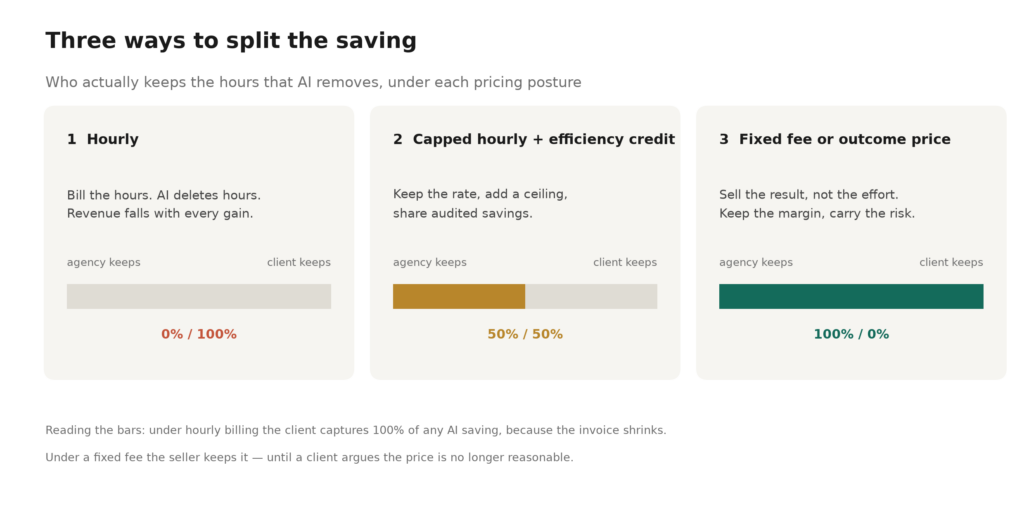
Every pricing posture answers the same question: when the cost of delivery falls and the price does not, who keeps the difference?
Hourly. The client keeps all of it, automatically, because the invoice shrinks. Efficient delivery is punished. This is where most agencies still live, and it is the posture New York just made untenable for lawyers.
Capped hourly with an efficiency credit. The rate holds, a ceiling goes on hours, and documented savings are shared on an agreed formula. Unfashionable, but it survives procurement review and it keeps the relationship honest while the cost base is still moving.
Fixed fee or outcome price. You sell the result and keep the margin — until a client argues the price is no longer reasonable. After Opinion 512 and after New York, that is a live argument rather than a theoretical one.
None of these is morally superior. The error is drifting between them without ever saying which one you are in.
If you run an agency: a 90-day repricing plan
Days 1–30. Rebuild the cost model at task level. Not by role, not by team, by deliverable. You cannot price an output you have never costed. Most agencies find their margins vary by a factor of four across service lines, and that the loss-making work is the work they are proudest of.
Days 31–60. Write the AI clause you would want as a client. Name the tools. Name what is included. Define what a scope change looks like when a model update halves a production cycle. Then decide, deliberately, whether savings are shared, retained, or reinvested in more work. All three are defensible. Silence is not.
Days 61–90. Move one service line to a fixed output price with a quality bar. Pick the most commoditized line — usually production or performance creative — keep everything else on the clock, and learn in one place before promising it everywhere.
And then do the thing nobody does: publish the hours. If 89% of clients already say they get value, transparency is not a threat. It is the argument that lets you charge for judgment instead of attendance.
If you are the client: five questions
What did AI change in this scope, and what did it not? Ask per deliverable, not per agency.
Which hours am I paying for — production, review, or both? Both is a legitimate answer. An unexamined answer is not.
What happens to the fee when the model gets better? If the answer is “nothing,” you are funding somebody’s margin.
Can I see the cost build once a year? You do not need the full P&L. You need to know whether price tracks work.
What would you stop doing if I paid for the outcome instead? The answer tells you what the agency actually believes its value is.
What “no” sounds like
The risk of doing nothing is not a dramatic collapse. It is a slow, quiet repricing executed by procurement, one benchmark at a time.
It looks like this. A holding company reports 5% organic growth for the third quarter of 2026 while guiding to an operating margin above last year’s industry-high 18.2% — efficiency landing as margin, not as a discount, because no client has yet asked the right question. Then a client asks, with an ISBA-style benchmark in hand and a WFA survey on the table. The next conversation is not about the rate. It is about the last three years of the rate.
The uncomfortable conclusion
New York did not kill the billable hour. It did something more useful: it made the hour honest, and then it made the price negotiable.
For agencies the sequence runs the other way. No committee is coming. The pressure will arrive as a procurement email with a number attached, in a year when AI has already changed the cost base but not yet the rate card.
The firms that win this transition will not be the ones with the best models. They will be the ones that can answer, in one sentence and without flinching, what a client is buying now that they are no longer buying hours.
New York’s lawyers were told the answer on Saturday. They have until the next invoice to learn how to say it out loud.
Key numbers
- 19% — share of multinational brands where labor-based pay is still the standard agency model, down from 54% in 2011
- 33% — share using fixed-fee or output-based models, up from 20%
- 20% — brands that have already changed their commercial models in response to AI; 61% intend to
- 48% — brands with sufficient transparency into agency costing; 89% say they get value for money
- 9.7% — worked-rate growth at Am Law 100 firms in H1 2026, a record fourth straight year
- 190 — hours a lawyer expects to save annually through AI, roughly $20 billion across the US legal market
- 12.2% — more tasks completed with AI in the BCG field experiment; 25.1% faster, and 19% worse outside the model’s competence
Quick answers
Is hourly billing now illegal for lawyers? No. The New York guidelines govern professional conduct, not statute. They make certain hours unbillable and certain fees challengeable after the fact.
Can agencies bill for AI-assisted work? They can bill for human time on the work — production, review, judgment. The open question is whether a client will keep accepting a rate card that has not moved while the cost underneath it has.
Does a New York rule matter outside New York? It binds New York lawyers. The reasoning travels, because ABA Formal Opinion 512 already set the standard most US clients and firms now argue from, and procurement teams read both.
What replaces hourly billing in practice? A hybrid: fixed or output pricing for defined deliverables, time for genuinely uncertain work, and a performance component wherever outcomes can be measured.
Why is this happening now rather than in 2024? Because AI’s efficiency is arriving at different speeds in different professions. Law is still being carried by AI-driven demand. Marketing’s cost base is already moving, and its clients have already started rewriting the pay models.