Why China Scaled AI Livestream First — and Where It Still Fails
At three in the morning your livestream room is still lit, but no human is behind the camera. In China this is no longer a novelty. The real question is not whether the technology works. The real question is whether the money it saves actually lands in your margin, or just disappears into a brighter-looking dashboard.
This article separates what is genuinely deployed from what is theater. The line is not drawn between human and machine. It is drawn between low-marginal-cost shifts and high-trust sales moments.
The Headline vs the Daily Reality
The headlines tell you digital hosts are replacing top streamers. The daily reality inside Chinese commerce teams is quieter and more useful. Most AI livestream hours are spent on the boring parts of the schedule: the 2am to 8am graveyard shift, the repeated product explanation for a long-tail SKU, the standard answer to the same ten questions.
None of that sounds like a revolution. All of it is real. The gap between the story and the operation is where most brands lose money, because they buy the story and only later discover they needed the operation.
What AI Livestream Actually Automates
Strip the marketing language and the system does three things:
- It reads a script and voices it through a digital human or a synthesized voice.
- It listens to viewer comments and matches them to pre-written replies.
- It keeps the room running without a salary, a break, or a mood.
That is the entire machine. Everything else marketed as intelligence is usually a rule, a template, or a human reviewing the output off-screen. Knowing this protects you from paying for capability that is not there.
Digital Humans: Where They Help
The places where digital hosts earn their keep share one trait: the cost of a human being there is higher than the value of their presence.
Night coverage is the clearest win. A human host costs the same at 3am as at 3pm, but the audience and conversion at 3am are thin. A digital host covers the slot for near zero marginal cost.
Standardized explanation is the second win. When the product is a phone case, a screwdriver, or a bottle of sunscreen, the pitch does not change. Repeating it through a digital human scales the explanation without scaling payroll.
Long-tail SKU coverage is the third. Brands with thousands of items cannot put a human on every one. A digital host can sit on the niche product page all day, answering the basics, so the human team focuses on the items that actually move.
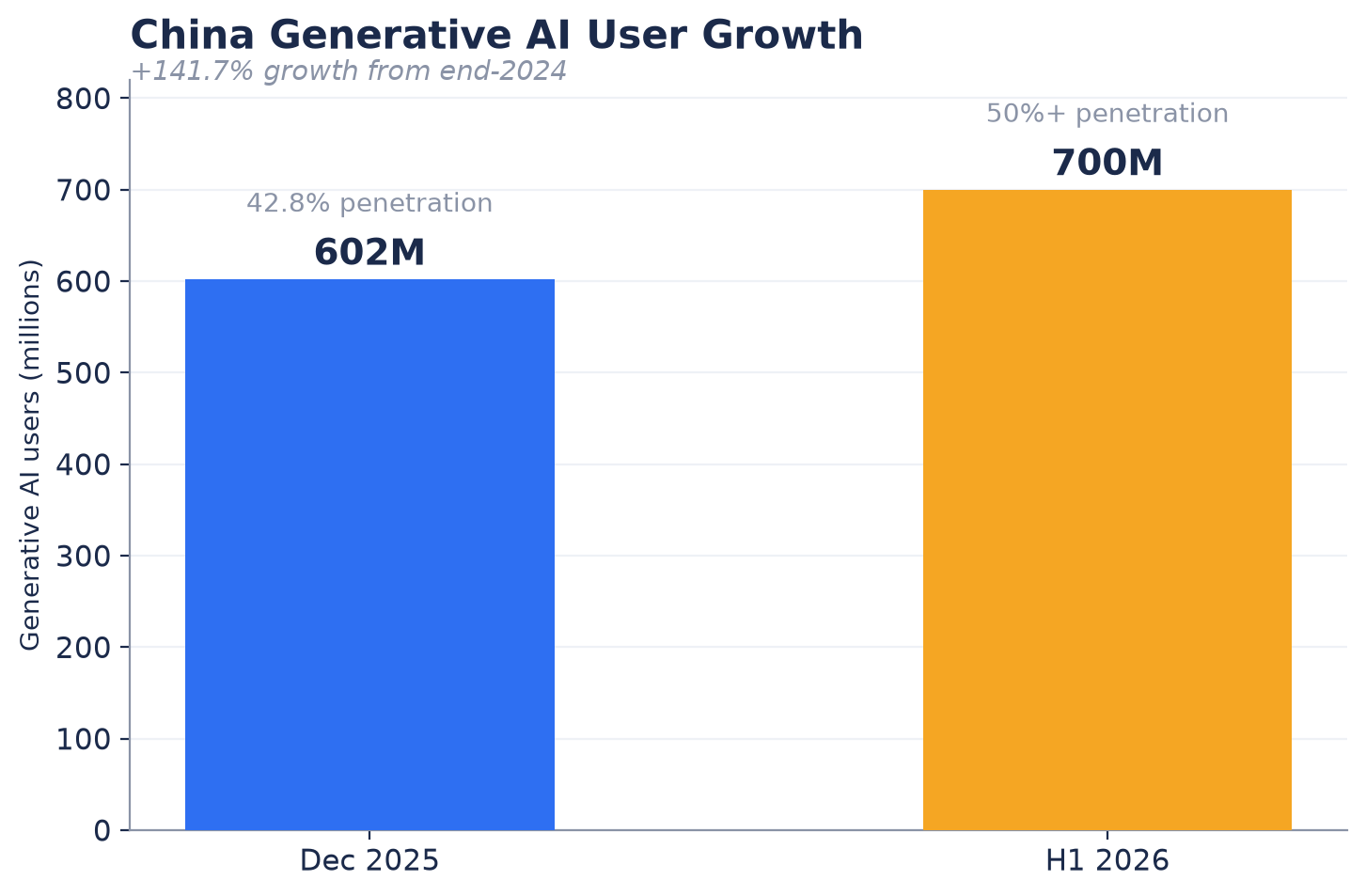
China is the right place for this to mature first. By December 2025, generative-AI users in China reached 602 million, with a penetration rate of 42.8 percent. That base trains the models and, just as important, trains consumer acceptance. People already talk to AI daily, so a digital host feels normal rather than strange. The same trajectory continued into the first half of 2026, when China’s generative-AI users crossed 700 million with penetration above 50 percent.
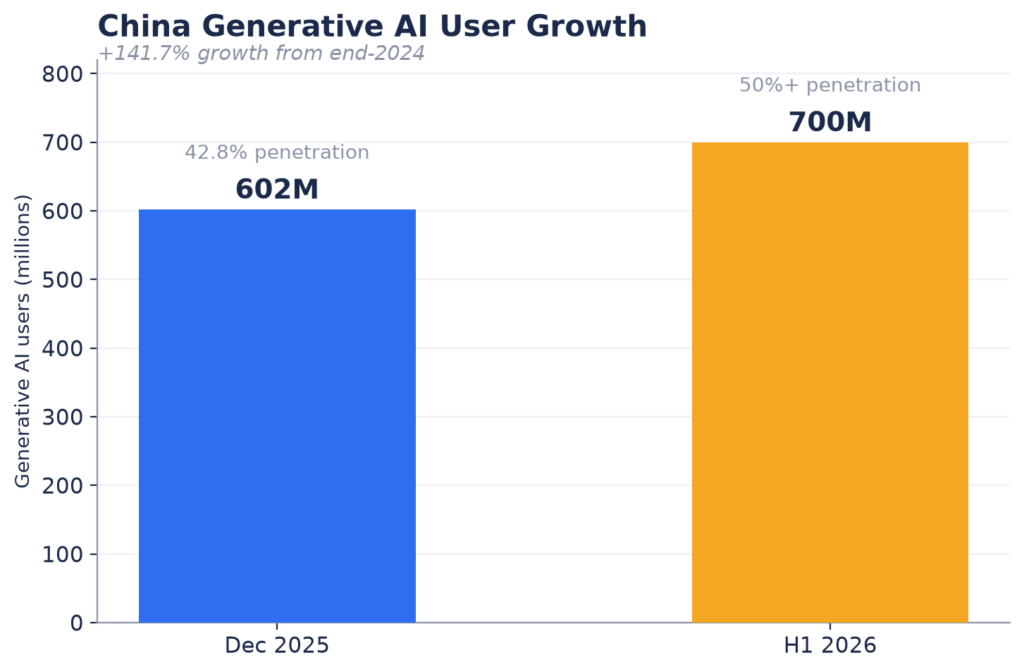
Insert here: a bar chart plotting generative-AI users in China at end-2024 (~249M), Dec-2025 (602M, 42.8% penetration), and H1-2026 (700M+, 50%+ penetration). Caption: “602M users and 42.8% penetration by Dec 2025, then 700M+ and 50%+ by H1 2026 — the acceptance base that makes digital hosts feel normal.” Source: CNNIC 57th Statistical Report; CNNIC Generative AI Application Development Report (2026).
Where They Still Fail
Digital hosts struggle the moment the sale depends on trust, taste, or a live decision.
They stumble on objection handling. A real viewer doubt, slightly off-script, still breaks the reply engine more often than vendors admit. They stumble on emotional selling. Enthusiasm, humor, and the feeling that someone is on your side are hard to fake at scale. They stumble on high-consideration purchases, where the buyer wants a human to vouch, negotiate, or take responsibility.
This is why the claim that digital hosts replace top streamers is hype. The top streamer sells trust. A digital host sells availability. Those are different products.
The Cost Math That Matters
The number that matters is not the software price. It is the labor hours displaced per streamed hour, multiplied by the conversion those hours actually hold.
A digital host that runs the night slot for free but converts at a fraction of a human may cost you more in lost sales than a human would have cost in wages. A digital host that runs a stable, low-stakes product page may pay back in days. The math flips by scenario, which is exactly why a blanket yes or no answer is useless.
Measure displaced labor, not subscription cost. Then measure whether the conversion held. Only then do you know if the line item helped.
Regulation on Disclosure
China moved early on labeling machine-generated content. The Cyberspace Administration of China has put in place rules requiring explicit identification when content is generated or synthesized by AI, and these obligations extend to platforms and service providers, not only to the user pressing go live.
For a brand running an AI livestream, the practical duty is simple to state and easy to miss: the room must not pretend to be human where the rules require disclosure. Treat labeling as a launch checklist item, not a legal afterthought. The exact clause text should be confirmed against the current CAC measures before you scale, because the requirement is real even when the wording is easy to overlook.
Why China Tried It First
Three conditions lined up in China before they lined up anywhere else. The livestream-commerce habit was already mass-market, so the audience was trained. The generative-AI user base was already huge, passing 602 million by the end of 2025. And digital humans had already entered consumption as a trend, with virtual idols and digital-person formats accelerating inside the broader digital-consumption market.
When the audience accepts the format, the infrastructure exists, and the new formats are already normalized, experimentation becomes cheap. That is the environment in which AI livestream went from demo to routine.
This domestic story sits inside a wider, uneven global picture. Globally, 78 percent of organizations reported using AI in 2024, up from 55 percent the year before, while generative AI attracted 33.9 billion US dollars in private investment worldwide, an 18.7 percent year-on-year rise. The investment is not evenly spread: United States private AI investment reached 109.1 billion dollars in 2024, roughly twelve times China’s 9.3 billion. China leads on adoption and acceptance; the West still leads on capital intensity. That gap explains why consumer-facing formats like digital-human livestream scaled in China first, while the frontier model work concentrates elsewhere.
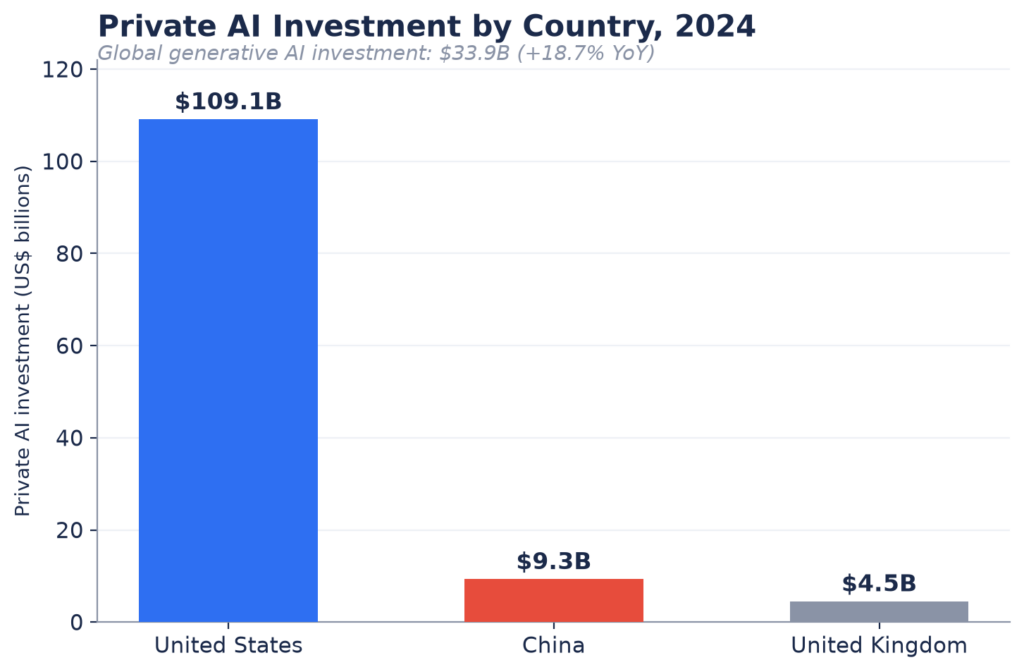
Insert here: a bar chart comparing US private AI investment ($109.1B), global GenAI investment ($33.9B), China ($9.3B), and UK ($4.5B). Caption: “Capital is uneven: US private AI investment is ~12× China’s, yet China leads on consumer adoption — 602M generative-AI users.” Source: Stanford AI Index 2025.
The Hype Narrative and Its Gaps
The hype says: humans out, machines in, cost to zero. The gaps in that story are visible if you look for them.
The hype ignores conversion decay on complex products. It ignores the disclosure burden. It ignores the fact that the biggest documented win, China’s generative-AI user base, measures adoption and acceptance, not livestream revenue. A 602 million user base tells you the soil is fertile. It does not tell you any single brand’s broadcast paid for itself.
Narratives travel faster than measurements. Your job is to keep the measurement in the room.
A Realistic Use-Case Map
Sort your livestream plan into four boxes.
- Real and worth scaling: night coverage, standardized explanation, long-tail SKU pages, FAQ loops.
- Real but watch the numbers: mid-funnel product education where some human backup helps.
- Hype dressed as reality: fully automated flagship launches, digital hosts replacing trusted sellers.
- Do not bother: high-consideration categories where trust is the product.
Most teams should live in the first box, peek at the second, and ignore the third.
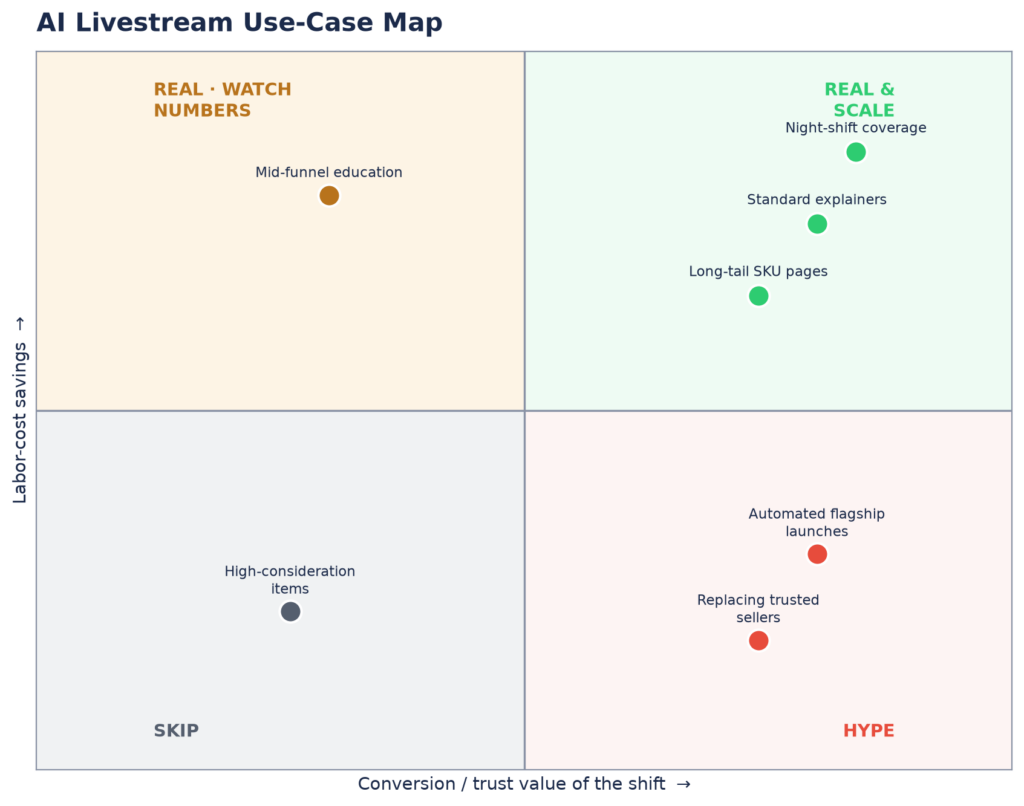
Insert here: a four-quadrant matrix. X-axis = conversion/trust value of the shift; Y-axis = labor-cost savings. Quadrants: “Real & scale” (night shift, standardized explainers, long-tail SKU); “Real, watch numbers” (mid-funnel education with human backup); “Hype” (automated flagship launches, replacing trusted sellers); “Skip” (high-consideration categories). Caption: “Most teams should live in the top-right and peek at the top-left — not the bottom.” Source: framework derived from CNNIC digital-consumption data and Stanford AI Index 2025.
Risks You Inherit With the Tech
Adopting the system means inheriting its failure modes. A script error broadcasts to everyone. A reply mismatch looks careless in public. A disclosure slip can draw a regulator’s attention rather than a customer’s thanks.
There is also the brand-risk of feeling cheap. A room that is obviously automated, poorly voiced, and lightly monitored can lower perceived quality faster than it lowers cost. The technology does not fail loudly. It fails by quietly eroding trust.
What to Pilot Before You Scale
Do not sign an annual contract on a demo. Run a controlled pilot first.
Pick one low-stakes product page. Run the digital host for the night slot only. Hold everything else constant and compare conversion, refund rate, and comment sentiment against a human-hosted baseline. Keep a human on standby to catch errors.
If the pilot holds conversion and the labor savings are real, expand one box at a time. If it does not, you have spent a week, not a budget.
The Honest Bottom Line
AI livestream in China is real, but mostly for the shifts nobody wanted to staff anyway. It is a coverage and repetition tool, not a replacement for the people who actually close the sale.
The brands that win treat it as operations, not magic: they measure displaced labor, they watch conversion, and they disclose what the law requires. The brands that lose buy the headline and discover the gap only after the invoice.
Digital hosts are here to stay. The question was never whether they work. The question is whether you deployed them where they do.