Why Retention Became Software in China — and Why the Playbook Won’t Copy
China did not invent customer relationship management. It invented a version that lives inside a chat window — and that difference now decides whether you keep a customer or keep paying to buy the same one back.
Executive summary
- SCRM in China is not a feature of CRM. It is a separate software category built on one platform’s identity graph, and it exists because the cost of re-acquiring a customer has outrun the cost of serving one.
- The measurable squeeze is documented; the famous headline numbers are not. Ad revenue in China is now growing roughly three and a half times faster than the physical-goods volume it sells against, but the widely quoted “30% a year” acquisition-cost figure has no auditable source and should be retired.
- The stack has four modules — touchpoints, content, automation, attribution — and only one of them, attribution, tells you whether the other three are worth funding. Most products sold as SCRM fail that test.
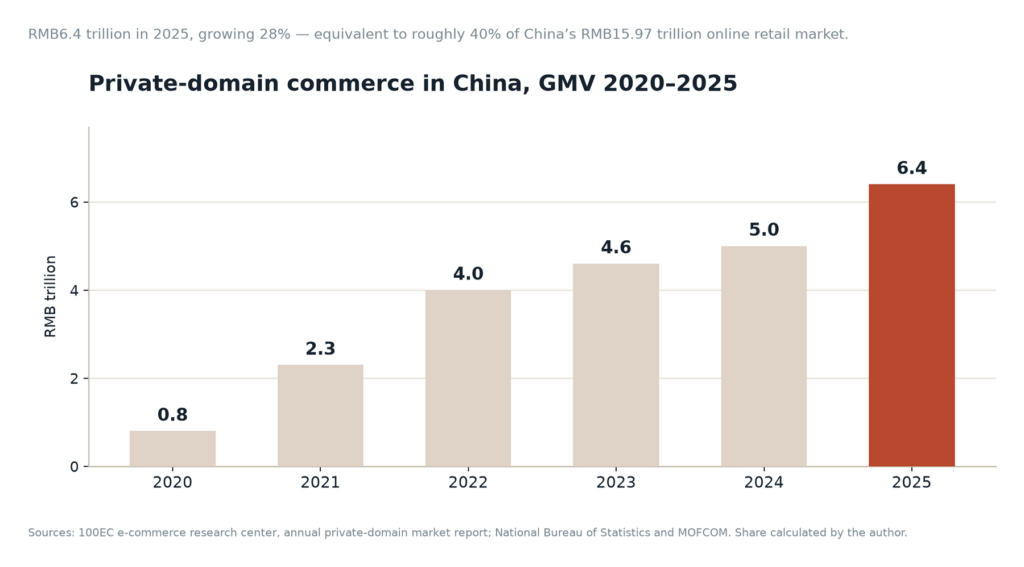
- Private-domain commerce reached RMB6.4 trillion in 2025, about forty cents of every yuan spent online in China. That is the market SCRM was built to operate. It is also the reason the category is structurally ahead of every other martech segment in the country, and why its playbook does not travel intact.
1. Why SCRM exists at all: the acquisition squeeze
Start with the arithmetic that every Chinese growth team runs in its head. You can rent an audience from a platform, or you can own a relationship with a customer. Renting is fast, priced by auction, and resets every quarter. Owning is slow, requires software, and compounds.
Two Chinese terms frame everything that follows. Gongyu (公域) is rented traffic on platforms you do not control. Siyu (私域) is an audience a company can reach directly, without paying for each impression. This article is about the software built for the second one.
For a decade, renting was cheap enough that owning looked like a hobby. That has inverted, and the inversion is visible in public numbers rather than in vendor decks.
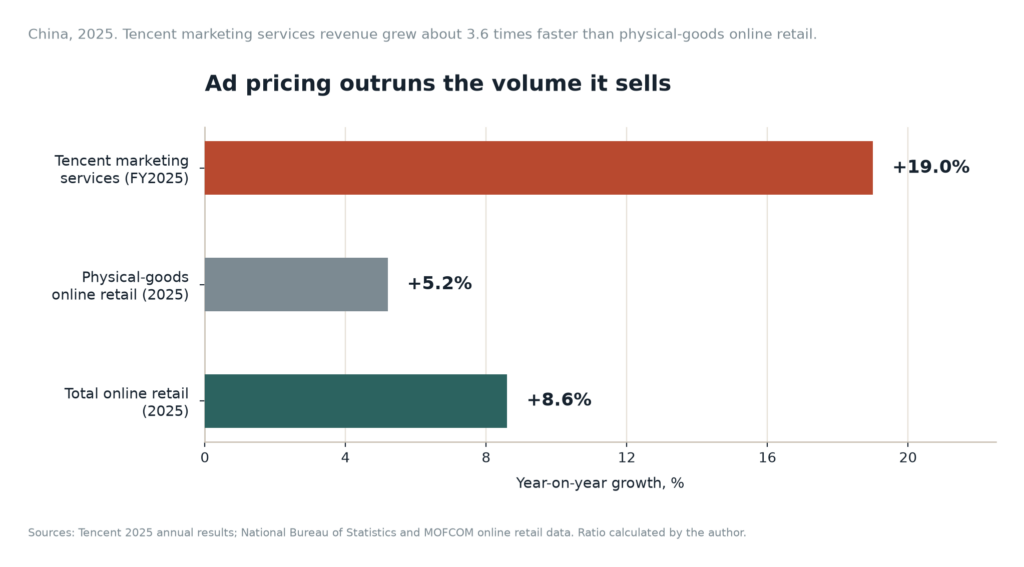
China had 1.125 billion internet users at the end of 2025, a penetration rate of 80.1% (China Internet Network Information Center, 57th Statistical Report, February 2026). There is no large pool of unconnected consumers left to harvest. When the supply of new attention stops growing, the price of attention does the adjusting. Tencent’s marketing services revenue rose 19% in 2025 to RMB145.0 billion, and the company attributed the growth to “growth in pricing and ad impressions,” with pricing helped by AI-driven targeting. Over the same year, physical-goods online retail grew 5.2% to RMB13.09 trillion. Advertising revenue therefore grew roughly three and a half times faster than the physical volume it was selling against.
That gap is the whole argument. It does not require a dramatic annual percentage to be true. It only requires that the cost of a marginal acquired order rises faster than the order’s margin. At 5.2% volume growth against double-digit ad-price growth, that is what the data shows. Budget pressure makes it worse rather than better: Gartner’s 2025 survey of 402 marketing leaders put budgets at 7.7% of company revenue, flat year over year, while the martech field those budgets buy from has swollen to 15,384 products. Same money, more vendors, higher auction prices.
Which brings us to a number you have probably seen. Many decks and listicles claim that the cost of acquiring customers on rented platforms in China rises more than 30% a year. I went looking for the primary series behind that claim and could not find one: no statistical release, no audited filing, no research report with a published methodology. What exists is a chain of blog posts citing each other. The direction is right; the decimal is folklore. Treat it as a metaphor, not a metric, and you will make better decisions than the people quoting it.
The strategic consequence is simple enough to state in one line: when the marginal cost of re-buying a customer exceeds the marginal cost of serving one, retention stops being a campaign and becomes infrastructure. Infrastructure means software, and in China that software has a name.
2. The four modules, and the one that decides everything
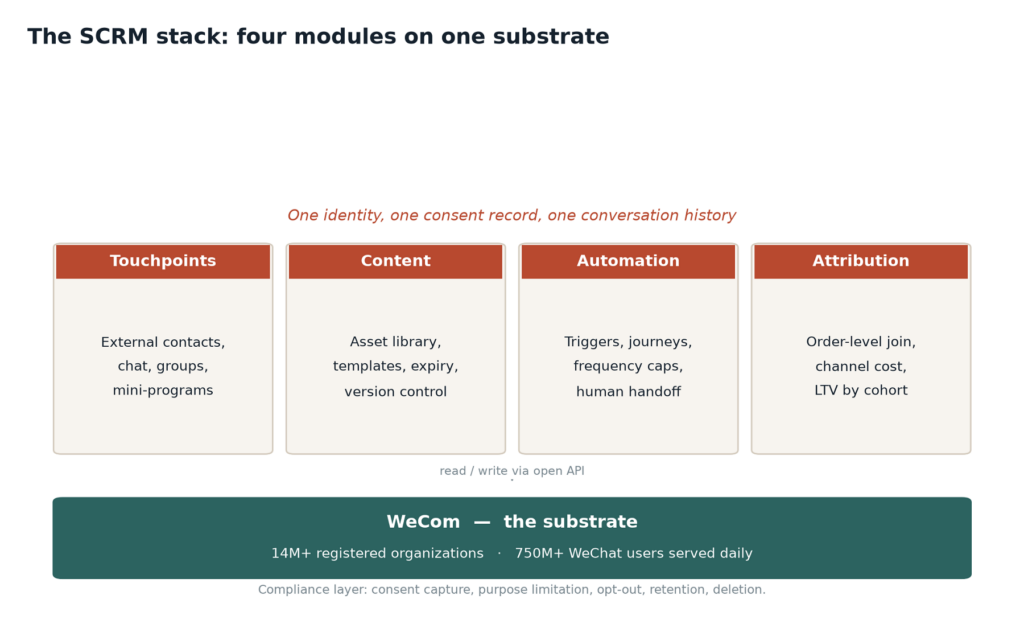
SCRM is commonly described as “CRM with social features,” a comparison about as useful as calling a car a carriage with an engine. The category has a specific architecture, and four modules define it. If a product is missing one, it is not SCRM; it is a chat add-on with a monthly invoice.
Touchpoints. A persistent, addressable, one-to-one channel to people outside your company, with a stable identity that survives staff turnover. In China this is WeCom’s external-contact layer: individual chats, customer groups, moments, and mini-programs. The test is not “can you send a message.” It is “can you prove, two years later, that this person consented to receive it.”
Content. A governed library of assets — offers, articles, product cards, scripts — with versioning, approval states, and expiry dates. Expiry sounds bureaucratic until a regulator asks why a promotion with an outdated claim was still circulating in a sales rep’s saved replies.
Automation. Triggers, journey logic, frequency caps, suppression rules, and the handoff to a human. The interesting part is not the flowchart. It is the suppression: knowing when not to send is what separates a system from a spam cannon.
Attribution. The join between a conversation and an order, then between an order and the channel cost that produced it. This is the module everyone skimps on and the only one that answers the question the CFO actually asked.
Here is the practical filter. Ask a vendor to produce a cohort repeat-purchase curve, net of discount and returns, joined to acquisition channel and campaign. If the answer involves the words “modeled,” “estimated,” or “assisted,” you are looking at a messaging tool. That is fine — but price it as a messaging tool.
3. WeCom is the substrate, not the product
Every stack has a floor. In China the floor is WeCom, Tencent’s enterprise communication product, and its scale is the reason the rest of the category can exist.
At its August 2025 product launch, WeCom disclosed that more than 14 million enterprises and organizations had registered on the platform, and that businesses were serving more than 750 million WeChat users through it every day. WeChat itself reported 1.418 billion combined monthly active accounts at the end of 2025, up 2% year over year. Put those two facts together: a company-run channel reaches roughly half of the world’s largest consumer graph every day, without asking anyone to install a second app.
The architectural details matter more than the headline scale. WeCom issues an identity that is the customer’s existing WeChat account, so there is no registration funnel to lose people in. It exposes external contacts, customer groups, and moments through an open API, which is what made a third-party software industry possible. It also offers conversation archiving for compliance, and Tencent’s own developer documentation spells out the setup: archive scope, network addresses, an encryption key — and a disclosure page that affected employees see when they log in.
That last point is the part foreign observers usually miss. Archiving is not a surveillance feature bolted on afterward; it is a sanctioned, disclosed, contractually governed record-keeping layer. Once chat history is a system of record, chat stops being a channel and becomes part of the customer database. That is what a substrate does.
4. The vendor landscape, and a number I deleted
Concentration in this market is structurally likely, for four unglamorous reasons. Platform certification and API access are gated and reviewed. Compliance surfaces — archiving, consent records, redaction, retention — are expensive to build and audited by customers’ legal teams. Enterprise implementations are labor-intensive and local. And the integration work with order systems, ERPs, and warehouses is bespoke in a way that rewards incumbents with reference architectures.
None of that tells you that the top vendors hold 75% of the market, although you will find that figure repeated across Chinese content mills. I traced it. It appears in SEO listicles and “tested ranking” articles, always unsourced, sometimes contradicting itself within the same paragraph. A separate report-resale document puts the top five at roughly 40%. Two claims, thirty-five points apart, neither with a methodology. I dropped both. If a market-share number cannot survive a request for its denominator, it does not belong in a budget meeting.
What can be said with confidence is that the vendor field splits into three archetypes with different economics.
| Archetype | What it sells | Where it wins | Where it breaks |
|---|---|---|---|
| Certified platform ISV | Pre-built modules on WeCom’s API, priced per seat or per contact tier | Speed to launch, compliance plumbing already built | Differentiation collapses when the platform ships the same feature |
| Vertical suite | Industry workflows — clinics, education, auto dealerships — with SCRM attached | Deep process fit, higher switching cost | Slow to adapt when regulation changes across sectors |
| In-house build | Internal platform on raw APIs plus a warehouse | Full control of data model, consent policy, attribution | Underestimates maintenance; compliance updates land on your team |
The honest signal for scale is disclosure. Only a handful of vendors publish audited revenue, and their numbers are small relative to the market because most of the value sits in implementation services rather than licenses. Anyone claiming a precise national share is guessing, and usually selling something.
5. Pricing models and the trap in each one
Chinese SCRM pricing has four moving parts, and buyers routinely negotiate three of them.
Per seat. Simple, predictable, and quietly punitive for service teams that grow. Watch for the definition of a seat: read-only analytics users are often billed at full rate.
Per contact tier. The list is the billing meter. This model punishes exactly the behavior the software is supposed to encourage, so negotiate tiered bands with a cap and a written definition of what counts as an active contact — archived, blocked, and deleted contacts should not count.
Per module. Content, automation, and archiving sold separately. Reasonable in principle, but archiving is a compliance requirement, not an upsell, and pricing it as an add-on tells you something about the vendor’s priorities.
Consumption. SMS credits, AI tokens, storage, and outbound message packs. This is where budgets leak, because it is variable, invisible in the demo, and often uncapped in the contract. Ask for unit prices, monthly ceilings, and an alert threshold in writing.
Then add the two lines that never appear in the quote: implementation and integration, and exit. A three-year total cost of ownership looks like this, and you should fill it in before you sign anything:
3-year TCO = (seats × seat price × 36) + (tier fees) + (consumption × volume × unit cost) + implementation + integration + migration-out cost
That last term is the one nobody asks about. If exporting your contact list, consent records, and conversation archive at the end of the contract requires professional services at day rates, you do not own your customer data. You are renting it with extra steps.
6. The 60–70% repurchase rate, taken apart
Now the claim that does the most work in Chinese private-domain sales decks: private-domain repurchase rates of 60–70%, against 15–25% for platform retargeting. It is repeated everywhere. It is also, as stated, unusable — not because it is necessarily false, but because it is unfalsifiable. Four mechanisms manufacture numbers like this.
The denominator disappears. Repurchase rate is often calculated on the subset of users who bought at least once. The 90% who never converted are excluded, which turns a 6% business-wide repeat rate into a 60% “loyalty” metric.
The window is chosen after the fact. A 30-day repeat window in a category with a 90-day replenishment cycle will look terrible; a 12-month window in the same category will look wonderful. Whoever picks the window picks the result.
Channel attribution is generous. Orders placed after a chat conversation get credited to the sales rep, even when the customer originally arrived from a platform ad. The private domain then appears to convert better than the platform that actually found the person.
Survivorship is baked in. Accounts that left the group, deleted the contact, or stopped responding are dropped from the panel, and the surviving cohort is reported as the average.
So what can be said with verified data? In 2025, private-domain commerce in China reached RMB6.4 trillion across roughly 680 million users, according to the 100EC e-commerce research center’s annual private-domain dataset. Divide one by the other and you get just under RMB9,400 of annual private-domain spend per user. That is a basket-size statement about a large, maturing channel. It is not a loyalty rate, and no amount of repetition turns it into one.
If you want a number you can defend, build these four instead:
- Cohort repeat rate at 90 and 180 days, measured from first order, with non-buyers included in the denominator.
- Contribution margin per cohort, after discount, returns, and service cost — because a 60% repeat rate achieved with permanent 40%-off coupons is a subsidy, not retention.
- Incremental conversion against a holdout group. Without a control, you are measuring enthusiasm.
- Contact decay. How many external contacts delete you per month? In a chat-native channel this is a hard, visible signal, and it is the most honest satisfaction metric the stack produces.
A vendor who can produce a cohort curve is selling you a system. A vendor who can only produce a percentage is selling you a slide.
7. Compliance: consent is now a supply-chain gate
Chinese retention software operates inside one of the world’s more demanding data regimes, and the regime got more specific in the last two years. Three laws form the frame — the Cybersecurity Law, the Data Security Law, and the Personal Information Protection Law — and two implementing rules changed how marketing actually works.
The Regulations on the Security Management of Network Data, in force since January 1, 2025, do three things that matter to a retention team. Article 22 governs consent mechanics: consent may not be obtained through misleading, fraudulent, or coercive means; sensitive categories require separate consent; repeated consent requests after a clear refusal are prohibited; and fresh consent is needed when the purpose, method, or category of processing changes. Article 42 addresses automated decision-making directly — a platform that pushes information to individuals through automated decisions must provide an easily understood, easily accessible switch to turn off personalized recommendation, and must let users delete the personal-feature tags behind it. Article 62 defines a “large network platform” as one with 50 million registered users or 10 million monthly actives, which triggers additional duties including an annual public report on personal information protection.
The second rule is fresher and, for outbound marketing, sharper. The Provisions on the Administration of Short Message Services, issued as Ministry of Industry and Information Technology Order No. 74 in February 2026 and effective May 1, 2026, put the burden of proof on the sender. Article 21 requires the message sender to supply the carrier with evidence of the recipient’s consent or request before a commercial message is transmitted — and if the sender cannot, the message is not sent. Article 22 requires an easy, effective opt-out communicated in the message itself, with no obstacles placed in the way. Article 23 forbids re-sending after a refusal. Article 24 requires senders to maintain internal systems and technical measures governing the timing and frequency of commercial messages.
Read those four articles together, and the design implication is unavoidable: consent is no longer a checkbox on a landing page. It is a record with evidence, scope, and an expiry date, and it has to be queryable at the moment of send by every module in your stack. Which means the consent ledger is not a compliance document. It is a database table, and it sits upstream of automation.
Data localization follows the same logic. If your SCRM vendor stores conversation archives outside mainland China, the cross-border transfer is yours to justify, not theirs — through a security assessment, a standard contract filing, or certification. Ask where the archive physically lives before you ask about features, and put the answer in the contract.
One more thing worth saying plainly, because it is where well-meaning teams get hurt: archiving is a consent product. Enabling it without a disclosure flow to employees, and without telling customers what is recorded, converts a compliance asset into a liability with a paper trail.
8. What foreign brands genuinely cannot copy
Here is where the argument usually goes soft. People say China’s private domain works because Chinese consumers like group chats, which is both condescending and wrong. The real barriers are structural, and there are five of them.
One identity graph. In China, the same account is the login, the chat handle, the payment method, the mini-program session, and the content subscription. In Western markets, identity is scattered across email addresses, phone numbers, cookies, app IDs, and retail loyalty cards. Stitching them together is a data-engineering project with a legal risk attached. Retention software works better when identity is free.
Social adjacency. Group chats make referral a native action rather than a campaign. The customer who brings a neighbor is not responding to an incentive program; they are forwarding a link in a conversation that already exists.
Payment inside the conversation. WeChat Pay closes the loop without a redirect. Every redirect is a place where attribution and conversion both leak.
A regulator that permits the record. Chat-based service is not merely tolerated; it is archivable, disclosable, and contractually governed. That is what allows a conversation to function as a system of record, which is the precondition for measuring retention at all.
No email spine. Email is a weak channel in Chinese consumer life, so the CRM history that Western companies keep in email lives in chat instead. The channel and the database are the same object.
The transferable lesson is narrower than the playbook being sold. Retention software needs two preconditions: a platform-owned identity that customers actually use, and a compliance forcing function that makes record-keeping mandatory. Where both exist, a private-domain stack makes sense. Where one is missing, you are buying a messenger.
9. Build versus buy, decided by what changes
The build-versus-buy debate usually collapses into cost comparisons, which is the wrong axis. The right question is what changes, and how often.
Build the parts that encode your own policy. The consent ledger, the event schema, the attribution join, the cohort models, and the handoff rules between automation and humans — these are the components that express how your business actually works, and they are the only durable differentiation you will have. No vendor can define what an active customer means for your business.
Buy the parts that change when the regulator changes. Channel connectors, archiving infrastructure, retention and redaction tooling, content-expiry engines, and anything that requires platform certification. Vendors absorb platform API churn and compliance updates; you should be paying them for exactly that, not for a database table you could own.
Two caveats keep this honest. First, integration labor dominates both options: the license is rarely the biggest line item, and the team that stitches order data to conversation data is a permanent cost. Second, a build decision made without a maintenance budget is a decision to accumulate debt quietly. Price the annual compliance refresh before you choose.
10. A reference stack that survives an audit
If you are assembling this from scratch, here is a configuration that holds up when someone asks how you know what you know. Nothing in it is exotic; the discipline is in the interface contracts.
| Layer | What it holds | Build or buy | The interface that matters |
|---|---|---|---|
| Identity and consent | Customer ID, channel identity map, consent records with evidence, purpose, scope, expiry, revocation | Build | Every other layer queries consent before acting |
| Channel | External contacts, groups, moments, conversation archive | Buy (certified ISV) | Must export contacts, consent, and history on exit |
| Content | Assets, versions, approval states, expiry dates | Buy the library, own the taxonomy | Only approved and unexpired assets are sendable |
| Orchestration | Triggers, journeys, frequency caps, suppression, human handoff with SLA | Buy or build | Suppression is global, not per-campaign |
| Data and attribution | Event stream, order join, cohort marts, channel cost | Build | Writes channel-level results back into planning |
Three rules keep this coherent. One identity per person, no duplicates per channel. One consent record, checked at send time, not at import time. One suppression list, shared by every module — because the fastest way to lose a customer is to have four teams each believe they are being tasteful.
The anti-pattern to avoid is the one that emerges quietly: four modules, four contact lists, four definitions of an active user, and a quarterly meeting where nobody can reconcile the numbers.
11. The scorecard, and the red flags
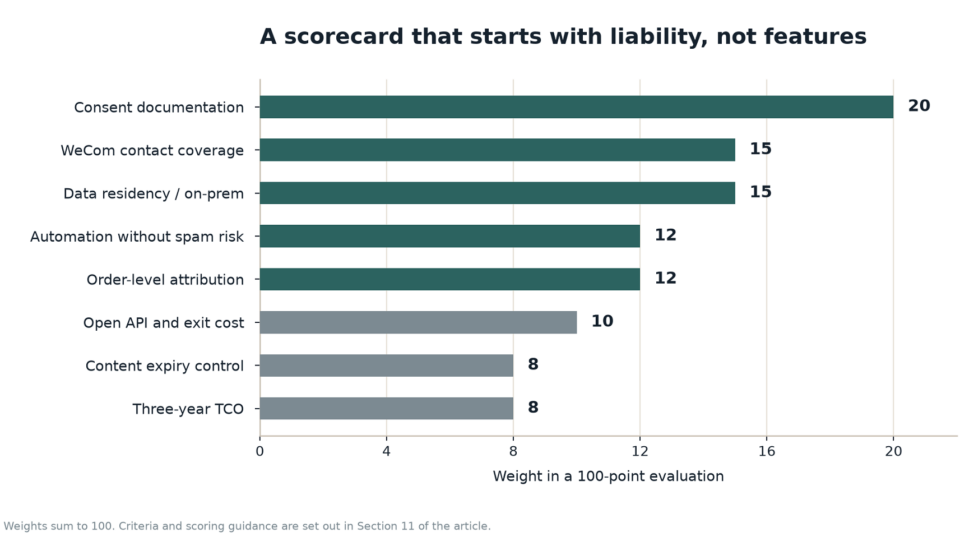
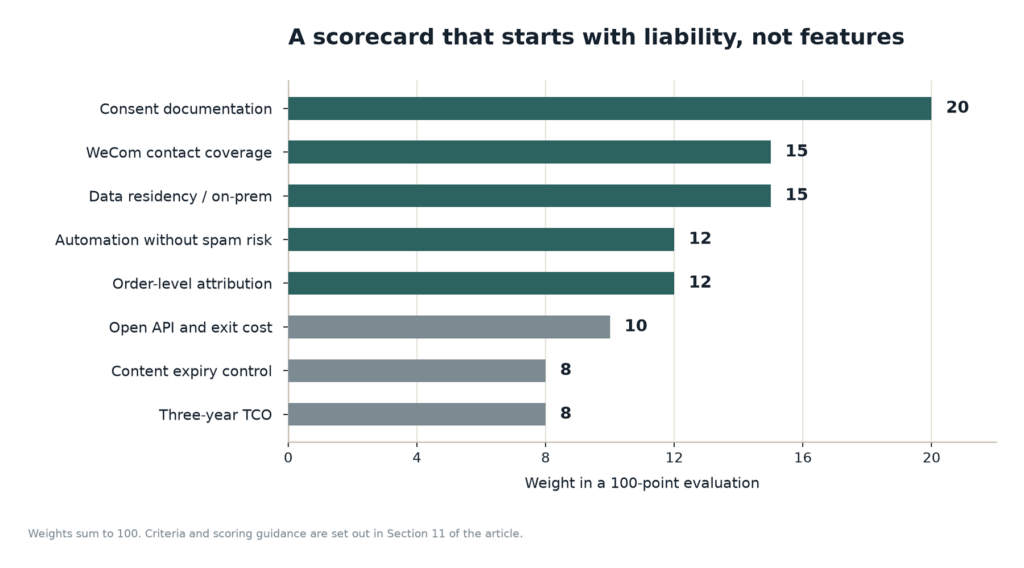
Feature comparisons are easy and mostly useless, because the feature lists converged years ago. What differentiates vendors now is liability handling and exit cost. The scorecard below weights eight criteria to 100 points, and it deliberately starts with the least glamorous one.
| Criterion | Weight | What a 5 looks like |
|---|---|---|
| Consent and consent-record provenance | 20 | Per-purpose records with timestamp, channel, evidence, expiry and revocation; exportable; enforce at send |
| WeCom-native contact and chat coverage | 15 | Full external-contact, group and moments API coverage; graceful handling of platform changes |
| Data residency and on-premise option | 15 | Mainland hosting by default; documented transfer mechanism; deletion on exit |
| Automation depth without spam risk | 12 | Global frequency caps, suppression, escalation to human with SLA |
| Order-level revenue attribution | 12 | Deterministic join to orders, returns and channel cost; cohort reporting |
| Open API and exit cost | 10 | Full export of contacts, consent, content and archive at no professional-services fee |
| Content library and expiry control | 8 | Approval states, expiry enforcement, claim-level versioning |
| Three-year total cost of ownership | 8 | Capped consumption, published unit prices, no seat creep on read-only users |
Six red flags, any one of which should stop a procurement: no consent export; attribution described as “modeled” rather than joined; per-contact pricing without a cap; archiving sold as an add-on with no disclosure flow; archive storage outside the mainland with no transfer mechanism; and a contract silent on data deletion at termination.
Score honestly, and most shortlists shrink. That is the point. In a category where the switching cost is your customer history, a bad selection is not a wasted license — it is a two-year detour.
12. What 2027 will actually test
Forecasting this market is a popular sport with a poor record. Still, five developments look structural rather than fashionable, and each one moves budget.
Consent becomes a cross-channel gate. The consent-evidence requirement that reached commercial SMS in May 2026 will be extended in spirit to app push, voice calls, and in-app messaging. Teams that built a consent ledger once will adapt in a sprint; teams that treated consent as a form will rebuild their outbound stack.
Agents get metered. AI drafting and AI-initiated outreach are already normal. What changes next is pricing and permission: platforms will meter automated sends and rate-limit them, and frequency caps will migrate from nice-to-have to contractual. The teams that win are the ones whose automation knows when to stay silent.
Attribution moves to order level or dies. Closed-loop measurement inside the super-app is improving, and it is being priced — Tencent’s own disclosure credits closed-loop marketing capability inside WeChat for part of its ad pricing power. Once the platform can prove the order, “assisted” attribution loses its budget.
The vendor field consolidates around compliance and data. Feature parity is gone as a selling point. What is left is who can carry liability and who can move data without breaking it, which favors fewer, more boring vendors.
Pricing shifts from seats to outcomes, with caps. Expect more consumption pricing and more outcome-linked components, negotiated with ceilings. Buyers who learned to cap tokens and message packs in 2026 will be the ones who benefit.
And one thing that will not change: the ceiling on automation is set by users, not by tooling. In a chat-native channel, an annoyed customer does not scroll past you — they delete you, permanently, and the deletion is visible in your own dashboard. That is a harsher constraint than any unsubscribe rate, and it is the reason the best private-domain operations in China look less like marketing and more like service.
What would change my mind. If WeCom’s external-contact reach plateaued while open rates held, or if platform ad pricing flattened against volume growth, the economic case for owning the relationship would weaken and the category would revert to a channel. Neither is happening in the data I can see. Watch those two series — they are the whole thesis in two lines.
The short version
Retention became software in China because renting attention got expensive at exactly the moment the audience stopped growing. SCRM is the software that resulted: four modules on a chat substrate that supplies identity, history, and a compliance surface. The category is structurally ahead of its peers elsewhere not because Chinese marketers are cleverer, but because the country built a single identity graph, a payment loop inside the conversation, and a regulator willing to make records mandatory.
Everything else — the vendor rankings, the 60% repurchase rates, the 75% concentration figures — is noise generated by people selling software. Strip it out and the argument survives. That is usually a good sign.
Frequently asked questions
Is SCRM just CRM with a chat app attached?
No. A CRM stores records about customers; SCRM operates a live channel to them and treats the conversation as part of the record. The practical difference is consent: SCRM cannot function without a per-person, per-purpose permission trail, because the channel is regulated and the customer can leave with one tap.
Can a company outside China run the same playbook?
Partly. The four-module architecture transfers; the substrate does not. Without a platform-owned identity that consumers already use for payments and content, plus a compliance regime that makes archiving standard, you end up with a messaging tool and a separate CRM. That is a legitimate stack — it is just not this one.
What does a mid-market SCRM deployment actually cost?
License fees are the visible part and rarely the largest. Budget for implementation and integration first, then consumption (messages, AI credits, archive storage), then seats. Ask for a three-year total cost of ownership with capped consumption and a written exit price, and compare vendors on that single number.
Is the 60–70% private-domain repurchase rate real?
Not as usually stated. The figure depends on which customers are counted, which window is used, and which channel receives credit. A defensible version exists — cohort repeat rate at 90 and 180 days including non-buyers — and it is almost always lower than the number in the deck. Ask for the cohort curve.
Do we have to archive conversations to do attribution?
No, and conflating the two is a common mistake. Attribution needs an order-level join and a stable customer identifier; archiving is a separate compliance decision with its own disclosure obligations. Plenty of teams do solid cohort analysis without retaining message content, and some are legally better off for it.