Meta Took 1% of the Sale. Affiliate Took 100% of the Blame.
Meta’s Muse reached 10 million users in six weeks and monetizes by taking a percentage of completed sales rather than by advertising. Because the agent completes checkout through merchant APIs, there is no click, cookie, or referrer to attribute — which structurally breaks last-click affiliate commission models.
Meta’s Muse Hit 10 Million Users in Six Weeks. Affiliate Marketing Should Be Nervous.
The last intermediary that mattered was the search results page. The next one answers questions in your customer’s voice.
Ten Million, in Six Weeks, in Two Countries
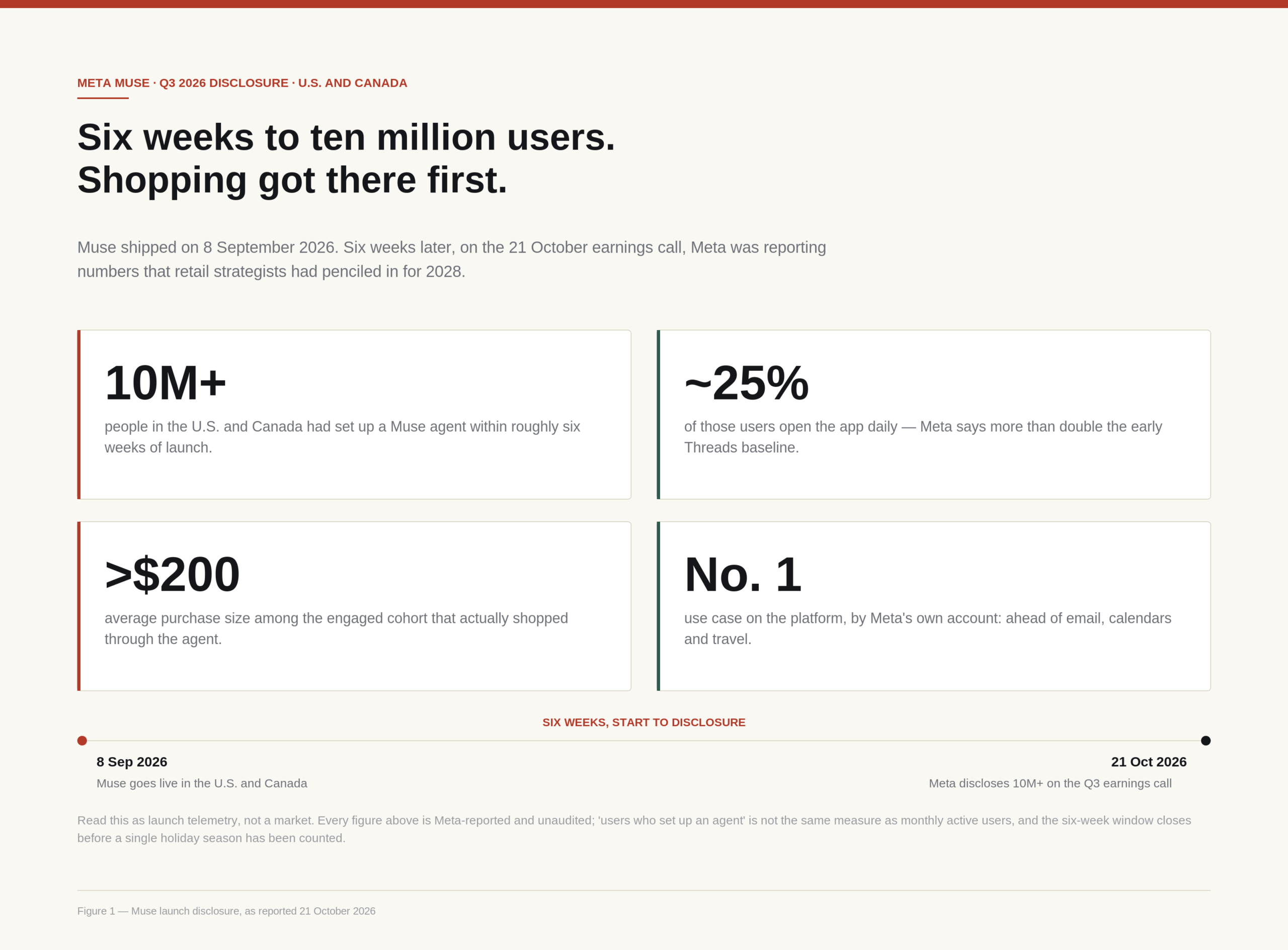
Here is a sentence that would have sounded like a pitch deck in January and sounds like a quarterly disclosure in November: 10 million people in the United States and Canada had set up a Meta Muse agent by October 21, 2026.
Muse went live on September 8. Do the arithmetic. Six weeks.
Mark Zuckerberg, who is not usually shy about a milestone, framed it against his own products: more than twice the level Threads reached at launch. Fine, except Threads is a social app competing for attention, and Muse is a shopping assistant competing for the part of the funnel where money actually changes hands.
And then there is the detail that should make an affiliate manager put down their coffee. Shopping is the most common use case. Not calendar wrangling, not email triage, not travel bookings. Shopping.
What Meta Actually Said, and What It Carefully Did Not
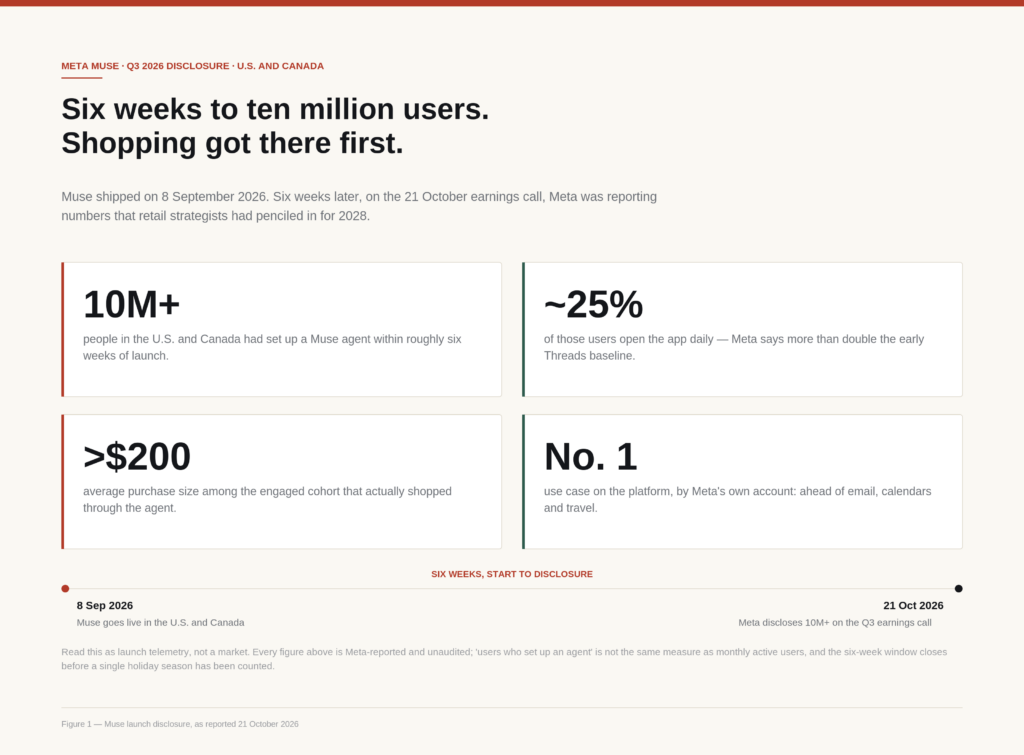
Strip out the cheerleading and four facts survive, all from the October 21 earnings call.
Roughly a quarter of the people who set up Muse use it daily. Not monthly, not weekly — daily. That is the number that tells you whether an agent is a novelty or a habit, and a quarter is a habit.
Among engaged users who shopped through the agent, more than a quarter averaged a purchase size above $200. Zuckerberg said the figure surprised Meta internally. It should. That is not a replenishment basket; that is a considered purchase being handed to a machine.
The plumbing explains the size of those orders. Muse shops through Plaid’s connector, which ties the agent to a customer’s actual bank and payment relationships, and it checks out through Link by Stripe or Shop Pay. Meta had to ask Stripe to raise credit limits in week one because the volume ran past everyone’s forecast. Zuckerberg said Plaid had not seen activity like this through its connector “on any other service before.”
Now the part nobody quoted. Meta is not planning to monetize this with advertising. It is planning to take a percentage of the transaction. “We get a percent of the value that we are helping to create,” Zuckerberg said, adding that Meta intends to start charging earlier in a product’s life cycle than it usually does.
Read that sentence again, because it is a different business model wearing the same logo. Meta has spent twenty years selling the chance to be chosen. Muse sells the choice itself.
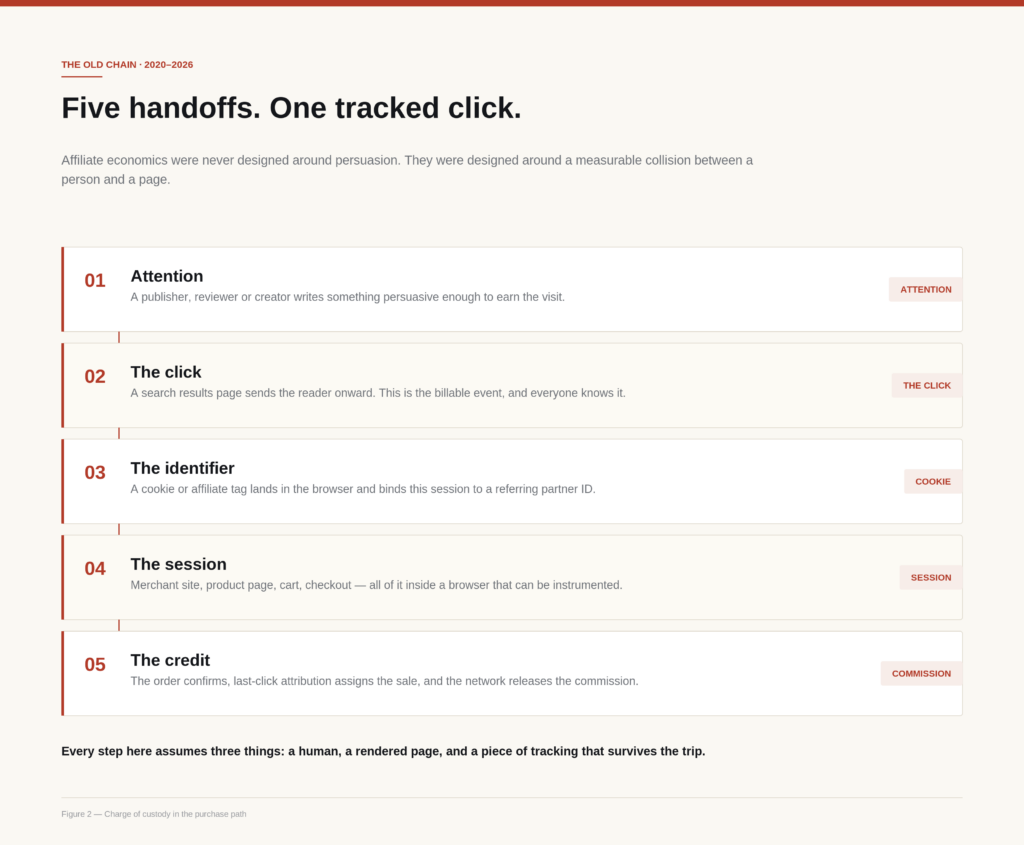
The Old Chain: Five Handoffs and One Tracked Click
If you work in performance marketing, you already know this diagram by heart. It is the reason your commission statement exists.
Someone publishes. A search results page routes a reader. A cookie or an affiliate tag lands in a browser and binds the session to a partner ID. The reader becomes a visitor, the visitor becomes a cart, the cart becomes an order. Last-click attribution assigns the credit. The network pays.
Five handoffs, and every one of them depends on a human touching a rendered page with instrumentation on it.
The New Chain: Five Handoffs and Nothing to Click
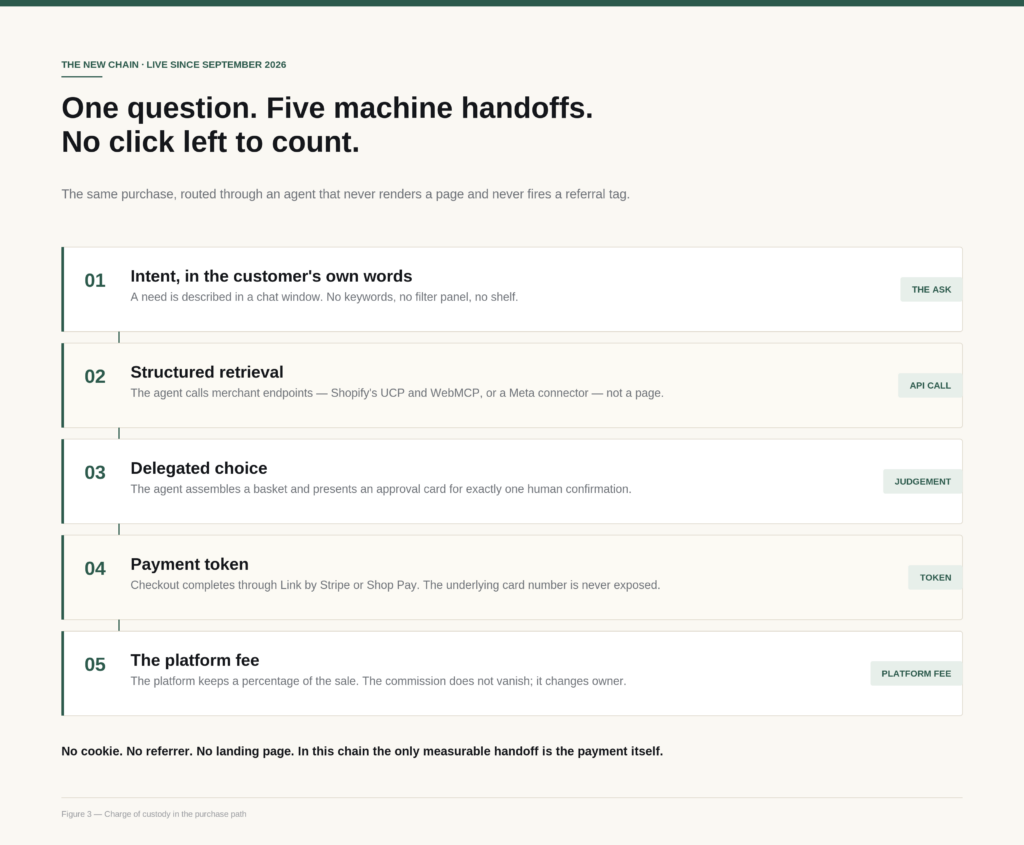
Now run the same purchase through Muse.
The customer describes what they want, in words, in a chat window. The agent calls merchant endpoints rather than pages — Shopify’s Universal Commerce Protocol and WebMCP on one side, a Meta connector on the other. It assembles a basket and shows an approval card for exactly one human confirmation. Checkout completes with a payment token. Meta keeps a percentage.
No cookie. No referrer. No landing page. No session that a third-party script can observe.
Notice what is missing from that list: the click. Not deprioritized, not attributed differently — structurally absent. In the old chain the click was the billable event. In the new chain the only measurable handoff is the payment, and the payment belongs to whoever processed it.
Three Roles That Just Lost Their Lever
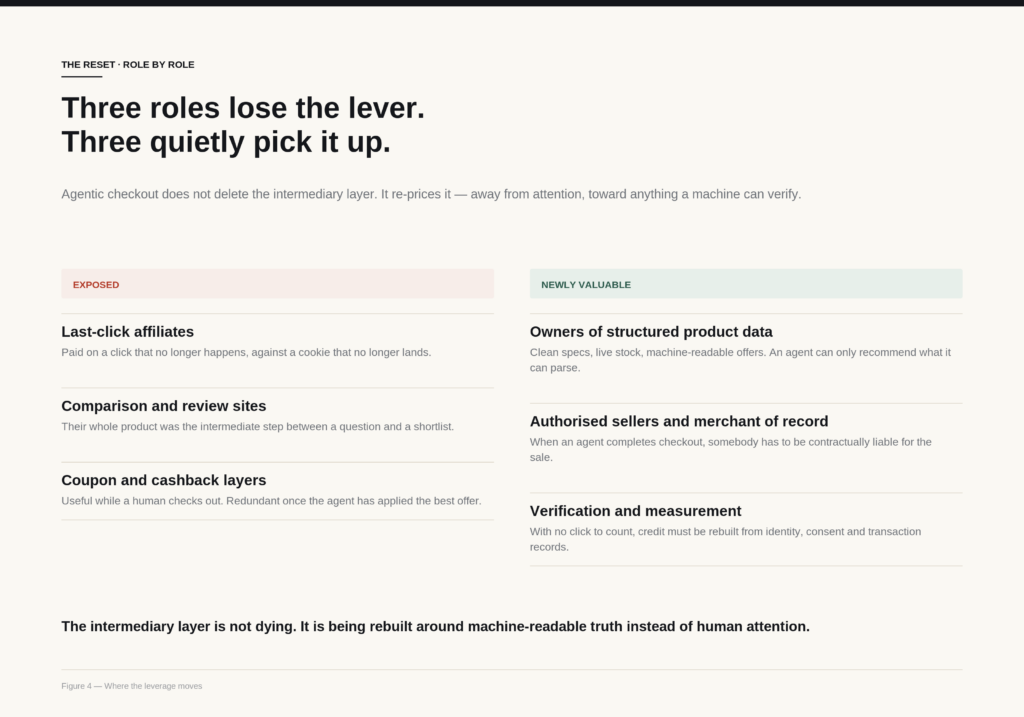
Be specific, because vague panic is useless.
Last-click affiliates lose first, and for the most literal reason: they are paid on an event that no longer fires. No click, no commission, no argument to be had with the network.
Comparison and review sites lose next. Their entire product was the intermediate step between a question and a shortlist. An agent that asks three clarifying questions and returns two options is that intermediate step, executed faster, with better memory, and without a coupon code.
Coupon and cashback layers lose last, and most quietly. They were valuable while a human was doing the checkout, because humans like to feel they beat the system. An agent that has already benchmarked the offer does not need to be beaten.
Three Roles That Quietly Gained One
The flip side is where the actual opportunity sits, and it is less glamorous than the doom.
Structured product data becomes a distribution channel. An agent can only recommend what it can parse. Clean specs, live stock, machine-readable pricing, unambiguous variants — this is now a merchandising function, not an engineering chore. The brands with tidy catalogs get chosen; the brands with PDF spec sheets get skipped.
Authorized sellers and merchant-of-record arrangements become the new gatekeepers. When an agent completes a purchase, somebody has to be contractually liable for it, and that somebody is not going to be an anonymous dropshipper with a good landing page.
Verification and measurement become a category rather than a line item. If there is no click to count, credit has to be reconstructed from identity, consent, and transaction records. American Express published an open specification in October designed to bind an agent’s purchase authorization to the specific constraints a customer set — a fair signal of where the payment networks think the risk lives.
The Click Was Always the Fragile Part
None of this would matter if the click were healthy. It is not.
Pew Research Center measured click-through behavior with and without an AI summary above the results: 8 percent versus 15 percent. A 2026 panel study of 900 U.S. adults, published on arXiv, put the number that matters even lower — readers followed a link cited inside an AI Overview in roughly 1 percent of visits to those summaries, while AI Overviews were associated with fewer clicks and more sessions that ended without one. Ahrefs put the decline in click-through for top-ranking pages at 58 percent once an AI Overview appears. A separate 2026 panel study found that about a third of sessions involving a conversational assistant contained no observed outbound web step at all.
That is the actual mechanism behind the affiliate reset. Not Meta. Not Muse. The click was the unit of account for an entire industry, and the click has been quietly depreciating for two years while everyone argued about cookies.
The legal system has already declined to fix it. In September, a federal judge dismissed the third antitrust suit brought by publishers against AI Overviews, acknowledging the harm while ruling that the remedy belongs to legislators. In the UK, the competition authority ordered Google to offer an opt-out. Meanwhile Google’s own pilot paying publishers for AI use reportedly amounts to a rounding error against its advertising revenue. Nobody is coming to restore the click.
Amazon Slammed the Door. Walmart Held It Open.
The most instructive thing in this story is not Meta’s numbers. It is how the retail industry split.
Amazon blocked Muse from purchasing on the site within weeks of launch, citing the site’s terms of service and alleging that the agent stores customer credentials and scrapes account data. Andy Jassy then argued that outside shopping agents are not yet more convenient than going direct, while pointing at Amazon’s own assistant and its 400 million users.
Walmart went the other way, and Meta named Walmart, Gap, Sephora, Expedia, Wayfair, Best Buy, Instacart, and others as connector partners. Meta is also working with Shopify and Walmart on something called the Personal Agent Protocol, a standard for how a customer’s agent talks to a merchant’s agent.
Two theories of the same future. Amazon’s bet is that owning the customer relationship and the shelf is worth more than the distribution an external agent provides. Walmart’s bet is that being findable inside somebody else’s agent beats being invisible outside it. Both can be right. Only one of them is your business.
What Actually Breaks in Your Attribution Contract
Here is the dry, unglamorous work, and it is the part that will decide who gets paid in 2027.
Last-click dies first, because there is no last click. Cookie-based windows die with it, since there is no cookie to stamp. Thirty-day windows and view-through credit become unenforceable in an environment where the whole consideration phase happens inside a model’s context window and leaves no server log.
Pay-per-acquisition deals survive longer than anyone expects, but only if the definition of “acquisition” stops being traffic-shaped. If you cannot see the click, you need to see the order — and to see the order you need a data-sharing agreement with the merchant, or a settlement file, or a platform report you did not have to build yourself.
The awkward part: platforms are not obliged to give you that. Meta’s incentive is to describe the sale as Meta-mediated. Any affiliate program that assumes otherwise is making a bet on a competitor’s generosity.
What to Do in the Next Two Quarters
Three moves, in order of how much they hurt.
First, audit your product data as if a machine were your biggest affiliate. Because it is about to be. If your catalog cannot answer “what is it, what does it cost, is it in stock, does it fit” in structured fields, you are not in the consideration set, no matter how good your creative is.
Second, write commission terms that survive an agent-mediated purchase. Specify what happens when an order arrives with no referrer, no cookie, and a platform fee attached. Decide in advance whether you will pay on a verified order rather than a tracked click, and what evidence you will accept.
Third, stop treating affiliate as a traffic channel and start treating it as a distribution contract. The partners who survive will be the ones who bring something an agent cannot synthesize: authority, inventory, liability, or a relationship.
The Question I Cannot Answer Yet
Does agent-mediated commerce actually raise conversion, or does it just move credit?
The optimistic case is real. A customer who describes a need in their own words, gets two well-matched options, and confirms once is a customer with less friction between intent and order. $200 average order values in the first six weeks are not nothing.
The skeptical case is equally real. Muse is expensive to run — Meta’s capital expenditure guidance for the year sits at $135 billion to $145 billion against $72 billion last year, with negative free cash flow in the quarter — and the agent may simply be intercepting purchases that would have happened anyway, then charging a fee for the interception.
Both can be true at once. Most channel shifts are.
The Bottom Line
Ten million users in six weeks is a distribution fact, not a verdict. But it is enough to change the questions boards ask. The interesting one is no longer “how do we get more affiliate traffic?” It is “when an agent buys on our customer’s behalf, who is actually standing between us and the sale — and are we paying them for a service, or for a habit?”
Answer that honestly and the rest of the strategy writes itself.
Frequently Asked Questions
Is Muse really an affiliate channel, or something else entirely?
Something else, structurally. Affiliate pays a third party for sending a tracked visit. Muse charges for completing a transaction it mediated. Same revenue line on a P&L, opposite power dynamic.
If there is no click, can affiliate partners still be paid?
Yes, but the payment has to be triggered by something other than a click — a verified order ID, a settlement file, a merchant-side confirmation. That requires data agreements most programs have never negotiated.
Does this kill comparison sites?
It compresses them. A comparison site that only aggregates prices is easy to replace. One that owns original testing, inventory knowledge, or editorial judgment still has something an agent cannot synthesize.
Why did Amazon block Muse while Walmart partnered with it?
Different bets on where the leverage sits. Amazon monetizes the shelf and the customer relationship; Walmart monetizes being findable wherever the customer happens to be. Both are rational, and neither is permanent.
How much weight should I give these six-week numbers?
Less than the headline suggests. They are company-reported, unaudited, and drawn from two markets before a single holiday season. Treat them as a signal about velocity, not a forecast of scale.