Prada Is Advertising That a Human Drew It. That’s the Strategy Now.
Prada Is Advertising That a Human Drew It. That’s the Strategy Now.
The most interesting thing about Prada’s new Christmas film is the sentence it doesn’t say out loud.
Not one frame of “Drawing Prada” mentions artificial intelligence. There is no disclaimer, no knowing wink, no little badge boasting that humans made this. Prada simply hired John Pomeroy — the animator who walked out of Disney with Don Bluth in 1979, drew The Secret of NIMH, and later supervised John Smith in Pocahontas — and let him work in pencil. Then it left the pencil marks in the film.
That is the whole move. Not a protest. A receipt.
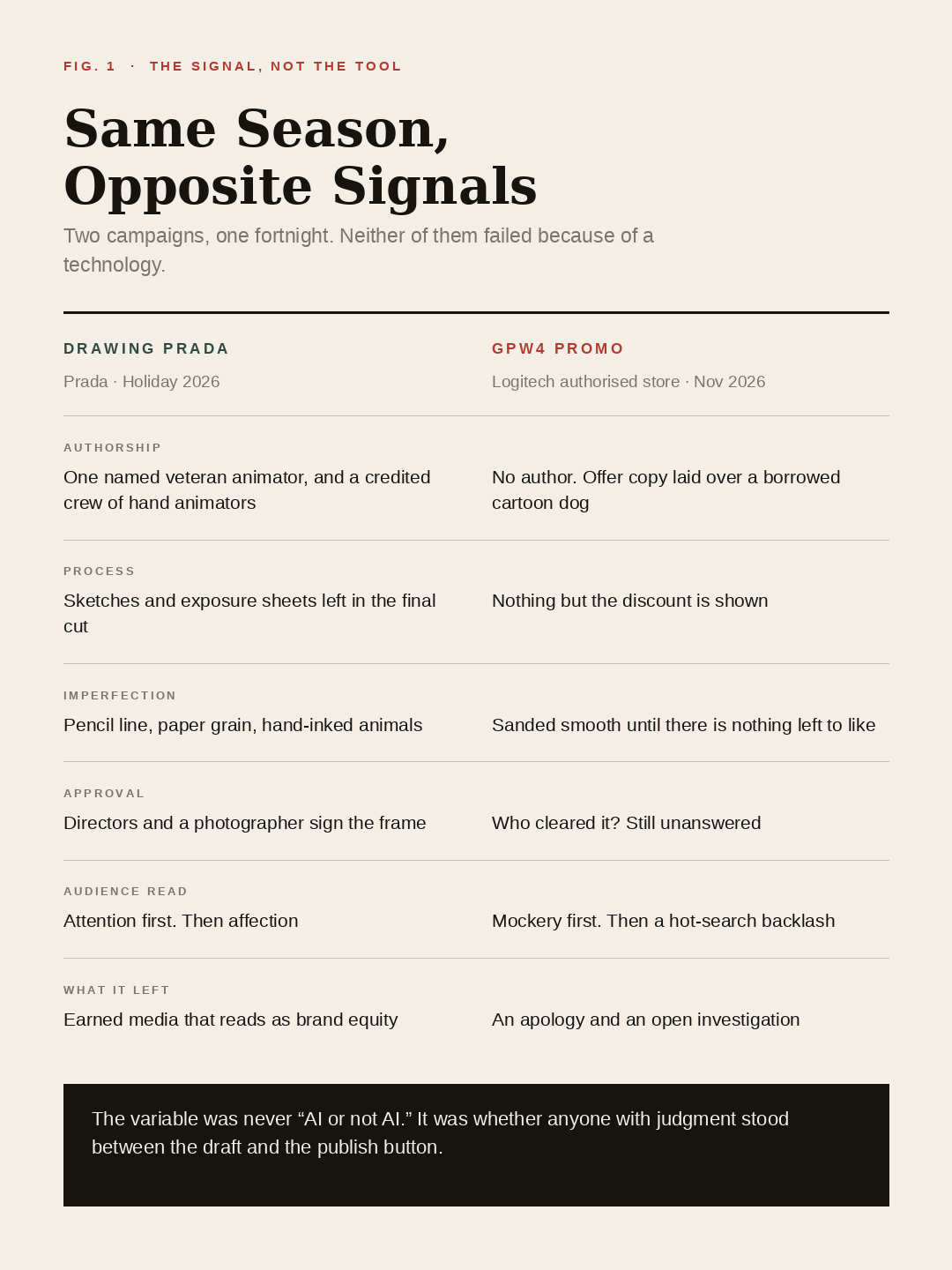
Two Campaigns, the Same Fortnight
Two very different pieces of commercial work arrived in front of the same audience within days of each other.
Prada released a holiday campaign built the slow way: hand-drawn animation by a crew led by Pomeroy and Tom Bancroft, live-action plates shot by Glen Luchford, and a cast that includes Sadie Sink, Maya Hawke, Kelvin Harrison Jr., Chen Haoyu and Luther Ford. Unusually, the finished work keeps the scaffolding — rough graphite drafts, exposure sheets with frame numbers pencilled in the margins, animators’ camera notes. The audience is invited to see the labour, not just the result.
On 2 November, a Douyin account called “Logitech G Audio-Visual Flagship Store Official” posted a promo for the GPW4 Suzaku gaming mouse. A cartoon dog waves off a 100-yuan discount: “not interested, thanks.” Then the price drops to 40% off, the dog’s eyes light up, and the caption reads “看人真准” — roughly, “you really know how to read people.” Chinese gamers read it the other way round: as a brand saying customers only show up when something is cheap.
The video is gone now. The store said it had launched an investigation and that Logitech China “always respects every player”. Logitech China said it was looking into the matter urgently. No verdict, no explanation. Seven months earlier, a different authorised store had posted a GPW3 promo with the line “the moment I cut the price, don’t you come running like a dog.” The company apologised, blamed an employee who skipped the review process, and the operator was later fined 200,000 yuan by Shanghai’s Jing’an market supervision authority.
What Prada Actually Bought
Two things, and neither is nostalgia.
The first is authorship. A named animator with fifty years of credits is a different proposition from “creative team”. It gives the audience somebody to be impressed by and somebody to hold responsible. Attention has an object.
The second is scarcity. You cannot scale a pencil. That is not a limitation Prada is apologising for; it is the asset. Luxury has always sold the arithmetic of “not everyone can have this”, and hand-drawn animation makes that arithmetic visible on screen.
The Logitech Video Is Not an AI Story
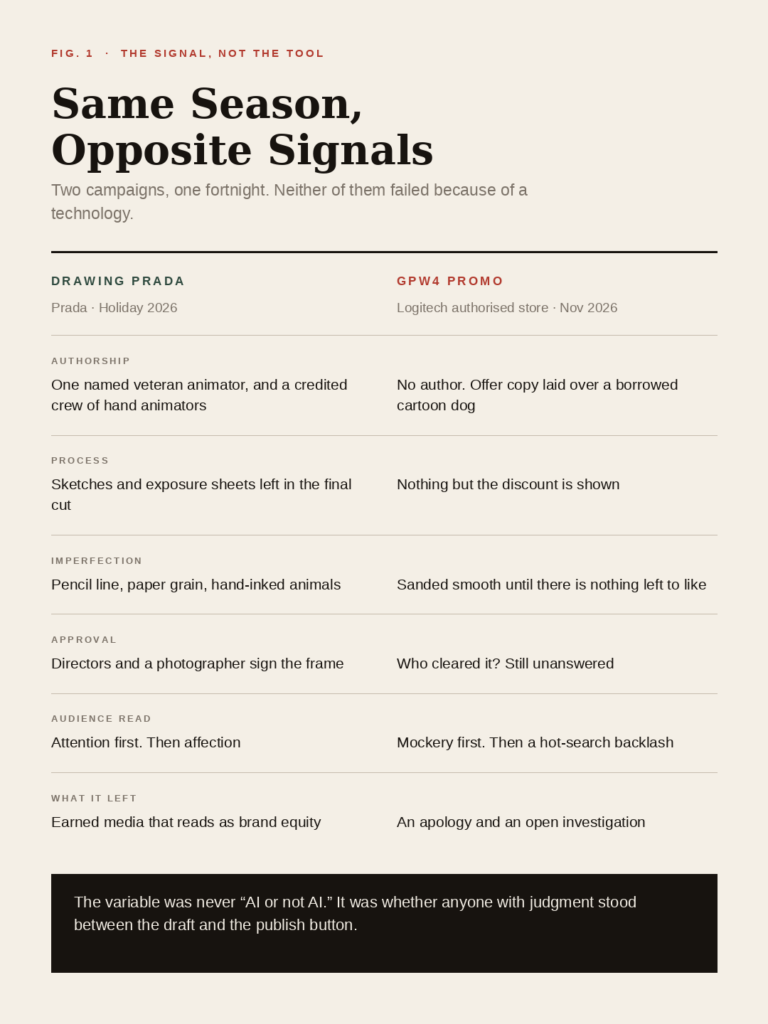
I want to be precise here, because the lazy version of this article writes itself and it would be wrong. Nobody credible has accused that promo of being AI-generated. It appears to be a borrowed cartoon dog, a discount and a caption — assembled by a person, badly.
Nobody alleged a model made it
So the usual “AI slop” frame doesn’t apply. If you file this under automation, you learn the wrong lesson and fix the wrong thing.
The economics are identical, though
Here is what does rhyme. One asset, many storefronts, an authorised operator with no equity link to the brand, a discount calendar to feed, and nobody in the last chair whose job was to say no. That is the same production logic that produces machine-made content: maximum output, minimum authorship, review treated as a formality.
Call it slop without a model. The tell isn’t the tool. It is the absence of a person who could have stopped it.
How People Actually Spot Machine Work
Audiences are not running detectors. They are using a much older instrument: the feeling that something was made too easily.
Texture
Real material has friction. Paper grain, an uneven pencil line, skin that catches light imperfectly. Generated surfaces tend to be uniformly clean — not ugly, just unmarked. People cannot usually name what is wrong. They just stop believing it.
Repetition
The giveaway is often consistency in the wrong place. The same jaw on four faces. The same rhythm in every sentence. The same three adjectives doing all the work. Human work repeats too, but it repeats unevenly, because attention drifts.
Uncanny polish
When everything is equally sharp — the foreground, the background, the thing you were supposed to look at and the thing you weren’t — the eye reads it as depthless. Craft is mostly the discipline of deciding what to blur.
This Is a Disclosure Problem Wearing a Quality Costume
Here is the trap. Most brands respond to this moment by trying to make AI output look handmade. That is the worst of the available options, because it converts a production choice into a small deception, and deception is what audiences actually punish.
The rules are catching up with that instinct. China’s measures on labelling AI-generated content took effect on 1 September 2025 and require explicit and implicit marking, with duties split between providers, platforms and users who publish. The EU AI Act’s transparency duties for synthetic media fall due on 2 August 2026, the Act’s general application date. In the US, the FTC’s position is blunter and older: using AI to mislead people is simply illegal, and no tool grants an exemption.
Notice what none of these require. None of them requires your work to be good. They require it to be disclosed. Quality is a craft problem. Disclosure is a governance problem. Brands keep solving the first and losing on the second.
The Human-Trace Checklist
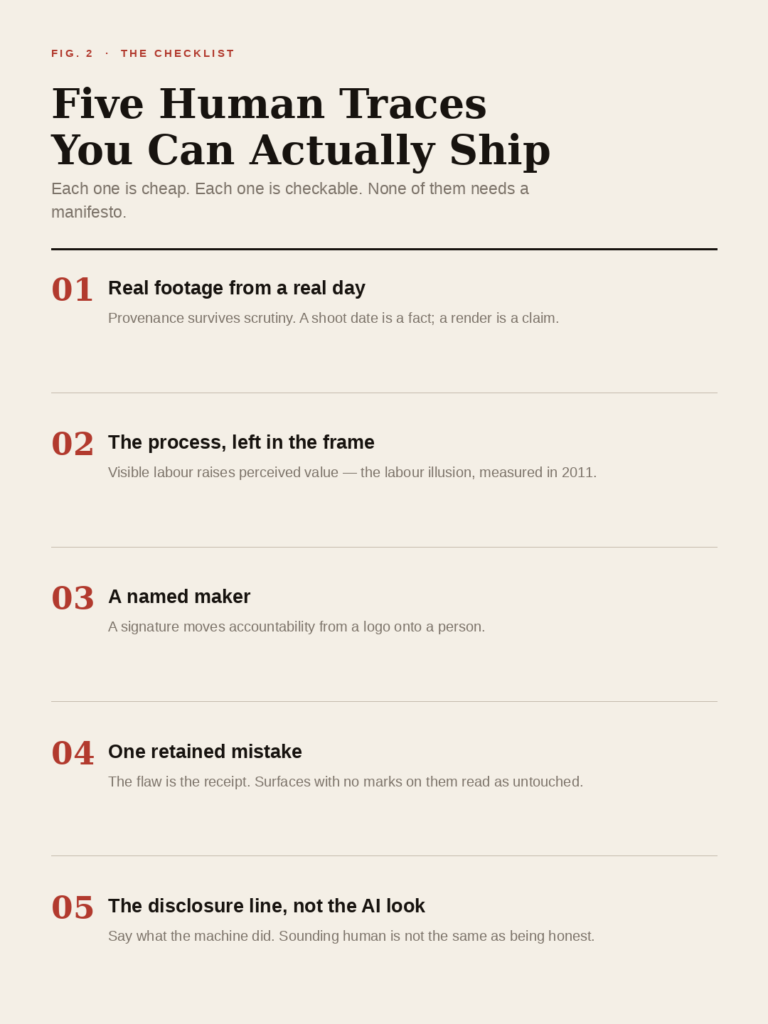
Five things you can add to a brief this quarter. Each is cheap, each is checkable, none requires a manifesto.
1. Footage from a real day
Book the shoot. Stamp the date. Provenance survives scrutiny because it is a fact rather than a claim, and, in an era of synthetic media, a verifiable date becomes a feature you can market.
2. The process, left in the frame
This is the labour illusion, and it has been measured: a 2011 Management Science study by Ryan Buell and Michael Norton showed that making operational work visible raises the value customers perceive. Prada is running that play at luxury scale by putting exposure sheets into the edit.
3. A named maker
A signature moves accountability from a logo onto a person. It also gives the audience a reason to care, which is rarer than it sounds.
4. One retained mistake
The flaw is the receipt. A wobbling line, an unplanned shadow, a sentence that could have been tidier — these are the marks that tell a viewer someone was present and made choices.
5. The disclosure line, not the AI look
Say what the machine did. Sounding human and being honest are different objectives, and audiences have started to notice which one you optimised for.
Where AI Still Wins, and Should
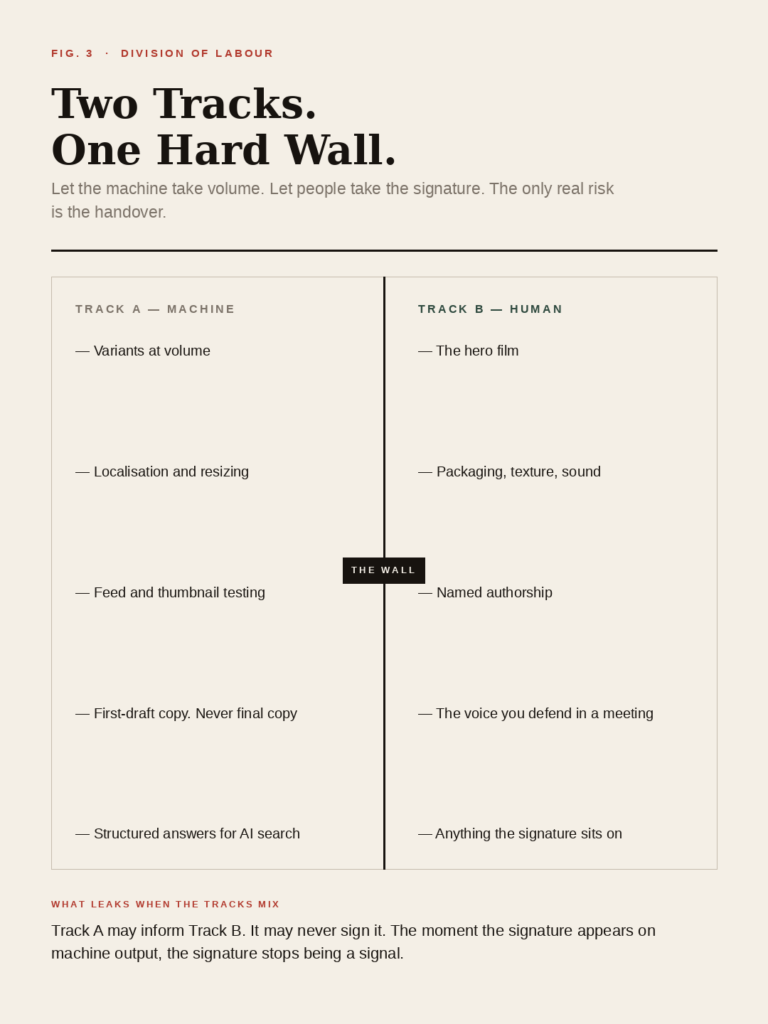
Pretending otherwise is how agencies lose budgets and credibility. Machines are genuinely better at volume: forty variants of a headline, eleven languages of a landing page, a hundred thumbnails to test against a feed, a first draft nobody will defend. They are also now the interface through which a growing share of buyers first meet your brand, which means structured, quotable, well-sourced answers matter more than another hero image.
Keep the tracks apart
Track A is production volume. Track B is the thing your brand signs. Staff them separately, budget them separately, and give them different approval rules.
The contamination rule
Track A may inform Track B. It may never sign it. The moment the signature appears on machine output, the signature stops being a signal — and you have spent the only asset this strategy has.
Buyers are feeling it from the other direction too. In the IAB’s September 2026 ad spend outlook, “AI slop” entered the list of top investment challenges for the first time, at 38%, based on a survey of more than 200 brand and agency decision-makers.
One Paragraph on Tone
A word about how to talk about all this. Whoever cut that Logitech video is probably not the villain of the story. More likely a contractor on a deadline at a storefront with a quota. The animators Prada hired are freelancers who answered a phone call. If your commentary punches down at whoever happened to be holding the mouse, you are reproducing the exact failure you are criticising — treating people as content. Critique the work. Name the decision. Leave the individual alone.
What to Do on Monday
Name one signer per asset, and put their name in the file. Give one human the authority to say no, and make that authority real by using it once in public. Log AI use per asset the way you log licences. Audit authorised storefronts before your legal team has to. And stop asking whether the work looks human. Ask who would defend it in a room.
FAQ
Can audiences really tell the difference, or is this wishful thinking?
Mostly they cannot diagnose it, and they do not need to. What they register is effort and intent — whether someone was present. That is why a slightly rough hand-drawn frame reads as more trustworthy than a flawless render.
Does using AI automatically damage a premium brand?
No. Concealment does. Plenty of luxury work uses AI in invisible places — retouching, variant generation, translation. The damage comes from presenting machine output as authored craft, because that is a claim about provenance, not a matter of taste.
Our budget doesn’t stretch to a Disney veteran. What is the cheap version?
Document what you already do. Film the factory floor, keep the rejected sketch in the layout, print the maker’s name on the box. Process footage is the cheapest premium signal available, and most brands throw it away in the edit.
Isn’t “human-made” just the new artisanal labelling?
It can become that, and it will if brands treat it as a sticker. The difference between craft and craft-washing is whether the claim survives a check. A named animator, a dated shoot and published sketches all survive. A badge that says “human” does not.
Where does this leave performance marketing?
Exactly where it was. Two tracks. Let machines chase the marginal click; keep the signature for the few assets that carry the brand. The mistake is believing the same team, the same rules and the same clock can do both.