INSIGHT — The Economics Behind the Brand Measurement Trap: Why Cutting the Tracker Feels Like Winning
Every CFO who has ever cut a brand tracker did it for a reason that looked, on paper, impeccable. The survey costs six figures. The dashboard it feeds hasn’t changed a decision in two quarters. Meanwhile, performance channels report revenue daily. Cut the tracker, keep the ads, book the saving. What could go wrong?
Almost everything, it turns out — and the failure isn’t a mistake. It’s an incentive structure.
The Accounting Asymmetry
Here’s the mechanism. The cost of measurement is immediate, visible and denominated in cash. The cost of not measuring is delayed, invisible and denominated in demand that never forms. Brand-building effects compound over years; budget reviews run on quarters. Every short review cycle therefore votes for the cut, because the harvest still looks fine while the planting quietly stops.
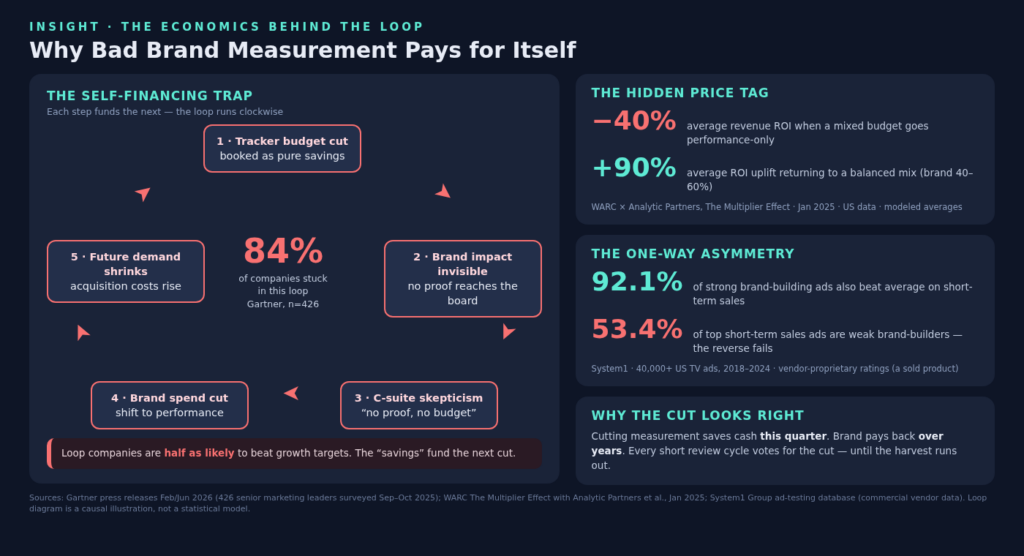
Gartner’s 2026 research gave this machine a name — the brand “doom loop” — and a prevalence: 84% of companies are stuck in it, per a survey of 426 senior marketing leaders. The loop runs: weak measurement → unclear impact → C-suite skepticism → budget cuts → weaker measurement. Companies inside it are half as likely to beat their growth targets. The saving funds the next cut. The trap is self-financing.
The Price Tag Nobody Invoices You For
The loop’s output is now quantified. WARC’s Multiplier Effect study with Analytic Partners (US data, January 2025) found that shifting from a mixed budget to performance-only cuts total revenue ROI by 40% on average — while moving back to a balanced mix lifts it by roughly 90%. You don’t see this bill in any quarter. It arrives disguised as rising acquisition costs: you’re paying to convert people who were never planted.
Why the Wrong Cut Always Looks Right
The cruelest part is the asymmetry in the ad evidence itself. System1’s database of 40,000-plus US TV ads (2018–2024) shows 92.1% of strong brand-building ads also beat average on short-term sales — but among the best short-term sellers, 53.4% are weak brand-builders. Brand ads do both jobs; sales ads mostly do one. (System1 sells these ratings, so treat the exact percentages as vendor testimony — the direction, though, matches the IPA’s independent databank findings.) So the quarter after you cut brand, sales hold. The dashboard applauds. The evidence for the cut is real — it’s just borrowed from the planting you did two years ago.
The Exit Is Boring, Which Is Why It Works
Nobody escapes by arguing that brand is magic. They escape by making the invisible ledger visible: stage-by-stage metrics, share of search as a free leading indicator, and a translation layer that turns brand movement into the revenue language the C-suite already speaks. Measurement isn’t a cost center defending itself. It’s the only instrument that prices the future — and the loop is what happens when you pawn it.