Great Marketing Runs on Boring Documents
Your best marketer just resigned. Two weeks later, the team is stuck on a campaign she used to run in her sleep — not because anyone forgot the password, but because the judgment walked out the door with her. Which audience to lead with, which approval to skip, which number actually mattered: none of it was ever written down. It lived in her head, and now it’s gone.
That’s the real cost of running marketing on heroics. Most teams rebuild the same launch, the same event, the same quarterly push from scratch every single time, because the knowledge exists only as memory and muscle reflex. The teams that scale don’t hire more geniuses. They write down the genius they already have — into a library of standard operating procedures, or SOPs: reusable templates that turn one person’s hard-won judgment into everybody’s baseline. Think of an SOP library as strategy, written down. The rest of this piece is about why that’s the highest-leverage boring work you’ll ever do, and how to build it without turning your team into a paperwork factory.
Why Heroics Don’t Scale
Let’s put a number on the problem, because “it’s inefficient” doesn’t move a budget.
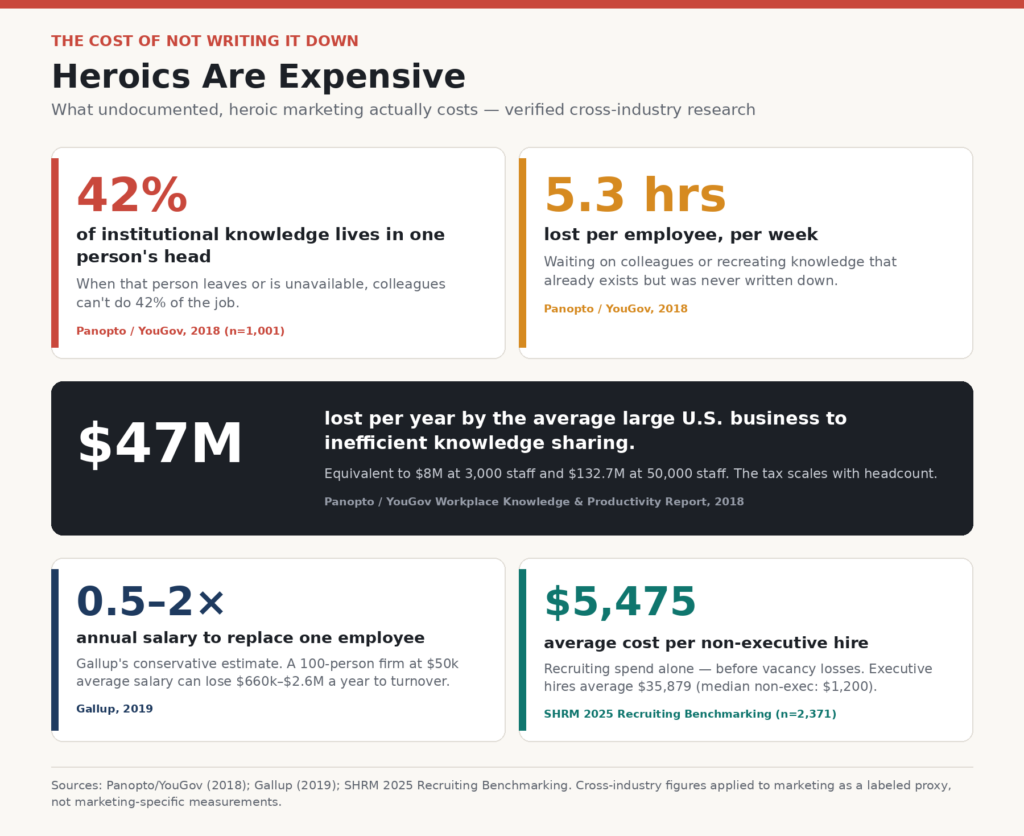
When process lives in one person’s memory, the team is hostage to retention. Every departure is an amnesia event. The Panopto Workplace Knowledge and Productivity Report, a 2018 study of 1,001 U.S. employees run with YouGov, found that 42% of institutional knowledge is unique to the individual — acquired for their role and shared by no one else. When that person leaves or is simply unavailable, colleagues can’t do 42% of the job. Read that again. Nearly half the work depends on knowledge that exists in exactly one head.
The day-to-day bleed is just as concrete. The same study found employees lose 5.3 hours a week either waiting on colleagues for information or recreating knowledge that already exists but was never captured. That’s not a marketing figure — it’s cross-industry — but if you’ve ever watched a teammate rebuild a launch checklist that someone wrote last year and then left, you know the tax is real. Panopto put the average large U.S. business’s annual loss from inefficient knowledge sharing at roughly $47 million.
Turnover makes it worse, and turnover is expensive on its own. Gallup’s conservative estimate is that replacing one employee costs one-half to two times their annual salary, and it puts the total toll of voluntary turnover at roughly $1 trillion a year across U.S. businesses. SHRM’s 2025 Recruiting Benchmarking report puts the average cost-per-hire at $5,475 for a non-executive role — and that’s recruiting spend alone, before you count the empty seat. So when your hero leaves, you pay twice: once to replace the body, and again while the replacement slowly re-learns what the hero knew by heart.
There’s a quieter cost, too: the ramp. Panopto found that while the average new hire gets about 2.5 months of formal training, it can take up to six months to ramp up fully — with as much as 3.5 of those months spent learning the job alone, hunting for information, and inadvertently redoing work that already exists. A library of templates is the difference between a new hire who contributes in weeks and one who spins for a quarter. You’re not just retaining knowledge; you’re compressing the time it takes to transfer it.
The reframe is simple: an SOP library is knowledge-retention infrastructure. It’s marketing’s version of a compounding asset, where process accumulates value instead of evaporating every time someone updates their résumé.
The Reinvention Tax Is Mostly Invisible
Here’s why this stays broken: the cost never shows up as a line item. Nobody invoices you for “rebuilt the same campaign brief for the fourth time this quarter.” It hides inside hours that look like work.
Adobe’s 2025 global content study, as reported by Forbes, found that 58% of marketers say 41% of their content-creation time — roughly 25 minutes of every hour — goes to administration, reviews, and approvals, and nearly 90% of teams run at least three approval stages before anything ships. That’s a marketing-specific number, and it’s damning. Almost half the hour is spent coordinating the work rather than doing it. A shared brief, a single named approver, and a launch checklist don’t just tidy things up; they claw back those 25 minutes.
Zoom out and the pattern holds. McKinsey Global Institute’s “The Social Economy” research estimated that the average interaction worker spends 28% of the workweek on email and nearly 20% hunting for internal information or tracking down the colleague who knows the answer. Crucially, MGI found that a searchable record of knowledge can cut the time spent searching by as much as 35%. (That study dates to 2012, so treat the exact percentages as directional — but the mechanism hasn’t aged a day.) The point isn’t the precise figure. It’s that “where did we put that?” and “who decided that?” are a tax you pay every week, and documentation is the one lever that reliably shrinks it.
What Actually Belongs in the Library
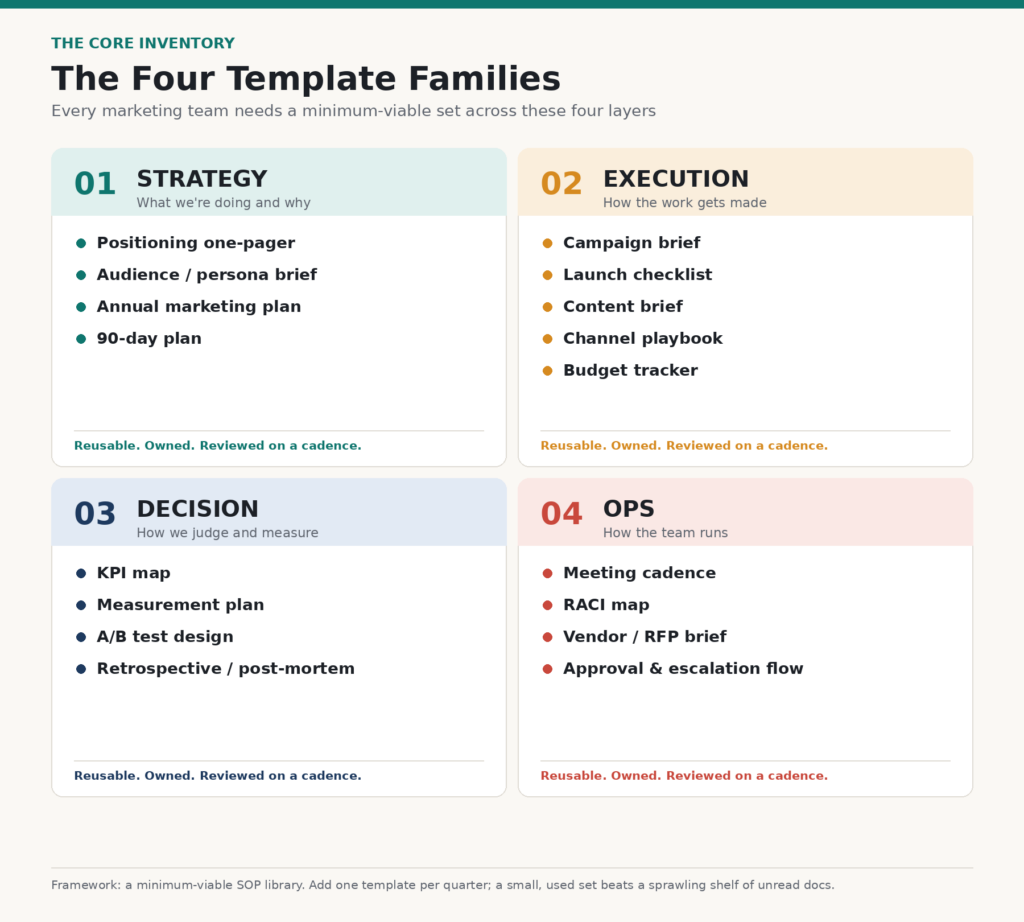
You don’t need a hundred templates. You need a minimum-viable set across four families. Get these right and you’ve covered the decisions a marketing team makes over and over.
Strategy Templates: The Decisions You Shouldn’t Re-Make
These capture what you’re doing and why so nobody re-litigates it every quarter: a positioning one-pager, an audience or persona brief, the annual plan, and a 90-day plan. The test is simple — if a new hire can’t tell who you’re for and what you’re trying to move, this layer is missing.
Execution Templates: The Work, Made Repeatable
This is how the work gets made: the campaign brief, the launch checklist, the content brief, the channel playbook, the budget tracker. These are the documents people touch daily, which is exactly why they carry the most leverage. A great campaign brief forces the hard choices up front, so execution stops being a negotiation.
Decision Templates: How You Judge What Worked
These encode how you measure and decide: a KPI map, a measurement plan, an A/B test design, and the retrospective or post-mortem. Without them, “did it work?” becomes a matter of opinion and whoever argues loudest. With them, judgment is something the team can reuse, not re-derive.
Ops Templates: The Machine That Runs the Machine
The unglamorous layer that keeps everything else honest: meeting cadence, a RACI map (who’s responsible, accountable, consulted, informed), the vendor or RFP brief, and your approval and escalation flows. Skip this and even brilliant strategy templates die in handoff limbo.
What Good Looks Like: One Campaign Brief
To make this tangible, picture a single campaign brief done right. At the top, one business goal with a number — say, 300 qualified demos in Q3, not “grow pipeline.” Below it, one primary audience and the single insight that moves them. Then the offer, the three channels you’ll actually use, the budget ceiling, and the one named approver. A launch checklist hangs off the bottom: assets, tracking links, QA, the go-live time. The whole thing fits on two pages, and anyone on the team can pick it up and run the campaign without a meeting. That’s the unit you’re replicating — not a 40-slide deck nobody reads, but a two-page document that makes the next launch faster than the last. Multiply that across a year of campaigns and the saved hours become a headcount you didn’t have to hire.
Templates Are Strategy, Not Bureaucracy
I can hear the objection: isn’t this just paperwork? Fair question. The difference is whether a template demands decisions or merely records activity.
A good template forces the choices that matter. It asks for a business goal with a number, not “raise awareness.” It asks for one primary audience, because if everyone is the audience, no one is. It asks for one named approver, because a committee is how momentum goes to die. The fields a template requires are the discipline. You’re not adding process; you’re embedding your best decisions into a document the next person can’t skip.
That’s the boring-document paradox: the least glamorous assets — the checklist, the brief — are the highest-leverage ones, because they’re read and reused every single time. And they lower the bar to good work. A mediocre marketer with a great template will outperform a great marketer with no process, because the template carries the accumulated judgment of everyone who improved it.
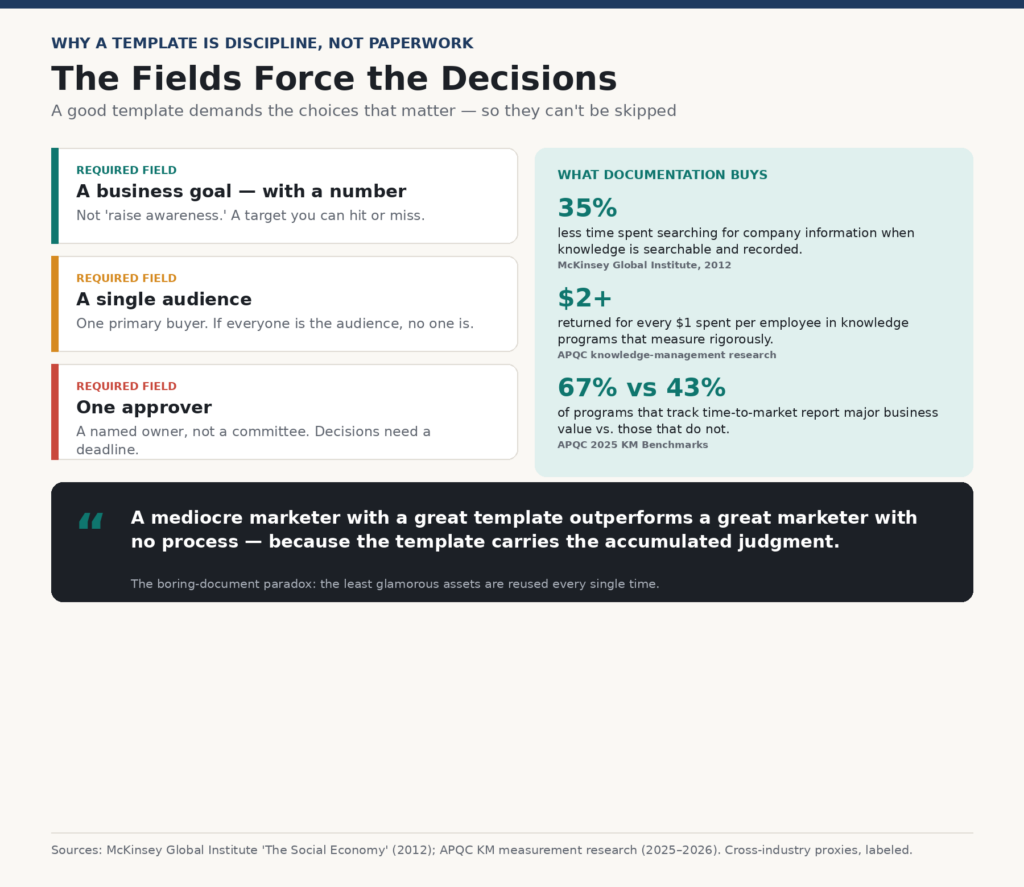
The evidence backs the instinct. APQC, the benchmarking and knowledge-management authority, reports that programs which measure their knowledge efforts rigorously can return $2 or more for every $1 spent per participating employee. And in its 2025 benchmarks, KM programs that explicitly measured speed of innovation or time-to-market were far likelier to say they deliver enormous or a lot of business value — 67%, versus 43% of programs that don’t track it. Documentation isn’t a cost center. Measured properly, it’s one of the few assets that pays you back.
How to Build It Without Killing Momentum
The fastest way to fail is to announce a “process initiative” and disappear into a quarter of document-writing. Build it the lean way instead.
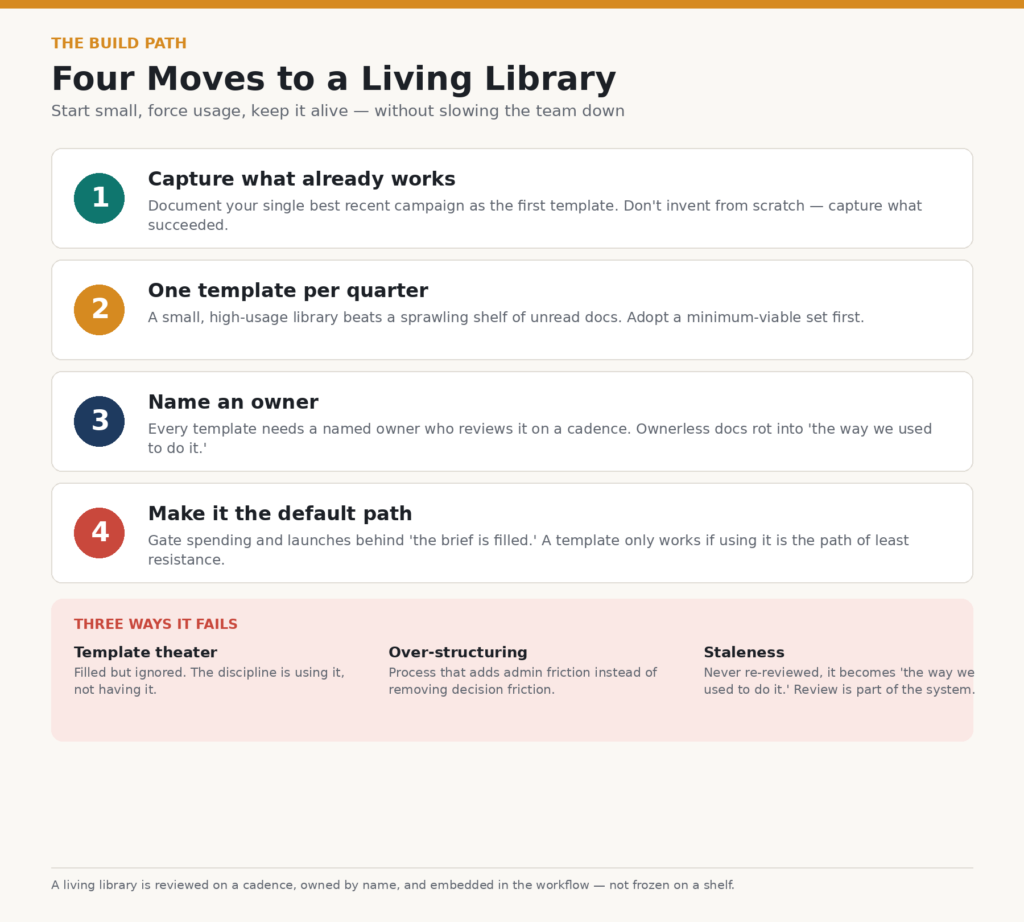
Start from what already works. Don’t invent a template from a blank page. Take your single best recent campaign and document that as the first template. You’re not designing an ideal process; you’re capturing a proven one.
One template per quarter is enough. A small, high-usage library beats a sprawling shelf of unread docs. Ship a minimum-viable set, watch what people actually open, and expand from there.
Make the owner explicit. Every template needs a named owner who reviews it on a cadence. Ownerless documents rot. The moment nobody’s responsible for a template, it quietly becomes “the way we used to do it.”
Force usage in the workflow. A template only works if it’s the default path. Gate spending and launches behind “the brief is filled.” If using the template is optional, it will be skipped exactly when it matters most — under deadline pressure.
The Honest Risks (Because This Isn’t Magic)
Three failure modes will kill an SOP library if you let them.
Template theater is the big one: a document that gets filled but ignored. The discipline is using it, not having it. If approvals happen in a side chat regardless of what the brief says, you’ve built a shrine, not a system.
Over-structuring is the opposite trap — process that adds administrative friction instead of removing decision friction. Templates should make the choices faster, not the paperwork longer. If a template takes more time to complete than the decision it replaces, cut it.
Staleness is the slow killer. A library that’s never re-reviewed hardens into orthodoxy. Review isn’t an optional maintenance task; it is the system. Which means the library has to be a living document, not a frozen artifact you wrote once and forgot.
There’s a telling gap here. APQC’s research on the “great retirement” found that 85% of C-suite leaders worry about knowledge loss from departing experts — yet only 8% of organizations consistently capture that knowledge before it walks out. Everybody knows the problem. Almost nobody builds the habit. That gap is your opportunity.
Why This Matters More in the AI Era
You might think AI makes all of this moot — why document process when a model can generate a brief on demand? It’s the opposite. AI is a multiplier on whatever you feed it, and a team with no written standard feeds it noise. A separate Adobe study from May 2025 found marketers using AI in their workflows save an average of 114 minutes a week on content creation — but that speed only compounds if the inputs are consistent. A documented brief, a fixed KPI map, a standard retrospective: these become the prompts and guardrails that let AI produce on-brand work instead of plausible-sounding filler. The library is what turns a fast tool into a reliable system. Teams that skip it will just generate inconsistency at higher speed.
The Takeaway: Write the Genius Down
Scaling marketing isn’t a talent problem. It’s a knowledge-capture problem. The teams stuck on heroics and inconsistent quality aren’t short on smart people — they’re choosing, every quarter, not to write down what they already know.
An SOP library — strategy templates, execution checklists, decision frameworks, ops playbooks — is the compounding asset that turns one good operator’s judgment into the whole team’s floor. Built in small pieces, owned by name, reviewed on a cadence, and wired into the workflow, it lowers the bar to consistently good work and removes the single point of failure every hero-dependent team carries.
And it’s more urgent than it looks. Standardization is already a proven lever elsewhere: PMI’s Pulse of the Profession research found that organizations using proven, standardized project-management practices waste dramatically less money — its 2017 report found top performers wasted nearly 28 times less money than low performers — and by 2018 the average waste from poor project performance had fallen to 9.9% of every dollar, down from 13.5% in 2013. Marketing runs projects too. The same discipline applies.
So stop depending on the genius staying in someone’s head. Write it down. The team that does is the team that keeps getting better while everyone else keeps starting over.