How Close Is China’s AI to the U.S. in 2026? Eric Schmidt Says Six Months
Six Months: What Eric Schmidt’s China AI Warning Actually Measures
The former Google chief says America’s lead over China has shrunk from roughly two years to about half a year. The number holds up. Most of the conclusions people are drawing from it do not.
The sentence that travelled
Late in October 2026, speaking on stage at the Masters of Scale Summit, Eric Schmidt was asked a direct question: how much daylight is left between the United States and China in artificial intelligence? His answer is now the most quoted sentence in the industry.
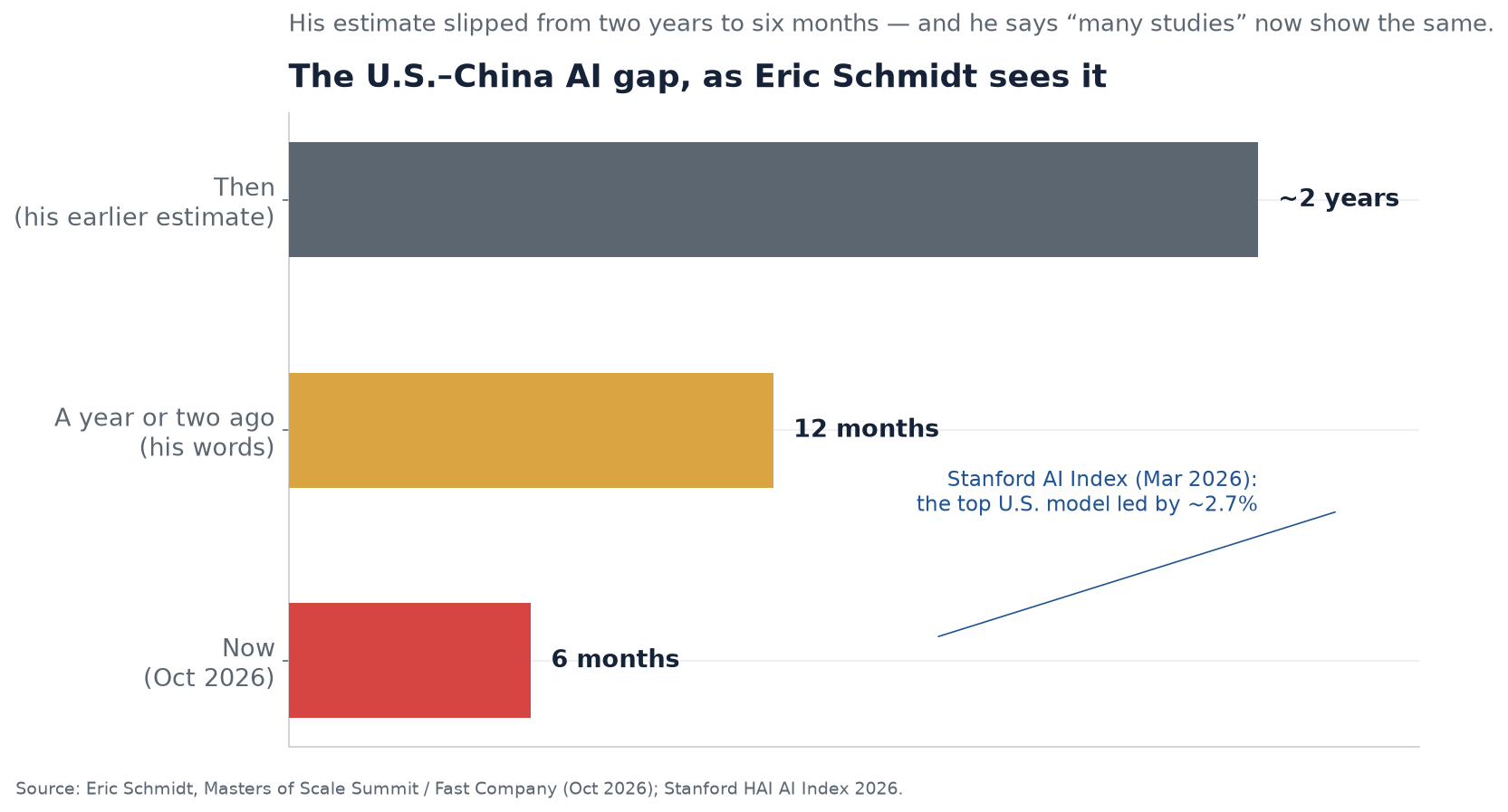
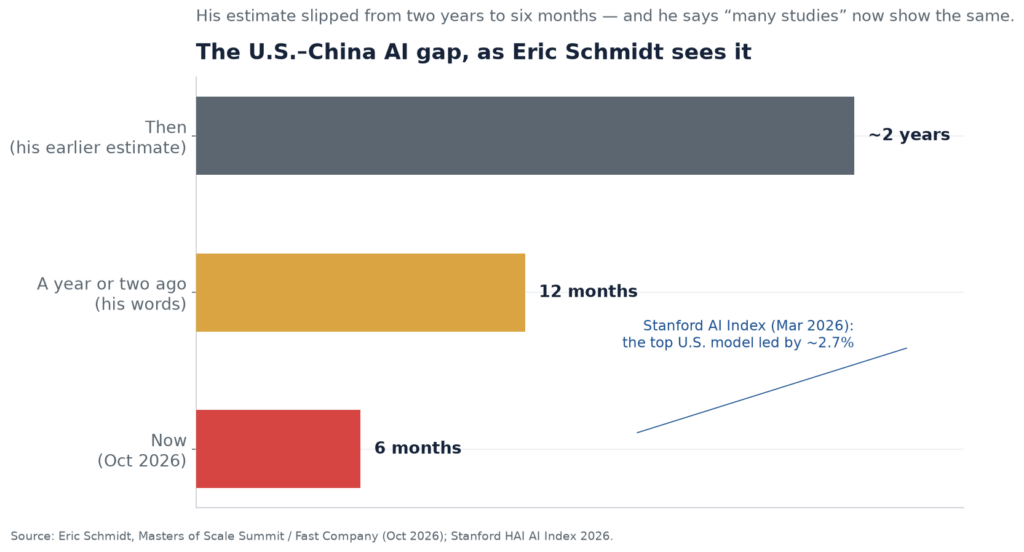
“A year or two ago, it looked like China was a year or two behind,” he said. “Now it looks like they’re six months behind, and there are many studies that show this.”
Schmidt is not a casual observer. He ran Google, advised the Pentagon, and was in the room when Washington decided to restrict China’s access to advanced chips. He also expected those restrictions to hold for a decade. They did not. That admission, not the six months, is the real story.
Why the gap closed, in his own account
Schmidt offers two explanations, and only one is about technology.
The first is economic. “The cost of software has gone from very expensive to almost nothing,” he told the audience. When something gets radically cheaper, you get radically more of it, and the binding constraint shifts from capability to deployment. China, in his reading, understands this as well as anyone.
The second is technical. Chinese labs, blocked from the best chips, rebuilt their approach around algorithmic efficiency instead. Schmidt’s estimate is that they now reproduce American-class results using essentially one-tenth of the energy, sometimes at slightly lower performance.
Put those together and you get his conclusion: it is a two-horse race. What he does not say, but what the phrasing implies, is that export controls bought time rather than distance. Time is useful. It is not a moat.
The independent data largely backs him up
This is where the story gets more interesting than the headline, because Schmidt’s six months is not a lone assertion. It maps onto several unrelated measurement systems.
Stanford’s AI Index, published in April 2026, puts it bluntly: the U.S.–China model performance gap “has effectively closed.” American and Chinese systems have traded the lead repeatedly since early 2025. In February 2025 a Chinese reasoning model briefly matched the best American system. As of March 2026, the top U.S. model led by just 2.7%, with arena-style scores of 1,503 against 1,464 for the best Chinese model.
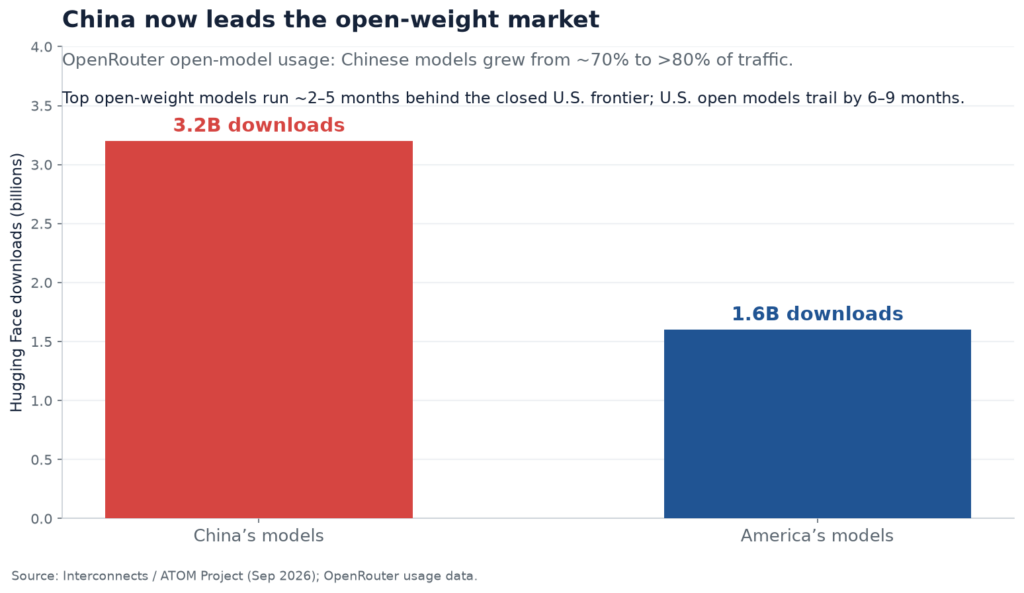
A second line of evidence comes from open-weight models, where tracking is more transparent. Analysis published in September 2026 by the ATOM Project and Interconnects found that China’s leading open-weight models run roughly two to five months behind the closed American frontier. America’s own open-weight models sit six to nine months behind. On the Artificial Analysis Intelligence Index, the top three positions were all Chinese, and fifteen Chinese models outscored the best American open release.
So: months, not years. And in the open-weight segment specifically, the United States is the one playing catch-up.
Where the six-month framing falls apart
Now the counterweight, because a number that travels this fast usually loses its qualifiers on the way.
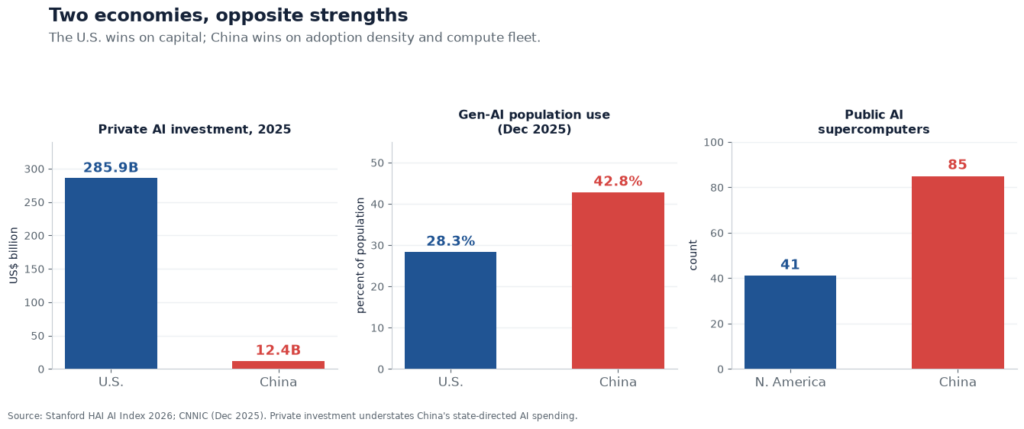
Money is still lopsided. U.S. private AI investment reached $285.9 billion in 2025, against $12.4 billion for China — a factor of 23. The comparison is also unfair in the other direction, because private venture capital is a poor proxy for Chinese state capacity. Beijing channels money through government guidance funds that never appear in those figures, and Stanford’s own analysts note the private number likely understates total Chinese spending. China’s core AI industry was separately estimated at more than 1.2 trillion yuan in 2025. Different metric, different denominator — anyone quoting one against the other is comparing a river to a reservoir.
Talent is moving the wrong way for Washington. The number of AI researchers and developers relocating to the United States has fallen 89% since 2017, with an 80% drop in the last year alone. And benchmarks flatter fast shippers: Chinese labs release more often and narrow their scope to tasks with clear user demand, which inflates public scores. Strip out distillation, and the gap between the strongest American systems and Chinese open weights widens by only one to two months. The six-month figure is a snapshot of a moving target, not a settled fact.
Cheap intelligence is the commercially important part
A capability gap measured in months barely matters to anyone buying AI. What matters is price.
Schmidt’s framing, that software cost has collapsed, shows up in the routing data. OpenRouter, a platform where developers switch models through a single interface, processed around one trillion open-model tokens per week in September 2025. A year later it was handling roughly 80 trillion. Across that period, Chinese models went from about 70% of open-model usage to more than 80%.
Downloads tell a similar story. Chinese open-weight models have been downloaded about 3.2 billion times, roughly double America’s total. China took the lead on that metric in July 2025.
None of this means Chinese models are better. It means they are cheap enough, good enough, and open enough that cost becomes the deciding variable for a growing share of production workloads. That is a stickier lead than any benchmark score.
The energy argument, in units you can check
Schmidt’s “one-tenth of the energy” line is about model efficiency. The national version of that argument is about electricity, and here the asymmetry is not subtle.
China consumed 10.4 trillion kilowatt-hours in 2025, up 5%, becoming the first country ever past the 10-trillion mark — and more than doubling the United States. Notably, power use in the internet and related services sector rose more than 30%. China’s intelligent computing capacity now exceeds 1,590 exaflops, and it runs 85 public or public-private AI supercomputers against 41 in North America.
The comparison cuts both ways. The United States still has 5,427 data centers, more than anyone, and its fleet draws more energy than any other country’s. Almost every leading AI chip is fabricated in a single Taiwanese foundry, which makes every projection hostage to one strait. Schmidt’s six-month estimate assumes that chokepoint holds. If it does not, the number changes.
Beijing is not running a six-month plan
No one in Beijing has ever described this as a sprint to parity.
In August 2025 the State Council issued its “AI+” directive, and the targets are unusually concrete. By 2027, deep integration across six priority sectors, with penetration of next-generation intelligent terminals and agents above 70%. By 2030, above 90%, with the intelligent economy established as a major growth engine. By 2035, entry into what the document calls a new stage of intelligent economy and intelligent society.
Read that as a deployment schedule rather than a research agenda. The plan is not to win a benchmark. It is to embed AI into manufacturing, agriculture, healthcare, education, and government at a scale no other economy can match, on a ten-year clock.
What that looks like on the ground: 602 million users
Adoption is the part Western commentary consistently underestimates.
China’s generative AI user base hit 602 million by December 2025, up 141.7% year on year, with penetration at 42.8%. By the first half of 2026, according to CNNIC’s dedicated generative AI report, the figure passed 700 million and penetration crossed 50%.
Set it against the global picture. Stanford’s data shows generative AI reaching 53% population adoption worldwide within three years, faster than the PC or the internet at the same stage. The United States ranks 24th on that measure, at 28.3%.
A country where half the population uses generative AI weekly behaves differently from one where a quarter does. Products get tested at scale. Failure modes surface early. Distribution becomes the scarce asset rather than the model.
The advertising number almost nobody quotes
For anyone in marketing, the most consequential figures in this story are not in the AI Index.
China’s advertising industry booked more than 2 trillion yuan in 2025, the first time it has crossed that line, according to the State Administration for Market Regulation. It did not stop there: first-half 2026 revenue at major advertising businesses passed 1 trillion yuan, up 11.3% year on year. Internet advertising accounts for roughly 793 billion yuan of the annual total.
Two months before Schmidt’s remarks, seven Chinese government departments published a five-year advertising plan targeting average annual growth of about 10% through 2030, and it regulates AI-generated advertising directly. When a state writes AI ad rules into an industrial plan, the technology has stopped being experimental.
Contrast the pace. Global advertising spend is forecast to pass $1 trillion for the first time in 2026, up 5.1%, with digital rising 6.7% to make up 68.7% of the total, according to dentsu. In the same outlook, China is expected to grow 6.1% — ahead of the global rate. China’s ad market is expanding more than twice as fast as the world’s, on a base already second in size.
The layer that is genuinely breaking: search
If the six-month gap feels abstract, the search channel makes it concrete.
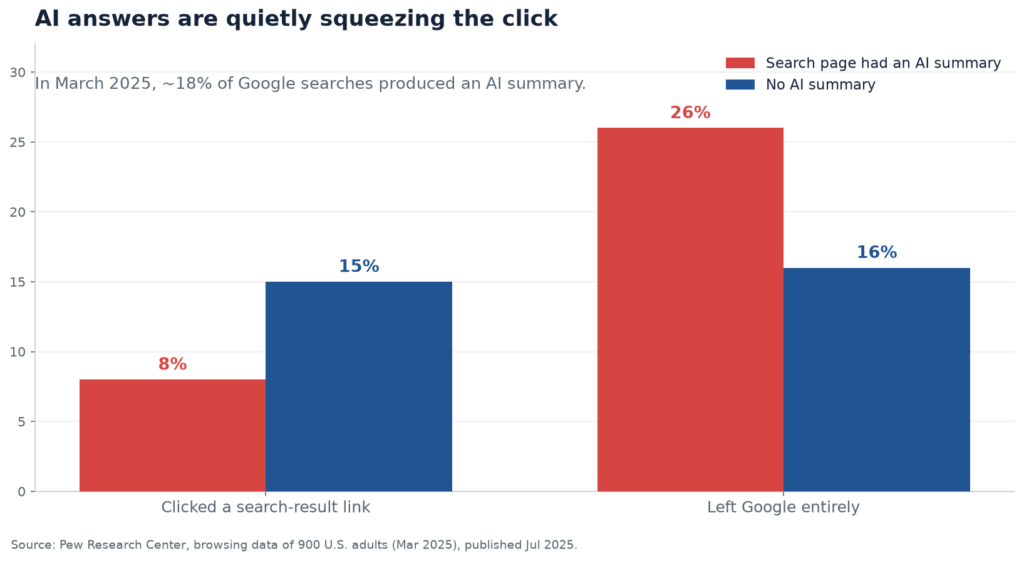
Pew Research tracked 900 U.S. adults through March 2025 and found that when a Google results page carried an AI summary, users clicked a traditional result link in 8% of visits, against 15% without one. Pages with an AI summary also ended the session entirely 26% of the time, versus 16% without. Roughly one in five searches produced a summary at that point, and the share has climbed since.
That is the mechanism by which a model gap becomes a marketing problem. Every month the gap narrows, the cost of inference falls, the answer layer expands, and the click-through economy that funded a generation of content shrinks. It is happening in both markets, at different speeds and under different guardrails.
Five things this actually changes for marketers
Model access stops being a competitive advantage. If the frontier is six months wide and the open-weight lag is two to five, no one can build a moat on “we use the best model.”
Cost per output becomes a strategy variable. When Chinese open models carry most open-model traffic at a fraction of closed-model pricing, unit economics stop being an infrastructure detail and start being a positioning decision.
The answer layer replaces the results page. Optimizing to be cited inside a synthesized answer is a different discipline from optimizing for a ranking. Structured facts, named sources, and clean entity definitions now do work that keyword density used to do.
China is a distribution channel with its own physics. A market adding generative AI users faster than any other is where new formats get proven — but its super-app distribution and regulatory expectations do not transfer cleanly. Treat it as a lab, not a template.
Regulation arrives as a creative constraint. AI-generated advertising is now explicitly on the policy agenda in China. Labeling, disclosure, and provenance become production requirements, not legal afterthoughts.
The scorecard, fairly stated
| Dimension | United States | China |
|---|---|---|
| Best frontier model | Leads by 2.7% (March 2026) | Effectively level |
| Open-weight models | 6–9 months behind frontier | 2–5 months behind frontier |
| Private AI investment, 2025 | $285.9B | $12.4B |
| Gen-AI population penetration | 28.3% (24th globally) | 42.8%, 602M users (Dec 2025) |
| Public AI supercomputers | 41 (North America) | 85 |
| Electricity consumed, 2025 | — | 10.4 trillion kWh (2× the U.S.) |
| Advertising market growth | ~5.1% (global) | +6.1% forecast; +11.3% (H1 2026) |
Read down the left column and America looks comfortable. Read down the right and it looks like a deployment machine. Both readings are correct, which is why single-number summaries keep going viral and keep being wrong.
What to watch over the next twelve months
Watch inference prices, not benchmark scores. If cost per million tokens keeps collapsing, capability differences matter less every quarter, and distribution wins.
Watch the open-weight download curve. China’s lead there is roughly two to one. If American labs cede that segment, the default stack for startups worldwide gets built elsewhere — and defaults are hard to reverse.
Watch how fast AI summaries absorb commercial queries. Pew’s 8% click rate is a warning shot. The metric that matters is not how good the models get, but how much of the buying journey happens before a human ever sees a results page.
Bottom line
Schmidt’s six months is a defensible estimate of the capability gap and deserves to be taken seriously. What it does not measure is the thing most likely to decide the outcome: the speed at which each economy converts capability into deployed, affordable, everyday use.
On that measure, the United States still leads on capital and frontier research. China leads on adoption density, grid headroom, open-weight reach, and the rate at which AI is being written into industrial policy. Six months of model gap, in other words, sits on top of a much wider deployment gap running in the opposite direction.
For marketers, the instruction is unglamorous. Stop planning around which model is best. Start planning around what happens when intelligence is cheap, abundant, and embedded in the answer itself.