INSIGHT — Why the Playbook Dividend Arrives Late
Every team has the same story about process documentation. Someone writes the playbook, everyone nods, and three months later nothing feels different. So the reviews get skipped, the document gets stale, and the organization concludes that playbooks are bureaucracy with a font choice.
That conclusion is wrong, and the reason is specific: the payoff of a learning system is back-loaded. The dividend arrives late — and most teams quit before it shows up.
The curve nobody warns you about
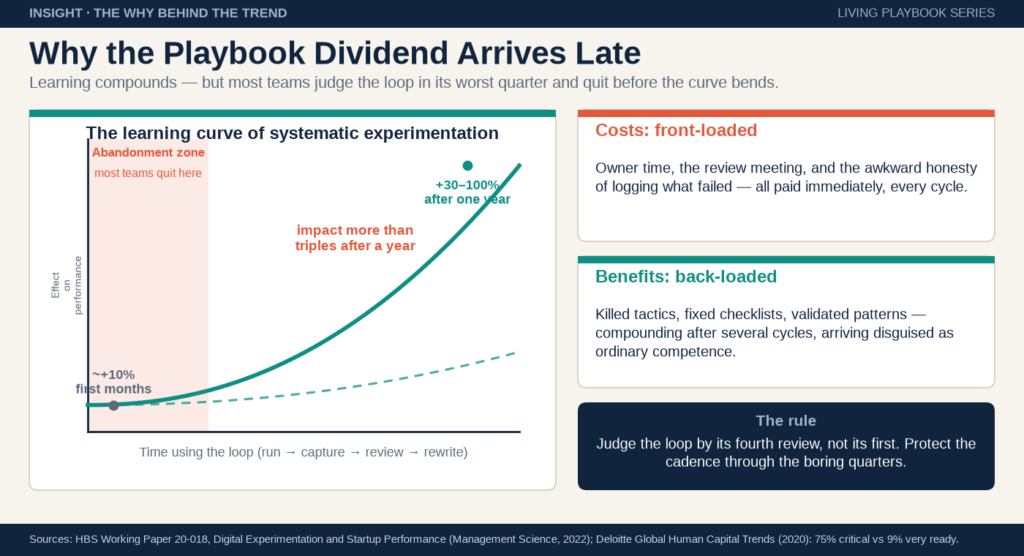
The cleanest evidence comes from Harvard Business School research on startups that adopted A/B testing — the laboratory version of the run-capture-review-rewrite loop. In the first months after adoption, the effect on page visits was roughly 10%. After a year of use, it ranged from 30% to 100%. The impact more than tripled. The software didn’t improve. The organization’s ability to learn from it did.
Now picture the same curve applied to a playbook. The first review mostly surfaces typos and one broken checklist step. Useful, but hardly transformative. The second review catches a pattern. The third kills a tactic that was quietly wasting budget. By the fourth, the document contains things no competitor could copy, because they were paid for in your own failed campaigns. The value isn’t in the writing. It’s in the accumulation — and accumulation is invisible at the start.
Why teams abandon the loop right before it pays
Here’s the incentive problem. Costs are front-loaded: the owner’s time, the meeting, the awkward honesty of logging what failed. Benefits are back-loaded: they compound after several cycles, and they arrive disguised as ordinary competence. Nobody throws a party for the disaster that didn’t happen.
So the loop gets judged by its first quarter, which is precisely its worst quarter. The review feels like overhead, the changelog feels empty, and a busy season supplies a respectable excuse to stop. The playbook becomes shelfware, the next campaign repeats an old mistake, and the organization reads that repetition as proof that documentation doesn’t work. The failure is self-confirming.
Deloitte’s Human Capital Trends research caught the same gap at organizational scale: 75% of firms said preserving knowledge was critical to their success; only 9% felt very ready to do it. The missing ingredient usually isn’t belief. It’s patience with a curve that pays late.
What this means if you own a playbook
Judge the loop by its fourth review, not its first. Protect the cadence through the boring quarters, because the boring quarters are where the curve is being built. And when someone proposes skipping the retro because nothing changed this quarter, remember what the data says: nothing changing on the surface is exactly what compounding looks like from underneath.
The teams that pull ahead aren’t the ones with better playbooks. They’re the ones that stayed on the curve long enough for it to bend.