Why Your Marketing Team Reviews the Right Metrics at the Wrong Time
Your marketing team isn’t failing for lack of effort. Look at the calendar and you’ll see plenty of effort — standups, syncs, reviews, retros, “quick catch-ups” that eat forty minutes. The problem is that most of that effort fires at the wrong frequency. A metric that only moves weekly gets checked every morning. A metric that can break in an hour gets reviewed once a month. And nobody can say which meeting exists to trigger which decision.
That’s not a discipline problem. It’s a rhythm problem. Marketing cadence is the discipline of matching each activity, meeting, and metric to its natural frequency — daily for the operational, weekly for the tactical, quarterly for the strategic — and keeping those streams ruthlessly separate. Get it right and the cadence disappears into the background, like a good drummer. Get it wrong and everything is loud: noise where you need signal, blind spots where you need alarms.
This playbook shows you what the research actually says about the cost of unrhythmical work, how to design the three beats, and how to install them without turning your calendar into a bureaucracy.
The Rhythm Problem: Why Cadence Beats Effort
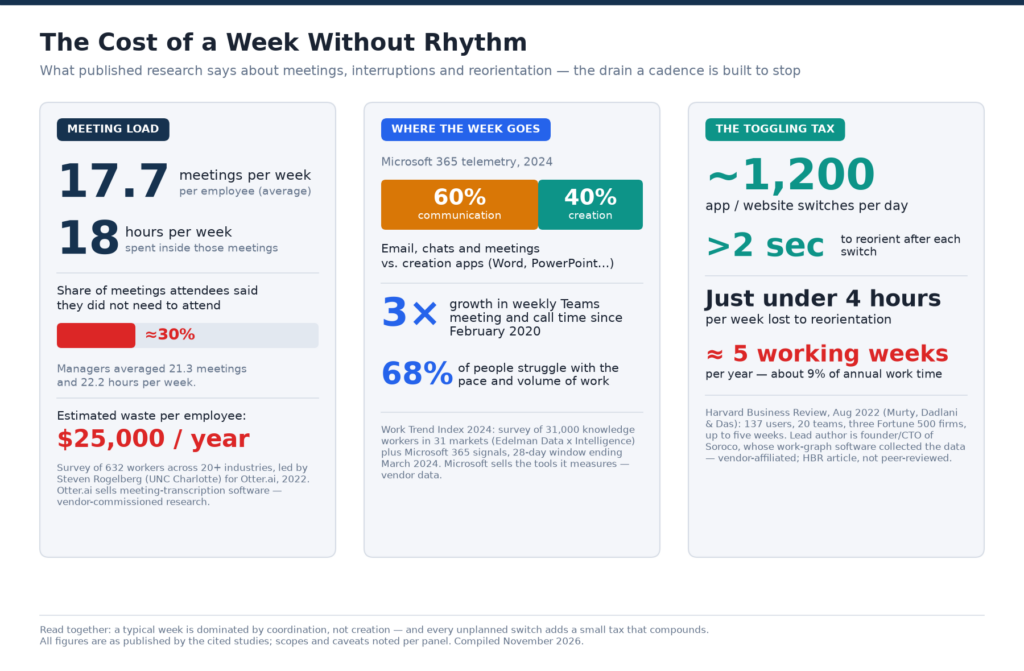
Here’s the uncomfortable truth about modern marketing work: most of the week goes to coordination, not creation. Microsoft’s 2024 Work Trend Index — a survey of 31,000 knowledge workers across 31 markets, run by Edelman Data x Intelligence, paired with telemetry from Microsoft 365 — found that users spend 60% of their time in email, chats, and meetings, and only 40% in creation apps like Word and PowerPoint. Sixty-forty. Before you’ve written a single brief, the majority of your week is already spoken for. (Worth noting: Microsoft sells the tools it measures, so treat this as vendor telemetry — but the scale of the dataset, a 28-day window across commercial tenants, makes the direction hard to dismiss.)
And the meeting load keeps climbing. Microsoft’s 2023 Work Trend Index found that weekly time in Teams meetings and calls had tripled since February 2020, with inefficient meetings ranked the number one productivity disruptor. Meanwhile 64% of people said they struggled to find enough time and energy to get their work done. The pandemic didn’t just move meetings online; it made them the default unit of coordination. Every hallway conversation became a calendar invite.
Marketing feels this more sharply than most functions, because marketing sits at the intersection of everything: sales wants leads, product wants launches, finance wants proof, and the CEO wants a deck by Thursday. When every stakeholder can book your time, your calendar becomes a public resource — and public resources get overgrazed.
The Frequency Error Nobody Names
The most common marketing failure isn’t laziness or even bad strategy. It’s the frequency error: doing the right thing at the wrong interval.
It cuts both ways. Check a weekly-moving metric daily and you manufacture noise — you’ll “see” trends in random variation, chase ghosts, and burn credibility with false alarms. Check a daily-breaking metric monthly and you build a blind spot — the tracking pixel that died on the 3rd gets discovered on the 30th, and you’ve paid for four weeks of traffic you can’t attribute.
There’s real money attached to this. In a 2022 study published in Harvard Business Review, researchers Rohan Narayana Murty, Sandeep Dadlani, and Rajath Das tracked 137 users across 20 teams at three Fortune 500 companies for up to five weeks. The average worker toggled between apps and websites nearly 1,200 times a day, each switch costing a little over two seconds of reorientation. That adds up to just under four hours a week — roughly five working weeks a year, about 9% of annual work time — spent not working, but re-finding your place. Two caveats matter here: it’s an HBR article, not a peer-reviewed paper, and the lead author is founder and CTO of Soroco, whose work-graph software collected the data. Vendor-affiliated, yes — but the mechanism it describes is one you’ve felt in your own skull every time a dashboard check derails a writing session.
Every unnecessary review meeting is a toggling event multiplied by the number of attendees. Frequency errors don’t just produce bad decisions; they tax everyone’s attention while producing them.
What the Meeting Sprawl Actually Costs
Let’s put a number on the meeting problem specifically. Steven Rogelberg, an organizational scientist at UNC Charlotte and one of the few academics who studies meetings for a living, ran a survey of 632 workers across more than 20 industries for Otter.ai in 2022. The average employee attended 17.7 meetings a week, consuming 18 hours. Managers averaged 21.3 meetings and 22.2 hours. Attendees said roughly 30% of those meetings didn’t need them — and the estimated waste came to about $25,000 per employee per year, or roughly $100 million annually for a 5,000-person company. (Otter.ai sells meeting-transcription software, so this is vendor-commissioned research — but Rogelberg’s academic track record on meeting science is independent and long-standing.)
Notice what that 30% really means. It’s not that meetings are bad. It’s that a third of the invitations went to people whose presence changed nothing — no decision they owned, no input only they could give. That’s a cadence design failure wearing a calendar costume.
The CMO’s version of this problem is even starker. A diary study published in the European Journal of Marketing (Sharma and colleagues, 2026) had senior marketing leaders log their actual working days before and during the pandemic. Before the disruption, CMOs spent about 67.5% of the workday in meetings; during it, that rose to 71.5%. And the casualty was exactly what a cadence is supposed to protect: time spent independently reviewing market performance and analytics fell from 7.3% to 3.0% — cut by more than half. Small sample (10 CMOs pre-disruption, 23 during, two-week diaries, India-based), so read it as directional. But the direction is chilling: when crisis hits, the strategic beat is the first thing teams sacrifice — precisely when they need it most.
The Three Rhythms: Daily, Weekly, Quarterly
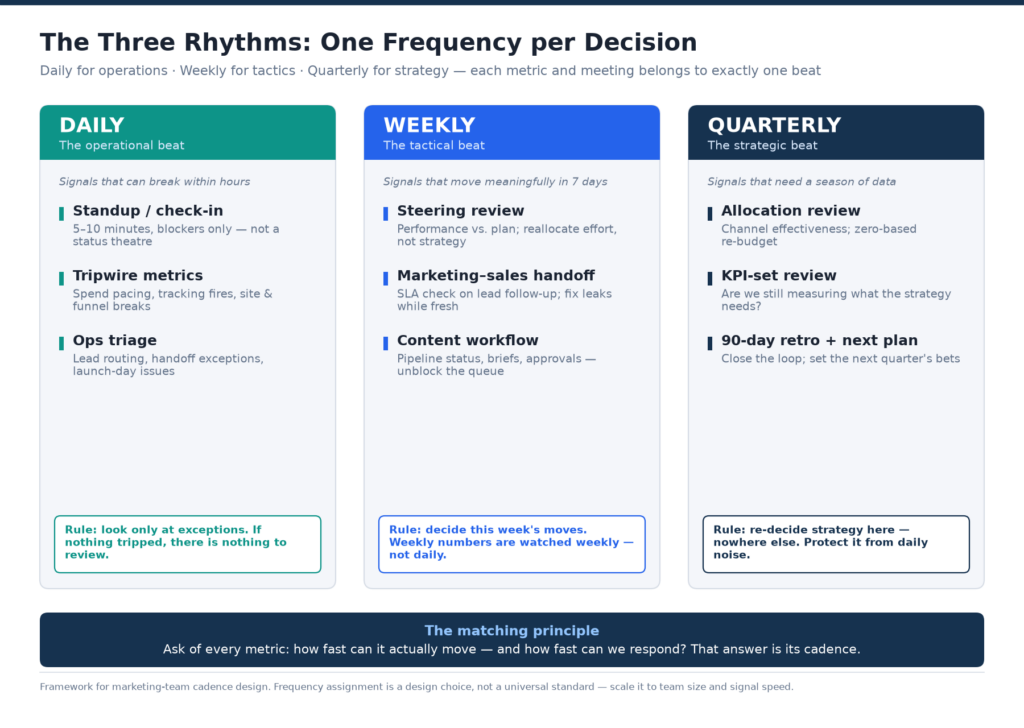
So what does a well-designed cadence look like? Three beats, each with its own job, its own metrics, and its own meetings. The governing principle: each metric and meeting belongs to exactly one frequency. Crossing the streams is where the noise and the blind spots come from.
The Daily Beat: Operations and Tripwires
The daily rhythm is short and defensive. A 5–10 minute standup for blockers — not a status theatre where everyone recites yesterday. An ops triage: lead routing exceptions, handoff misses, anything breaking in production. And tripwire metrics only — the exception report. Spend pacing that’s about to blow the budget, a conversion funnel that fell off a cliff, a tracking fire. If nothing tripped, there’s nothing to review. The daily beat exists to catch what breaks fast, not to admire what’s stable.
The Weekly Beat: Tactics and Steering
The weekly rhythm is where marketing actually gets managed. The steering review compares performance against plan and reallocates effort — pause this ad set, boost that channel, unblock the content queue. The marketing–sales handoff check verifies the SLA on lead follow-up while the leads are still warm. The content workflow review keeps briefs, drafts, and approvals moving. Weekly-moving metrics — CPL trends, pipeline velocity, organic traffic — get watched here, weekly. Not daily. Their signal doesn’t exist at a daily resolution, and pretending otherwise just trains your team to react to noise.
The Quarterly Beat: Strategy and Allocation
The quarterly rhythm is where strategy gets re-decided — and the only place it should be. The allocation review examines channel effectiveness and re-budgets from zero: if we were building this mix today, would we buy it again? The KPI-set review asks whether you’re still measuring what the strategy needs. And the 90-day retrospective closes the loop: what did we bet, what happened, what’s next quarter’s bet? This is the horizon where the expensive decisions live, which is why it must be protected from daily noise. You cannot re-think your channel mix in the fifteen minutes between a standup and a stakeholder sync.
Designing the Cadence: Three Matching Rules
Rule One: Match Frequency to Signal Speed
For every metric, ask two questions: how fast can this number actually move, and how fast can we respond to it? The slower of the two sets the cadence. Brand search volume shifts over weeks — watching it hourly is astrology. Ad spend pacing can break in an afternoon — reviewing it monthly is negligence. The cadence isn’t a preference or a tradition; it’s a property of the signal. Write it down next to each KPI. If you can’t justify the frequency, you’ve found either noise-making or a blind spot.
Rule Two: No Decision, No Meeting
Every recurring meeting must name the decision it serves. Not the topic — the decision. “Weekly performance review” is a topic. “Decide which campaigns get budget shifted this week” is a decision. If a meeting isn’t the trigger for a named action with an owner on the other end, it’s a status ritual, and status can travel asynchronously. Cut it or re-scope it. This one rule, enforced consistently, is the difference between a cadence and a meeting cult.
Rule Three: Different Roles, Different Beats
Cadence is not “everyone meets all the time.” Ops lives in the daily beat. Campaign managers live in the weekly beat. Leadership lives in the monthly and quarterly beats — and crashes the daily one only when a tripwire genuinely fires. A cadence is a filter: its most valuable output is telling you what not to look at right now, which is most of what’s on the average dashboard.
The Evidence That Cutting Meetings Works
Skeptical that trimming the calendar actually moves outcomes? The published experiments are encouraging — with honest caveats.
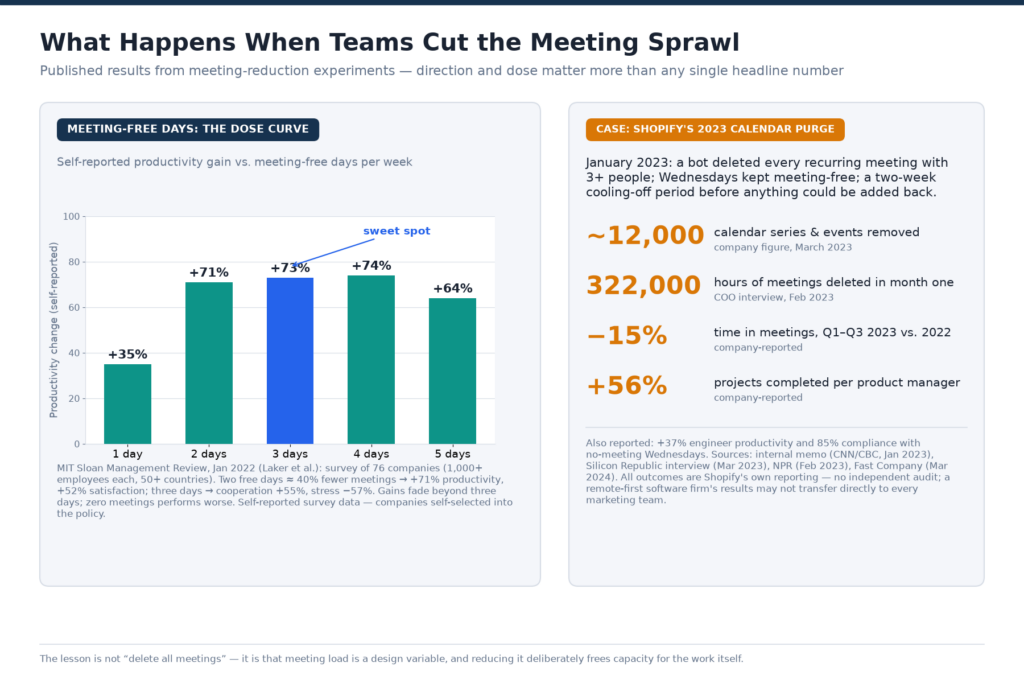
The strongest dose-response evidence comes from MIT Sloan Management Review. In 2022, Benjamin Laker and colleagues surveyed 76 companies — each with 1,000+ employees, operating in 50+ countries — that had introduced one to five meeting-free days per week. With two meeting-free days (about 40% fewer meetings), employees reported 71% higher productivity and 52% higher satisfaction. With three days, cooperation rose 55% and stress fell 57%. But the curve bends: beyond three days the gains flatten, and companies that abolished meetings entirely performed worse on satisfaction, engagement, and cooperation. The lesson isn’t “zero meetings” — it’s that meeting load is a dose, and most teams are overdosed. Two caveats: these are self-reported survey figures, not measured output, and the companies chose the policy themselves, so early failures likely dropped out of the sample.
Then there’s the field experiment everyone in marketing ops should know. In January 2023, Shopify’s COO Kaz Nejatian ran what the company called a calendar purge: a bot deleted every recurring meeting with three or more people, Wednesdays were kept meeting-free, large meetings were confined to a Thursday window, and a two-week cooling-off period blocked anything from being re-added without deliberate thought. The company reported removing roughly 12,000 calendar series and events; a month in, Nejatian said 322,000 hours of meetings had been deleted — the equivalent, he argued, of adding 150 employees. Comparing the first three quarters of 2023 with 2022, Shopify reported 15% less time in meetings, 37% higher engineer productivity, and 56% more projects completed per product manager. All of these are Shopify’s own numbers, reported to press (CNN, CBC, NPR, Silicon Republic, Fast Company) without independent audit — and a remote-first software company isn’t a marketing department. But the design is the transferable part: delete the default, force every meeting to re-earn its slot, and give refusal explicit social permission.
Why Rhythm Compounds: The Real-Time Dividend
A cadence isn’t just hygiene — there’s a strategic payoff at the top end. MIT’s Center for Information Systems Research, in an August 2024 study by Peter Weill and colleagues with Insight Partners, surveyed C-suite leaders at 259 global companies (average revenue around $10 billion) about how “real-time” their operations were: trusted data accessible to employees, decisions made at the point of sensing, governance that doesn’t route everything up the hierarchy. Companies in the top quartile of real-time capability showed 62% higher revenue growth and 97% higher net margins than the bottom quartile. This is correlational survey research, and “real-time business” is broader than meeting design — but read it alongside the cadence argument and the connection is hard to miss. A team whose daily tripwires fire in hours, whose weekly steering actually reallocates, and whose quarterly loop genuinely re-decides strategy has built the sensing-and-responding machinery that the top quartile runs on. The cadence is the cheapest on-ramp to that capability. You don’t need a data platform transformation to stop reviewing weekly numbers daily. You need a calendar and a rule.
There’s also a quieter dividend: pressure. Duke’s CMO Survey — the 2025 edition, directed by Christine Moorman with Deloitte and the American Marketing Association, polling 281 senior US marketing leaders (99% VP or above) — found that proving marketing’s impact on financial results is now the profession’s top challenge, with 63% reporting increased pressure from CFOs, up from 52%. When the finance committee wants proof, the teams that survive are the ones whose review rhythm already produces decision-grade evidence on a schedule — not the ones scrambling to assemble a narrative the night before. Cadence is how you make the proof routine instead of heroic.
How to Install a Cadence in 30 Days
You don’t need a consulting engagement. You need four moves, in order.
Week one: audit the calendar. List every recurring meeting and write next to it the decision it serves. Be honest — “alignment” is not a decision. Anything that serves none gets removed or re-scoped on the spot. Expect discomfort; the 30% unnecessary-meeting figure means roughly a third of your recurring calendar is about to evaporate, and some of it belongs to senior people. Do it anyway, with their blessing.
Week two: map metrics to frequencies. Take your KPI set and assign each one a review cadence using the signal-speed rule: daily tripwires, weekly steering, quarterly allocation. One frequency per metric, written down, visible to everyone. This is also the moment to kill the dashboard-checking habit — if a number isn’t a tripwire, looking at it daily is a toggling tax you’re paying for entertainment.
Week three: plant the quarterly anchor. Put the 90-day plan and its retrospective on the calendar as fixed points — the two immovable objects everything else hangs from. Then work backward: what weekly steering does this quarter’s plan need? What daily tripwires protect it? Build the spine first and let the smaller beats attach to it, rather than accumulating meetings bottom-up until the calendar is full.
Week four: enforce and schedule the decay check. Make “no decision, no meeting” the standing rule with a named owner — usually the marketing ops lead — empowered to challenge any recurring invite. And book a quarterly calendar audit, because cadences quietly re-sprawl one “quick sync” at a time. The rule without an owner is a poster; the rule with an owner is a system.
Risks and Honest Caveats
Four failure modes to watch, because a cadence can go wrong in ways that look like going right.
The cadence-for-its-own-sake trap. A perfect rhythm that produces no output is just organized busyness with better attendance. The cadence serves the work; the moment the team spends more energy maintaining the rhythm than making decisions inside it, you’ve built a metronome, not a system.
The over-meeting relapse. Meeting sprawl is entropy — it returns unless someone spends energy against it. Every crisis spawns a “temporary daily war room” that outlives the crisis by eight months. The quarterly calendar audit and the decision-anchor owner are your antibodies.
The rigidity risk. A fixed cadence needs a break-glass protocol: when a genuine crisis or a genuine opportunity fires, the rhythm suspends, explicitly and temporarily. The cadence is a default, not a prison. Teams that can’t break their own rhythm in an emergency have confused the map with the territory.
The team-size reality. A four-person team needs one daily sync and a whiteboard, not a three-tier governance stack. A forty-person org needs the separation precisely because informal coordination stops scaling. Scale the rhythm to the team; don’t copy a big company’s ceremony onto a small one, or a startup’s improvisation onto a big one.
Conclusion: The Right Thing at the Right Frequency
Marketing doesn’t run on resolve. It runs on rhythm. The evidence is consistent across independent research groups: the modern week is drowning in coordination, the switching and meeting tax is measurable in hours and dollars, and teams that deliberately cut the sprawl report better focus, more output, and less stress — up to the point where they cut too much and lose the connection that meetings, at their best, provide.
The discipline is simple to state and genuinely hard to keep: match every metric, meeting, and activity to its natural frequency. Daily for operations. Weekly for tactics. Quarterly for strategy. One frequency each, a decision on the other end of every meeting, and an owner who guards the rule. Do that, and the rest of your operating system — the 90-day plan, the reporting stack, the SOP library — stops being a folder of documents and starts being a working machine. The noise falls away. The blind spots close. And the team finally stops confusing busyness with momentum.
The right thing, at the right frequency, with a decision waiting on the other end. That’s the whole game.