The cheapest document in marketing decides the price, the rounds, and whether the work works. Most teams skip it.
Executive summary
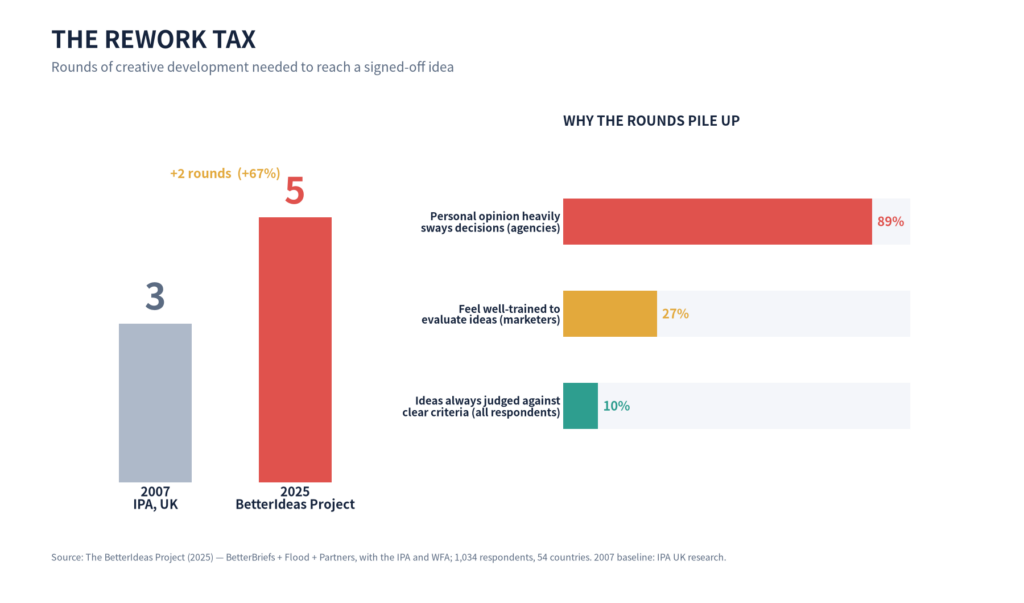
The brief is the cheapest, highest-leverage document in marketing — and the most neglected. The evidence is uncomfortable: in the BetterBriefs Project global study of more than 1,700 marketers and agency staff across 70-plus countries, 80% of marketers believe they write good briefs, while only 10% of agencies agree. On strategic direction the gap is just as stark: 78% of marketers think they give clear direction; 5% of agencies say they receive it. Respondents estimated that up to a third of the marketing budget is wasted on poor briefs and misdirected work. Great work is downstream of a great brief. The skill is writing it short — one page, seven blocks — and decisive: one audience, one message, one measure, one approver. This piece walks through the data, the anatomy, and the three sentences most briefs leave out.
The brief is the whole game
Here is a thought experiment. Two teams get the same budget, the same channel, the same talented agency. One hands over a clear one-page brief. The other hands over a forty-slide deck that says “be seen as innovative.” Which team gets better work? You already know the answer. The brief is not paperwork. It is the place where the decisions get made before any money is spent.
The reframe that changes everything: a brief is strategy on one page. Not a summary of a meeting. Not a wish list. A set of choices — who we are talking to, what we want them to do, what we want them to remember, and who gets to say yes. When those choices are made, the work has a direction. When they are deferred, the work becomes the place where you try to make them, expensively, in public, in round three.
Sir John Hegarty put it bluntly: writing bad briefs is the most expensive way to write advertising. The data, as we will see, agrees with him.
It decides the price
The quote is built from the brief. Anything missing gets priced upward, because no one prices work they cannot predict. Is it one video or a six-month campaign? One market or twelve? A film for a trade-show screen or a film for the feed? If the brief does not say, the agency protects itself with a bigger number. Vagueness is not free. It is a contingency fee you pay in advance.
It decides the rounds
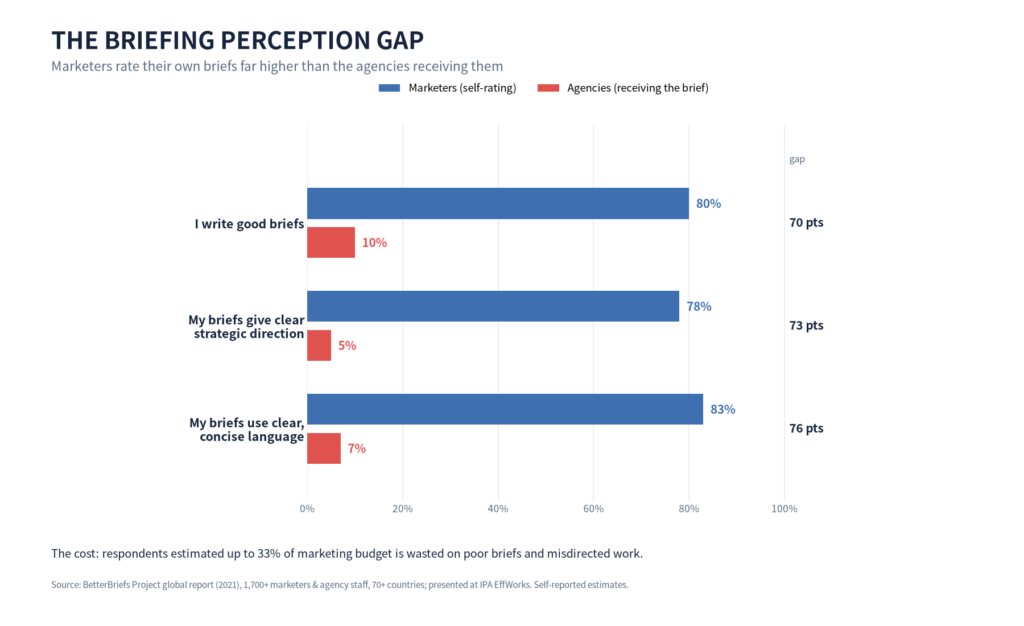
A vague brief does not slow the start. It slows the review. “Actually, who is this for?” arrives in week three because it was never closed in the brief. The 2025 BetterIdeas Project — BetterBriefs and Flood + Partners, with the IPA and the World Federation of Advertisers, surveying 1,034 people across 54 countries — found it now takes an average of five rounds of creative development to reach a signed-off idea. In 2007, IPA research in the UK put that number at three. Two extra rounds, on every project, is a tax on every brief that did not make its decisions up front.
It decides whether the work works
A brief with a measurable action — “the technical director downloads the catalogue” — produces work you can evaluate. A brief with a feeling — “be seen as innovative” — produces work you can only argue about. The distance between a behavior and a feeling is the distance between evaluable and unmeasurable work. If you cannot say what someone should do after seeing the campaign, you cannot say whether the campaign did anything. You can only say whether you liked it.
The perception gap: the honest data
Let us sit with the numbers, because they are the reason this skill matters. In the 2021 global study, 80% of marketers thought they wrote good briefs; 10% of agencies agreed. That is a 70-point gap. On strategic direction, 78% versus 5% — a 73-point gap. On clear, concise language, 83% of marketers versus 7% of agencies. These are three different questions, and on all three, the people writing the briefs and the people receiving them live on different planets.
It gets worse before it gets better. Three in five marketers admit they use the creative process to clarify their own strategy. Read that again. The strategy is not arriving in the brief; it is being discovered, at agency rates, during production. And nine out of ten marketers admit their briefs change once they have been briefed in. No wonder 69% of marketers and 73% of agencies say rebriefs happen too often.
A note on honesty, because it matters. BetterBriefs is a consultancy that sells briefing training, so it has a commercial interest in this problem being large. And the “wasted budget” figure is a respondent estimate, not an audited measurement. Treat it as a directional signal from people doing the work, not a precise accounting fact. The signal is still loud.
The cost of the gap
Respondents in the global study estimated that up to 33% of the marketing budget goes to waste through poor briefs and misdirected work. A UK follow-up in 2022 put the figure at 26%; the 2025 wave put the global average nearer 30%, with Asian marketers estimating 37%. The exact number moves with the sample. The direction does not: roughly a quarter to a third of the money is spent on directions that never landed.
You can scale that into a headline if you want — the founders have multiplied their estimate against WARC’s forecast of about US$1.07 trillion in global ad spend to suggest up to US$350 billion at risk. Just remember what that is: an estimate times a forecast, not a measured loss. The useful takeaway is not the trillion-dollar drama. It is that the cheapest performance fix in marketing is a better brief, and almost nobody is doing it.
Anatomy of a one-page brief: the seven blocks
So what does a good brief actually contain? The IPA, BetterBriefs and Mark Ritson published a best-practice guide, “The best way for a client to brief an agency,” and the ANA has its own “Better Creative Briefs” work. Synthesise them and a one-page structure emerges. Seven blocks. Each one closes a decision the work depends on.
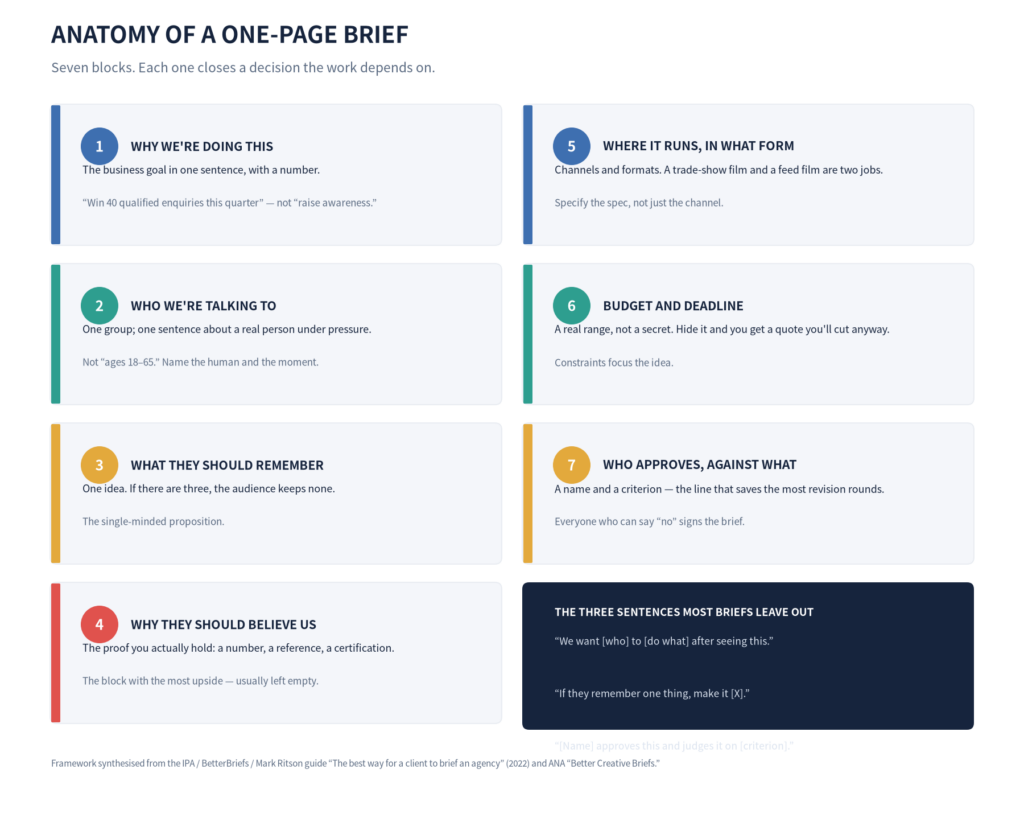
Block 1 — Why we are doing this. The business goal in one sentence, with a number. “Win 40 qualified enquiries this quarter,” not “raise awareness.” If you cannot attach a number, you have not finished deciding.
Block 2 — Who we are talking to. One group. One sentence about a specific person and the pressure they are under right now. “Ages 18–65” is not an audience; it is a census. Ritson’s warning is worth keeping: demographic clichés like “millennials” are a sure sign you have not got a strategy.
Block 3 — What they should remember. One idea. The single-minded proposition. If there are three messages, the audience keeps none of them. The guide is explicit: a single-minded brief contains only one key message.
Block 4 — Why they should believe us. The proof you actually hold — a number, a reference, a certification. This is the block with the most upside and the one most often left empty. A claim without proof is just a louder opinion.
Block 5 — Where it runs, in what form. Channels and formats. A film for the trade-show screen and a film for the feed are two different jobs, with different lengths, different sound-off assumptions, different first frames. Name the spec, not just the channel.
Block 6 — Budget and deadline. A real range, not a secret. Hide the budget and you get a quote you will cut anyway, after the agency has priced the dream. Constraints do not kill ideas; they focus them.
Block 7 — Who approves, against what. A name and a criterion. This single line saves more revision rounds than anything else on the page. The ANA guidance goes further: everyone on the client side who can say “no” should align with and sign the brief. No exceptions.
The three sentences most briefs leave out
If the seven blocks are the skeleton, three sentences are the spine. Most briefs omit all three.
“We want [who] to [do what] after seeing this.” A behavior, not a feeling. This is the line that makes the work evaluable.
“If they remember one thing, make it [X].” This settles half the future arguments in the edit. When round two cuts, it cuts against this line — not against whoever spoke loudest in the room.
“[Name] approves this and judges it on [criterion].” Often missing, most valuable. Knowing the sign-off up front makes the first cut land closer to the last.
The pattern underneath all three: a great brief is decisive. It makes the choices the work depends on, and refuses to defer them to “we will figure it out in review.”
A brief is not a briefing
Here is the part most teams miss. Writing the document is half the task. The IPA guide draws a hard line between writing briefs and briefing the brief. A structured briefing — a real conversation where the agency can interrogate the challenge, push back, and confirm shared understanding — is what turns a page into alignment. Send a PDF into the void and you have not briefed anyone. You have filed something.
The ANA adds a discipline that costs nothing and saves rounds: every meeting where creative is presented should start with a review of the brief. The brief is the neutral reference point for judging the work. Without it, evaluation becomes a contest of personal taste — and the 2025 data shows 84% of marketers and 89% of agencies admit personal opinion heavily sways decisions, while only 10% of all respondents say ideas are always judged against clearly defined criteria. That is the real reason the rounds pile up. It is not a creativity problem. It is a criteria problem.
Risks and honest caveats
A few traps, so you do not trade one failure for another.
The length trap. A forty-page briefing deck is not a brief; it is a dumping ground. Length usually signals unmade decisions, not more information. The ANA’s phrase is “guardrails, not handcuffs” — give the what and the why, leave the how to the creatives.
The AI-production wrinkle. In AI-assisted production the brief becomes a scoring input: assets get checked against it automatically, at scale. A vague brief used to multiply into one wrong direction. Now it can multiply into hundreds of wrong assets before anyone notices. The cost of vagueness has gone up, not down.
The one-size-fits-all error. A template that ignores local context — languages, approvers, channels, regulatory review — fails at exactly the points that bite later. Adapt the structure; do not import it blindly.
The workshop alternative. For genuinely open questions, a two-hour workshop beats a document. The brief is for decided work, not for discovering what the work is. If you are still arguing about the strategy, you are not ready to brief. Nail the strategy first, then brief it in.
Conclusion: write it short, write it decisive
Nothing in marketing offers a better return than the hour spent writing a proper brief, and nothing is more consistently skipped. The brief decides the price, the rounds, and whether the work does anything at all. The data says marketers think they are good at it while agencies disagree by 70 points, and a quarter to a third of the budget is spent on directions that never landed. The fix is small and unglamorous: one page, seven blocks, and three sentences that name the action, the single message, and the approver. Write it short and decisive — then the work, not the revisions, becomes the line item.