Why Martech Utilization Stalled: The Absorption Gap Behind the 49%
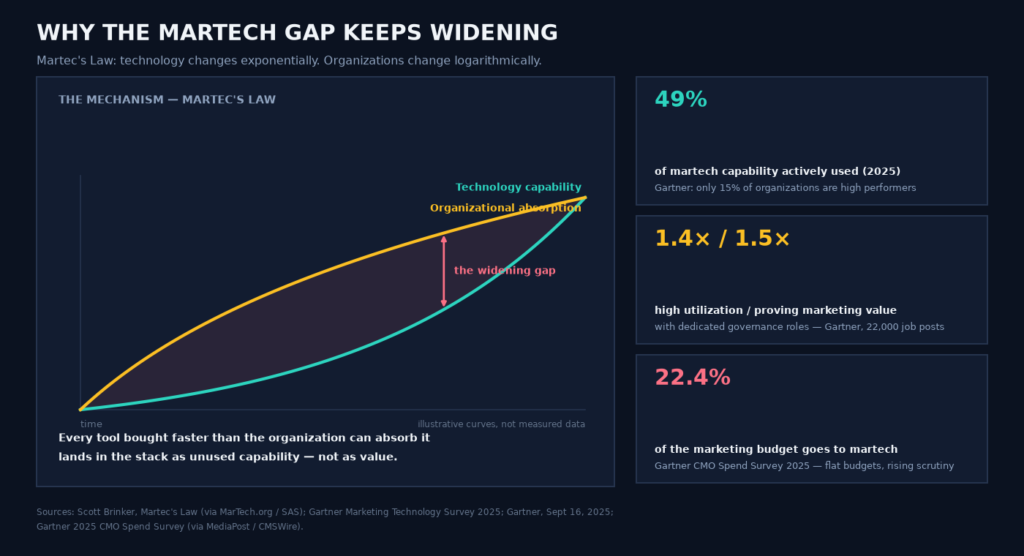
Start with a number that should bother you: martech eats 22.4% of the average marketing budget — the lowest share in a decade, per Gartner’s 2025 CMO Spend Survey — yet Gartner’s 2025 Marketing Technology Survey finds teams actively using only 49% of what they buy. Less money, same waste. That pattern tells you the problem was never the price tag.
Mechanism 1: The Absorption Gap Is Structural
Scott Brinker named this dynamic Martec’s Law: technology changes exponentially, but organizations change logarithmically. Software capability compounds every quarter; hiring, training, process redesign and data governance crawl. The gap between the two curves is not a failure of effort — it is the default state of any organization buying software. Every tool purchased faster than the team can absorb it lands in the stack as unused capability. Gartner’s 2023 survey of 405 marketing leaders put a number on the struggle: only 11% had improved utilization by more than ten points in a year, and the most common blockers were ecosystem complexity, customer data challenges and inflexible governance. Notice what is not on that list: the tools themselves.
Mechanism 2: Buying Is Budgeted. Absorbing Is Not.
Here is the incentive asymmetry nobody puts on the invoice. A purchase has a line item, an owner and a demo that makes the future look easy. Absorption has no line item: integration work, identity resolution, training and change management get paid for out of scattered budgets and unpaid overtime. So the rational move inside most organizations is to buy the next capability rather than finish activating the last one. The stack grows because buying is easy to approve and using is hard to fund. That is why utilization can fall even while every individual purchase looked justified.
Mechanism 3: Governance Is the Missing Organ, Not the Missing Tool
The strongest evidence for the mechanism is what fixes it. In Gartner’s September 2025 analysis of 22,000 job postings, organizations that created dedicated roles to govern martech were 1.4x more likely to report high utilization and 1.5x more likely to prove marketing’s value. Not better tools. Not more training. A role whose job is to ask, before purchase, whether the capability is already owned, how its data will connect, and who will retire it when it stops earning. Gartner’s high performers — just 15% of organizations — behave the same way: composable stacks, capability-driven measurement, templatized operations. They govern the composition of the stack, not just its operation.
What This Means for Your Next Renewal
The quiet crisis is an absorption crisis wearing a procurement costume. You cannot buy your way out of a logarithmic curve. The teams that escape it do three unglamorous things: they fund the absorption work as explicitly as the license, they give someone the authority to say no before the contract is signed, and they measure activated capability instead of owned capability. The smallest stack that decides beats the largest that displays — and now you know why most teams keep building the latter.