Why the Silo Tax Survives Every Offsite
You’ve seen the ritual. Leadership rents a venue, hangs “One Team” on a banner, and runs trust exercises. Everyone comes back warm, aligned, inspired — and within a quarter, marketing is again complaining about lead quality and sales is again ignoring the queue. Why does the silo tax survive every attempt to culture it away?
Because it was never a culture problem. It’s an incentive structure, and incentive structures beat banners every time.
The Payoff Matrix Nobody Draws
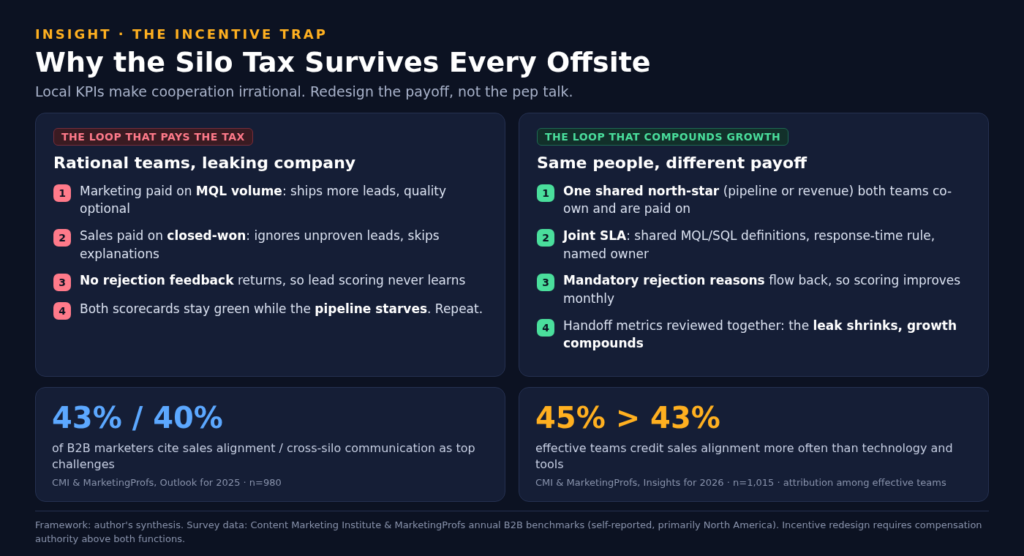
Look at what each team is actually paid to do. Marketing’s scorecard says MQL volume. So the rational move is to loosen qualification and ship more leads — quality is someone else’s cost. Sales’ scorecard says closed-won. So the rational move is to ignore unproven leads and spend hours only where deals are near — explaining rejections is unpaid work. Neither team is being lazy or tribal. Both are being perfectly rational, given the game they’re in.
That’s the mechanism: the silo tax is what a company pays when its local incentives are mathematically incompatible with its shared outcome. Every handoff becomes a border where value gets taxed, because crossing it costs one side effort and returns that side nothing.
Why Feedback Dies First
Notice which behavior disappears first under this structure: rejection feedback. Writing a reason code on a rejected lead helps marketing’s scoring improve next month — a benefit that lands entirely on the other team’s scorecard. So it never gets written. Marketing’s model never learns, lead quality never improves, sales’ distrust becomes self-fulfilling, and the loop tightens. The missing feedback isn’t a communication failure; it’s an externality. Nobody’s budget captures the value of creating it.
The survey data fits this reading uncomfortably well. In CMI and MarketingProfs’ 2025 B2B benchmark (980 marketers), sales alignment (43%) and cross-silo communication (40%) sit near the top of the challenge list year after year — problems that survive endless rounds of tooling and team-building. And in the 2026 edition (1,015 marketers), teams that rate themselves effective credit sales alignment (45%) more often than technology and tools (43%). The people getting results keep pointing at the relationship, while the budgets keep pointing at the software.
The Uncomfortable Implication
If the tax is structural, then the fix has to be structural too — and it lives higher up the org chart than most alignment initiatives dare to go. Shared dashboards don’t change payoffs. Joint meetings don’t change payoffs. Only moving a meaningful slice of both teams’ compensation onto one shared number changes payoffs. That requires an executive with authority over both scorecards, which is why real alignment is a governance decision, not a marketing initiative.
So the next time an offsite fails, don’t conclude that people don’t want to cooperate. They do. They’re just being paid not to.