Stop Planning the Year. Start Compounding Quarters.
Every November, marketing teams perform the same ritual. They open a fresh deck, forecast twelve months of campaigns, allocate a budget down to the last channel, and present the whole thing to the CFO with confident charts. By February, the market has moved. By March, the plan is a PDF nobody opens. Sound familiar?
Here’s the uncomfortable truth: the annual marketing plan isn’t failing because your team is lazy. It’s failing because a year is the wrong unit of work. The fix isn’t a better forecast. It’s a shorter loop — ninety days, one initiative, one honest result, and a plan for the next quarter written from what you just learned.
This is the 90-day marketing plan: a repeatable launch loop you can run every quarter. Let’s break down why it works, how to run it, and where it can quietly betray you.
Executive Summary
The annual plan is direction; the quarter is execution. Ninety days is long enough to run a full plan-build-launch-learn cycle and short enough to finish before the assumptions rot. The research backs the instinct: companies that actively reallocate resources out-earn static ones by a wide margin, agile delivery beats waterfall on success rates, and marketing budgets themselves are now managed under quarterly constraint. The teams that win don’t plan the year harder — they compound quarters, feeding each loop’s learning into the next loop’s plan.
Why Annual Plans Fail
Three failure modes, and you’ve probably lived all of them.
The forecasting fantasy. A twelve-month plan pretends to predict a market that re-prices, re-regulates, and re-platforms every quarter. Consider the environment CMOs are actually planning into: Gartner’s 2026 CMO Spend Survey (401 marketing leaders across North America, the UK, and Europe) found budgets stuck at 7.8% of company revenue — flat since 2022 and roughly 18% below the level of four years ago — with 56% of CMOs saying they lack the budget to deliver their own strategy. When the ground shifts that fast, a plan written last November is fiction by spring.
The commitment paradox. Teams over-commit in January — everything is a priority — then abandon the plan at the first shock. The document survives; the system doesn’t. The CMO Survey’s 35th edition (Duke Fuqua, Deloitte, and the AMA; 308 U.S. marketing leaders, January 2026) captures the mood: overall spending growth has slowed to 1.7%, budgets sit at their lowest share of revenue since 2021, and marketing leaders’ pessimism is at its highest since the pandemic. Nobody executes a fantasy plan with conviction.
The learning-orphan problem. Annual plans are written before evidence arrives and rarely rewritten after. Next year’s plan repeats this year’s assumptions because nothing forced anyone to check them.
The reframe: the annual plan isn’t worthless. It’s the direction. But direction without a quarterly execution loop is a vision with no engine.
Anatomy of the 90-Day Loop
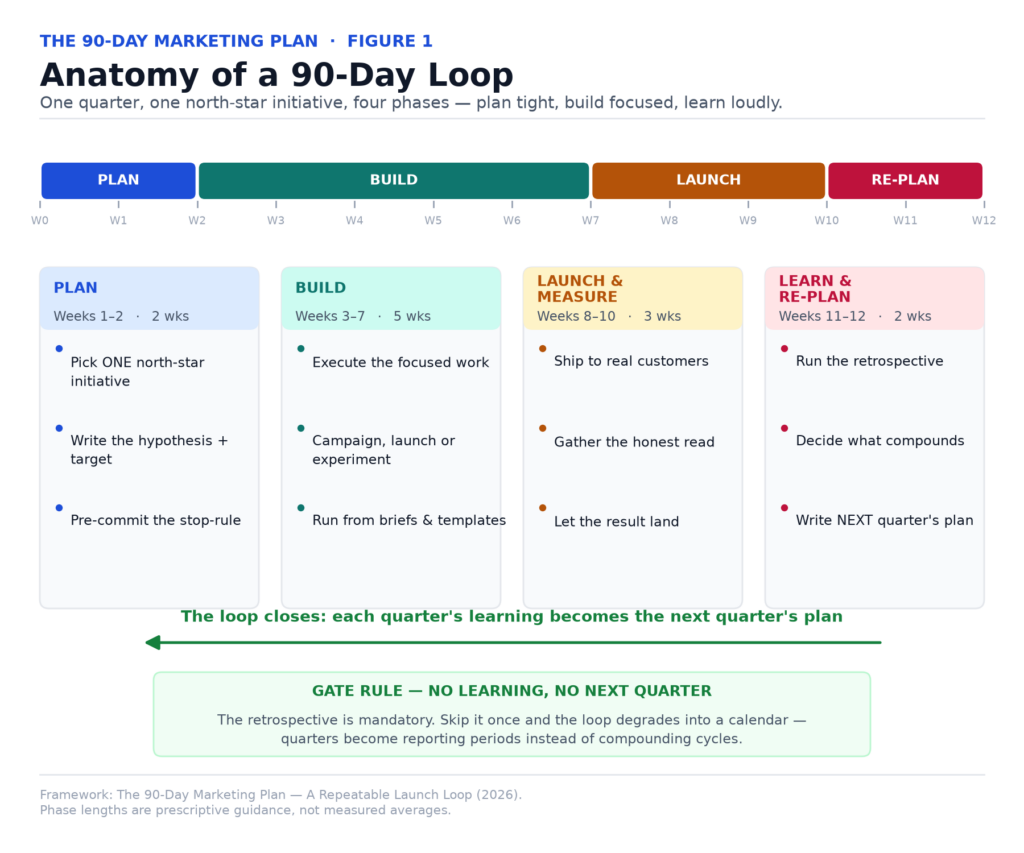
Every quarter runs the same four phases.
- Plan — the first two weeks. Pick one primary initiative that moves a north-star metric. Write a hypothesis and a target, not a to-do list of everything. If you can’t state what number should move and why, you’re not planning; you’re wishing.
- Build — weeks 3 to 7. Execute the focused work: the campaign, the launch, the experiment. Run it from briefs and templates so the team spends its energy on decisions, not formatting.
- Launch & measure — weeks 8 to 10. Ship to real customers, gather the honest read, and let the result land. Not the read you hoped for. The read the data gives you.
- Learn & re-plan — weeks 11 to 12. Run the retrospective, decide what compounds, and write next quarter’s plan from the learning. The loop closes — or it was never a loop.
Notice what this structure does: it makes the plan phase the shortest phase. Two weeks of thinking, ten weeks of doing and learning. Most annual planning inverts that ratio, and it shows.
Why 90 Days Is the Right Unit
Is ninety days arbitrary? No — it sits at the intersection of three real constraints.
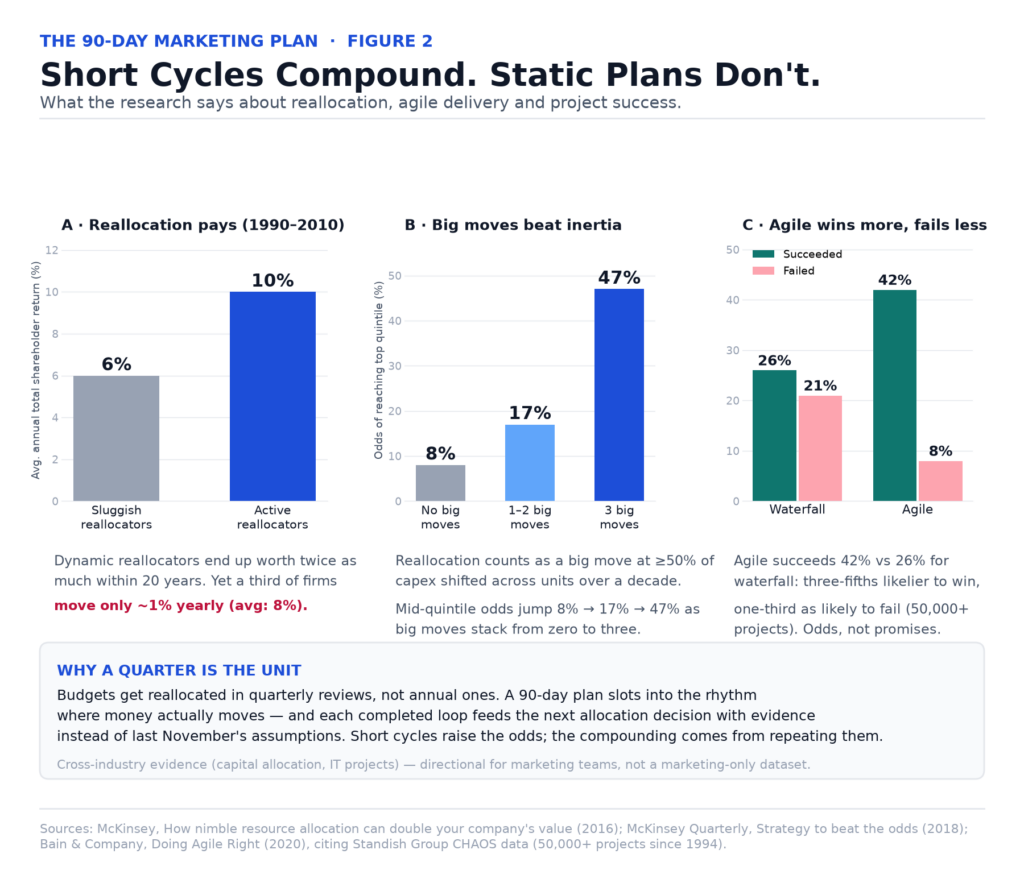
It matches the decision cadence. Quarterly reviews are where budgets actually get reallocated. McKinsey’s research on resource allocation found that companies which actively shift resources deliver, on average, a 10% annual total return to shareholders versus 6% for sluggish reallocators — and within twenty years the dynamic reallocator is worth twice as much. Yet a third of companies move barely 1% of their capital year to year. A 90-day plan slots into the rhythm where money actually moves, instead of fighting it.
It’s long enough to see an effect, short enough to stay honest. Activation and pipeline moves show up within a quarter. The CMO Survey found the median duration of marketing’s impact on customers has lengthened to six months — which means even short-term effects outlive a single campaign, and you’re never more than ninety days from a course correction.
It caps the fantasy. You cannot put everything into twelve weeks. The quarter forces the trade-off the annual plan never forces: what is the one move that matters most? McKinsey’s strategy research found that mid-tier companies have just 8% odds of reaching the top quintile of economic profit — but one or two big moves raise those odds to 17%, and three moves to 47%. The lesson isn’t “do more.” It’s that deliberate, stacked moves beat inertia. A quarter is the natural container for one such move.
The Evidence That Short Cycles Win
The ninety-day instinct isn’t just vibes. Three independent research streams point the same way.
Reallocation beats inertia. Beyond the returns gap above, 83% of executives in McKinsey’s research named reallocation the top management lever for growth — ahead of operational excellence or M&A. The threshold that separates dynamic reallocators from the rest is striking: shifting at least 50% of capital expenditure across business units over a decade. Static budgets aren’t neutral; they’re a slow leak.
Agile delivery beats big-bang delivery. The Standish Group’s CHAOS database — more than 50,000 projects tracked since 1994, analyzed by Bain in Doing Agile Right — shows agile projects succeeding 42% of the time versus 26% for waterfall, and failing 8% versus 21%. Agile work is three-fifths more likely to succeed and about one-third as likely to fail. Short feedback loops don’t guarantee outcomes; they improve the odds.
Marketing-specific proof exists too. When John Deere applied agile methods to its Enterprise Advanced Marketing group, HBR reported that work accomplished per sprint rose on average by more than 200%, with some teams above 400% and one team up 800%. A new machine-form concept went from idea to working prototype in about eight months — a process that traditionally took eighteen months at best. And McKinsey’s agile marketing guide documents teams that once needed months to field a simple offer shipping in under two weeks, with revenues in agile-run segments growing by as much as a factor of four.
The pattern across all three: the win doesn’t come from moving fast once. It comes from repeating a short cycle until learning compounds.
How to Run the Loop: Four Operating Rules
A framework without rules is a poster. Here are the four that make the loop repeatable.
Rule 1 — One north-star initiative per quarter. The loop fails when you chase five priorities. Pick the single move that matters most and give it the quarter. Everything else is maintenance or backlog. This feels wasteful until you remember that five half-finished initiatives produce zero measured results.
Rule 2 — Name the target and the stop-rule up front. What number proves it worked? What will you do differently if it didn’t? Pre-commit both, like a good experiment. A stop-rule written after the results arrive isn’t a rule; it’s a rationalization.
Rule 3 — Keep a running decision-log. Every choice and its rationale, recorded as you go. Retrospectives without a log are memory contests, and the loudest person wins. The log is the compound asset: it’s what lets next quarter’s plan inherit this quarter’s judgment instead of this quarter’s folklore.
Rule 4 — Gate the next plan on the last retrospective. No learning, no next quarter. If the retro gets skipped, the loop is just a calendar with nicer branding. Make the re-plan phase mandatory and put it on the calendar before the quarter starts — weeks 11 and 12 belong to learning, not to one more campaign.
The Quarterly Trap: Brand Effects Outrun the Quarter
Now the honest caveat, because a 90-day obsession has a failure mode of its own.
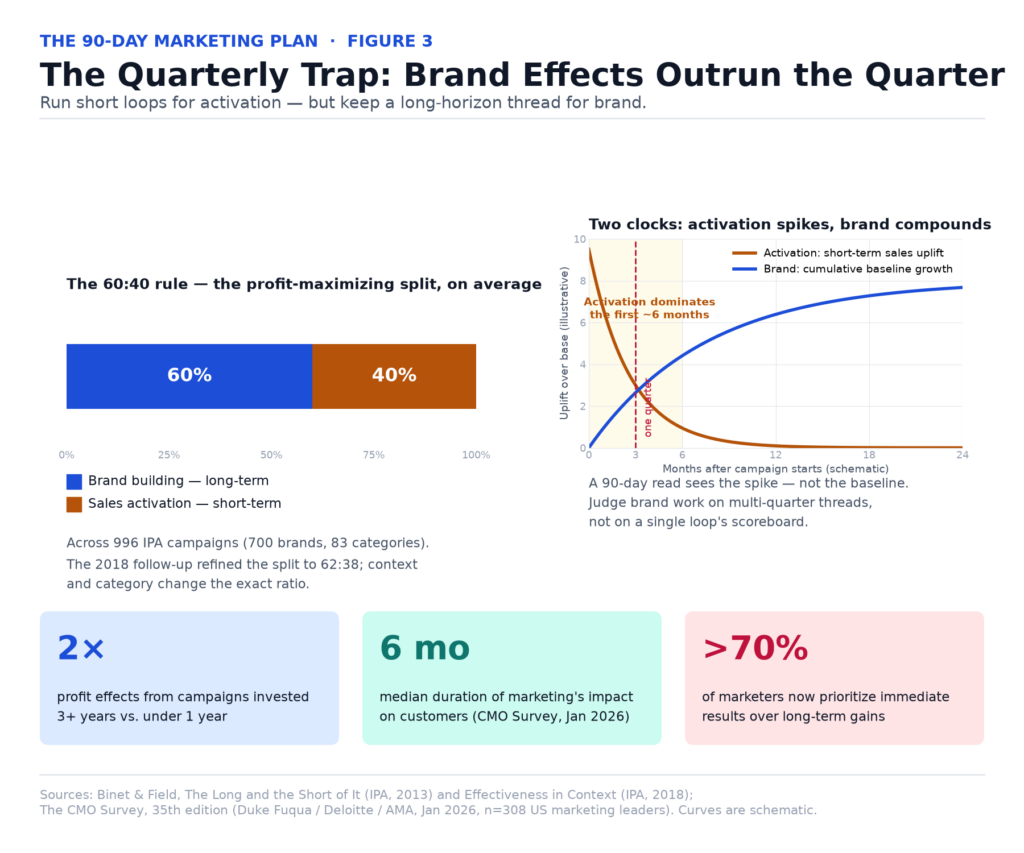
Binet and Field’s analysis of the IPA Effectiveness Databank — 996 campaigns, 700 brands, 83 categories — found that short-term activation effects dominate for roughly the first six months, while brand-building effects accumulate slowly and keep paying for years. Their famous 60:40 rule (roughly 60% of budget to long-term brand building, 40% to activation, refined to 62:38 in the 2018 follow-up) exists precisely because the two effects run on different clocks. Campaigns sustained for three-plus years deliver about double the profit effects of campaigns under a year.
Read that again next time a quarterly dashboard screams that brand spend “isn’t working.” A ninety-day read sees the activation spike; it cannot see the baseline rising underneath. And the industry is drifting the wrong way: the share of IPA campaigns running under six months grew from under 10% to about 25% over a decade, while the CMO Survey found more than 70% of marketers now prioritize immediate results over long-term gains — even as acquisition budgets remain 26% larger than retention budgets that demonstrably perform better.
The fix isn’t abandoning the loop. It’s holding two time horizons at once: run activation inside the quarter, and run brand as a thread across quarters — measured on multi-quarter trends, protected from any single loop’s scoreboard.
Risks and Honest Caveats
Beyond the brand trap, three more ways the loop dies:
- The forced fit. Some real initiatives — a rebrand, a platform migration — don’t fit ninety days. Don’t amputate them to fit the loop; run them as threads across loops with quarterly milestones.
- The plan-obsession trap. The loop is for doing. If your plan phase grows ornate decks and pre-meetings, you’ve rebuilt the annual plan in miniature. Two weeks, one page, one hypothesis.
- The cadence drift. Loops die when the retrospective gets skipped “just this once” during a busy month. The discipline is the entire value. A loop with occasional retrospectives compounds nothing — it just reports.
And one epistemic caveat worth stating plainly: the strongest numbers here come from capital allocation and software-project research, not marketing-only trials. They justify the shape of the loop — short cycles, active reallocation, honest measurement. Your mileage will vary by category, and anyone promising you a guaranteed 42% success rate is selling something.
Conclusion: Direction Lives in the Annual, Momentum in the Ninety
The annual plan is where marketing strategy goes to be optimistically wrong and quietly abandoned. The 90-day plan is the realistic unit of work: one north-star initiative, a full build-launch-learn loop, and a result measured honestly before the next quarter is written.
Run the loop — plan tight, build focused, learn loudly, re-plan from the learning — and quarters stop being reporting periods and become compounding cycles. Keep the annual plan as your compass. But put the engine in the ninety days.