OpenAI’s ChatGPT Wallet Lets AI Agents Complete Purchases — With a Human Finger on the Trigger
The card networks are in, the crypto rails are out, and merchants now have to decide whether to let the agents through the door.
OpenAI on Friday, November 13, 2026 launched ChatGPT Wallet, a payment feature that lets its “dots” shopping agents finish online purchases on a user’s behalf — without ever seeing the user’s real card number. It is the first time a major AI assistant has closed the loop from product recommendation to completed checkout using ordinary card payments, and it arrived with American Express, Mastercard and Visa as development partners rather than a crypto wallet or a new payment network.
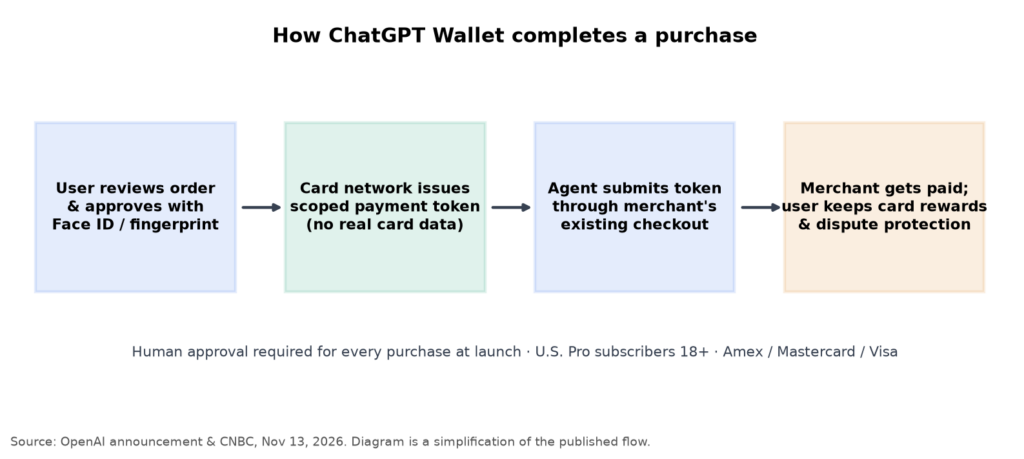
The design choice matters more than the feature list. Every purchase at launch requires the user to review the items, the total and the selected card, then approve with Face ID or a fingerprint. Only then does the card network issue a scoped payment token — a substitute card number, security code and expiry — that the agent passes through the merchant’s existing checkout. The real card details never reach the agent or the store. Users keep their card rewards and eligible dispute protections; merchants keep control of pricing, fulfillment, returns and customer service.
What actually shipped
The rollout is deliberately narrow: ChatGPT Pro subscribers aged 18 or older in the United States, with eligible U.S.-issued American Express, Mastercard or Visa cards. Wallet lives inside dots conversations, not ordinary ChatGPT chats. OpenAI says 1.2 billion people use ChatGPT each week, many of them to research and compare products — the wallet is aimed at converting that research traffic into completed transactions.
OpenAI told CNBC it is not taking a cut of transactions to start. That is a distribution play, not a margin play: the company is buying merchant relationships and consumer habit before it worries about monetization. Alongside the wallet, OpenAI published a Commerce Partner Playbook covering product feeds, payment and risk integration, and agent access via Web Bot Auth signed requests so that CDNs and firewalls can distinguish a legitimate shopping agent from a scraper. Fraud-prevention partners listed at launch include Forter, Riskified, Sardine and Signifyd; payment service partners include Adyen, Checkout.com and Stripe.
This is a different architecture from OpenAI’s Instant Checkout, introduced with Stripe in September 2025, which required participating merchants to build a dedicated integration. Wallet instead lets agents navigate ordinary storefronts and use the checkout forms that already exist. Three days before the wallet launch, OpenAI also introduced business profiles that let companies update product information and engage potential customers inside ChatGPT — the supply-side and demand-side pushes are clearly coordinated.
The trust problem is now a merchant problem
OpenAI’s own terms acknowledge the friction: some websites may block shopping agents outright, and risk systems may flag legitimate Wallet purchases as fraud. That is not hypothetical. Reuters has reported that Amazon blocked Meta’s Muse agent, and United Airlines announced restrictions on third-party assistants operating without authorization in its booking channels.
For merchants, the decision is no longer abstract. An agent that can pay is also an agent that can comparison-shop your margin, and blocking it may mean disappearing from the answer a customer’s assistant gives. The playbook’s Web Bot Auth mechanism is effectively an invitation to whitelist agents selectively — authentication first, blocking later. Expect the next battleground in agentic commerce to be access policy, not payment rails.
The card networks, for their part, had every reason to join. If agents become a primary shopping entry point, the worst outcome for Visa, Mastercard and Amex would be transaction volume migrating to a new network — stablecoin-based or otherwise. By issuing the tokens themselves, they keep the new channel wired into existing clearing, rewards and chargeback infrastructure. Sherri Haymond, Mastercard’s global head of digital commercialization, framed it bluntly in the announcement: an agent making a purchase “should strengthen, not bypass, the trust built into payments.” For American Express, this is its first integration under its Agentic Commerce Experiences program.
What’s next, and what to watch
OpenAI says it plans to let users pre-authorize future purchases within spending limits, product categories or time windows — full delegation, with guardrails. No date has been given. Until then, the human-in-the-loop requirement is the product’s defining constraint and its main safety argument.
Three things will determine whether Wallet becomes infrastructure or a demo:
- Merchant acceptance. Whether large retailers whitelist agents or block them will decide where agent-driven demand actually lands.
- Fraud outcomes. If tokenized agent purchases produce elevated dispute rates, issuers will tighten approval flows and the convenience case erodes.
- The delegation step. Pre-authorized spending is where the economics change — and where regulators and consumer groups will focus first.
The broader signal: the industry’s first production-grade answer to “how does an agent pay?” was not a new rail. It was a scoped credential on the old one, with a biometric checkpoint and a named institution to call when something goes wrong. That is a liability-allocation product as much as a payments product — and it is probably why it shipped.