The Content Engine: How to Ship, Multiply, and Refresh on a Loop That Compounds
Open your company blog and scroll to the most recent post. Now look at its date. If it landed three months after the one before it, you’ve already found the problem — and it isn’t a shortage of talented writers.
Every content team knows the rhythm I’m describing. A launch is coming, so everyone sprints. Six posts go live in two weeks. Then the launch ships, the roadmap swallows the team, and the blog goes quiet for a quarter. Your audience notices. So do search engines. And when you finally come back, you’re rebuilding trust from zero — again.
Here’s the uncomfortable truth: the blogs and channels that win aren’t the ones with occasional flashes of brilliance. They’re the ones that show up. Every week. On a cadence. And consistency, it turns out, is not a creativity problem. It’s an operations problem. That distinction changes everything about how you fix it — because you can’t inspire your way out of a broken pipeline, but you can engineer your way out.
This piece is about building that pipeline: a content engine that turns publishing from a heroic burst into a boring, beautiful, repeatable function.
Why Content Fails Without an Engine
The feast-or-famine cycle
Without a pipeline, content gets made when someone feels guilty enough to make it. Before a launch. During a slow quarter. When the CEO asks why the blog looks dead. Output arrives in bursts, and between bursts there’s silence — and silence is expensive. Audiences forget you. Rankings slip. Every restart costs more than the last one, because you’re not resuming a relationship; you’re re-introducing yourself.
The benchmark that should sting
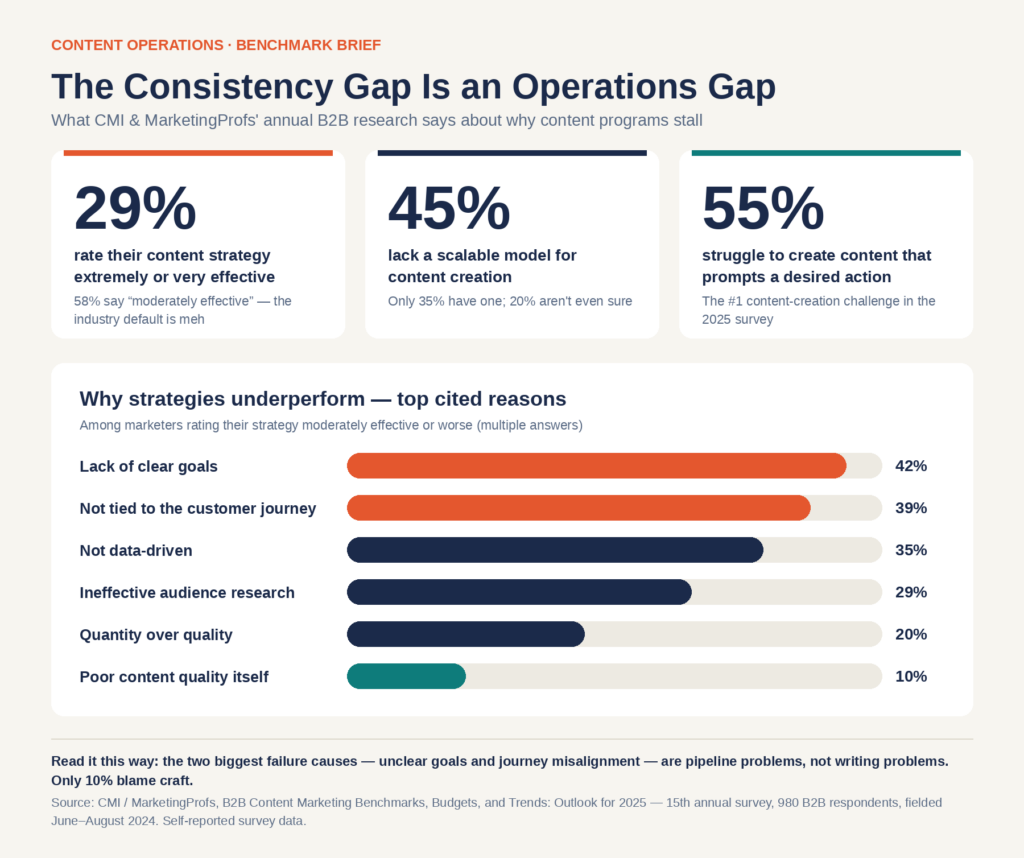
The industry data backs this up, and it’s sobering. In the Content Marketing Institute and MarketingProfs annual B2B survey — the 2025 edition drew 980 B2B respondents, mostly North American, fielded mid-2024 — only 29% of marketers rated their content strategy extremely or very effective. Fifty-eight percent settled for “moderately effective.” That’s the industry default: meh.
Now look at why. Among those rating their strategy moderately effective or worse, the top two culprits were a lack of clear goals (42%) and content not tied to the customer journey (39%). Poor content quality itself? Just 10%. Read that again. The things breaking content programs are overwhelmingly process failures, not craft failures. Teams don’t fail because they can’t write. They fail because nobody decided what the writing is for, where it sits in the buyer’s path, or how it gets made twice.
And the biggest single content-creation challenge that year — cited by 55% of respondents, more than any other option — was creating content that prompts a desired action. Not finding ideas. Not producing volume. Getting a reader to do something. That’s a strategy-and-operations gap wearing a creativity costume.
Creativity doesn’t scale; process does
A brilliant one-off post can win a week. A library of consistent, connected posts wins a market — because each piece compounds: it earns links, feeds internal search, gives sales something to send, and gives AI assistants something to cite. But libraries don’t happen by accident. Only a pipeline produces a library. Nearly half of those same CMI respondents (45%) admitted they lack a scalable model for content creation at all. That’s the gap between a content habit and a content engine.
The Four Components of a Content Engine
A real engine has four connected parts. Miss one and the whole thing stalls — usually at the part you skipped.
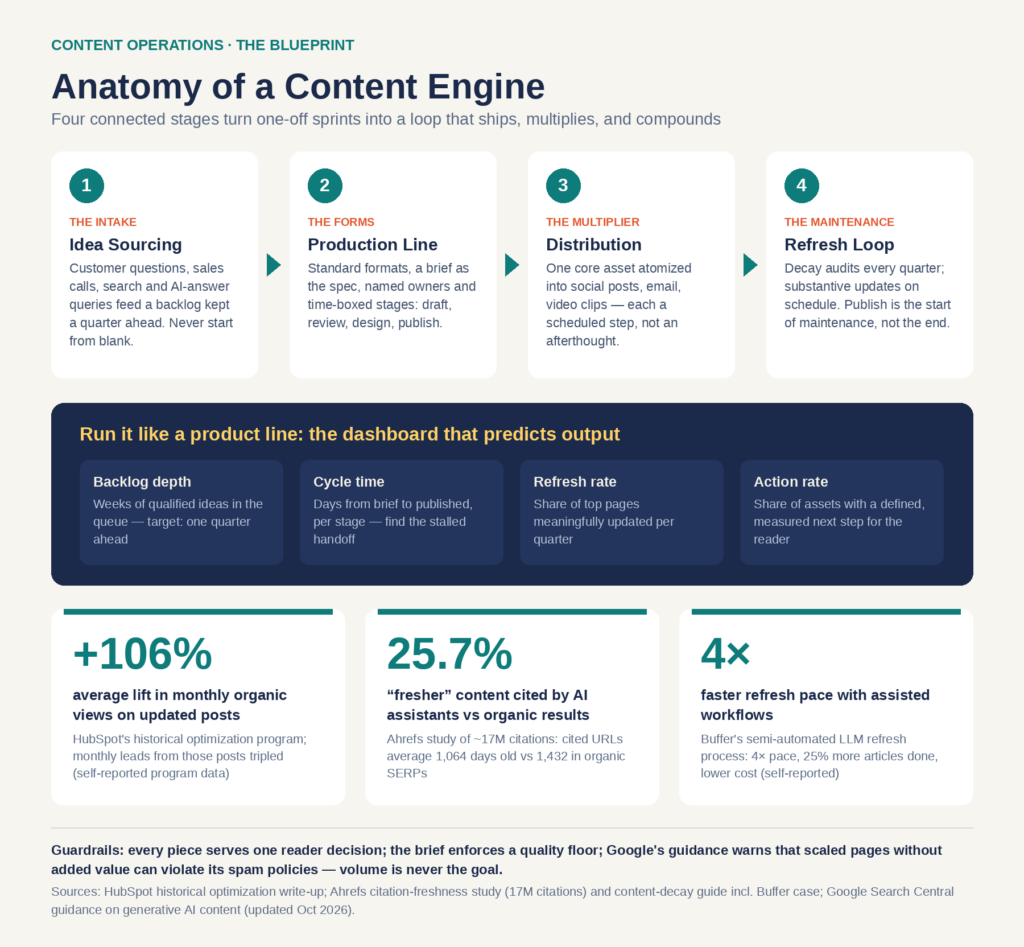
1. Idea sourcing: the intake
The engine’s fuel. Always-on inputs — customer questions, sales-call objections, search queries, competitor gaps, and increasingly the questions people ask AI assistants — flow into a backlog. The rule is simple: you never start from a blank page, because the next ten briefs already exist. Intake is a standing responsibility, not a brainstorm you schedule when you’re desperate.
2. Production line: the forms
Standardized formats with defined owners and templates. A how-to looks like a how-to. A teardown looks like a teardown. The brief is the spec — audience, decision it serves, angle, sources, length — so a piece moves through draft, review, design, and publish without renegotiating the process every single time. Custom negotiation per asset is where calendars go to die.
3. Distribution workflow: the multiplier
One core asset, atomized into many: the blog becomes three social posts, an email, a short video script, a sales one-pager. Each derivative is a scheduled step with an owner, not an “if we have time” afterthought. Publishing is the midpoint of the work, not the finish line.
4. Refresh and compound loop: the maintenance
Published content decays — rankings slip, data ages, competitors improve. The engine treats publish as the start of maintenance: quarterly audits, scheduled updates, substantive refreshes rather than date-stamp theater. This is the part almost everyone skips, and it’s the part with the best-documented payoff, which we’ll get to shortly.
The Operations Mindset Shift
Treat content like a product line, not an art project
Products ship on a roadmap with a spec, an owner, and a release date. Content deserves the same respect. The brief is the spec. The editorial calendar is the roadmap. The retrospective — what shipped, what stalled, what performed — is the sprint review. None of this kills creativity; it gives creativity a frame to fill instead of a void to panic in.
Decouple creation from inspiration
Here’s the quiet superpower of an engine: you can produce on a bad-creativity day. The audience is decided, the format is decided, the angle is decided, the sources are gathered. Craft fills the frame; it doesn’t have to build the frame from scratch at 4pm on a Thursday. Inspiration becomes a bonus, not a dependency.
Measure throughput and health, not just hits
Viral spikes are lottery tickets. Pipeline metrics are predictors: weeks of qualified ideas in the backlog, days from brief to publish per stage, share of top pages refreshed per quarter, share of assets with a defined reader action. When cycle time balloons, you can see exactly which handoff is broken — the reviewer who’s underwater, the designer with no SLA — and fix that, instead of vaguely resolving to “try harder next month.”
How to Stand Up an Engine: The Build Path
Start with one lane, not all channels
Pick one format — say, the weekly how-to — and build its loop end to end before you touch anything else. Prove the cycle works, measure it, then replicate the pattern into a second lane. Teams that try to launch six formats at once usually end up with six half-built pipelines and zero finished loops.
Backlog first, calendar second
Fill the idea backlog a quarter ahead before you commit to a publishing calendar. A calendar without a backlog is a countdown to panic; a backlog without a calendar is potential energy. You want both, in that order. Intake is the engine’s fuel — if the tank runs dry, no amount of process discipline will move the belt.
Name owners and SLAs at every stage
Draft, review, design, publish. Each stage gets a named human and a time-box. “The team will review it” means nobody will review it. Loops stall at handoffs, not at keyboards — so instrument the handoffs. Two days for review, one day for design, whatever fits your team, but written down and agreed, not implied.
Build the refresh loop from day one
Schedule the maintenance when you schedule the publish — not someday, not when traffic dips. The evidence for why this matters is unusually strong, and it comes from a team that actually ran the experiment at scale.
Refresh Is Where the Compounding Lives
The HubSpot experiment
When HubSpot’s blog team stopped treating old posts as sunk costs and started systematically updating and republishing them, their monthly organic views on those updated posts rose 106% on average — and monthly leads from those posts roughly tripled. They eventually scaled the program to a couple of updates per week. That’s not a marginal gain from new heroics; that’s doubling the yield of assets you already paid for, on a schedule. (This is HubSpot’s own program data, self-reported — but it’s one of the most replicated results in content operations.)
Why decay is physics, not bad luck
Ahrefs, whose SEO tooling sits on a large crawl index, defines content decay plainly: the gradual decline of a page’s traffic and rankings as the web moves around it — competitors publish better answers, intent shifts, your statistics age. Their recommended countermeasure is unglamorous and effective: a quarterly decay audit, flagging any page down more than 20% year over year, then deciding deliberately between update, consolidate, rewrite, or prune. Maintenance as a recurring process — exactly what an engine makes possible.
AI assistants reward fresh pages, too
The maintenance case just got stronger. Ahrefs analyzed roughly 17 million cited URLs and found that AI assistants cite content averaging 1,064 days old, versus 1,432 days for pages in organic search results — about 25.7% fresher. ChatGPT’s citations skewed even newer. One caveat worth stating: that’s an association, not proof that recency causes selection. But directionally it’s hard to ignore — the answer engines assembling recommendations for your buyers are reaching for maintained pages more than search alone does. A refresh loop is now a GEO strategy, not just an SEO one. (Ahrefs sells SEO and AI-visibility tooling, so treat this as vendor research — large sample, but their data, their framing.)
And maintenance can itself be systematized. Buffer’s growth marketing director described a semi-automated refresh workflow using LLM agents that quadrupled their refresh pace while getting 25% more articles done at lower cost — again, self-reported, but the pattern is the point: the refresh loop is a pipeline too, and pipelines can be accelerated.
The 2027 Speed Trap: Why Faster Isn’t Better
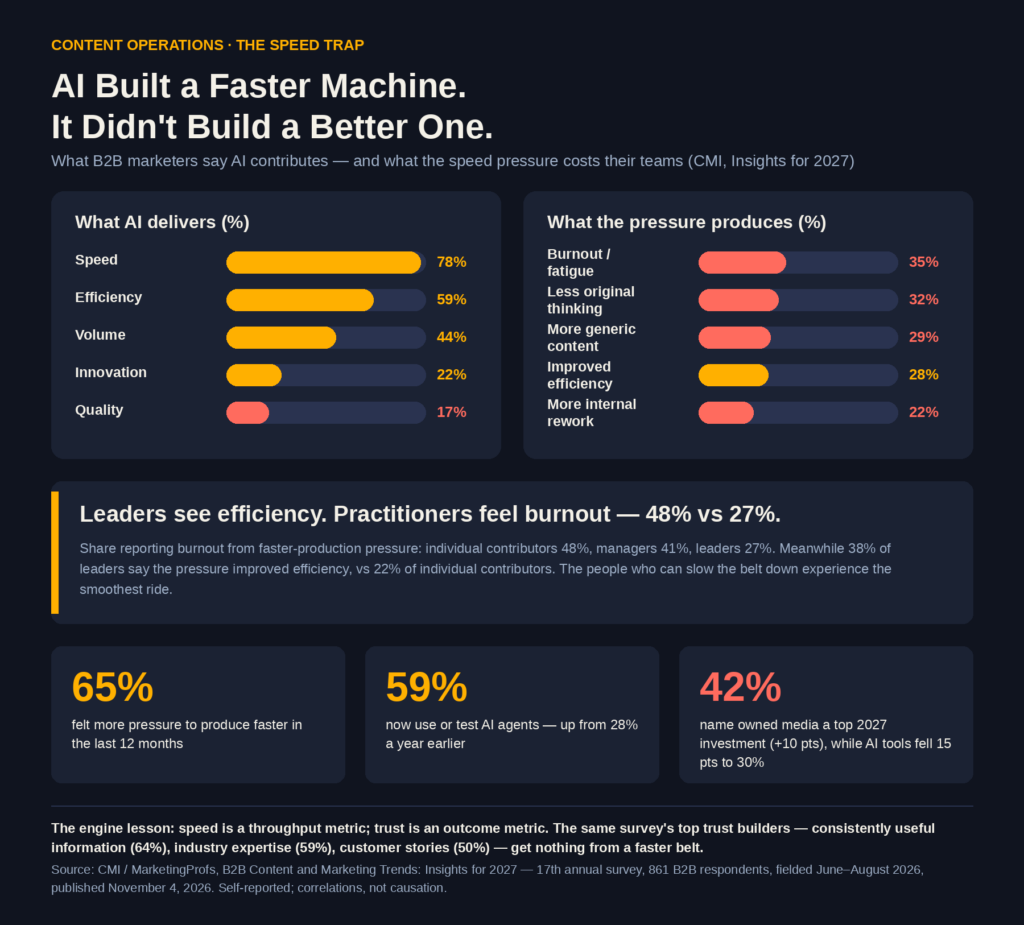
Just when engines got easier to build, a new failure mode appeared. CMI’s newest survey — the 17th annual edition, 861 B2B respondents, published November 4, 2026 — found that 88% of teams now use AI content tools, and agent usage has jumped from 28% to 59% in a year. But ask what AI actually contributes, and the answers are telling: speed (78%), efficiency (59%), volume (44%) — while quality lands near the bottom at 17%.
Meanwhile, 65% of marketers say pressure to produce faster increased over the past year. And what did that pressure produce? Burnout or creative fatigue (35%), less original thinking (32%), more generic content (29%). Improved efficiency came in fourth, at 28%. The belt sped up, and the chocolate started getting wrapped worse — Robert Rose’s I Love Lucy analogy, and it fits.
The stratification is the most damning part. Among individual contributors, 48% report burnout from the speed pressure; among leaders, 27%. Leaders are also far likelier to say the pressure improved efficiency (38% versus 22%). The people who can slow the conveyor belt experience the smoothest ride. If your engine’s dashboard only measures throughput, you will optimize exactly this outcome: more output, less thought, exhausted writers — and you’ll call it productivity right up until the quality collapse shows up in your numbers.
Risks and Honest Caveats
The volume-for-its-own-sake trap
An engine without a decision behind each piece produces “publish and pray” content at industrial scale. Remember that 55% figure — the top challenge is prompting action, not producing text. Every brief should name the one decision the piece helps a reader make. If you can’t name it, the piece doesn’t enter the pipeline. Speed multiplies whatever you feed it; feed it ambiguity and you get ambiguity, faster.
The AI-shortcut trap
The 2025 survey already showed the ceiling: 81% of teams used generative AI, but only 17% rated its output excellent or very good, and just 4% of teams reported high trust in what the tools produced. That’s teams rating their own outputs — a confidence gap, not an audience study, but it lines up with what most editors see daily. Google’s own guidance is blunt: using AI to generate many pages without adding value for users may violate its spam policies on scaled content abuse, and it expects human fact-checking before publication — a stance Google extended to AI-generated search answers in 2026. AI belongs in the engine as an accelerator inside the quality gates — research, drafts, refresh passes — never as a bypass around them.
The pipeline-over-strategy trap
An engine optimizes whatever you point it at. Without a content strategy above it — audience, positioning, the journeys you’re serving — you’ll efficiently produce content nobody needed. Strategy steers; the engine ships. Confusing the two is how teams end up with beautiful dashboards and flat pipelines.
Conclusion: Build the Loop, Then Let It Compound
No one ever won an audience with occasional brilliance. They won it by showing up — and showing up is a systems outcome, not a personality trait. The data keeps pointing at the same place: the failure causes are unclear goals, journey misalignment, and content that doesn’t prompt action — operations gaps, every one. And the newest benchmarks add a warning: AI made the belt faster without making the chocolate better, so the engine has to enforce quality, not just cadence.
So build the loop. One lane first. A backlog a quarter deep. Named owners and time-boxes at every handoff. Distribution as a scheduled step. And a refresh rhythm from day one — because the compounding lives in maintenance, and the answer engines are already rewarding it. Do that, and consistency stops being a discipline you force. It becomes the way the team works.