AI Marketing’s Real Gap Isn’t Technology — It’s Organizational Readiness
AI Marketing Moves From Pilot to Operational Backbone
The pilot era of AI marketing is over. Sometime in the past year, the industry stopped asking whether marketing teams should use AI and started asking a harder question: why don’t the returns match the adoption? The answer, across nearly every credible 2026 survey, is that most teams have the tools but not the operating model built around them. That is the story now — and it is the gap that will separate the winners from everyone else.
Adoption is no longer the story
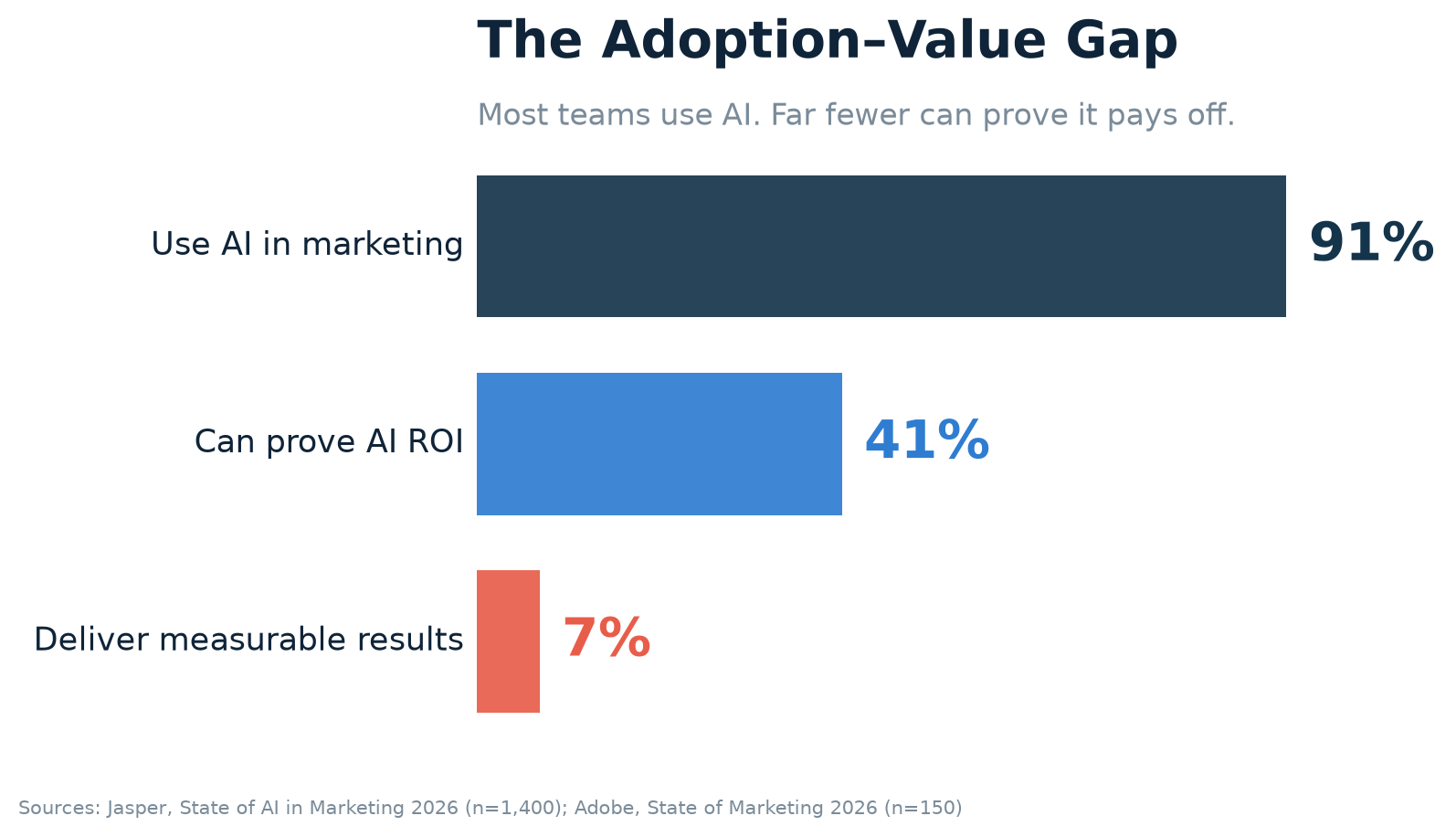
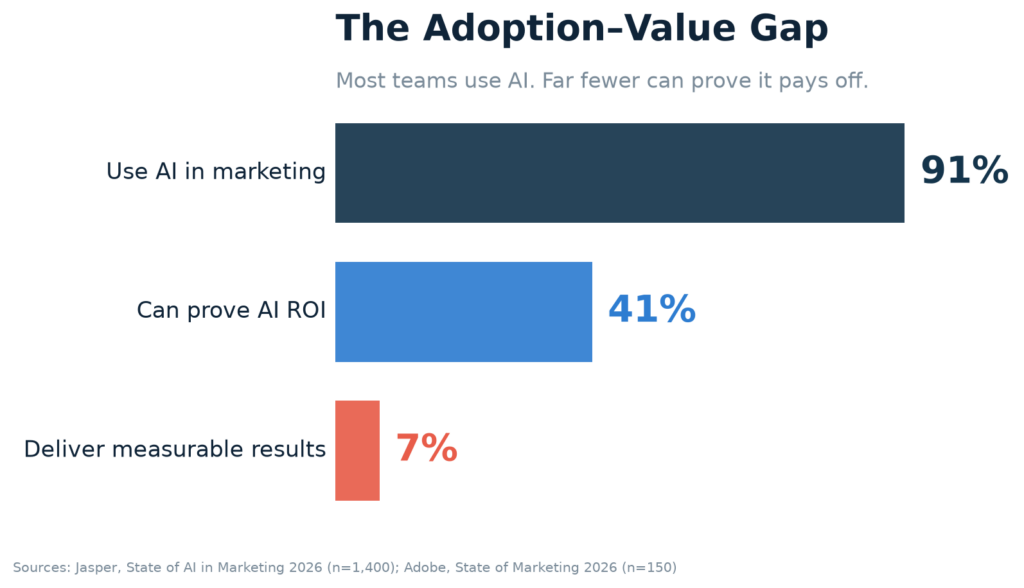
Start with the adoption numbers, because they have quietly become boring. The CMO Survey, run by Duke University, Deloitte, and the American Marketing Association, found AI use in marketing has more than tripled since 2022, with companies projecting AI will account for more than half of all marketing activities within three years. Jasper’s State of AI in Marketing 2026 report, drawn from 1,400 marketing professionals, is even more direct: 91% of marketing teams now use AI, up from 63% a year earlier.
When nearly every team has access to the same models and tools, access stops being a competitive advantage. It becomes table stakes. The conversation has moved from getting AI into the stack to what you do with it once it is there — how you govern it, how you wire it into daily workflows, and how you prove it is moving a number that matters.
The bottleneck is value, not tools
Here is where the picture turns uncomfortable. Adobe’s State of Marketing in an AI-Driven World report — a survey of 150 marketing leaders and practitioners across the US, UK, Canada, France, and Germany — found only 7% of organizations have embedded AI in ways that deliver measurable business results. Adoption is near-universal, but fewer than one in ten teams has turned it into something they can actually count.
The CMO Survey makes the same point from the academic side, and more sharply: no marketing-technology activity scores above 5 on its 7-point performance scale. That includes the basics — integrating technology into the customer funnel, and generating ROI from marketing technology. Jasper adds the falling-confidence detail: only 41% of marketers say they can confidently prove AI’s return on investment, down from 49% a year earlier. Confidence in returns is dropping even as adoption climbs.
That is not a contradiction; it is a raised bar. Teams used to measure AI by hours saved. Now they are judged on pipeline and revenue, and most cannot yet make that connection. The payoff is real for those who do: among marketers who track AI ROI, 60% report at least a 2x return. The value exists. It just does not show up automatically.
The gap is the operating model
So what is actually in the way? Not the technology. Adobe’s sharpest finding is that the biggest barriers to scaling AI are old organizational weaknesses the technology has made more visible: inconsistent workflows (51%), lack of centralized coordination (47%), and insufficient training (44%).
The CMO Survey reaches the same conclusion in different words. It calls the barriers “decidedly organizational” — budget, integration, bandwidth, and talent. And it backs that with a telling number: training budgets have fallen to just 3.8% of marketing spending, down from a pre-pandemic high of 5.8%. Teams are being asked to run AI at scale while spending less, not more, on the people who have to operate it.
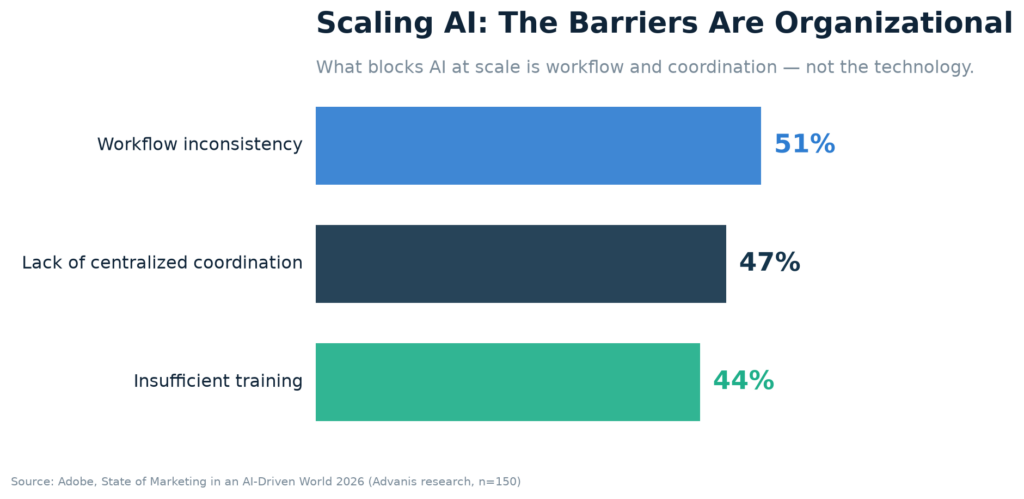
The pattern is unmistakable. You cannot bolt AI onto a fragmented workflow and expect it to scale. When content is created in one system, reviewed in another, activated in a third, and performance data lives somewhere else entirely, AI speeds up individual steps without ever connecting them. That is what Adobe means when it warns that adoption without coordination keeps AI “tactical rather than transformative.”
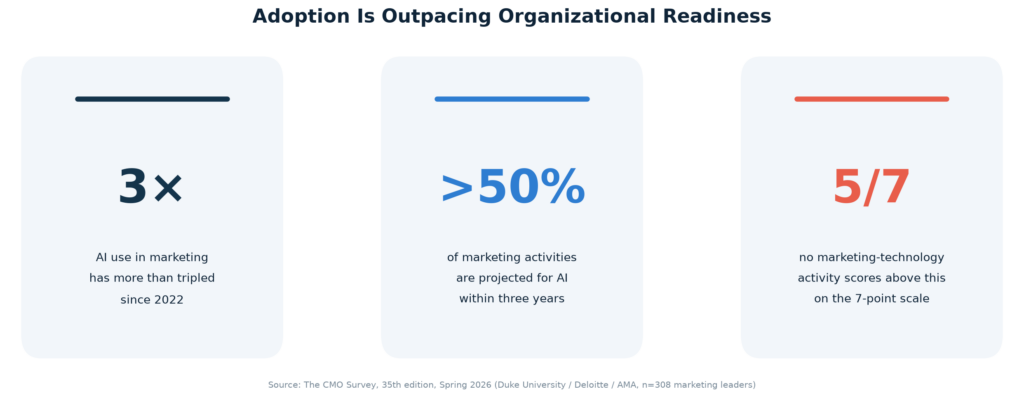
The teams pulling ahead are treating AI as a system to orchestrate, not a set of tools to subscribe to. They are rewiring the workflow around AI rather than retrofitting AI into the workflow they already have.
China runs the same experiment at a different scale
The pattern is not unique to Western markets. At the 33rd China International Advertising Festival in October 2026, CTR — one of China’s leading market research organizations — reported 94.1% of Chinese advertisers had already invested in AI marketing. Yet 60.3% rated their results as only mediocre.
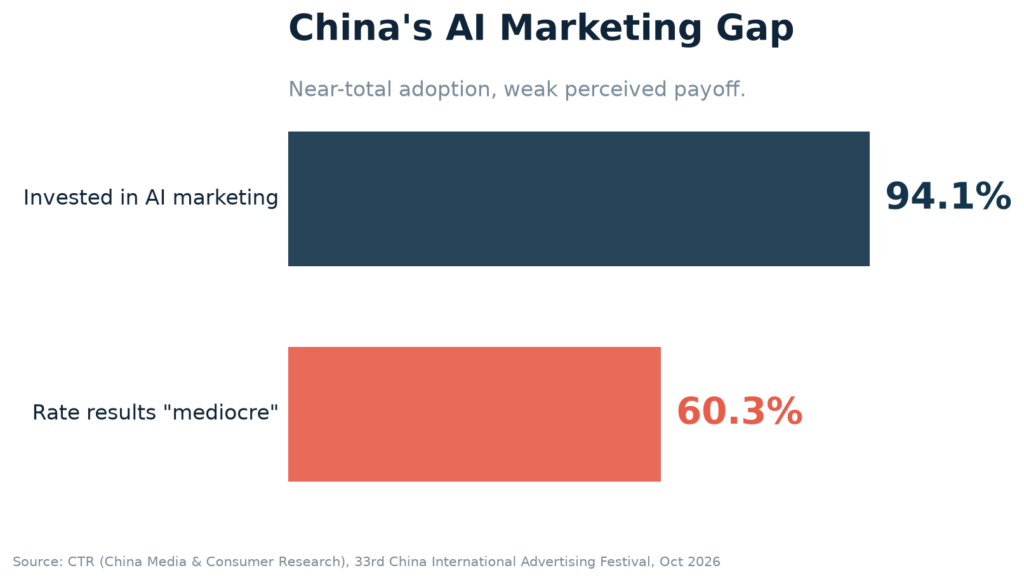
That is the same gap, compressed and amplified: near-total adoption on one side, weak perceived payoff on the other. China reached AI-marketing mainstream before its measurement caught up — the exact trap the rest of the world is now trying to avoid.
The framing that actually helps
So what should a reader do with all this? One actionable way to think about it: stop treating AI as something you buy and start treating it as something you build.
The competitive gap is no longer access to AI tools. It is the operating model around them — the workflows, the governance, the measurement, and the people who own all three. The teams that win will not be the ones with the most AI licenses. They will be the ones who can answer a single question for every AI initiative: what business outcome did this move, and how do we know?
That is a management problem dressed up as a technology problem. And that is why it is finally getting interesting.