Beyond the Results Page: Why Brands Now Pay for Share of Voice in AI Answers
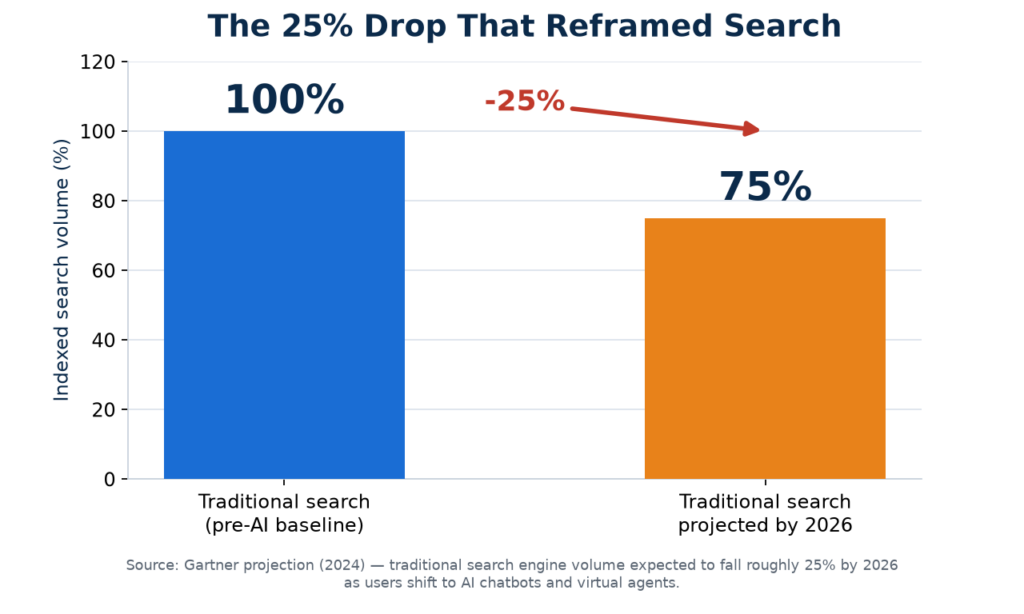
The number everyone kept quoting came out of Gartner back in early 2024, and by late 2026 it finally stopped feeling like a prediction and started feeling like a spreadsheet: traditional search volume was projected to fall roughly 25% by 2026 as users and systems alike route their questions through AI-generated answers instead of a results page. What changed in the past twelve months is not that people started asking AI for answers. It is that the discipline built around getting cited inside those answers — Generative Engine Optimization, or GEO — became a real line item.
It now has its own agencies, its own tracking tools, its own executive owners, and, most tellingly, its own budget. Here is what that shift actually means for marketers, and why treating GEO as SEO with a new coat of paint is a mistake that is about to get expensive.
The Gartner Benchmark Nobody Could Ignore
The forecast is worth stating precisely, because it frames everything that followed. Gartner projected that by 2026 traditional search engine volume would drop around 25%, with search marketing losing share to AI chatbots and other virtual agents. The prediction was made in early 2024, before most of today’s answer engines had meaningful scale.
That timing matters. The 25% figure was not a slow, gradual decline measured after the fact — it was an early, deliberately attention-grabbing call about a structural shift. It gave executives permission to start planning for a world where the blue links are no longer the primary storefront, and it gave birth to a question that now has its own discipline: if answers replace listings, how does a brand get into the answer?
What GEO Actually Is
Generative Engine Optimization is the practice of improving how often and how favorably a brand appears inside responses generated by AI systems. The term arrived in a 2023 academic paper that later landed at a major data science conference, and it has since splintered into a family of near-synonyms: answer engine optimization, artificial intelligence optimization, and large language model optimization, among others.
The naming mess matters less than the shared goal. Whatever you call it, the objective is the same — influence what a model retrieves, summarizes, and presents when it answers a user. That is a fundamentally different target from a ranked results page, and it requires a different set of levers.
The Line That Finally Split SEO From GEO
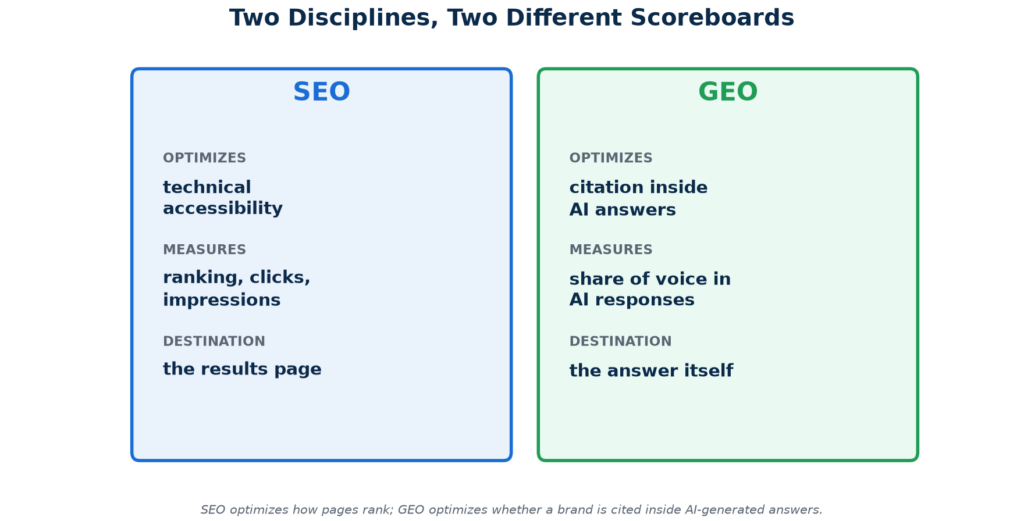
The cleanest way to separate the two disciplines is by what each one measures, not by what each one does.
SEO, at its core, is about technical accessibility. Can the engine crawl the page, index it, understand it, and rank it? Its currency is ranking position, keyword performance, impressions, and clicks. The destination is always the results page.
GEO measures something downstream: whether the page — or the brand behind it — ends up inside the answer a model composes. Its currency is share of voice inside AI responses. How often is a brand cited? Is it recommended, referenced, or left out entirely when the answer engine decides what is true?
That distinction is not semantic. A page can rank first in organic search and still be invisible to an answer engine that draws from a different set of sources, a different weighting of authority, and a different idea of what a user actually wants. Two teams, two scoreboards, two different games.
Why a 25% Decline Hurts More Than It Sounds
A quarter of search volume vanishing is not a quarter of marketing value disappearing evenly. The shift is concentrated in the high-intent, commercial, research-heavy queries that have always carried the most value — the comparison questions, the buying-decision research, the how-do-I-choose moments.
When those queries move to an answer engine, the economics invert. A results page shows ten links and lets ten brands compete. An answer often names one, two, or three sources. The winner-take-most dynamic is what turned GEO from a niche experiment into an executive priority. In a world of ten results, being eighth is survivable. In a world of one answer, being absent is fatal.
Google and Microsoft Cannot Even Agree
One sign that a field has truly matured is that the platform giants argue about what to call it — and now they do, in public, in official documentation.
Google released its first formal guide to optimizing for generative AI search features in mid-2026, and its position is deliberately deflationary: optimizing for AI search is still just SEO, because you are optimizing for the same search experience. Microsoft took the opposite rhetorical path, writing generative engine optimization into its own webmaster guidelines and shipping guidance that splits answer engine optimization for AI assistants from GEO for generative search surfaces.
You do not need to pick a side. What matters is that the two biggest gatekeepers both now publish formal, competing frameworks for the same problem — which is exactly what happens when a practice stops being a trend and becomes infrastructure.
The Money Moved First
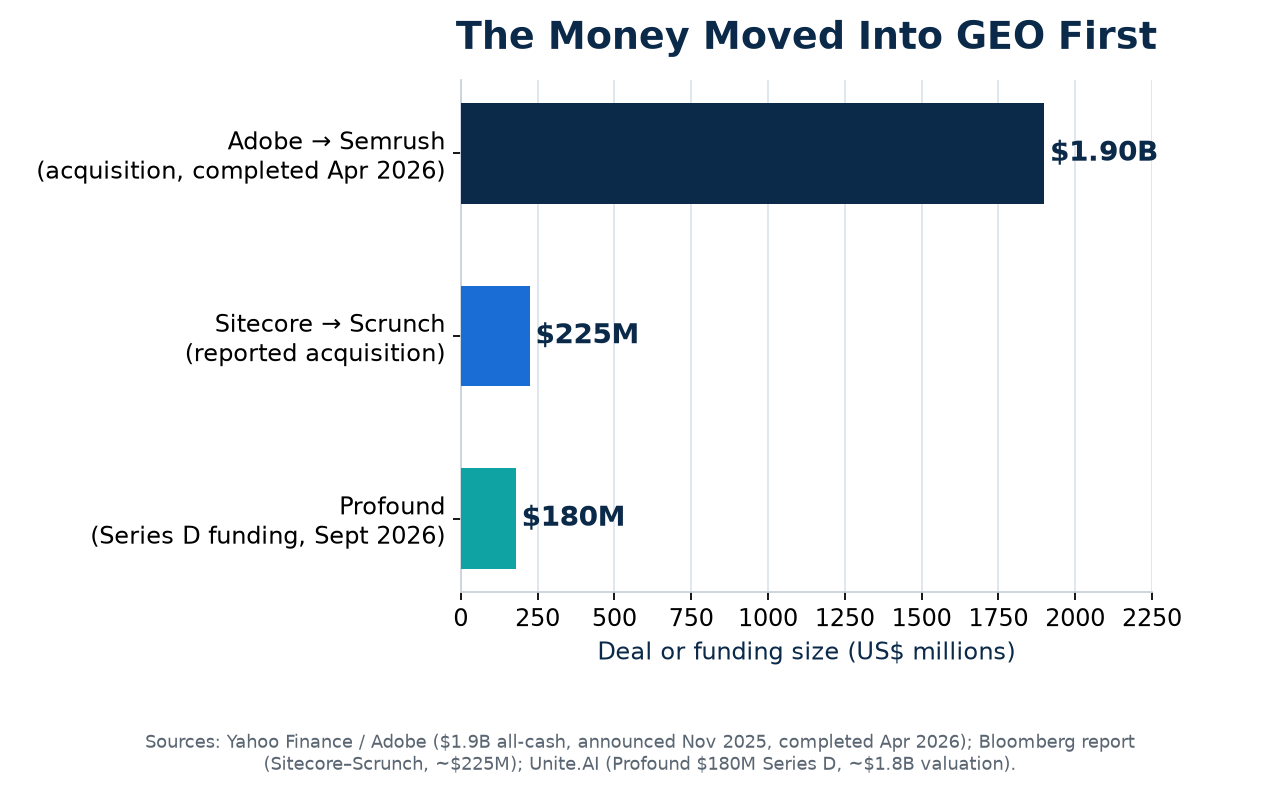
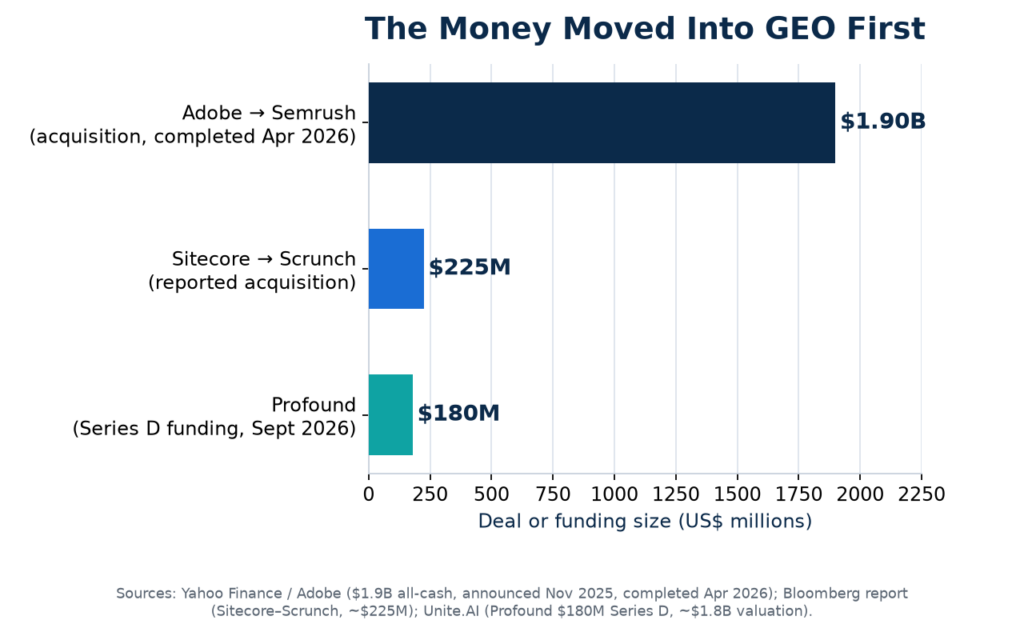
Budget follows conviction, and conviction showed up with a checkbook. In November 2025 Adobe agreed to buy the SEO leader Semrush for about $1.9 billion in cash, a deal it completed in April 2026 at a premium of more than 75% to the prior share price. The AI-visibility startup Profound closed a $180 million Series D that valued it around $1.8 billion. Sitecore reportedly bought the AI-search startup Scrunch for roughly $225 million. Adobe followed its own deal by launching a product explicitly marketed as a GEO platform.
None of that activity looks like a category that is still a footnote. It looks like a land grab. When the largest marketing-software companies pay nine-figure sums for measurement and visibility tools aimed at AI answers, the standalone budget line is already decided — the finance teams just have not finished renaming the spreadsheet columns yet.
The Skepticism Is Part of the Maturity
It would be dishonest to paint 2026 as universal euphoria, and the dissent is as informative as the hype. Analysts at Forrester have argued that answer engine optimization is meaningfully different from SEO but not fundamentally different, and that some vendors exaggerate the gap to carve out room in marketers’ tech stacks. Trade press has reported that practitioners are questioning expensive AI-visibility tools whose results are inconsistent. A representative from one answer engine has publicly cautioned against vendors overstating their expertise.
That friction is healthy. It is the same pattern every new measurement layer goes through before it standardizes — inflated promises first, then skepticism, then a smaller set of tools that survive contact with reality. For buyers, the lesson is not to avoid the category. It is to measure it against outcomes, not against a vendor’s slide deck.
China Is Where the Shift Runs Fastest
For a global audience, China is the case that makes the rest of the trend look tame — not as a single company story, but as a scale signal.
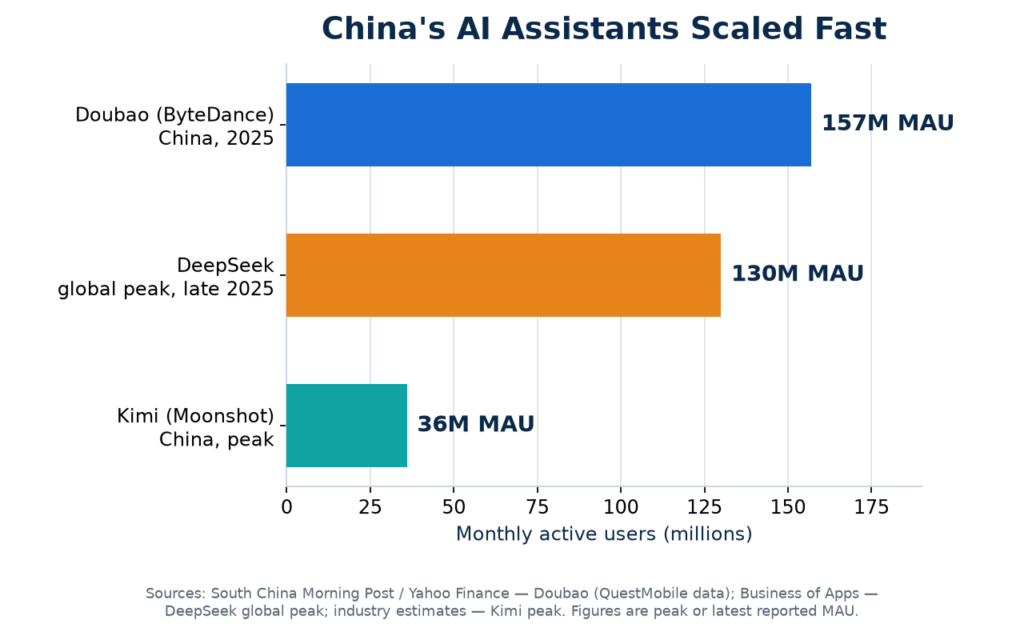
China’s AI assistant market scaled to hundreds of millions of monthly active users in roughly two years. ByteDance’s Doubao became the country’s most-used AI assistant, reaching about 157 million monthly active users by late 2025 and passing 100 million daily active users by December. DeepSeek rattled the entire industry in early 2025 and peaked at roughly 130 million monthly active users globally by year’s end. Tencent’s Yuanbao overtook DeepSeek in downloads within weeks. Baidu, the incumbent search leader, was forced to push AI-first search while watching a generation of users skip the query box entirely in favor of a chat interface.
Why this matters for GEO: in China, the fragmentation happened fast and the incumbency was shallow. There was never a single, stable answer engine to optimize for. Brands had to learn, almost overnight, how to be cited across a half-dozen assistants with different retrieval behavior, different source preferences, and different interfaces. That multi-engine reality — not a single dominant AI — is the future global marketers are now walking into.
What Enterprises Are Actually Funding
Strip away the acronyms and the enterprise spending in 2026 falls into three buckets.
First, measurement — tools that track how often a brand is cited, referenced, or excluded across ChatGPT, Gemini, Perplexity, Copilot, and their Chinese equivalents. Second, content engineering — rewriting and restructuring material so it is quotable, attributable, and shaped for how models summarize rather than how crawlers index. Third, governance — deciding which systems may cite a brand, which content may be included, and how the whole thing reports up to the C-suite.
The common thread is that all three are new. They do not replace the SEO function; they sit next to it, measuring a different outcome with different tools.
The KPI Gap Is the Real Story
If there is one insight that defines GEO’s arrival as a standalone discipline, it is this: GEO is not SEO renamed. It measures share of voice inside AI responses, which is a different KPI set than ranking and click-through. A brand can win the results page and lose the answer. The teams that treat the two as one budget, one scoreboard, and one team are measuring the wrong thing — and doing it at exactly the moment the ground is shifting under them.
What This Means for the Next Twelve Months
Three things are likely to hold. The 25% decline benchmark will keep getting cited until the actual numbers settle it. The vendor consolidation will continue as the big platforms buy their way into AI-visibility measurement. And the terminology war will resolve the way these things always do — not by agreement, but by whichever framework the biggest platforms and buyers quietly adopt.
For the marketer, the immediate move is smaller and more concrete than any of that: pick an answer engine, look up your own brand, and read what the machine says about you when nobody is watching. That output — not your ranking report — is the new first page of the internet.
Conclusion and Recommendations
GEO matured in 2026 from an SEO footnote into a distinct practice with dedicated agencies, tooling, and executive budgets. The Gartner projection of a 25% decline in traditional search volume by 2026 was the opening shot; the funding, the vendor launches, and the dueling platform guidelines were the follow-through.
The practical path forward is to treat GEO as its own measurement layer: separate share of voice in AI answers from traditional ranking, assign an owner, budget for visibility tooling, and start optimizing content to be cited, not just crawled. Do it before your competitors do — because in a one-answer world, second place is not visible at all.
Summary
- Gartner projected traditional search volume would drop about 25% by 2026 as users shift to AI answers, and that forecast became the anchor for a new discipline.
- GEO is the practice of appearing inside AI-generated responses; it measures share of voice, not ranking position.
- SEO optimizes technical accessibility and ranking; GEO optimizes citation and presence inside answers — a different outcome with a different KPI set.
- Google and Microsoft now publish formal, competing frameworks for the practice, a sign the field has become infrastructure.
- Major money moved in 2025-2026, including Adobe’s $1.9 billion Semrush acquisition, Sitecore’s reported $225 million Scrunch deal, and Profound’s $180 million Series D.
- China demonstrates the fastest version of the shift, with Doubao passing 157 million monthly active users and DeepSeek peaking near 130 million.
- The core insight for any marketer: GEO is not SEO renamed, and treating them as one scoreboard is now a measurable liability.
-
Frequently Asked Questions
Q1: What is Generative Engine Optimization (GEO)?
GEO is the practice of improving how often and how favorably a brand or page appears inside the answers generated by AI systems such as ChatGPT, Gemini, Perplexity, and Copilot. It targets citation and visibility inside the answer itself, rather than position on a results page.Q2: How is GEO different from SEO?
SEO optimizes technical accessibility and measures ranking, clicks, and impressions on a results page. GEO optimizes for citation inside AI answers and measures share of voice in those responses. The destination and the measured outcome are different, even though the underlying content work overlaps.Q3: Why is GEO becoming a standalone discipline?
Because the measured outcome changed. Gartner projected traditional search volume would fall about 25% by 2026, and enterprises began funding separate teams, tools, and budgets to win share of voice inside AI answers — a KPI set ranking-based SEO cannot capture.Q4: What is “share of voice” in AI search?
Share of voice in AI search is how often a brand is cited, referenced, or recommended when an answer engine responds to relevant queries, compared with competitors. It is the core KPI of GEO.Q5: Is traditional SEO dead?
No. Technical accessibility and ranking still matter, and answer engines lean on crawlable, authoritative content. What is changing is that SEO no longer covers the whole job — it is becoming one layer beneath a new, separate measurement layer.Q6: Why is China relevant to GEO?
China’s AI assistants — led by Doubao, DeepSeek, and Yuanbao — scaled to hundreds of millions of users in about two years, fragmenting attention across many engines faster than anywhere else. It is the clearest preview of the multi-engine reality global brands are now entering.