Apple Picks Qwen, Google Builds a Universal Cart, ChatGPT Runs Ads: The Four-Way War for the AI Shopping Funnel
In the space of six weeks, four of the world’s most influential technology platforms made moves that, taken together, redraw the map of how people buy things.
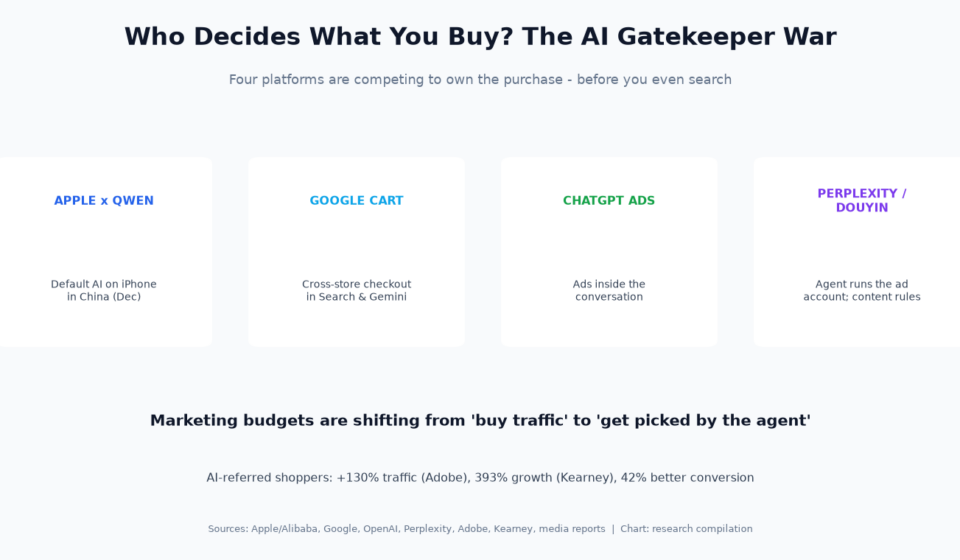
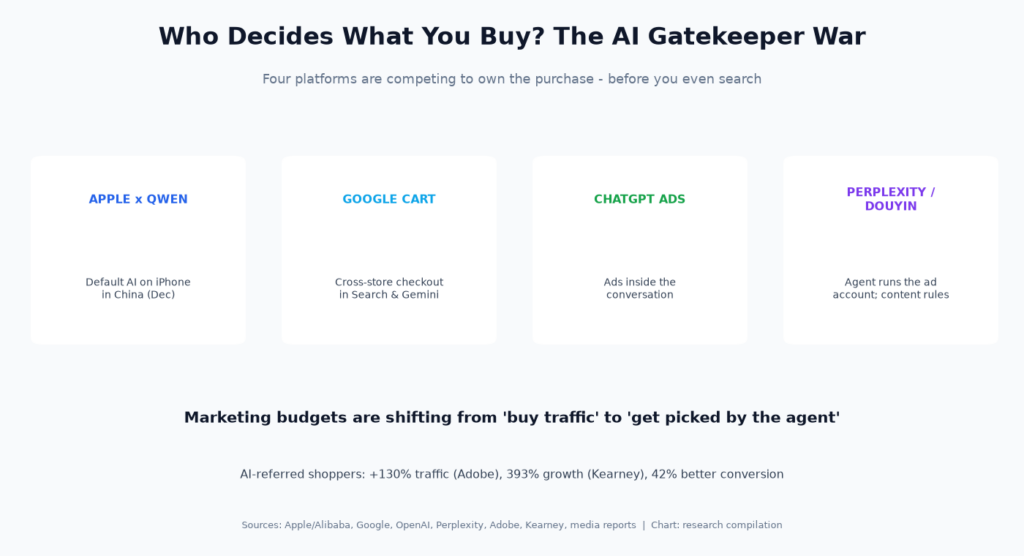
Apple partnered with Alibaba to bring its Qwen model into Apple Intelligence in China, with a December launch planned. Google rolled out Universal Cart across Search and Gemini in the US on October 15, creating a cross-retailer checkout layer. ChatGPT expanded advertising into markets such as the UAE, as OpenAI built out an ads team. And Perplexity launched an e-commerce workflow that lets its Computer agent run Meta ads, Klaviyo email and Shopify stores from a single interface.
Individually, each looks like a product update. Together, they describe the emergence of a new layer in commerce: AI agents that do not merely surface products, but complete purchases, allocate ad budgets, and decide which brands a user ever sees. The battle for e-commerce is shifting from which website a shopper visits to which agent the shopper trusts.
Four battlegrounds
The four platforms are attacking the same problem from different directions.
Hardware-level integration. Apple’s deal with Alibaba to power Apple Intelligence in China with Qwen is the most consequential because it is the least visible. When Siri becomes the default assistant on an iPhone in China, it becomes the default entry point for countless queries — including product searches. A brand that is not surfaced by that assistant is, for practical purposes, invisible. There is no ad auction for this placement, no bid to raise, no dashboard to optimise. It is gatekeeping at the operating-system level.
Search-to-checkout ownership. Google’s Universal Cart is a direct attempt to own the transaction. Announced at Google I/O in May and launched in the US on October 15, it aggregates products from multiple retailers into a single cart, tracks prices and stock, and completes checkout through a framework Google calls Universal Commerce Protocol. Google already owns discovery; Universal Cart extends that ownership to the moment of purchase.
Conversational ad inventory. ChatGPT’s advertising expansion is the newest front. Ads inside a conversational interface are fundamentally different from search ads: they are inserted into a dialogue rather than triggered by a query. Done well, they can feel like recommendations; done poorly, they erode trust. OpenAI is building the team to figure out which.
Agent-as-executor. Perplexity Computer, and to some extent the agentic tools Meta is testing, represent a fourth model: an AI that runs the marketing operation itself. Perplexity’s workflow connects Shopify sales data to Meta ad campaigns and Klaviyo email flows, with a human review gate. Here the agent is not just a gatekeeper for consumers; it is a gatekeeper for marketers, deciding how budget is spent and which creatives get tested.
The common thread
What unites these four moves is a single strategic goal: keep the user inside the platform’s interface, and own the transaction that results.
For two decades, the dominant e-commerce model was destination-based. A shopper searched on Google, clicked through to a retailer’s site, and completed the purchase there. The retailer owned the customer relationship, the upsell and the data. Google owned discovery; Amazon owned the transaction for its own marketplace.
The agentic model inverts this. If the AI can complete the purchase inside its own interface, the platform owns everything: discovery, decision support and transaction. The retailer gets the sale but loses the relationship. This is precisely the dynamic that made Amazon so powerful, now being applied to the open web by a new set of players.
The counter-move from Douyin
Not every platform is moving in the same direction. On the other side of the world, Douyin has been tightening its ad engine, Qianchuan, to penalise low-quality content and force brands to produce authentic, real-footage videos.
The logic is different but the destination is similar. Douyin is not trying to insert an AI between the shopper and the purchase; it is trying to raise the quality bar so that the platform’s own content — and therefore its own commerce — becomes more trustworthy and more valuable. Where Google and Apple are building AI gatekeepers, Douyin is building a content gatekeeper.
For brands, the two strategies converge on the same demand: product strength and genuine content matter more than paid reach. Whether the gatekeeper is an AI agent or an algorithm, the brands that win are the ones whose products and content can survive being chosen.
The data behind the shift
The shift is not speculative. Adobe forecast that AI-driven traffic to US retail sites would rise 130% year over year during the 2026 holiday window, and that AI-referred shoppers are worth about 83% more to retailers than those from traditional channels.
Kearney’s research reinforces the point. AI-referred traffic to US retail sites grew 393% year over year in the first quarter of 2026, and it now converts 42% better than other channels — a full reversal from a year earlier, when it converted 38% worse. AI-referred shoppers behave like high-intent search users, not casual browsers.
These numbers explain why every platform wants to own the AI interface. If AI-referred traffic is growing at triple-digit rates and converting better than anything else, then whoever controls the AI controls the most valuable traffic in commerce.
What it means for marketing budgets
The practical consequence is a reallocation of marketing budgets. The old model optimised for clicks and conversions on a brand’s own site: buy traffic, drive it to a landing page, convert. The new model optimises for being selected by an agent: structure product data so machines can read it, ensure availability and pricing are accurate, and build the kind of reputation and content that AI systems trust.
That is a different skill set. It looks less like paid media buying and more like a combination of technical product-data hygiene, content quality and brand trust. It is closer to SEO and PR than to SEM and social advertising.
There is also a defensive imperative. If purchases complete inside an AI interface, brands lose direct access to the buyer. Building owned channels — email, loyalty programmes, community — becomes more important, not less, because those are the relationships the agent cannot intermediate.
The attribution problem
There is a deeper problem that the automation narrative tends to gloss over: attribution.
When an AI agent both recommends a product and completes the purchase, the traditional attribution model breaks down. Was the sale driven by the AI’s recommendation, the brand’s content, the retailer’s pricing, or something else? If the agent also runs the ad campaign, it is effectively grading its own homework. Independent measurement, or at least transparent methodology, becomes essential.
This is not a reason to reject agentic commerce; it is a reason to approach it with clear eyes. The platforms that win will be those that can demonstrate real value, not just claimed value.
What brands should do
Three practical steps stand out.
First, make product data machine-readable. If an AI agent is deciding what to recommend, the structured data, availability and pricing a brand exposes will determine whether it gets picked. Agentic commerce optimisation is becoming as important as SEO once was.
Second, invest in trust signals. AI systems, and the people who rely on them, favour brands with clear information, consistent quality and credible reviews. Reputation is becoming a machine-readable asset.
Third, protect the direct relationship. Even as AI intermediates more purchases, owned channels remain the only way to reach customers without a gatekeeper. Email, loyalty and community are not legacy tactics; they are the hedge against platform dependency.
What to watch
Four signals will show how quickly this materialises: whether Apple Intelligence’s China launch in December drives measurable shifts in product discovery; whether Universal Cart adoption grows beyond early adopters during the holiday season; whether ChatGPT’s ad formats gain traction with major advertisers; and whether agentic marketing tools publish independently verified performance data.
The bottom line
The AI shopping funnel is forming faster than most brand teams realise. When Apple’s Siri, Google’s Gemini and ChatGPT all become shopping agents, the marketing question stops being “what is my return on ad spend?” and becomes “does the agent even know my product exists?”
The platforms are racing to become the gatekeeper. The brands that thrive will be the ones that make themselves easy for the gatekeeper to choose — and that keep a direct relationship with the customer, even when the transaction happens somewhere else.