480 Debuts, One 6G Prototype, a 100-Billion-Yuan Display Cluster: Inside the New Logic of CIIE
For a trade fair built on the promise of imports, the loudest story on day one of the ninth China International Import Expo was not about buying at all. It was about launching.
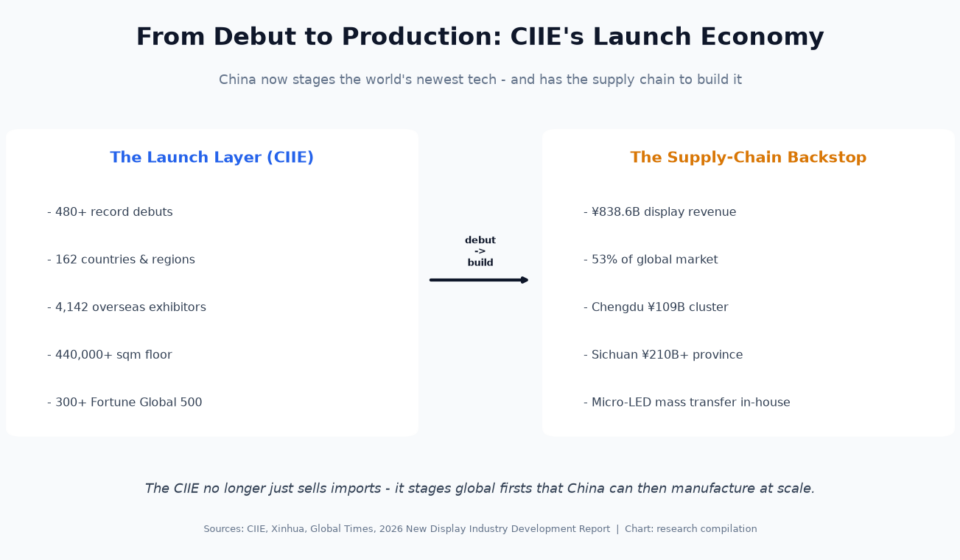
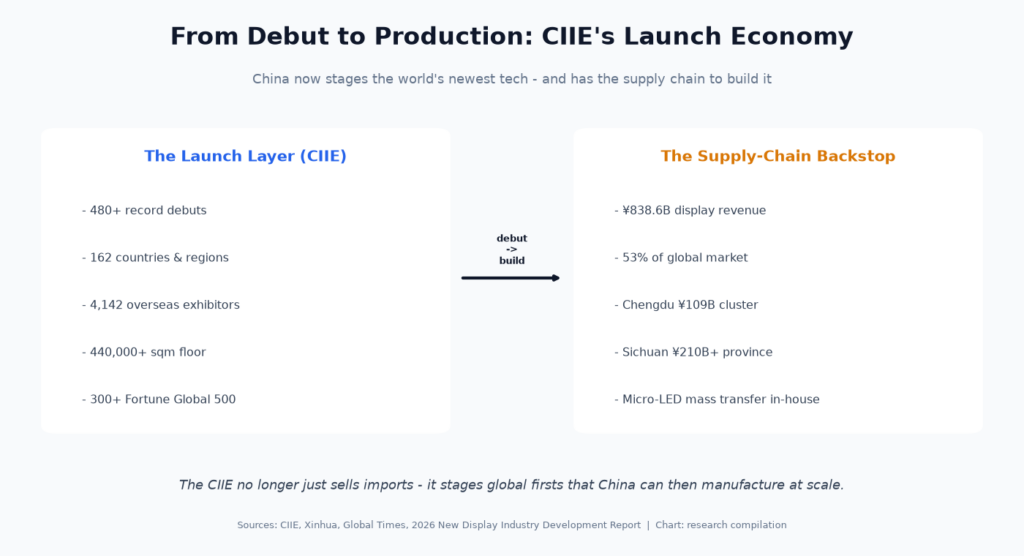
CIIE 2026 opened in Shanghai on November 5 with 162 countries and regions, 4,142 overseas exhibitors, more than 300 Fortune Global 500 companies and an exhibition floor that, for the first time, exceeds 440,000 square meters. The number organisers are most eager to discuss, however, is 480: the count of products making their global, Asian or China debut — the highest in the expo’s nine-year history.
That single number captures a strategic pivot that has been building across several editions. The CIIE was conceived in 2018, at the height of the first US-China trade war, as a diplomatic counterweight — a public demonstration that China was willing to buy the world’s goods. Nine editions later, its function has quietly inverted. The expo is now less a bazaar for surplus inventory than a stage for the world’s newest technology, and the countries and companies that treat it as a mere sales channel are missing what it has become.
The launch layer
The debut-heavy programme is deliberate. Organisers have leaned into the language of firsts — global, Asian and China debuts — and structured the fair around frontier categories: AI, advanced manufacturing, medical technology and next-generation connectivity. More than 2,000 exhibitors are first-timers this year, a signal that the launch narrative is attracting companies that might otherwise have skipped a traditional import fair.
The most symbolically loaded debut came from a US company, which unveiled a 6G terminal prototype on Chinese soil. In an era of export controls and technology decoupling, a US firm still chose Shanghai as the venue for a global first — a reminder that commercial logic and geopolitical logic do not always point in the same direction.
For global brands, the CIIE has become a low-cost, high-visibility launch platform. A single debut here reaches 162 countries, 300-plus Fortune 500 peers and a media corps that treats the event as a barometer of China’s openness. If you launch it at CIIE, the world is watching; if you do not, your competitor will.
The supply-chain backstop
A launch economy only works if someone can build what gets launched. That is where the second half of the story sits — and it was happening 1,900 kilometres west, in Chengdu.
The same week, the western city hosted the 2026 World Display Industry Innovation and Development Conference, where a government-backed report put China’s new-display industry revenue above 838.6 billion yuan for 2025 — roughly 53% of a global market valued at about 1.5 trillion yuan. Chengdu’s cluster alone surpassed 109 billion yuan, and Sichuan province exceeded 210 billion yuan, supported by more than 150 chain enterprises.
More revealing than the headline figures was the list of upstream breakthroughs unveiled alongside them: a domestically built Micro-LED laser mass-transfer machine, the country’s first G8.6 linear evaporation source, a G6 large-mask projection scanner, a fully domestic 18-micron ultra-thin metal mask and a 130-inch LCD polariser. These are the components that, until recently, China had to import.
Put the two events together and the logic of the new CIIE becomes clear. A product that debuts in Shanghai can be sourced, produced and scaled inside the same country. The expo’s pitch is no longer just market access; it is end-to-end industrial capability. The debut is the shop window, and the supply chain behind it is the factory floor.
Why the loop matters
This closed loop is the real innovation. For most of the past decade, global companies treated China as two separate propositions: a market to sell into and a factory to produce from. The CIIE’s evolution merges them. A brand can now launch a product to the Chinese market and, in the same trip, find the suppliers, materials and manufacturing partners needed to build it at scale.
That is a meaningful shift in how global innovation gets commercialised. Historically, the path ran from a Western or Japanese launch to a Chinese manufacturing contract. Increasingly, the launch itself happens in China, because the feedback loop — between debut, market response and production ramp — is faster there than anywhere else.
For Chinese firms, the loop cuts the other way. The display-industry breakthroughs reduce dependence on foreign equipment, and the CIIE gives domestic suppliers a stage to demonstrate capability to global buyers. The two trends reinforce each other: the more China can manufacture at the frontier, the more attractive it becomes as a launch venue, which in turn pulls more frontier technology into the country.
The evolution of CIIE
The arc is worth tracing. In its early editions, the CIIE emphasised volume — how much China would import, how many deals would be signed. The messaging was defensive, calibrated to answer critics who accused China of closing its market.
By the 2023 edition, the emphasis had shifted to turning exhibits into products, and products into investments. The 2026 edition goes further: it treats the fair as a global launch platform, with a programme built around firsts rather than tonnage. That is a confident posture, and it reflects a calculation that China’s relevance to global business now rests less on its appetite for imports than on its capacity to commercialise innovation.
The format change also serves a domestic purpose. A launch-focused CIIE signals to Chinese consumers and firms that the country remains plugged into global technology, even as geopolitical tensions rise. It is a way of demonstrating openness without downplaying ambition.
The geopolitical subtext
None of this happens outside politics. The CIIE’s growth coincides with intensifying US-China competition over technology, including export controls on advanced chips and display equipment. The fact that a US company chose Shanghai for a 6G prototype debut is therefore notable — it suggests that, for many firms, the commercial opportunity still outweighs the political risk.
At the same time, the emphasis on domestic upstream breakthroughs is partly a response to that same competition. Each domestic tool reduces exposure to foreign suppliers and, by extension, to policy risk. The CIIE and the Chengdu conference are two faces of one strategy: open to the world’s best technology, while building the capacity to make it at home.
What’s missing
For all the pageantry, concrete commercial numbers remain sparse on day one. Kazakhstan signed roughly $100 million in agreements on opening day — a useful anchor, but far from a full picture of the deals that will be inked over the six-day run.
This is a familiar pattern with launch-focused events: the spectacle arrives before the spreadsheet. A pharma executive offered the most telling quote of the day: this is our ninth consecutive year taking part, and many medicines we first presented at the expo have since launched here. That is the real CIIE story — not a single transaction, but a recurring pipeline from debut to market.
What it means for global companies
Three practical takeaways stand out.
First, treat the CIIE as a launch venue, not a sales channel. If you have a product that needs global visibility, Shanghai in early November is now one of the highest-leverage stages on the calendar.
Second, use the fair to map the supply chain. The same trip that showcases your product can connect you to the manufacturers, materials and equipment suppliers who can build it. The co-location of the launch and the industrial base is the underrated advantage.
Third, watch the upstream breakthroughs. The domestic display tools matter beyond display; they signal how quickly China is closing gaps in the equipment and materials that underpin advanced manufacturing. That has implications for sourcing strategy across electronics, automotive and AR/VR.
What to watch
Three things will define whether the 2026 edition lives up to its billing: the total value of deals signed by the close on November 10; whether the 6G prototype is followed by concrete commercial partnerships; and whether the debut-heavy format keeps drawing first-time exhibitors in 2027.
There is also a longer-term question. If the CIIE’s function is now to launch global technology in China, does that make it more or less resilient to geopolitical shocks? A fair built on imports can be disrupted by tariffs. A fair built on launches is harder to derail, because the incentive to be seen runs both ways.
The bottom line
Day one at CIIE 2026 made one thing clear: China’s trade fair is no longer a passive “we buy what you make” event. It is an active demand signal that says the world’s newest technology gets its biggest stage here — and that the supply chain to build it sits just a train ride away