Three Labs, 69% of Enterprise AI Spend: Why the AI Market Is Growing Fast and Concentrating Faster
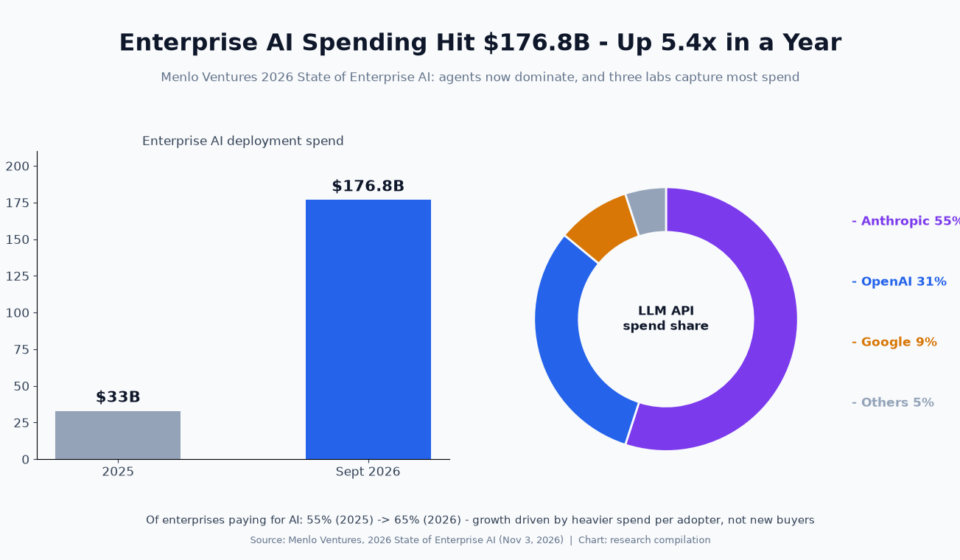
Menlo Ventures’ fourth annual State of Enterprise AI report, released on November 3, contains a number that stops the reader cold: enterprise AI spending reached $176.8 billion by September 2026, up from $33 billion a year earlier — a 5.4x increase in twelve months.
That is more than $140 billion in new annual spending, roughly four times the size of the entire market a year ago. Few enterprise technology categories have ever grown this quickly.
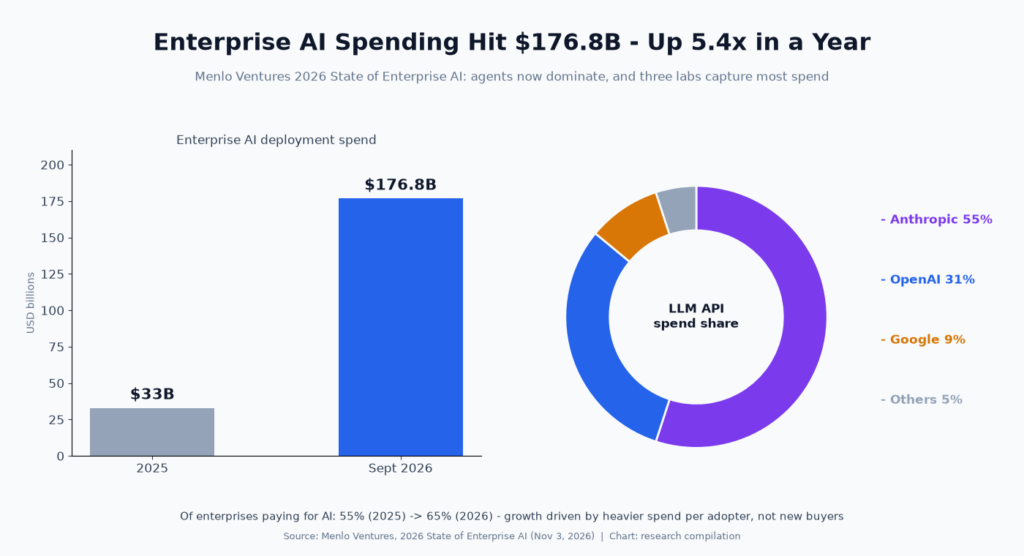
But the most important finding in the report is not the headline figure. It is a smaller number buried in the detail: the share of enterprises paying for AI rose only modestly, from 55% to 65%. Which means the explosive growth is not coming from a wave of new buyers. It is coming from existing adopters spending far more.
The 65% insight
This distinction matters enormously. If growth were driven by new adoption, the story would be about market expansion — more companies joining. If growth is driven by deeper spending among existing users, the story is about intensification — the companies already using AI are scaling up dramatically.
Menlo’s data points firmly to the latter. A 10-point rise in adoption alongside a 5.4x rise in spending implies that the average adopter is spending roughly five times more than a year ago. That is consistent with what the report describes: AI is moving from experimentation to production, and production workloads consume far more compute than pilots.
The implication is that the AI market still has a large untapped base. If only 65% of enterprises pay for AI, there remains a substantial cohort that has not yet committed. The next phase of growth may come from converting those laggards — or from the current adopters scaling even further.
Agents outspend humans
The report’s most striking operational finding is that AI agents now consume far more AI than humans do. In other words, the growth in enterprise AI usage is not primarily employees typing prompts into a chatbot. It is autonomous agents running tasks, calling models repeatedly, and generating compute demand at a scale that human usage cannot match.
That shifts the economics of the market. Human-driven usage is intermittent and bounded by working hours. Agent-driven usage is continuous and scales with the number of tasks deployed. As more enterprises deploy agents into workflows — customer service, coding, research, back-office operations — the compute demand compounds.
It also explains the spending acceleration. An agent that runs thousands of tasks a day is a very different customer from a knowledge worker who uses a chatbot a few times an hour.
The 69% concentration
The report finds that frontier labs capture 69% of enterprise AI spending, and within enterprise LLM API spending the concentration is even sharper. Anthropic rose from 40% to 55% of that spend, OpenAI grew from 27% to 31%, and Google fell from 21% to 9%.
That last number is the most surprising. Google, despite its research pedigree and its cloud business, lost share in enterprise LLM API spending over the year. Anthropic’s rise to 55% suggests that, for enterprise buyers, capability and reliability on coding and agentic tasks have become the deciding factors — and that Anthropic has won that contest so far.
The concentration raises a strategic question for buyers. Relying on a single dominant supplier creates dependency risk, but multi-sourcing adds integration cost and complexity. Most enterprises will likely run a primary model plus fallbacks, which is good for the leaders and difficult for challengers.
Is AI cannibalising software?
A persistent fear in the software industry is that AI will eat existing software budgets — that every dollar spent on AI is a dollar taken from SaaS. Menlo’s report suggests the opposite: AI is expanding the software market rather than cannibalising it.
That is an important finding for investors and for software companies. If AI is additive, the total addressable market grows and incumbents can participate. If it is substitutive, incumbents face disruption. The evidence so far points toward expansion, though it is early and the picture could change as AI-native tools mature.
What it means for buyers
For enterprises, three practical lessons emerge.
First, the cost curve is steep but the value curve may be steeper. Spending is rising fast, but so is capability. The question is not whether to spend but where — which workloads deliver measurable return.
Second, agents change the deployment model. Building agentic workflows requires different infrastructure, governance and evaluation than deploying a chatbot. Enterprises that treat agents as a minor extension of existing AI efforts will underinvest.
Third, supplier concentration is a real risk. With three labs capturing most of the market, procurement strategy matters. Diversification, portability and exit clauses deserve attention.
What it means for vendors
For AI vendors, the report is both encouraging and sobering. The market is enormous and growing fast. But it is also concentrating, and the winners are pulling away. Challengers face a difficult path: they must differentiate on capability, cost or vertical focus, because competing head-on with the leaders on general capability is a losing game for most.
The application layer may be where the remaining 31% of spend sits — and where smaller players can build durable businesses by solving specific problems for specific industries.
The contradictions and risks
The report’s optimism should be read alongside some caution. A 5.4x increase in spending is extraordinary, but it also raises questions about sustainability. If enterprises are spending five times more without a corresponding fivefold increase in measurable value, budget discipline could tighten.
There is also the question of whether the concentration is healthy. Three labs capturing 69% of spending creates a market structure that is efficient in the short term but potentially fragile in the long term — vulnerable to pricing power, supply constraints and strategic behaviour.
And there is the political dimension. As AI spending becomes a larger share of enterprise budgets, scrutiny will increase — from regulators, from boards, and from the public. The same week that Menlo published its report, the US midterms delivered a signal that AI infrastructure expansion faces real political resistance. Spending growth and political friction are on a collision course.
What to watch
Three signals will show how the next year unfolds: whether enterprise adoption climbs meaningfully above 65%, broadening the buyer base; whether Anthropic’s 55% share holds or erodes as competitors respond; and whether spending growth moderates as enterprises demand clearer returns.
The bottom line
The $176.8 billion figure will make headlines. But the sentence that should keep enterprise software executives awake is simpler: agents now consume more AI than humans do — and the companies that figure out how to deploy them profitably will define the next decade of enterprise technology.