Perplexity’s AI Agent Now Runs Meta Ads, Klaviyo and Shopify — and It Previewed the End of the Ad Agency as We Know It
On November 3, Perplexity announced something that looked, at first glance, like a product update: new e-commerce workflows for its Computer digital worker that connect Shopify sales data to Meta advertising and Klaviyo email campaigns.
It is more than a product update. It is an early public demonstration of a structural shift in digital advertising: when a single AI agent can analyse store performance, generate landing pages, launch ad campaigns and send email flows, the traditional division of labour between agency, media buyer and analyst starts to collapse into one automated layer.
What Perplexity Computer actually does
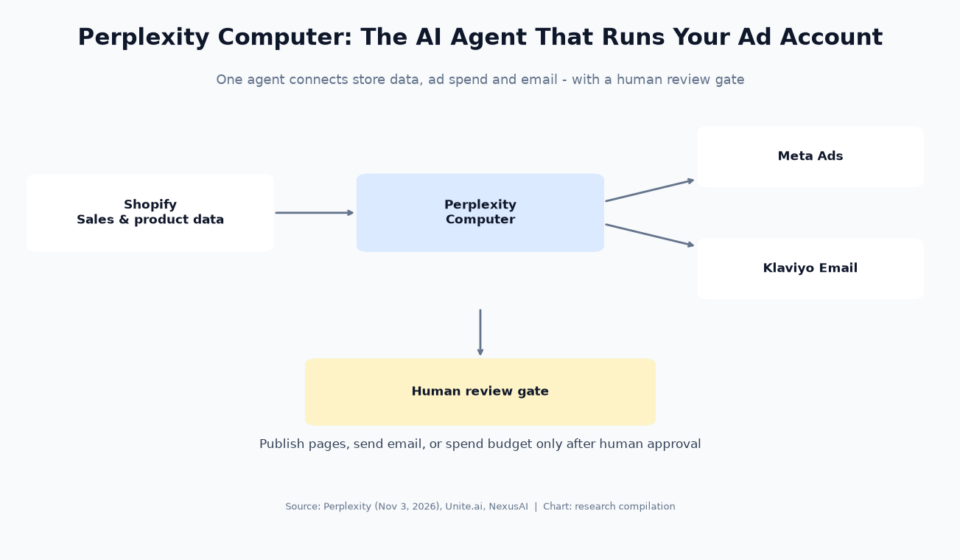
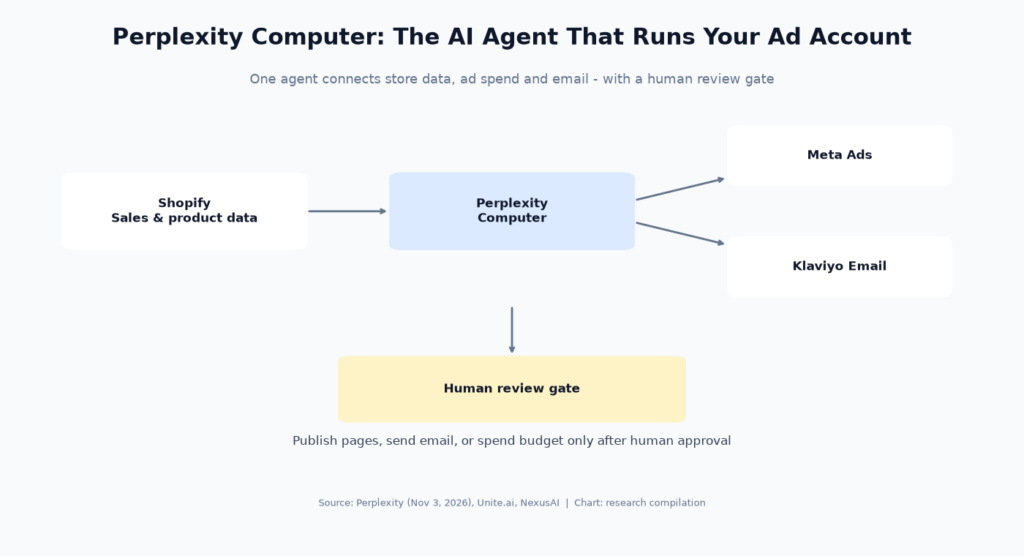
Perplexity Computer is an agentic product that executes multi-step tasks on a user’s behalf. In its e-commerce configuration, it connects to three systems: Shopify, for sales data and product pages; Meta, for advertising; and Klaviyo, for email marketing.
The workflow is end-to-end. The agent can analyse Shopify sales to surface product opportunities, auto-generate listing and landing pages, run Meta ad campaigns, and manage Klaviyo email flows — all from within a single interface. According to Perplexity, businesses can set campaign parameters and require human review before the agent publishes pages, sends emails or spends budget.
That human review gate is important, and it is easy to overlook amid the automation narrative. Perplexity is not claiming the agent runs unsupervised. It is claiming the agent does the work and a human approves the output — a design choice that reflects both practical caution and a recognition that fully autonomous spending is still a step too far for most businesses.
Why it matters
The significance lies in what it replaces. A traditional e-commerce growth operation involves a media buyer to manage Meta campaigns, a copywriter to produce ads, a designer to build landing pages, an email marketer to run Klaviyo flows, and an analyst to connect the data. That is five roles, several tools and constant coordination.
Perplexity Computer collapses that into one agent plus one reviewer. It is not that the agent does each job better than a specialist; it is that it does all of them together, with shared context, at a fraction of the coordination cost. For small and mid-sized merchants, that is a meaningful change in what is economically viable.
For agencies, the implication is more uncomfortable. If a single agent can handle routine campaign execution, the value of an agency shifts from doing the work to supervising, strategising and handling exceptions. The lower rungs of the agency ladder — the execution-heavy, low-margin work — are the most exposed.
The competitive context
Perplexity is not alone in this direction. OpenAI has been expanding its ads team, and ChatGPT has begun offering advertising in markets such as the UAE. Notch founders Vinay and Aman Jain, who built an AI agent that creates and optimises ad campaigns, joined OpenAI’s ads team — a signal of where the company sees the future. Meta, meanwhile, is testing an agentic ad assistant that can create campaigns, change targeting and adjust budgets, with advertisers retaining approval over changes.
The pattern is consistent: every major platform is moving toward AI that does more of the campaign work. Perplexity’s e-commerce workflow is notable not because it is unique, but because it is a public, concrete example of the full loop — analysis, creative, execution and measurement — in one agent.
The attribution question
There is a deeper issue that the automation narrative tends to gloss over: attribution. Traditional attribution models assign credit to touchpoints — last click, first click, multi-touch — based on human-defined rules. When an AI agent both runs the campaign and analyses the results, it is effectively grading its own homework.
That is not necessarily a problem, but it changes what ROI means. If the agent decides what to spend and then reports the return, the business needs a way to verify that the reported return is real — not just an artefact of how the agent measured it. Independent measurement, or at least transparent methodology, becomes essential.
The caveats
Perplexity has not published audited performance data. The workflow is a vendor claim, not a verified case study. We do not know the ROI it produces, how it compares with human-managed campaigns, or how it performs across different categories and budgets. Those gaps matter, and they should temper any conclusion that the ad agency is obsolete.
The honest framing is that this is a concept demonstration — an early signal of direction rather than proof of outcome. That does not make it unimportant. Early signals are how industries see what is coming. It just means the signal should be read as a signal, not a verdict.
What it signals
Three things stand out.
First, the tool stack is consolidating. The days of stitching together five point solutions are numbered; agents that span the stack are the direction of travel.
Second, the human role is shifting upward. Less execution, more supervision, strategy and exception-handling. That is a different skill set, and it has implications for hiring and training.
Third, the barrier to entry for e-commerce is falling. A merchant that could never afford a full growth team can now deploy an agent. That increases competition, which is good for consumers and challenging for incumbents.
What to watch
Three signals will show how quickly this materialises: whether Perplexity or competitors publish independently verified performance data; whether agencies begin restructuring around supervision rather than execution; and whether platforms like Meta and Google build native agentic tools that make third-party agents redundant.
The bottom line
The first ad agency replaced by AI will not make headlines. It will simply stop getting contracts. Perplexity’s Shopify-Meta-Klaviyo workflow is what that replacement looks like in its earliest form — imperfect, unproven, and pointed unmistakably in one direction.