AI Shoppers Spend 83% More — and Google Just Built the Checkout to Capture Them
Two announcements, seven weeks apart, now frame the most important shift in e-commerce since the smartphone.
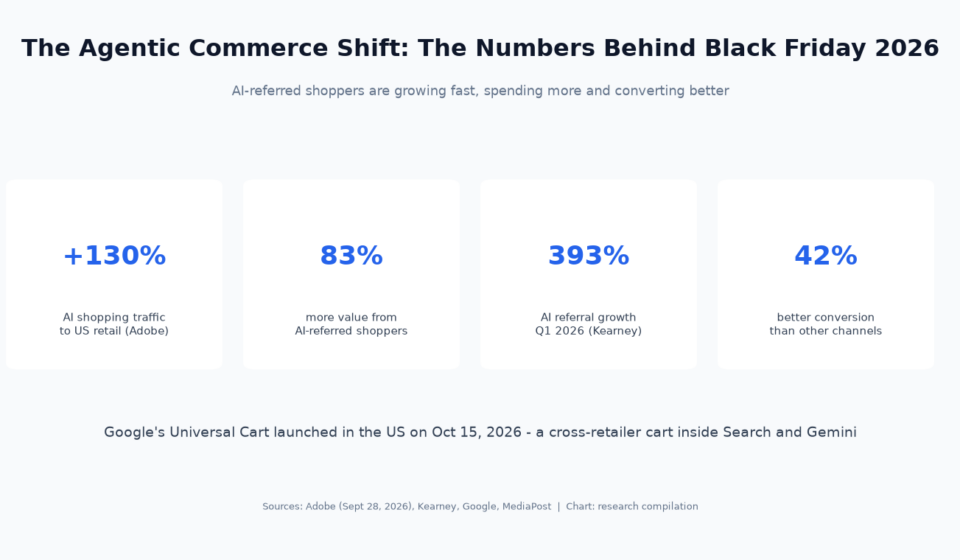
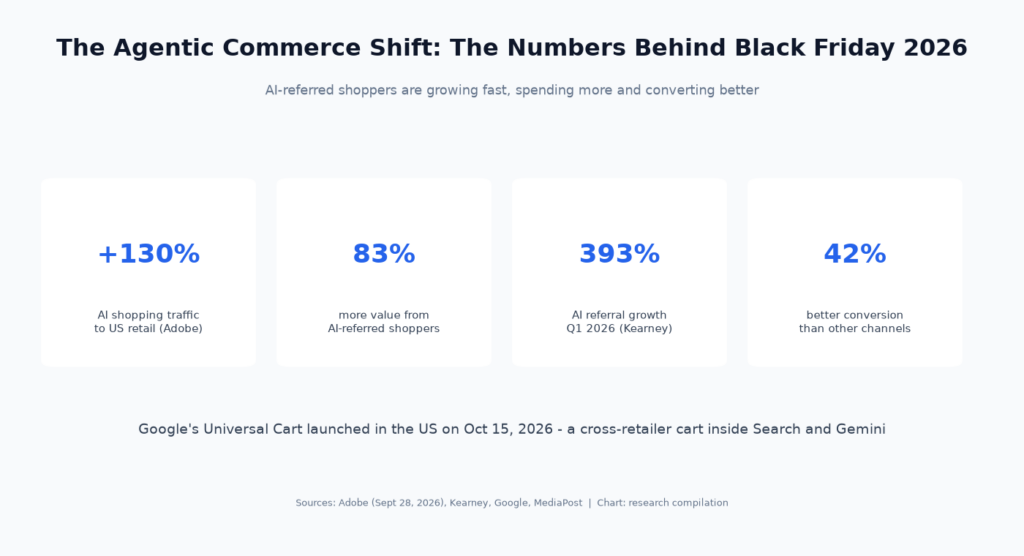
In September, Adobe forecast that AI-driven traffic to US retail sites would rise 130% year over year between November 1 and December 31, 2026 — and that the overall US holiday shopping season would reach a record $275.1 billion online, up 6.7%. In October, Google launched Universal Cart in the United States: a shopping cart inside Search and the Gemini app that lets users collect products from different retailers, track prices and stock, and check out in one place.
Individually, each is significant. Together, they describe a structural change: the battle for e-commerce is moving from which website a shopper visits to which AI agent completes the purchase.
What Universal Cart actually does
Universal Cart is best understood as Google’s attempt to own the checkout layer of the open web. Announced at Google I/O in May and rolled out in the US on October 15, it aggregates products from multiple retailers into a single cart, tracks prices and availability, and — through a framework Google calls Universal Commerce Protocol — completes transactions for participating stores.
The strategic logic is that Google already owns the top of the funnel: search, discovery and increasingly AI-assisted research through Gemini. What it has never owned is the transaction. Universal Cart is an attempt to close that gap, turning the moment of purchase into something that happens inside Google’s surfaces rather than on the retailer’s site.
For shoppers, the appeal is convenience: one cart, many stores, price tracking, no repeated checkout forms. For Google, the appeal is data and leverage: whoever controls the checkout controls attribution, and whoever controls attribution shapes where advertising budgets flow.
Adobe’s forecast, unpacked
The Adobe numbers deserve careful reading, because they are frequently misquoted. The 130% figure refers to the growth in AI-driven traffic to US retail sites during the holiday window — not a 130% increase in overall online sales. The overall holiday forecast is $275.1 billion, up 6.7% year over year.
The more striking Adobe finding is about value. Shoppers arriving via AI referrals are worth roughly 83% more to retailers than those arriving through traditional channels. In other words, AI traffic is not just growing quickly; it is higher-intent and higher-value. That combination is why retailers are racing to optimise for it.
Kearney’s research reinforces the point. AI-referred traffic to US retail sites grew 393% year over year in the first quarter of 2026, and it now converts 42% better than other channels — a full reversal from a year earlier, when it converted 38% worse. The behaviour of AI-referred shoppers, Kearney notes, resembles high-intent search rather than broad browsing.
Why checkout is the battleground
If AI agents are increasingly the starting point for shopping, then the company that owns the agent’s checkout owns the economics of the transaction. That is why Universal Cart matters more than it might first appear.
Consider the flow. A shopper asks Gemini for a recommendation. The AI surfaces three products. The shopper picks one. With Universal Cart, the purchase can complete inside Google’s interface, using stored payment details, without the shopper ever visiting the retailer’s site. The retailer gets the sale, but loses the customer relationship, the upsell opportunity and the first-party data.
This is the same dynamic that made Amazon so powerful: control the transaction, and you control the terms. Google is now trying to apply that model to the open web.
The Google paradox
There is a complication. Google has tried to win e-commerce before, and it has largely failed. Google Shopping was repeatedly outmanoeuvred by Amazon, and PYMNTS noted that Google’s next big bet is a business it has never won.
The difference this time is AI. Universal Cart is not a shopping comparison site; it is an agentic checkout layer embedded in the interfaces people already use. If Gemini becomes the default way people research purchases, the cart becomes a natural extension of that behaviour — and Google’s distribution advantage, which failed to translate into commerce before, may finally count.
Whether that works depends on execution and on retailer cooperation. Retailers are wary of ceding the checkout to Google, just as they were wary of ceding it to Amazon. Some will participate because the traffic is too valuable to ignore; others will resist, preferring to keep the transaction on their own sites.
What it means for brands
For brands and retailers, the practical implications are already visible.
First, product data quality becomes a marketing function. If an AI agent is deciding what to recommend, the structured data, availability and pricing a brand exposes will determine whether it gets picked. Agentic commerce optimisation — making store data machine-readable — is becoming as important as SEO once was.
Second, the customer relationship is at risk. If purchases complete inside an AI interface, brands lose direct access to the buyer. Building owned channels — email, loyalty, community — becomes more important, not less.
Third, attribution gets murkier. When an AI agent mediates the journey, the traditional last-click model breaks down. Brands will need new ways to measure what actually drove a sale.
Black Friday 2026 as a test case
This holiday season is the first in which AI agents are a mainstream shopping interface. Universal Cart, ChatGPT’s advertising experiments, and a wave of AI shopping tools are all live at once. Black Friday and Cyber Monday will be the first large-scale test of whether AI-mediated shopping actually converts at the rates the forecasts imply.
If it does, expect a rapid reallocation of marketing budgets toward AI visibility and agentic commerce optimisation. If it does not, the shift may be slower than the headlines suggest — but it will still be happening.
What to watch
Three signals will show how fast this is moving: whether Universal Cart adoption grows beyond early adopters during the holiday season; whether retailers report measurable revenue from AI-referred traffic; and whether Google expands Universal Cart to more markets in 2027.
The bottom line
Black Friday 2026 will be remembered less for its discounts than for the moment AI agents became a primary shopping interface for millions of consumers. The brands that thrive will be the ones that make themselves easy for machines to find, understand and buy — and that keep a direct relationship with the customer even when the transaction happens somewhere else.