53% of the World’s Display Market, a 100-Billion-Yuan Chengdu Cluster: Inside China’s Full-Stack Screen Strategy
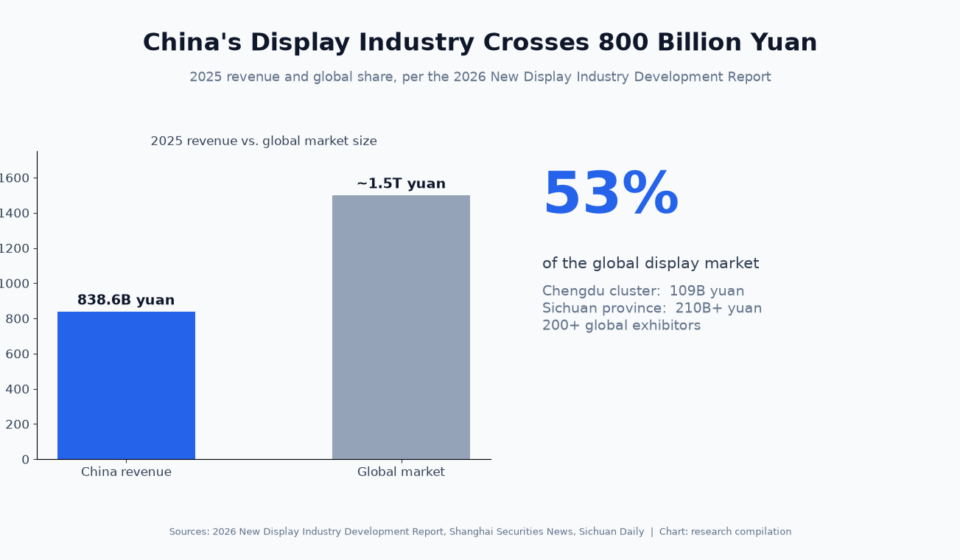
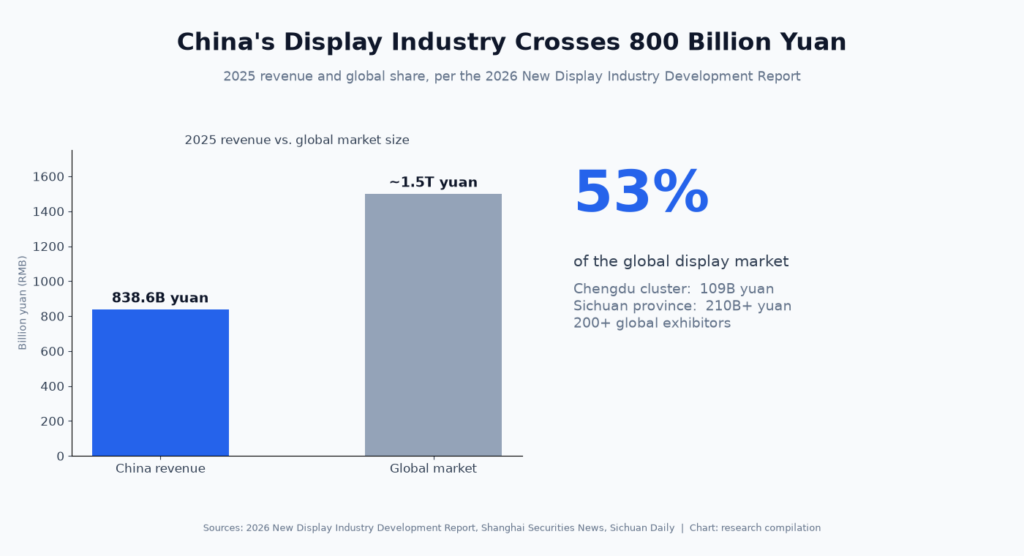
The numbers from Chengdu were almost too large to absorb. At the 2026 World Display Industry Innovation and Development Conference, held on November 4 and 5, a government-backed report put China’s new-display industry revenue above 838.6 billion yuan for 2025 — roughly 53% of a global market valued at about 1.5 trillion yuan.
But the more revealing story was not the headline figure. It was the list of upstream breakthroughs unveiled alongside it: a domestically built Micro-LED laser mass-transfer machine, the country’s first G8.6 linear evaporation source, a G6 large-mask projection scanner, a fully domestic 18-micron ultra-thin metal mask, and a 130-inch LCD polariser. These are the components that, until recently, China had to import.
Taken together, the conference marked a shift in how China’s display industry should be understood: no longer just the world’s largest manufacturer of screens, but an increasingly complete supply chain that designs, builds and equips the factories that make them.
A scale leader becomes a full-stack competitor
For most of the past decade, China’s display story was one of volume. It became the world’s largest producer of LCD panels, and its share of large-format LCDs now exceeds 75%. That scale gave it pricing power and a manufacturing base, but it depended on imported equipment and materials for the most advanced processes.
The 2026 conference suggested that dependence is narrowing. The five breakthroughs on display are all upstream — the equipment and materials that determine whether a country can build next-generation fabs without foreign suppliers. A domestic Micro-LED mass-transfer tool, for instance, addresses one of the hardest steps in manufacturing Micro-LED displays, a process notorious for low yields and high cost.
The report also noted that China has become one of the most complete display-technology ecosystems in the world, pursuing multiple routes in parallel: TFT-LCD as the mainstream, AMOLED advancing from small to medium sizes, and Micro-LED, silicon-based OLED, e-paper and laser display accelerating toward commercialisation.
Chengdu’s cluster model
Chengdu, the host city, illustrates how the strategy works on the ground. Its new-display industry surpassed 109 billion yuan in 2025, up 17.2% year on year. Sichuan province as a whole exceeded 210 billion yuan, with more than 150 chain-leader and supporting enterprises, a supply-chain completeness rate above 70% and a local supporting rate above 40%.
The cluster model — chain leaders anchoring a broad base of suppliers — is deliberate. BOE and other major panel makers act as anchors, while smaller firms fill in materials, equipment and components. The result is a local ecosystem where a new product can be designed, prototyped and produced without long international lead times.
This matters beyond Chengdu. China has formed four major display clusters — around Beijing, the Yangtze River Delta, the central-western region and the Pearl River Delta — each with distinct strengths. The geographic spread reduces concentration risk and allows different regions to specialise.
The technology roadmap
The report laid out a clear technology hierarchy. TFT-LCD remains the mainstream, with China’s output ranking first globally and its share of large-format panels above 75%. AMOLED has moved from small smartphone screens toward medium sizes and reached advanced levels. The forward-looking technologies — Micro-LED, silicon-based OLED, e-paper and laser display — are accelerating toward industrialisation.
Micro-LED is the most strategically important of these. It offers superior brightness, contrast and durability, and is seen as the likely technology for next-generation AR glasses, automotive displays and premium televisions. The domestic mass-transfer breakthrough is a signal that China intends to compete at the leading edge, not just in mature LCD.
At the conference, companies showcased products that illustrate the ambition: a 308-inch TFT-based Micro-LED cinema screen, a 1.85-inch transparent Micro-LED watch, AI+AR glasses, and 16K ultra-high-definition light-field 3D displays. These are not commodity panels; they are attempts to define new categories.
The AI convergence
A recurring theme at the conference was the fusion of display with AI. As generative AI and smart devices proliferate, the screen is shifting from an output device to an interactive interface — one that connects users, devices and digital content.
This has concrete implications. In smart vehicles, cockpit digitalisation is driving demand for higher-resolution, more immersive and more reliable automotive displays. In near-eye devices, AR and VR are pushing requirements for finer resolution, higher brightness, faster response and thinner form factors. In semiconductors, AI’s demand for compute and data transfer is pushing glass substrates from display into advanced packaging — an adjacency that could expand the addressable market significantly.
Corning’s China president captured the shift: the screen is becoming an important interface connecting users, devices and digital content. That framing matters because it positions display not as a mature, commoditised industry but as a foundational layer of the AI era.
The geopolitical dimension
The display industry sits squarely in the middle of US-China technology competition. Display equipment and materials have been subject to export controls, and the push for domestic substitutes is partly a response to supply-chain risk.
The conference’s emphasis on upstream breakthroughs should be read in that light. Each domestic tool reduces exposure to foreign suppliers and, by extension, to policy risk. It also strengthens China’s position in global negotiations over technology standards and supply.
At the same time, the industry remains globally interdependent. Japanese and Korean firms still lead in certain materials and processes, and the “three countries, four regions” competitive dynamic — China, Japan and Korea developing in offsetting ways — is likely to persist. China’s advantage is scale, completeness and speed of industrialisation; its challenge is closing remaining gaps in the most advanced equipment and materials.
What it means globally
For global electronics brands, the implications are twofold. First, sourcing: China’s display supply chain is now deep enough that avoiding it entirely is impractical for most consumer-electronics categories. Second, competition: Chinese display makers are moving up the value chain, which will pressure margins for incumbents in Korea, Japan and Taiwan.
For investors, the display sector offers exposure to several secular trends at once — AI hardware, automotive electronics, AR/VR and premium consumer devices. The upstream equipment and materials segment may be particularly interesting, because that is where the remaining bottlenecks and the highest margins sit.
What to watch
Three things will determine whether China’s display industry converts scale into durable leadership: whether the domestic upstream tools move from showcase to mass production; whether Micro-LED yields improve fast enough to enable commercial products at scale; and whether export controls tighten further, accelerating or complicating the domestic-substitution push.
The bottom line
China’s display industry has spent a decade becoming the world’s largest. The 2026 Chengdu conference suggested the next decade will be about becoming the world’s most complete — a shift that matters far beyond screens, because displays are becoming the interface through which people interact with AI.