€53 Billion in Orders for a €9 Billion Bond: Inside Meta’s Record Euro Debut and the AI Debt Boom
Meta Platforms just demonstrated something remarkable about the state of AI finance: investors are willing to lend the company tens of billions of dollars at a premium, even as rating agencies warn that its spending is getting out of hand.
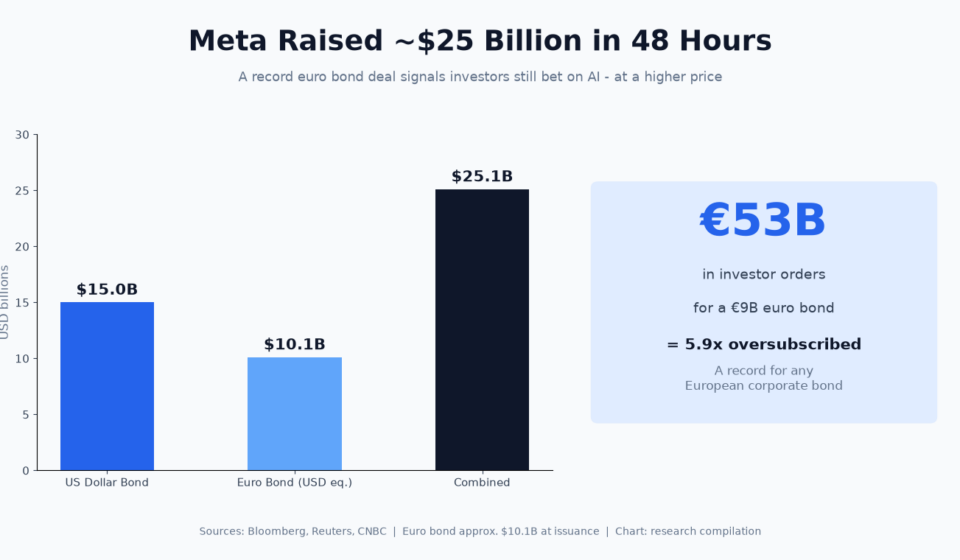
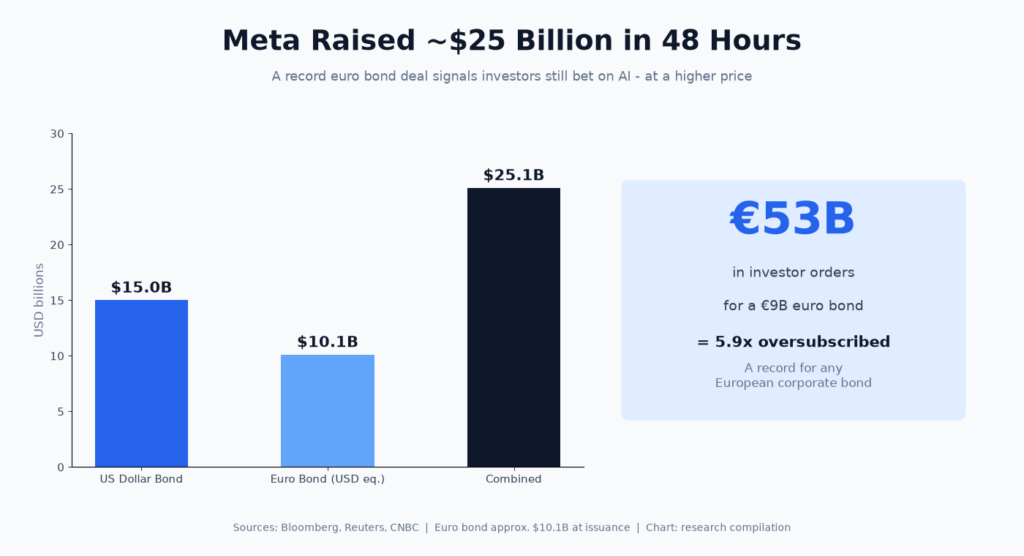
In the space of 48 hours, Meta raised roughly $25 billion. On November 3 it sold $15 billion of US dollar bonds in five parts. On November 4 it priced its first-ever euro-denominated bond, a €9 billion deal split across six tranches with maturities ranging from just over four years to more than 38 years. That euro sale attracted a record €53 billion in orders — the largest order book ever for a corporate bond in Europe, and nearly six times the amount raised.
The price of admission
The demand was strong, but it was not free. Meta is paying about 1.4 times the risk premium that Alphabet offered on comparable euro debt priced just days earlier. Lenders are effectively charging Meta a surcharge for its aggressive AI spending and the free-cash-flow deficit that comes with it.
That premium is the tell. Investors are not blind to the risks of the AI capex cycle. They are simply pricing them in — and still buying, because the alternatives are worse.
The S&P paradox
Days before the sale, S&P Global Ratings revised Meta’s outlook from AA- stable to AA- negative, citing the strain that AI infrastructure spending is placing on its finances. A negative outlook is a warning shot: the agency is signalling that a downgrade is possible if the spending trajectory does not improve.
And yet the bond sale was a runaway success. This is the central paradox of the AI debt boom. Rating agencies look at cash flow and see danger. Bond investors look at the yield and see opportunity. Both can be right at the same time, because they are answering different questions — one about creditworthiness, the other about relative value.
Why it matters beyond Meta
Meta is not alone. Across the technology sector, companies are increasingly turning to debt markets to fund AI infrastructure, moving away from the historical norm of funding growth from operating cash flow. This is a structural change in how the industry finances itself, and it carries implications for every investor exposed to tech credit.
The scale matters too. When a single company can absorb €53 billion of demand in one afternoon, it tells you that global fixed income is hungry for AI exposure — and that the market’s appetite for the trade remains intact, at least for now.
The contradiction to watch
The interesting question is not whether Meta can raise money. It clearly can. The question is what happens when the spending it is financing runs into the political and physical constraints now emerging elsewhere — the data-centre moratoriums, the power shortages, the community opposition.
If the buildings cannot be built, the bonds still have to be repaid.
What to watch
Three things will define the next chapter: whether S&P follows through with an actual downgrade; whether other hyperscalers replicate Meta’s euro-denominated playbook; and whether the premium Meta pays widens or narrows as the AI capex cycle matures.
For now, the market has spoken clearly. It will finance the AI buildout — but it intends to be paid for the privilege.