The Price Scissors Behind China’s Short-Drama Boom
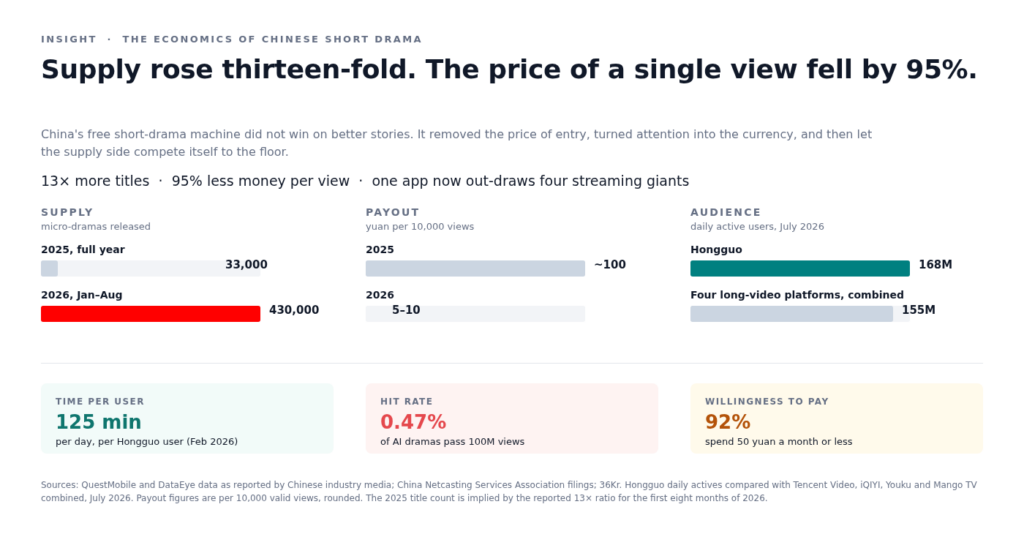
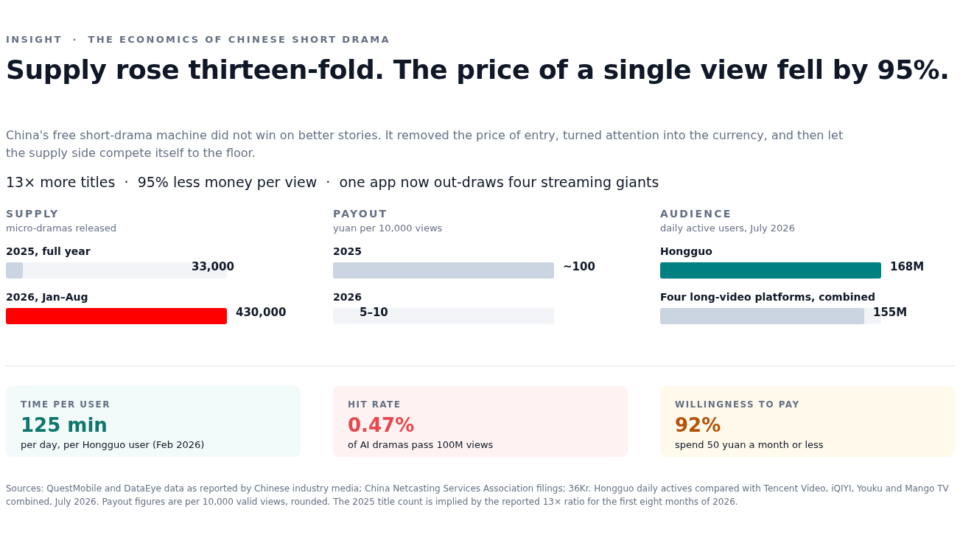
In July, a three-year-old app called Hongguo passed 168 million daily users. Tencent Video, iQIYI, Youku and Mango TV — between them, China’s entire premium streaming industry — reached about 155 million that same month. One free app, built almost entirely on ninety-second episodes, out-drew the whole paid category.
The lazy explanation is that Chinese viewers have shorter attention spans. That is description pretending to be cause. The real mechanism is three cost curves crossing at once, and all three were engineered.
Curve one: the price of entry went to zero. Hongguo did not compete on quality; it deleted the transaction. Pay-per-episode gave way to watch-an-ad, unlock-the-next. Six in ten short-drama users have never paid a yuan for the format, and 92% spend ¥50 a month or less. Remove the price and the question stops being “is this worth paying for”. It becomes “do I have ninety seconds”.
Curve two: the cost of supply collapsed. A live-action micro-drama still runs ¥500,000 to ¥1 million. AI production has pushed finished minutes down to ¥800–1,500. The constraint on supply simply disappeared: 430,000 titles shipped in the first eight months of 2026, thirteen times the whole of 2025, more than nine in ten of them AI-made.
Curve three: distribution was already free. Hongguo never had to build an audience. More than half its new users arrive from Douyin, which also sells the advertising that funds the loop. The app is the destination; the funnel and the ad system came pre-built.
Put the three together and you get a price scissors: supply up thirteen-fold, revenue per view down 95%. Roughly ¥100 per 10,000 views a year ago now sits at ¥5–10. Only 0.47% of AI dramas clear 100 million views, and about 1.3% ever break even. In August, Hongguo cut its top-tier guarantee from ¥50,000 to ¥10,000. The platform did not get greedy. It became the buyer, and the buyer sets the price.
For anyone marketing into China, the useful part is what this attention actually is. Hongguo’s audience skews older and lower-tier — 40 million users aged 50 and over by February, about 13% of the base — and unusually ad-tolerant, because they were never inside a subscription. At 125 minutes a day, it is the deepest cheap reach available in the country.
Cheap, though, is the word with the expiry date. When supply inflates faster than attention, the audience gets pickier: the first three seconds decide everything, and the platform answers with tighter rules rather than better shows.
The boom is not a content revolution. It is an advertising arbitrage run at national scale — and the arbitrage is what is now closing.