Nobody Test Drives Anymore: The Unbundling of Car Buying in China
Picture a mall in Chengdu on a Saturday afternoon. Between a bubble tea counter and a nail salon sits a white SUV behind a velvet rope. No desk. No finance manager. No laminated options sheet. Just the car, two spotlights, and a QR code on a small stand.
Scan it and the same vehicle opens on your phone: your colour, your wheels, the price your city actually charges, a delivery window counted in weeks. There’s an option to book a twenty-minute drive. You can also skip it.
That QR code is the story. Not because showrooms vanished — they didn’t — but because the showroom stopped being where the decision happens.
The short version
China is the world’s largest car market, and the most digital one. In 2025 it sold 34.4 million vehicles, 16.49 million of them new-energy, and shipped 7.09 million abroad. A year on, domestic passenger-car retail is down 22% through October, the industry’s profit margin has been compressed to 3.3%, and the country’s largest dealership group has more or less walked away from selling new cars.
Those two facts belong in the same sentence. A growing market forgives lazy distribution. A shrinking one does not. When volume disappears, marketing has to do the job the dealer network used to do: qualify, configure, price, reassure, close — and then keep selling through the next five years of ownership.
Most global brands read this as a channel problem. It’s a question of who owns the customer.
2025 was the peak. 2026 is the invoice.
Start with the numbers, because they explain every decision that follows.
China produced 34.53 million vehicles in 2025 and sold 34.4 million, up 10.4% and 9.4% — the seventeenth straight year at number one. New-energy vehicles (NEVs) made up 16.49 million of those sales, a 28% jump, and 47.9% of the total market. At home, NEVs took 50.8% of sales; for passenger cars alone, 54%. Chinese brands climbed to 69.5% of passenger-car sales. Exports reached 7.09 million, with NEV exports doubling to 2.62 million.
That was the peak of a subsidy-assisted cycle. The invoice arrived fast.
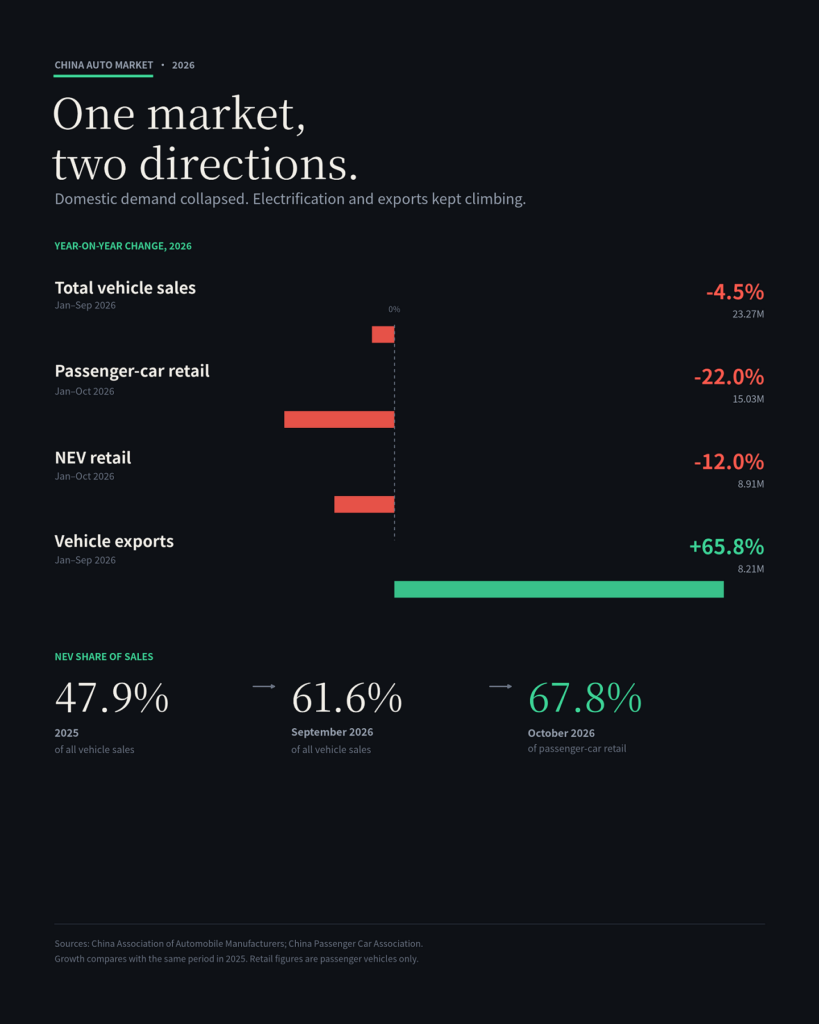
Through September 2026, vehicle sales slipped 4.5% to 23.27 million. Passenger-car retail is down 22% through October. In October, retail dropped 25% year on year to 1.693 million units, and NEV retail posted its tenth consecutive monthly decline. September’s domestic sales of conventional fuel passenger cars collapsed 47.3% to 526,000 units — a hole no amount of electric demand was going to fill.
And yet electrification kept eating the market. NEVs reached 61.6% of all vehicles sold in September and 68.5% of domestic passenger-car sales. By October, NEV retail penetration hit a record 67.8%. In September, for the first time, the internal-combustion share of China’s passenger-car market fell below one-third, and battery-electric vehicles alone took 47.3% of it.
The two halves of this story are not contradictory. They’re the same story: the market stopped growing and started swapping. A first-time buyer market became a replacement market, and replacement buyers are pickier, slower, and far better informed.
Then there’s the escape valve. Exports hit 8.205 million units in the first nine months — more than the whole of 2025 — and are on pace to clear 10 million for the first time. September exports alone reached 1.053 million, up 61.4%, with NEVs at 571,000.
Read those numbers as a marketer and a pattern appears. The domestic fight is no longer about reaching more people. It’s about being chosen by the people who are still buying.
Why a 3.3% margin turns marketing into a survival skill
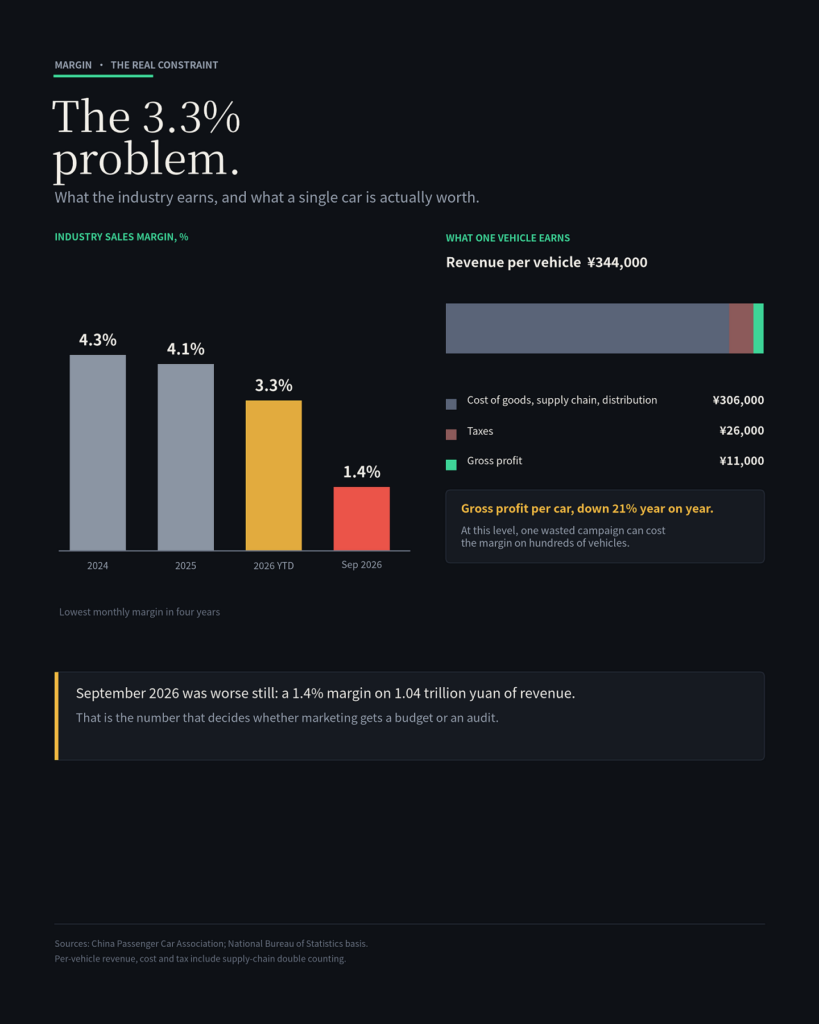
Here’s the number that reframes everything else: 3.3%.
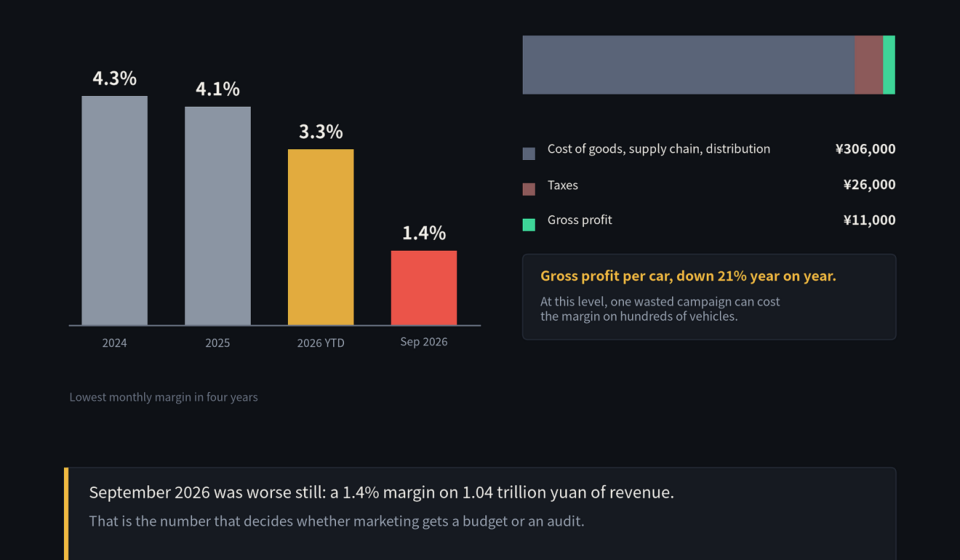
That was the Chinese auto industry’s sales profit margin for January through September 2026, down from 4.3% in 2024 and 4.1% in 2025. Industry profit fell 23% to 267.5 billion yuan on revenue of 8.04 trillion yuan. September was worse — a 1.4% margin, the lowest in four years.
Per vehicle, the arithmetic is brutal. Average revenue across the supply chain came to 344,000 yuan per car. Costs took 306,000. Taxes took 26,000. Gross profit landed at 11,000 yuan per vehicle, down 21%.
Sit with that for a second. A single mispriced media plan, a launch that misses its window, a discount campaign that trains buyers to wait — any one of those can wipe out the gross profit on hundreds of cars.
This is why Chinese car marketing looks so strange from the outside. There’s no budget for brand films that don’t convert. There’s no patience for a three-month awareness phase. Every yuan has to be traceable to an order, because the margin no longer absorbs the ambiguity.
The middleman didn’t lose a fight. He was made redundant.
You can’t understand the app-based purchase journey without understanding what happened to the physical one.
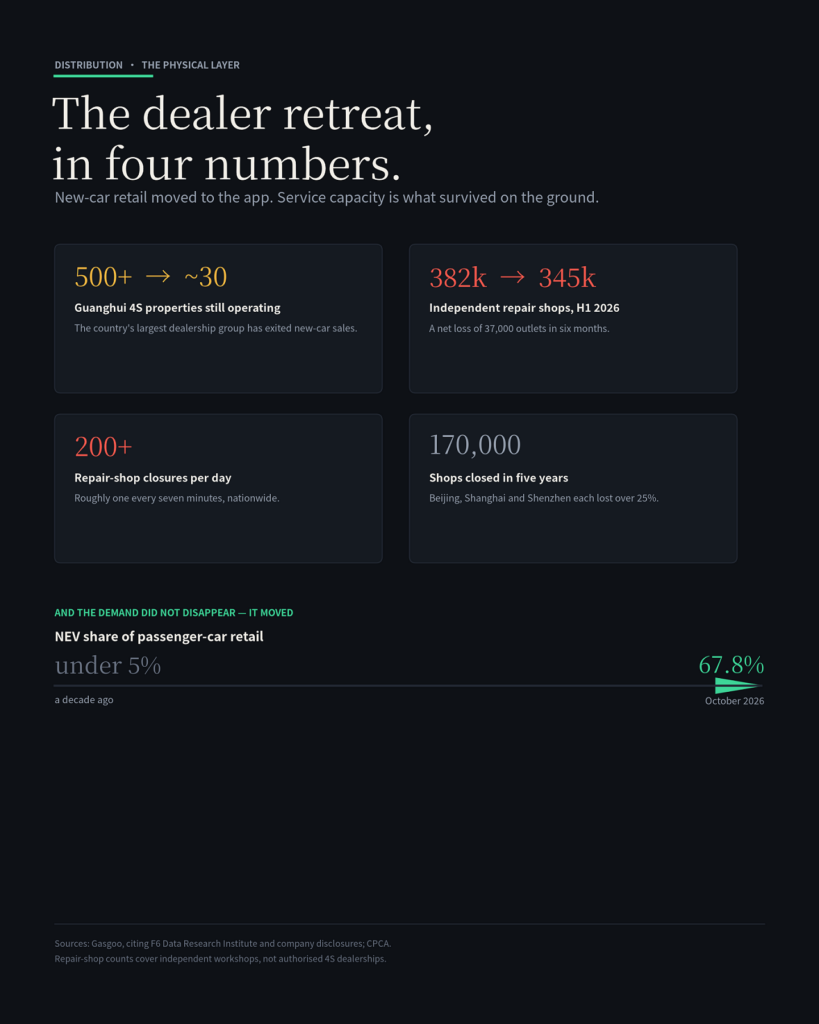
Guanghui Auto, long the top-ranked dealership group in the country, has effectively exited new-car sales. It still holds more than 500 properties that contain 4S showrooms. About 30 remain operational, and they focus on maintenance and repair. That is not a strategic pivot. That’s a write-down with a press release.
Individual closures tell the same story. Nanjing’s Lizhi Mercedes-Benz 4S store — an 18-year fixture — shut both of its locations in August 2026 under the phrase “business adjustment.” Joint-venture plants are running below 50% utilisation in some cases, as ICE sales for Volkswagen, Toyota and Honda fall by more than 20%.
The aftermarket is thinning even faster. F6 Data Research Institute counted 382,000 repair shops at the start of 2026 and 345,000 by mid-year — more than 200 closures a day. Over five years, 170,000 have gone. Beijing, Shanghai and Shenzhen have each lost more than a quarter of their traditional repair outlets.
Why? Because an electric car doesn’t need oil changes, spark plugs or transmission service. The recurring revenue that funded the entire dealer and repair economy evaporates when the drivetrain loses its moving parts.
So the physical layer that used to own the customer relationship is being written off, in real time, in public. Something had to absorb the relationship. In China, that something was the app.
The journey, rewired
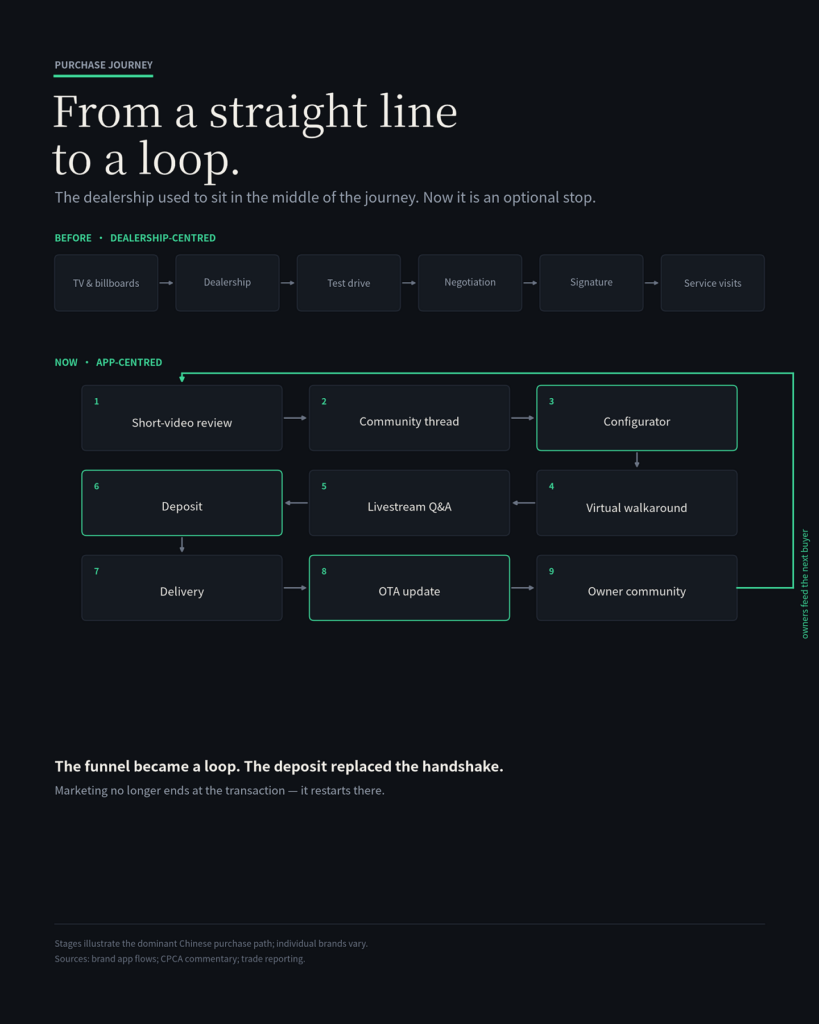
The old sequence is familiar to anyone who has bought a car anywhere:
Television and billboards → dealership visit → test drive → negotiation → signature → service visits.
The Chinese sequence now looks like this:
Short-video review → community thread → configurator → virtual walkaround → livestream Q&A → deposit → delivery → over-the-air update → owner community.
Two structural changes matter more than the individual steps.
First, the funnel became a loop. The owner community feeds the next buyer’s discovery. A delivery-day post is content. A software update is a campaign. Marketing doesn’t end at the transaction; it restarts there.
Second, the deposit replaced the handshake. A locked order is a measurable marketing outcome — not a lead, not a test-drive booking, but a number the finance team can plan production against.
Stage one: discovery happens in a feed
Chinese car buyers don’t start with a brand. They start with a problem — “best SUV under 200,000 yuan for a family of five” — and a feed answers it.
The platforms divide the labour with unusual precision. Douyin supplies reach and the launch moment. Bilibili supplies depth: forty-minute teardown videos, chassis comparisons, battery-thermal tests. Xiaohongshu supplies lifestyle framing, and it’s where the female buyer segment actually gets addressed. WeChat holds the private-domain layer afterwards — owner groups, service bookings, referrals.
The content itself has shifted. Foot-traffic data from NEV dealerships, reported across the Chinese trade press, shows shoppers asking about driver assistance and infotainment far more often than about engine specifications. That tracks with adoption: Level 2 driver assistance now appears in about 70% of new passenger vehicles, up from 64% in the first three quarters of 2025, and more than 30% of models offer navigation-assisted driving. The installed base is roughly 61 million L2-equipped cars, including about 15 million with navigation-on-autopilot capability, plus 16 million vehicles with 5G terminals.
When the product becomes software, the spec sheet becomes content. And when the spec sheet becomes content, the review video is the advertisement.
Stage two: the configurator is the new showroom
Here’s where global marketers usually nod along and then miss the point. The configurator isn’t a website feature. In China it’s the store.
Xiaomi is the cleanest example, partly because it arrived late and had to buy attention the hard way. Its Sky Nomad series launched on 7 September 2026 and collected more than 70,000 locked orders within 30 days; 12,444 were delivered that month. October deliveries topped 50,000, the company’s best month of the year. Through October, Xiaomi had delivered at least 336,490 vehicles — about 61% of a 550,000 annual target it will almost certainly miss — for a cumulative total of roughly 888,000 since launch.
Notice what the order book does for marketing. It converts a launch into a demand signal with a timestamp. It creates scarcity you don’t have to invent. And it lets a company with no dealer network behave like a consumer-electronics brand: announce, take orders, ship.
NIO shows the other half of the model — pricing power without discount theatre. The NIO brand delivered its one-millionth vehicle on 21 September 2026, and its average transaction price has stayed above 400,000 yuan. That’s a luxury brand holding price in a market that has spent two years cutting it. It did so with fixed pricing, an app, and a community, not with end-of-quarter clearance events.
Stage three: the test drive got unbundled
The test drive didn’t die. It got broken into pieces and distributed across the journey.
The first “drive” is usually a video: a reviewer’s two-hour highway run, filmed from the passenger seat. The second is a configurator walkaround, where you see your specification in your colour. The third is a livestream Q&A, where a product specialist answers the questions a salesperson used to guess at. Only the fourth is physical — and by then it’s a confirmation, not a discovery.
The retail footprint has changed shape to match. Li Auto runs 485 retail centres across 160 cities but 532 service and repair centres across 217 cities. Retail clusters where people already are: malls, transit hubs, office districts. Service sits where cars already are. Those two maps used to be the same map, because one building did both jobs.
NIO went further and made the physical space a clubhouse rather than a sales floor. NIO Houses host owner events, work sessions and coffee; the car is the membership card, not the exhibit.
All of this runs against a regulatory current, though, and smart marketers should notice it. China’s draft rules published in October 2026 would require at least 30,000 kilometres of reliability testing and a validation cycle described as “two winters and one summer” for new models, with real-vehicle testing of driver assistance and smart-cockpit systems, plus validation of every over-the-air update. Virtual convenience is fine at the point of sale and suspect at the point of engineering.
Stage four: the order book is a media channel
Chinese launches are built around a countdown, a livestream, and a number that gets published within hours. Locked orders. Wait-list length. First-day configuration mix.
This is genuinely new as a marketing discipline. Western launches report sales quarterly, if at all. Chinese launches report demand in real time, and the number itself becomes the next day’s content — which is why order announcements are so carefully staged, and why they deserve scepticism.
The CPCA has been blunt about this. It noted that most NEV brands currently lack blockbuster models, yet manufacturers keep production running to hit targets, producing a wide gap between externally estimated order figures and companies’ actual deliveries. Treat the order number as a marketing artefact, not an audited metric — useful for reading intent, useless for forecasting revenue.
Stage five: the campaign that ships after the sale
An over-the-air update is a product release and a press release at once. New parking assist behaviour, a redesigned interface, a range improvement — each is a reason to re-engage an owner who bought two years ago and to generate fresh review content for a buyer who is deciding now.
That’s the logic behind treating OTA notes as campaign copy. It’s also the logic behind the regulatory tightening: if software can change the car, then marketing claims about the car have to be validated in the software that ships. The October draft would require automakers to test combined driver assistance, autonomous driving and smart-cockpit systems in real vehicles, including extreme scenarios, and to validate OTA updates before release.
Translation for marketers: the “we’ll fix it in software” era is closing. Claims now need paperwork.
The channel map, without the hype
| Channel | Job in the journey | What good looks like | What to watch |
|---|---|---|---|
| Douyin | Reach, launch moments, livestream commerce | A reveal event with a published order number within hours | Creative fatigue; order inflation |
| Bilibili | Depth, technical credibility | Long-form teardown by a reviewer with an engineering audience | Slow to scale; high production cost |
| Xiaohongshu | Lifestyle positioning, female buyers | “My first EV” content that reads as a diary, not an ad | Astroturfing risk; disclosure rules |
| Brand app / mini-program | Configurator, order, finance, service, OTA | Quote a real delivery date, not “coming soon” | Churn after delivery |
| Mall retail centres | Physical confirmation, handover | Staff who can answer software questions, not just trim questions | Cost per visit |
| WeChat private domain | Retention, referrals, service | Owner groups with actual engineers in them | Group fatigue; moderation load |
| Livestream | Q&A at scale, price transparency | A host who can say “no” to a bad-fit buyer | Compliance on capability claims |
Why global brands can’t copy-paste this
Volkswagen’s third quarter is the cautionary tale. China deliveries fell 38.5% to 406,000 vehicles, group revenue slipped 6.3% to 75.28 billion euros, and the quarter closed with a multi-billion-euro loss. Ralf Brandstaetter, Volkswagen’s China chief, has said publicly that he expects the country’s passenger-car market to shrink by about 20% in 2026. Honda’s China sales fell 24.28% in 2025 to 645,345 units. FAW-Volkswagen delivered 1,587,065 vehicles, down 4.34%.
The reasons are structural, not creative.
Dealer contracts. Legacy brands are bound to franchise networks that own the customer relationship, the pricing, and often the data. Moving to fixed pricing and app-based ordering means renegotiating with the very partners who funded the last two decades.
Model-year versus feature-drop. A global brand plans a model year eighteen months out. A Chinese competitor ships a software feature in three weeks and markets it in four.
Claims approval. A Chinese launch team can greenlight a livestream in days. A global team needs legal, regional and brand sign-off — which is exactly the wrong cadence for a market where the competitive set changes quarterly.
Joint-venture autonomy. Foreign OEMs operating through JVs have less control over marketing than direct-sales EV brands. Some JV plants are running below half capacity, which limits both the budget and the appetite for experimentation.
Content ecosystem. There is no Western equivalent of the Bilibili auto reviewer — a creator with an engineering-literate audience who will spend forty minutes on a chassis. That’s an infrastructure problem, not a budget line.
The regulatory reset: you can no longer oversell the software
For three years, the easiest way to win a Chinese launch was to over-claim. Call a Level 2 system “autonomous.” Imply the car drives itself. Ship the promise, patch the reality.
That window is closing, and it’s closing with a specific document.
On 10 October 2026, the Ministry of Industry and Information Technology, together with three other agencies, published draft rules on automotive innovation design and R&D verification. Alongside the testing requirements, the draft states that automakers must accurately explain the operating boundaries and restrictions of innovative designs, must not exaggerate capabilities, must not conceal technical limitations, and must not encourage drivers to neglect their safety responsibilities. Public comment runs to 10 November; new models would need to comply from 1 January 2027.
The same draft proposes banning foldable and flexible displays, requiring physical controls for lights, wipers and defrosting, and preventing anyone but the driver from operating key safety functions by voice while the car is moving. Separately, regulators have been tightening how “smart driving” language can be used in advertising and at the point of sale, and the first conditional Level 3 approvals — granted to Changan and BAIC in December 2025 — apply only to designated road sections and operating conditions.
What does that do to marketing? It turns claim discipline into a competitive advantage. The brands that can produce evidence — test footage, third-party validation, real owner data — will out-market the ones still writing adjectives. “Verified” becomes the new “revolutionary.”
The car as a media surface, and why the screen is narrowing
The obvious next frontier is the cabin. Sixteen million Chinese passenger cars already carry 5G terminals, and about two million have cellular vehicle-to-everything connectivity. In-car screens have been pitched as the next premium ad inventory: a captive audience, geo-aware, with payment already attached.
Two things are in the way. The first is safety regulation, which just moved to ban foldable and flexible displays and to require physical controls for core functions. The second is culture: Chinese consumers have spent a decade being trained by app-based interfaces, and they are unusually intolerant of advertising that interrupts a task they’re trying to complete.
The realistic version of this future is narrower than the pitch decks suggest. In-car commerce will live in service moments — charging, parking, maintenance booking — not in pre-roll. Treat the windshield as ad inventory and you’ll be designing for a screen that regulators may not let you build.
The risks nobody puts in the deck
The market is shrinking, not just rotating. NEV retail has fallen year on year for ten straight months. Anyone planning 2027 budgets on “EV growth” headlines is planning against the wrong number.
Cost inflation is coming from upstream. Memory prices have surged and lithium carbonate has roughly doubled, squeezing margins from the supply side while price competition squeezes them from the demand side. September’s 1.4% industry margin is what that looks like.
Policy is tightening at both ends. The purchase-tax break on NEVs runs to the end of 2027, but it is halved for 2026 and 2027, and in October 2026 the export VAT rebate on NEVs was cut to 9%. Subsidy-driven demand has a habit of reversing.
Trust is fragile. The industry is still absorbing a widely discussed brake-component failure on a flagship model that remains under investigation. One serious safety story can reset purchase intent across a category that markets itself on software confidence.
Order books can lie. As the CPCA’s warning suggests, estimated orders and actual deliveries have drifted apart. Marketing built on a number you can’t reconcile with registrations is marketing built on sand.
What to do in the next ninety days
If you run marketing for a brand selling into China, or competing against Chinese brands elsewhere, six moves matter more than a new campaign.
1. Change the KPI. Stop reporting leads. Report locked orders, configuration mix and delivery-date accuracy. If your dashboard can’t see a deposit, it can’t see the business.
2. Make the configurator answer three questions in under ninety seconds. What does it cost me here? When does it arrive? What do I get that the other one doesn’t? Any human in the loop is a delay you’re choosing.
3. Publish evidence, not adjectives. Under the new draft rules, every capability claim needs a test report behind it. Build a claims register now and give legal a seat in the creative review.
4. Split retail from service. Put showrooms where people already walk; keep workshops where cars already live. One building doing both jobs is a 1990s answer to a 2026 cost structure.
5. Treat software releases as campaigns. An OTA note is a press release with a changelog. Most global brands ship the feature and forget the announcement — then wonder why owners feel no attachment.
6. Fund the feed, not the spot. Bilibili depth, Douyin reach, Xiaohongshu context. A 30-second film is a rounding error in a journey that starts with a 40-minute review.
What this actually means
The test drive didn’t die. The dealership didn’t die either. What died was the assumption that a single physical location could own the entire relationship — discovery, specification, financing, delivery, service and resale — in a market where the buyer is holding a better-informed device than the salesperson.
China replaced that assumption with a loop: content creates intent, the configurator converts it, the order book amplifies it, delivery confirms it, and software renews it. The model was built during a boom, and it is being stress-tested in a slump — 22% down, 3.3% margins, repair shops closing at more than 200 a day.
That’s the part global brands keep misreading. They think they’re watching a Chinese marketing trend. They’re watching what a car purchase looks like when the margin gets thin enough that nobody can afford a middleman who doesn’t add information.
FAQ
Is the dealership actually dead in China?
No — but it’s been demoted. New-car retail has migrated to brand apps and direct sales, while the physical network survives mainly as service capacity. Guanghui, formerly the country’s largest dealership group, still holds more than 500 properties with 4S showrooms, but only about 30 remain operational and they focus on maintenance and repair. The building survived; the business model inside it didn’t.
What replaced the test drive?
Nothing single. It was unbundled into a review video, a configurator walkaround, a livestream Q&A, and finally a short physical drive that confirms rather than discovers. That’s why retail footprints are shrinking and clustering in malls: the store’s job changed from demonstrating a car to removing the last objection.
Why does a locked-order number matter more than an impression count?
Because at a 3.3% industry margin, marketing has to be reconcilable with production. A locked order tells the factory what to build, tells finance what to expect, and gives the next launch a social proof number within hours. It also gives you something to be wrong about publicly — which is why order inflation is now a real credibility risk.
Can a global brand replicate this model?
Not without renegotiating its distribution. The blockers are contractual (franchise dealer agreements), structural (joint-venture autonomy), and procedural (claims approval cycles measured in months, not days). Volkswagen’s 38.5% China delivery decline in the third quarter of 2026 is what the gap looks like in a P&L.
What changed with the October 2026 rules?
The draft would require accurate marketing of capability boundaries, ban exaggeration and concealment of limitations, mandate at least 30,000 km of reliability testing plus a “two winters and one summer” validation cycle, and require real-vehicle testing and validation of OTA updates. For marketers, the practical effect is that claims need documentation, and “we’ll improve it later” stops being a launch strategy.