Micro-Drama + E-Commerce: The Ad Format That Skips the Middleman
Forty seconds in, the character opens a bottle of serum. The camera does not linger, because it does not have to. A card slides up from the bottom of the screen: the bottle, the price, one button. Her thumb moves before she finishes reading the sentence. She never leaves the episode. She never opens a shopping app. She is not really shopping at all, which is exactly why she buys.
That one gesture is the most consequential change in Chinese retail since livestream selling taught several hundred million people to buy from a stranger talking at them. It is also the least understood, because it looks like product placement and behaves like a checkout counter.
The ad, the store, and the till now occupy one screen
Brand-funded short drama is not new. Starbucks released a time-travel story set in an ancient coffee house back in 2024, and every major beauty group in Shanghai has commissioned something similar since. That is sponsorship with a plot: pleasant, expensive, and still a campaign.
The format that matters does something narrower and stranger. It removes the handoffs. Three things that used to sit in sequence — the advertisement, the storefront, the payment — now sit in the same rectangle of glass, and a thumb travels between them. The drama is not a wrapper around the product. The drama is the shelf.
The Chinese industry calls it 短剧带货, drama-led selling. The more useful name is watch-to-buy.
Three business models wearing one name
Most of the confusion about this market comes from lumping three businesses together.
The first is paid episodic drama: the viewer unlocks the next ninety seconds with a coin. It is a pay-per-unlock business with a churn problem, and it is where the format learned to hold attention.
The second is free, ad-supported drama. ByteDance’s Hongguo built an empire on it by giving the episodes away and selling the audience to advertisers. It is a media business with a margin problem, because content is expensive and the advertiser pool is finite.
The third is commerce: the drama exists to move product, and revenue comes from what the audience buys rather than from what it watches. This is the newest and least documented, and it threatens the advertising industry rather than the streaming industry.
The same show can run on all three models at once. That is why four research houses will give you four market sizes, and why the disagreement is more informative than any single figure.
The scale nobody budgeted for
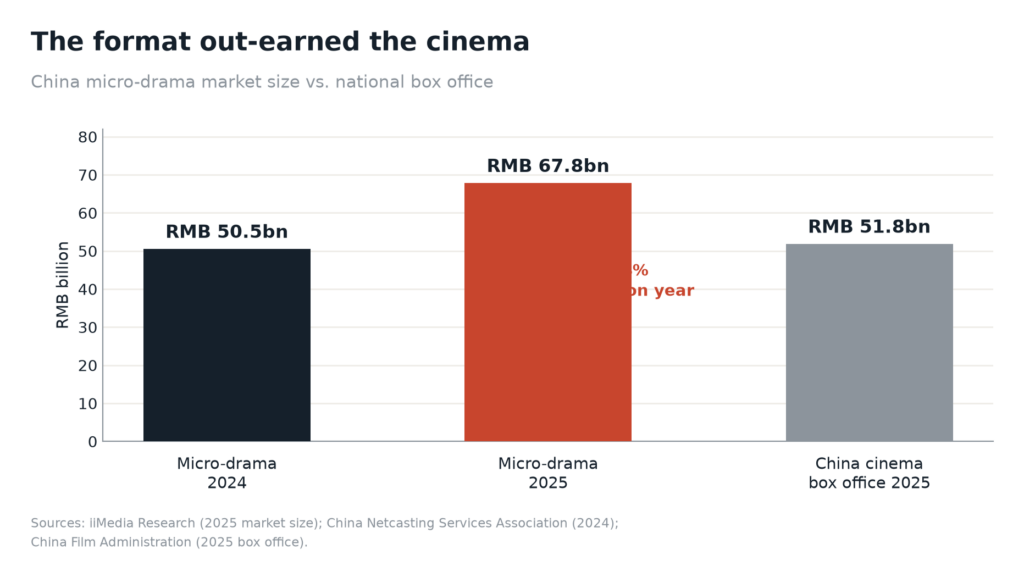
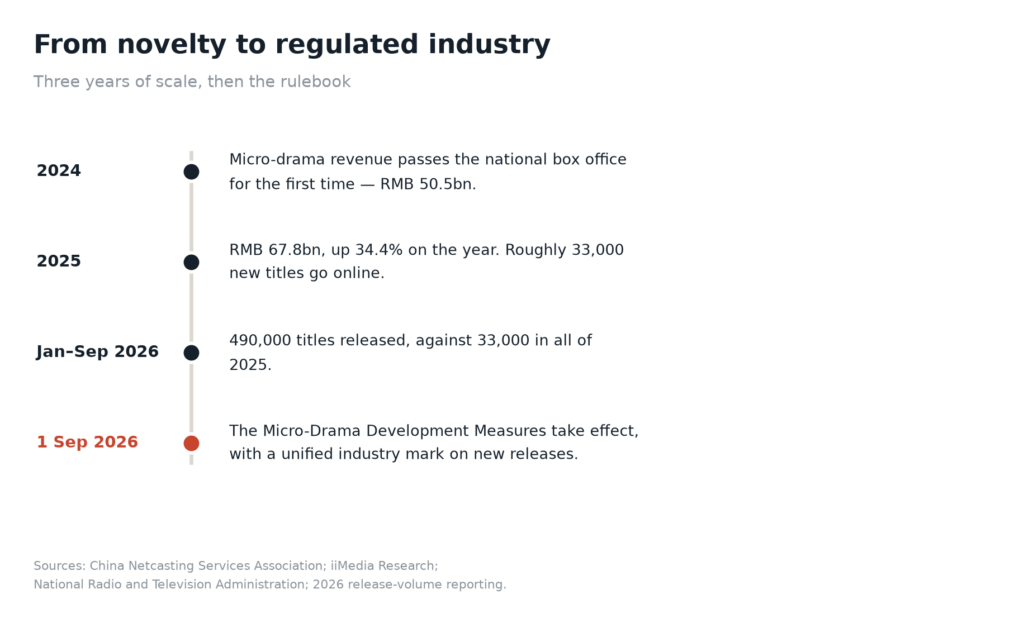
Micro-drama stopped being a curiosity in 2024, when the sector’s revenue passed the national box office for the first time: RMB 50.5 billion — roughly USD 7.1 billion — against a cinema industry that had spent a century building multiplexes. In 2025 the gap widened. iiMedia Research puts the market at RMB 67.79 billion, up 34.4% year on year, while the China Film Administration reported nationwide box office of RMB 51.83 billion.
Ask a fifth institution and you will get a fifth number, because nobody agrees on whether to count advertising, subscription, commissioned production, and in-drama sales the same way. Several now place the industry’s total scale above RMB 100 billion. The disagreement is itself the story: this is a market growing faster than its accounting.
Attention is the currency that matters. QuestMobile measured 851 million deduplicated short-drama users by May 2026, roughly two-thirds of everyone active on China’s mobile internet. They spend 26.9 hours a month there, more than they give the long-video platforms.
The supply side has exploded as well. Roughly 33,000 titles went online in 2025. Between January and September 2026 the figure was 490,000, most of it AI-assisted animation. Almost none of it will be watched. But the volume tells you what the marginal cost of a story has fallen to, and why every brand with inventory and a budget is now asking what a drama costs.
The time data is blunter still. Short-drama video grew from about ten million users to four hundred million in under three years, a pace QuestMobile puts at a 443% compound annual growth rate. In the third quarter of 2026, short drama and short video together accounted for 111.5% of the net increase in time spent on the Chinese mobile internet, which means every other category, in aggregate, lost ground.
One app outran four platforms
The clearest evidence that this is structural rather than fashionable sits in an app most Western marketers have never opened.
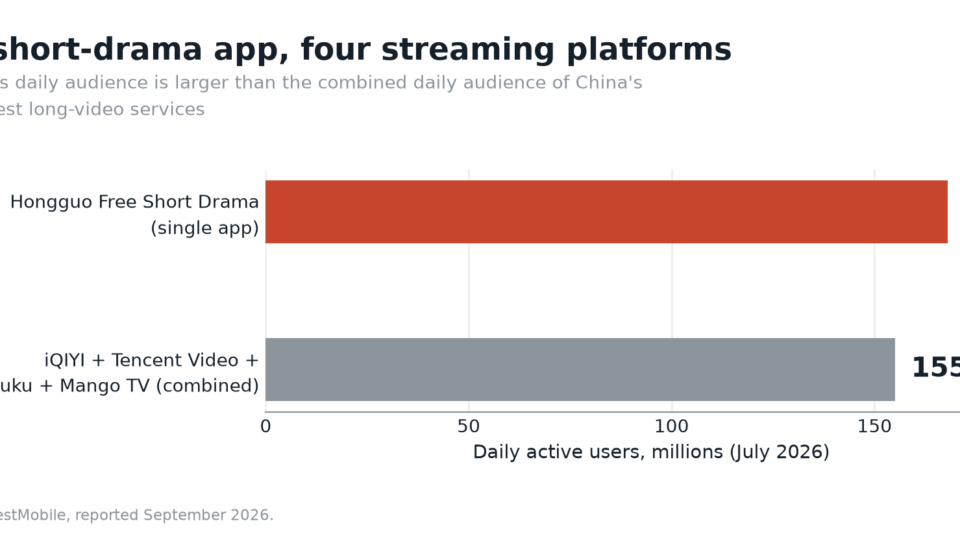
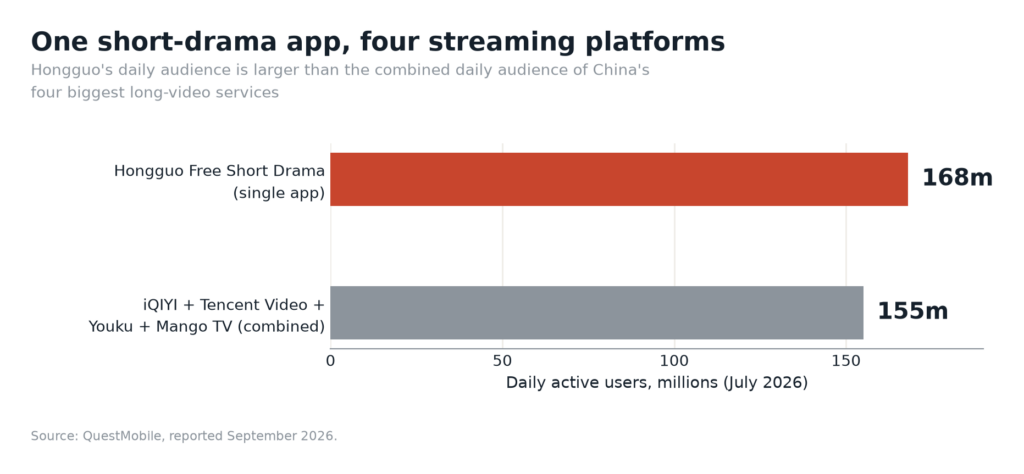
Hongguo Free Short Drama, ByteDance’s ad-supported service, reached 168 million daily active users in July 2026, up 107% year on year. iQIYI, Tencent Video, Youku, and Mango TV — the four platforms that defined Chinese streaming for a decade — had about 155 million between them.
By September, QuestMobile counted 430 million deduplicated users on Hongguo, ahead of Doubao and second only to Douyin itself inside ByteDance’s portfolio. A free app that gives away what the incumbents charge for, then sells the resulting attention, has become the second-largest property in the most valuable media company in the country.
That is the demand side, and it explains the supply side. When 430 million people open the same app to be told a story, the cheapest place to put a product is inside the story.
Two booms, one collision point
None of this works without a second boom underneath it.
China’s livestream commerce market cleared RMB 6 trillion in 2025, growing roughly 20% — several times the pace of total retail sales — according to an industry report co-published by Xinhua’s China Economic Information Service. Livestreaming taught a generation of shoppers to buy from a person on a screen, mid-performance, without leaving the app. Micro-drama inherited that reflex and removed the person.
Livestream selling has a structural weakness: it needs a human in real time. Supply is capped by the number of hosts, quality collapses as volume grows, and every hour of selling burns an hour of labor. A drama is recorded once and plays forever. Its seller never tires, never improvises a discount, never says the wrong thing on a bad night. For a brand, that is the difference between renting attention and owning an asset.
The two booms met on shared rails: one recommendation engine, one payment layer, one logistics network. That is why the format appeared in China first, and at this speed.
What skipping the middleman actually means
Here is the funnel most marketers still draw: awareness, consideration, intent, purchase, with a different team, budget, and platform at every arrow.
The micro-drama version has two steps: the scene, and the tap.
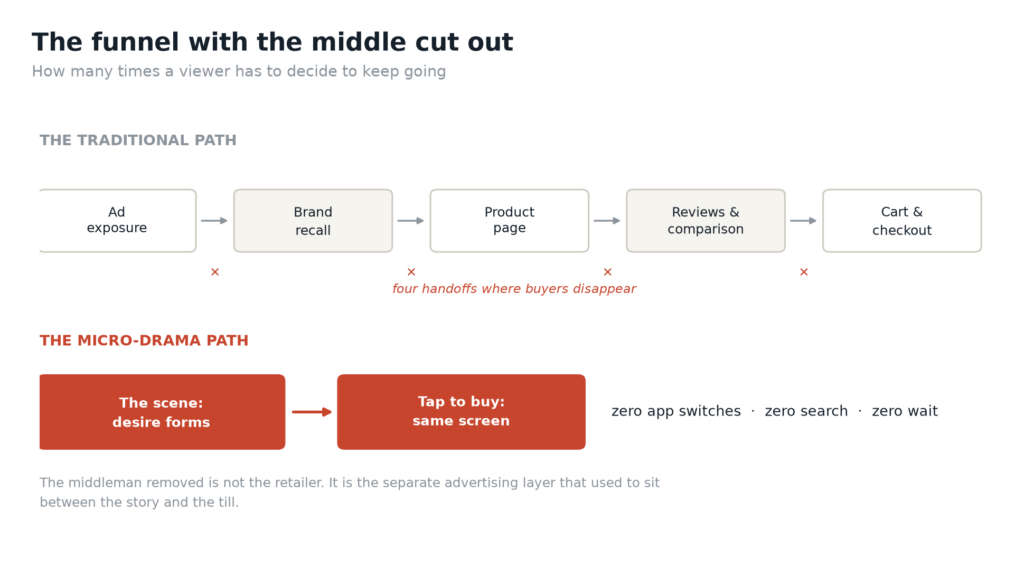
The middleman being removed is not the retailer and it is not the agency. It is the translation layer — the whole apparatus built to convert a feeling into a click: the media buy that chases the person who had the feeling, the landing page that tries to recreate it, the retargeting that reminds them, the discount that finally closes them. In this format nobody translates anything, because the feeling and the button share a moment.
Three costs vanish at once. Media cost: the placement is the story, so there is no separate buy to fund. Translation cost: no brief explaining the mood to a performance team, no landing page arguing with the ad. Decay cost: desire has a half-life measured in seconds, and removing the gap removes the decay.
That last cost is the one people underestimate. Traditional e-commerce is a business of chasing intent after it has begun to fade. Watch-to-buy is a business of catching intent while it is being manufactured.
The mechanics
In-episode product cards
As a character uses an object, a tappable card appears. Tap it and the purchase flow opens over the video rather than instead of it; the episode keeps playing behind the checkout. It sounds like a minor interface decision. It is the whole design. A viewer who never has to decide to leave never asks whether to leave.
Scene-linked inventory
Production teams tag scenes to specific products: the kitchen scene to the pan, the bathroom scene to the serum, the commute to the bag. Done well, the tag is invisible. Done badly, the plot bends around an inventory list and the audience smells it immediately. This is where most brand experiments fail, because it needs writers who understand narrative causality and warehouse stock at the same time.
The handoff to livestream
Many campaigns end an episode by handing the audience to a live host: the actor reappears as a seller, and the story becomes a room. The hybrid exists because drama converts desire and livestream converts doubt. The drama makes you want it. The live room answers whether it will arrive, whether it fits, whether it is worth the money.
Commission instead of a fee
The commercial model is shifting from a flat production payment to a share of sales. In April 2026, Douyin’s e-commerce arm was reported to have carved out a dedicated Hongguo e-commerce unit, with creators earning commission on what their drama sells. That single change does more to behavior than any creative brief: when a writer’s income depends on the conversion rate of scene four, scene four gets written differently.
The commerce layer is not a side door, either. Douyin Mall, the shelf inside Douyin, grew 240% year on year in the third quarter of 2026, while China’s total internet advertising market grew 3.1%. Content is now dragging the transaction along with it.
Why it works: four levers
Narrative discounts the price
A viewer inside a story is not comparison shopping. Attention is fully occupied by the plot, so price gets weighed against the stakes of the scene rather than against three competitors in another tab. Nobody puts this in a media plan. It is the most powerful mechanism in the format.
Friction is the tax
Every step in a purchase path is a place where a buyer disappears. Watch-to-buy has almost no steps: see, tap, pay. A five-decision journey collapses into one decision taken in a state of lowered resistance.
Characters endorse without endorsing
A character who uses a product as a tool — to fix something, prepare for something, survive something — carries a credibility a testimonial cannot, because nothing is being claimed. It is the oldest trick in storytelling and the newest instrument in performance marketing.
The impulse window is short, and the format aims at it
Emotional peaks last seconds. The format is engineered so that a checkout is waiting at the peak instead of three screens later.
The measurement problem nobody has solved
Attribution was built for journeys with handles: a click, a cookie, a coupon code. Watch-to-buy has a tap, but the reason for the tap happened four episodes ago, in a scene nobody tagged with a UTM parameter. Last-click will credit the product card. It will never credit the plot.
So the industry improvises. Brands run holdout tests and brand-lift studies, or compare a drama campaign against a matched control cell on the same platform, or simply watch whether repeat purchase moves among people who watched to the end. All of it is imperfect, and all of it is more honest than a dashboard that claims to know which minute of episode six caused the sale.
This is the real bottleneck: not production capacity, not audience appetite, but measurement. The format works better than the industry can currently prove. That is a strange and temporary condition, and whoever solves it will sell a great deal of media.
Where it works, and where it dies
The category test is brutal: can the product be used on camera, understood in eight seconds, and wanted without an explanation?
It works for skincare and color cosmetics, where the result is visible and the emotion is aspirational. It works for food and beverage, where consumption is inherently watchable. It works for home and lifestyle goods, where the product is a prop in a life the viewer is briefly inhabiting. It works for fashion and accessories, worn by people the audience has spent forty episodes with.
It dies in B2B, financial services, and complex technology, because those purchases need deliberation no narrative can shortcut, and because the cost of a bad decision is not the cost of an impulse buy. It struggles with luxury for a subtler reason: luxury sells scarcity and distance, while micro-drama sells intimacy and volume. Put a handbag in a plot about a struggling office worker and you have not elevated the bag. You have discounted it.
The bill comes due
The rulebook arrived
On September 1, 2026, the National Radio and Television Administration’s Micro-Drama Development Measures took effect: the first dedicated regulation for the format, complete with a unified industry mark that now appears in the opening seconds of new releases. Classification rules and review responsibility were tightened in stages through 2026, and the investment threshold separating ordinary titles from key ones was raised. For a brand, the practical consequence is that a drama campaign now carries compliance risk closer to that of a television commercial than to that of an influencer post, and the work has to survive a review cycle before anyone sees it.
Returns
Impulse cuts both ways. A purchase made at an emotional peak is a purchase made without the usual defenses, and some of those buyers change their minds once the episode ends. Returns are a real line item. Any brand modeling watch-to-buy on gross merchandise value alone is modeling a fantasy.
The glut
490,000 titles in nine months is not a healthy market. It is a market where the median product earns nothing. Volume is rising because AI made production cheap, not because appetite for stories is infinite. Attention is the fixed resource, and it has already been allocated.
Platform dependency
The cart, the recommendation, and the payment all belong to somebody else. Commission structures, placement rules, and traffic allocation can be rewritten in a quarter, and a brand that built its acquisition engine on a rented shelf has no vote in the redesign.
What happens next
Production cost keeps collapsing. When an episode costs less than a display campaign, brands stop commissioning a film and start commissioning a season, then a slate. The constraint moves from budget to imagination, which is a worse constraint for most marketing departments.
Checkout becomes native to the player. One-tap repurchase, saved payment, and a recommendation engine that matches the next episode to the last thing you bought. The distance between story and till keeps shrinking until it is a gesture.
The format travels; the rails do not. Micro-drama is already a Chinese export, with studios and apps pushing it into the United States and Southeast Asia. But watch-to-buy needs a commerce layer inside the video player, and most Western platforms still treat the transaction as somebody else’s business. That is a gap, and gaps close.
A short playbook
- Choose the SKU by demonstrability, not by margin. The product that looks best on camera beats the product with the best contribution margin.
- Buy a series, not a spot. The advantage compounds with episodes. One film is just an expensive ad with a plot.
- Write the product in as a tool, never as a prize. Characters who win products are endorsements. Characters who use them are recommendations.
- Put the tap within three seconds of the use shot. Conversion falls with every second after the peak.
- Price for impulse. A drama audience is not in a considered-purchase frame of mind, and a five-figure price breaks the spell.
- Measure returns and repeat purchase, not just GMV. The number that matters is whether the story sold something the buyer kept.
The takeaway
Micro-drama commerce is not a new advertising channel. It is the removal of a layer the industry spent thirty years building and defending — the layer that stood between a feeling and a transaction and charged a fee for the walk.
That layer is not gone everywhere. It is gone wherever the story, the shelf, and the payment are built by the same company on the same glass. Increasingly, that means China.
For marketers elsewhere, the useful question is not whether the format arrives. It is which of their categories can survive being sold inside a story, and how much of their budget is still paying for a walk that no longer needs to happen.