Short-Drama Marketing: China’s Billion-Dollar Ad Format Explained
Three years ago, a ninety-second vertical soap opera was the cheapest attention in China. Then the arithmetic changed. Here is what brands actually bought, what broke, and what still works.
One cart link, four hundred million yuan
In early 2023, a skincare label most Western analysts had never heard of did something that would have looked absurd on a media plan. Kans — 韩束, owned by Shanghai Chicmax — paid a Douyin influencer named Jiang Shiqi to star in five short dramas. Not sponsorships. Not product placement inside somebody else’s show. Five serials, roughly eighty episodes, about four hours of story, commissioned and shaped around its products.
The cost was somewhere between forty-five and fifty million yuan. Call it about seven million dollars — roughly the production budget of a premium television commercial, before media.
The return: more than five billion cumulative views. A monthly Douyin sales line that jumped from tens of millions of yuan to over a hundred million. And in one episode of Heartbeat Unstoppable, a single in-app shopping-cart link that reportedly moved four hundred million yuan of product.
By the end of 2023, Kans was the number-one beauty brand on Douyin with 3.34 billion yuan in platform sales, about a billion ahead of L’Oréal. Its parent company’s net profit rose 213.5%.
That is the story everyone tells. Here is the half they leave out: by late 2024, Kans’ own founder was telling contacts that supply had risen twentyfold, prices had doubled, and effectiveness had fallen by a factor of forty. The brand released eleven short dramas in 2024 and three in the first half of 2025. None crossed a hundred million views.
Both halves are true, and together they are the actual lesson. The format did not fail. A specific, one-time arbitrage did.
So what is a short drama, exactly?
Strip away the hype and it is a simple object: a vertical, serialized video drama, usually one to three minutes per episode, sixty to a hundred episodes long, shot for a phone held in one hand.
The vertical frame is not an aesthetic choice. It is thumb economics. Horizontal video on a phone asks the viewer to rotate the handset, and every rotation is a chance to leave.
Structurally, a short drama is a feature film chopped into a hundred cliffhangers. The series runs about as long as a movie, but it is consumed in a dozen sittings across a couple of weeks — which means a dozen separate exposures to whatever the brand put in the frame. That is the entire commercial premise, and it is why the format out-earns almost anything else per minute of attention.
Distribution runs through Douyin and Kuaishou, through dedicated apps such as ByteDance’s Hongguo Short Drama, and through WeChat mini-programs. The genres are mass-market, not art-house: revenge, class reversal, family humiliation, workplace triumph, period fantasy. If you are looking for subtlety, you are in the wrong aisle.
The numbers, and where they disagree
Two sets of figures circulate, and the gap between them is itself informative.
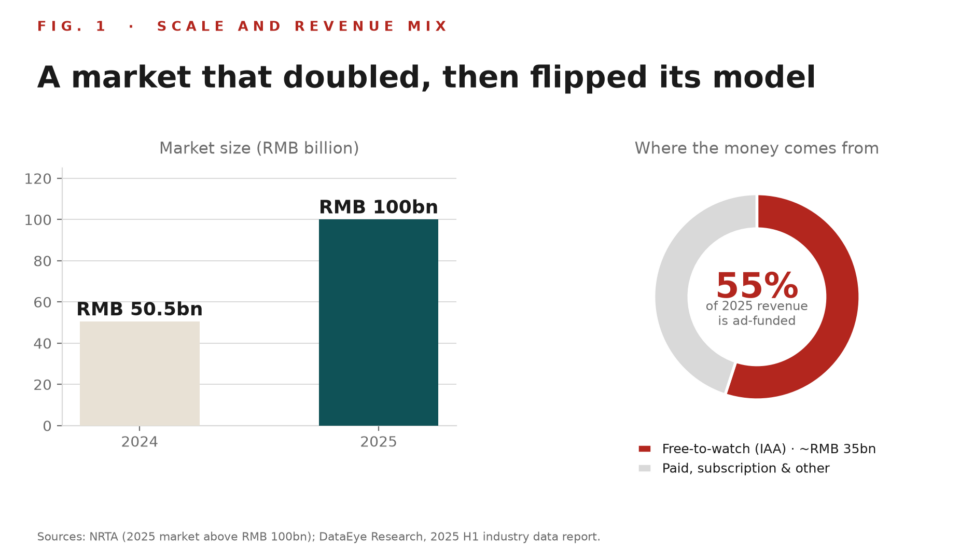
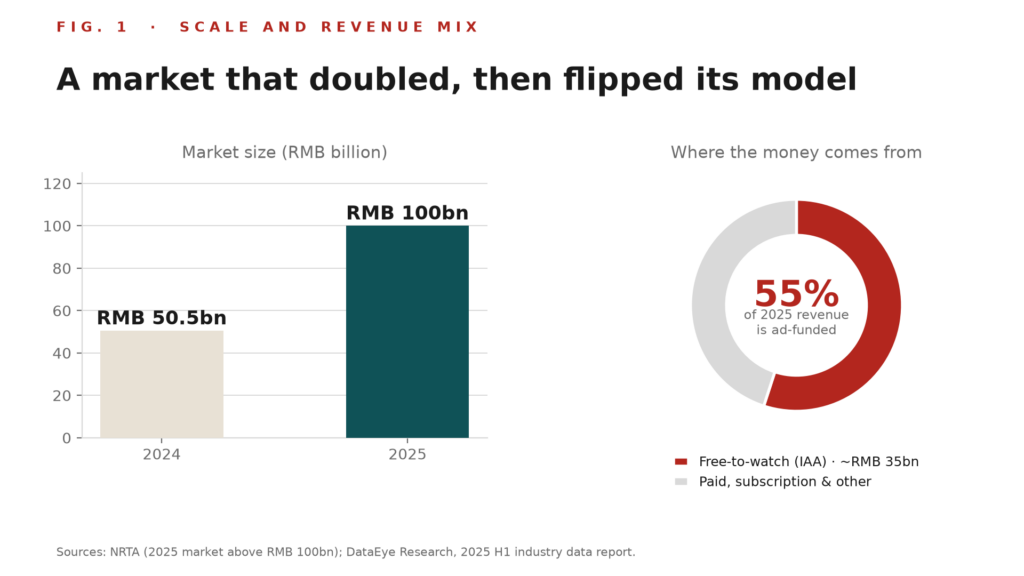
Research houses spent 2024 forecasting that China’s micro-drama market would reach about 63 billion yuan in 2025. The regulator then reported something considerably larger: the market passed 100 billion yuan in 2025, roughly double the 50.5 billion recorded in 2024 — the year micro-drama revenue first overtook China’s entire domestic box office.
What the forecasters missed was the business model flipping underneath them. In 2025, free-to-watch, ad-supported drama became the majority of the market: DataEye put the segment at around 35 billion yuan, growth of roughly 40%, and about 55% of total revenue. The paid-unlock model that defined 2022 and 2023 was quietly demoted.
Users: about 700 million at the end of 2025, according to the National Radio and Television Administration. By September 2026 the same regulator put the figure above 800 million.
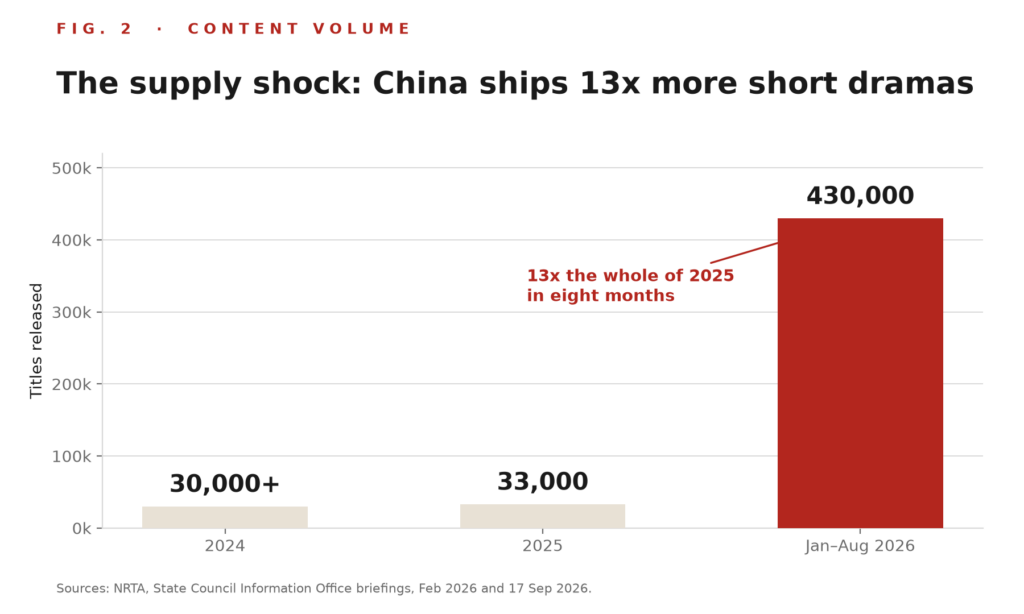
Now the number that should make a media planner sit up. In 2025, Chinese platforms put 33,000 new micro-dramas online. In the first eight months of 2026 they released 430,000 — thirteen times the whole of the previous year, in two-thirds of the time. More than 90 percent of those were AI-generated.
The platform that ate the living room
One more structural fact, because it explains why brand budgets followed the audience.
Hongguo Short Drama, a free, ad-supported app owned by ByteDance, reached roughly 245 million monthly active users in October 2025. That placed it fourth among all Chinese online video services, ahead of Bilibili and Youku. An app built on ninety-second soap operas now sits in the same league as the platforms that commission prestige television.
It also tells you where the money went. Free, ad-supported drama did not undercut the paid model at the margin — it replaced it, and in doing so turned the entire category into an advertising business. Which is precisely why brands could suddenly buy their way in.
The audience is older than the people making the ads
Here is the detail most Western write-ups skip, and it changes how you would brief the work.
Among Chinese micro-drama viewers, the three largest cohorts are 18-to-30-year-olds at 42.5%, 40-to-59-year-olds at 36.7%, and the over-sixties at 15.8% and rising. On the free tier, men went from a minority to about 52% of users during 2025, and viewers under forty crossed 50%.
Read that again. This is not a youth format. It is a mass-market format with a pronounced middle-aged and older core — closer to daytime television than to TikTok. Which is why the products that convert here tend to be everyday, functional purchases whose value a viewer can justify in about three seconds.
Why the format defeats ad-skipping
Most digital advertising is a tax on impatience. The viewer wants the next thing; you are standing in the doorway.
Short drama inverts that. When the product is load-bearing in the plot — when the heroine’s competence, her social escape, her entire arc runs through the object — the brand is not interrupting the story. It is the story’s engine. In Kans’ first series, the brand and its products appeared seventy-six times across sixteen episodes. Nobody counted that as seventy-six ads. They counted it as one character.
Three mechanics do the heavy lifting.
Cliffhangers create appointments. Every episode ends mid-crisis. The viewer comes back tomorrow, and the brand comes back with her. That is not reach. That is a subscription the audience did not know it bought.
Autoplay removes the decision. No skip button, no thumbnail grid, no moment at which the viewer chooses you again. Attention is inherited rather than re-earned.
The emotional payoff is compressed. A feature film takes two hours to make you feel something. A short drama does it in ninety seconds, then does it again. Brands are renting the residue.
Three ways a brand gets in
Placement. The product appears in someone else’s series, woven into the plot rather than parked on a table. Cheapest entry, least control, and the route most often botched into a glossy interruption.
Commissioned series. The brand finances the whole thing and it lives on the brand’s own account — a sustained campaign disguised as entertainment. This is the Kans model, and the one that global marketers consistently underestimate, because it requires a writers’ room rather than a media buy.
Inventory. Buy the slot inside platform-distributed drama: pre-roll, mid-roll, in-feed. Least glamorous, largest by volume, and now the majority of the money as the free tier swallowed the paid tier.
These are not three tiers of sophistication. They are three different businesses with three different cost curves. Most brand failures come from buying the third and expecting the first.
The squeeze, on two axes
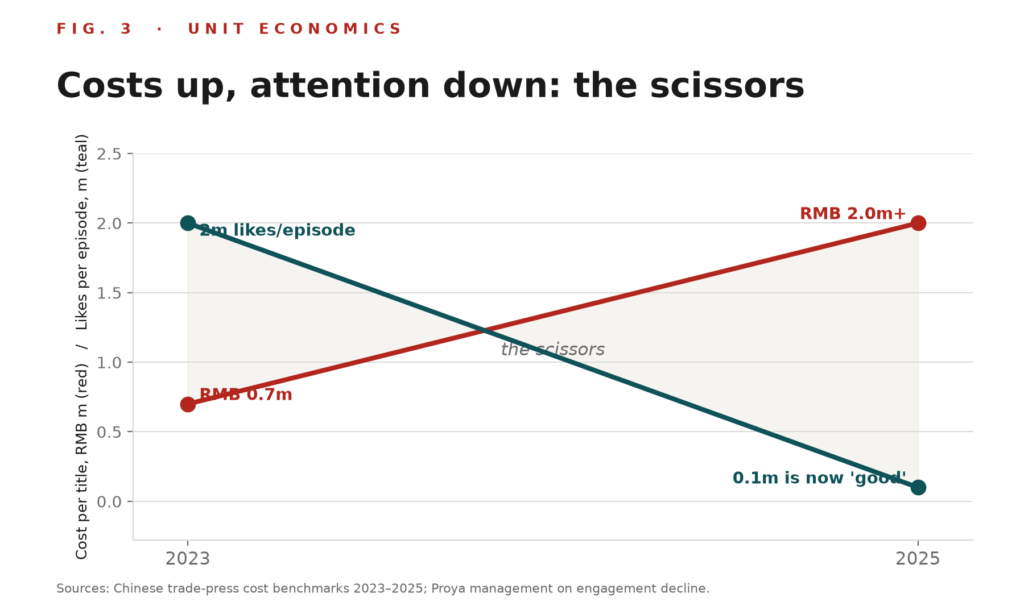
Here is the whole problem on one chart. In 2023, a mid-tier brand drama cost about 700,000 yuan to produce. By 2025 the same brief cost more than two million. Over the same period, the cost of buying a thousand promotional impressions rose from between fifty and eighty yuan to somewhere between 150 and 200 — and past 300 during competitive bursts, on the estimate of one China marketing consultant.
Engagement moved the other way. A Proya executive put it bluntly: the early Jiang Shiqi placements drew more than two million likes per episode; today, a hundred thousand is considered a strong result.
Cheaper to make? No. More expensive to distribute? Yes. Less persuasive? Also yes.
The financial statements agree. Kans’ marketing and promotion spend rose 90% in 2024 to 3.32 billion yuan. Marubi’s reached 1.64 billion, up 36% — faster than revenue. You can buy growth this way for a while. You cannot buy it this way indefinitely.
Who is actually doing this
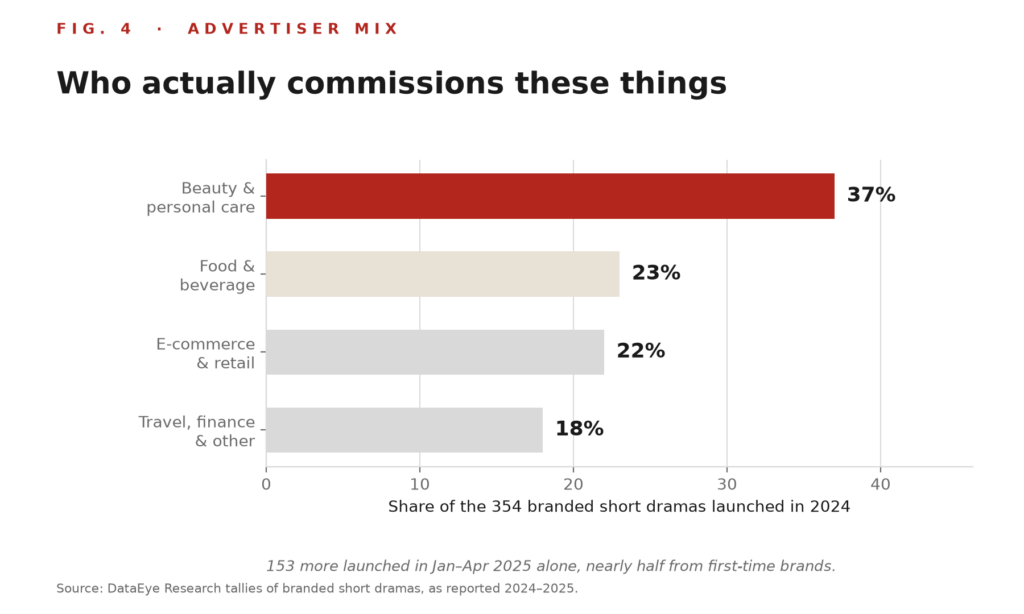
In 2024, 354 branded short dramas launched in China. Beauty and personal care took about 37% of them. Food and beverage, e-commerce, travel, finance and even pharmaceuticals crowded in behind.
Then something odd happened. In the first four months of 2025, another 153 launched, and nearly half came from brands doing this for the first time. In the middle of a documented decline in returns, the number of entrants went up. That is what a format looks like once it becomes a box to tick.
What the survivors do differently
The brands still extracting value from this format in 2026 have quietly abandoned the hero-series model. Five things separate them.
They treat the drama as a testing ground, not a campaign. A producer can put the opening episodes in front of a defined audience, watch whether they convert, and only then fund distribution. Fail fast, spend late. That is media-buying discipline applied to storytelling, and it is why volume has become a feature rather than a symptom.
They cast the product as the mechanism of the plot. Not the reward at the end — the tool the protagonist uses to escape. When the product is what the character wins, the ad reads as sentiment. When it is what she is handed, the ad reads as an ad.
They budget distribution as the main line rather than the residual. Production is the cheap part. Getting the right people to see it is where the money goes, and brands that plan for a one-to-one split discover too late that they are underfunded.
They reuse the footage everywhere. The series feeds in-feed ads, search ads, the livestream backdrop, the product page. Kans did this obsessively, and it is the difference between one campaign and an entire content system.
They measure the handoff, not the applause. Views are vanity. What matters is three-second hold rate, retention to episode three, cart click-through, and sales per thousand views in the seven days after exposure. If your dashboard cannot produce those four numbers, you are buying reach and calling it performance.
Who this format is wrong for
Honesty is cheaper than a failed pilot. Three categories should sit this one out.
Luxury and prestige brands, because the genre’s engine is humiliation reversed and status restored by acquisition — a dynamic that flatters mass-market goods and cheapens considered ones.
High-consideration B2B, because there is no cart to click and no seven-day attribution to point to.
Brands with no commerce surface in the market, because the format’s entire advantage is that the story ends near a purchase button. Take away the button and you are paying for brand recall at performance prices.
The AI shock is a distribution story
Everyone reads the AI numbers as a production story. It is not.
When 90 percent of new titles are machine-made, the marginal cost of another episode approaches zero and the bottleneck moves downstream. If anyone can make a watchable drama, nobody can guarantee that anyone watches it. Scarcity migrates from the writers’ room to the recommendation algorithm and the paid-traffic auction — which is exactly where that CPM curve was already heading.
For brands this cuts both ways. Cheap iteration is genuinely useful: you can test twenty openings for the price of one shoot and put money behind the two that hold. But the same collapse in costs is what produced the thirteenfold supply spike. The regulator said the quiet part out loud in September 2026 — AI is a tool, people remain the main body of creation — and paired it with a premium live-action support plan and mandatory labeling of synthetic drama.
Regulation is a production constraint now
If you plan to operate here, treat compliance as a line item rather than a legal afterthought.
Content is filed and reviewed in tiers before release. Around May Day 2025, regulators and platforms pulled more than two thousand titles in a single sweep — child-endangering plots, crude reversals, vulgar family conflict. By September 2026 the cumulative total had passed 68,000. AI-generated drama must now be labeled, with verified consent for likeness and voice and vetting across the whole production chain. A dedicated micro-drama management framework is being drafted alongside a “micro-drama plus” program aimed at tourism, sport and agriculture.
The practical read: the genres that convert hardest — revenge, humiliation, class fantasy — are the ones under the most scrutiny. Put compliance review inside the writers’ room, not after the edit.
Why global brands still hesitate
Ask a Western CMO why they have not tried this and you will hear about budget. Budget is not the constraint.
The constraints are these. There is no in-house or agency bench that can sustain eighty episodes of Chinese domestic melodrama without it collapsing into pastiche. There is no measurement vocabulary that maps episode retention onto a Western funnel. And there is a genuine cultural mismatch: the pleasures of this genre — public humiliation reversed, class barriers smashed, family hierarchy upended — are specific, and they do not survive subtitling.
Which is also the opportunity. The brands winning here are not translating global campaigns. They are hiring local writers and handing them a product and a brief.
The format is already leaving China
One more data point, because it reframes the argument. In the first quarter of 2025, Chinese short dramas passed 270 million downloads worldwide — a count of download instances, not unique viewers, but enough to show where the format is heading. Producers now shoot for overseas audiences from day one, and Chinese-built vertical drama apps have become a fixture on entertainment charts in North America and Southeast Asia.
The question is no longer whether this format reaches your market. It is whether you will understand it when it does.
The numbers that actually matter
Stated plainly, because most decks bury them:
Production cost is not the budget. Distribution is.
Episode-three retention tells you more about revenue than episode-one views ever will.
Sales per thousand views in the seven days after exposure is the only number that survives a CFO’s questions.
Everything else — likes, plays, follower growth — is a leading indicator that has already been gamed.
What I would do first
If you run marketing for a consumer brand with any China exposure, three moves, in this order.
Buy a small amount of inventory and watch the creative closely for a month. Not to convert — to calibrate your taste. You cannot brief a genre you have not sat through.
Commission one short season — twelve to twenty-four episodes, not eighty — with a local writer, a product with a genuine functional story, and a distribution budget at least equal to the production budget.
Instrument it before you spend, not after: retention curve, cart behavior, seven-day sales per thousand views. If those numbers move, you have built a capability your competitors are still calling a gimmick. If they do not, you learned something cheap.
The bottom line
Short-drama marketing was never a cheat code. It was a temporary gap between the cost of attention and the price of it — and the gap closed the moment everyone found it, then slammed shut when AI multiplied supply thirteenfold.
What remains is more interesting than the gold rush. A format where the brand is the plot, distribution is the real spend, and the winners treat it as a content system rather than a campaign. That capability does not expire when the arbitrage does.