The Cheap Token Was Never a Discount
The same industry is selling output at zero and financing capacity at infinity. That gap is where the middle layer dies.
Two price systems are running at once inside the AI industry. One prices a copy of intelligence, and that price is collapsing. The other prices the machinery that produces the copies, and that one is compounding. Neither number is wrong. That is what makes the situation hard to read.
The argument in six sentences
- Token prices are set by marginal cost and competition, and they are falling by roughly 60 to 70 percent a year.
- Capacity prices are set by capital structure and contract length, and the ones that get counted have roughly doubled in six months.
- The gap between the two is a term arbitrage: borrow at the capacity price, sell at the output price, keep the spread.
- That arbitrage is open only to whoever can carry a decade of contracted cost and a decade of cheap capital.
- Everyone in between — resellers, wrappers, thin SaaS, agencies — is short the spread: rigid upstream, transparent downstream.
- The middle layer does not die because AI is overhyped or underhyped. It dies because the arbitrage was never available to it.
Two headlines from the same week
One story did the rounds of procurement teams in the first week of November. A million tokens of competent model output now costs less than a dollar. Ninety-seven cents on the blended index, the lowest reading since anyone began keeping score, and less than half the summer peak. One firm that tracks this daily described it as the point at which inference stopped being a decision.
The other story came out of Tokyo. Nikkei Asia counted the AI obligations that five American technology companies have taken on without putting them on the balance sheet — leases, purchase commitments, joint ventures, the special-purpose vehicles that hold the buildings. The total: about $3.2 trillion. Six months earlier it was roughly $1.65 trillion. Nearly double, in half a year.
Both stories are true. Both are about the same industry, in the same week, and neither is a rounding error.
So hold them in your head at the same time. Intelligence is getting cheaper by the month. The ability to produce intelligence is getting more expensive by the month, and the bill for that ability is being moved off the page. You cannot resolve that with a shrug about hype cycles. You need to notice that the two numbers are not the same kind of number.
The distinction that resolves it
The price of a token is a marginal cost question. What does it cost to produce one more? Once a model is trained, that number is mostly electricity, depreciation on silicon, and a small amount of human attention. Competition pushes it toward that floor, and the floor keeps dropping as chips improve and serving software gets smarter.
The price of capacity is a capital structure question. What can you borrow, at what rate, against what contract, for how long? A ten-year lease on a 5-gigawatt campus is not priced by the cost of the next token. It is priced by the cost of money and the patience of whoever is lending it.
Two different objects. Two different clocks. Two different owners.
The output price is deflating because production is getting more efficient. The capacity price is inflating because financing is getting more aggressive. Both are behaving exactly as they should. The contradiction is only apparent if you assume they measure the same thing.
This matters for a practical reason. If you are buying AI, the two prices arrive on different schedules. Your invoice falls every quarter. Your vendor’s obligations rise every quarter. Somewhere in the gap between those two schedules, somebody has to absorb the difference. For now that somebody is the layer between the model and the customer — the reseller, the application company, the agency that promises outcomes and buys tokens to deliver them.
What ninety-seven cents actually prices
Start with the number itself, because it is carrying more weight than it appears to.
The index that hit 97 cents is a blended, quality-adjusted figure: what the market pays to generate a million tokens at roughly the capability level of a leading model from a couple of years ago. That is a useful deflator. It is not a price list.
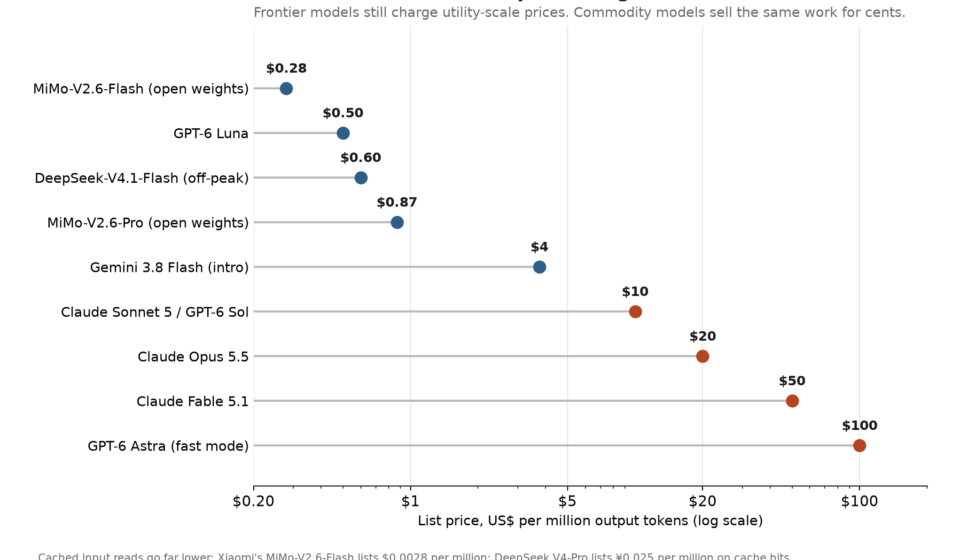
Real price lists in the first week of November spanned an enormous range. Xiaomi’s MiMo-V2.6-Flash, an open-weight model, listed output at 28 cents per million tokens. OpenAI’s GPT-6 Luna came in at 50 cents, priced at half its predecessor’s rate or less. DeepSeek-V4.1-Flash, running off-peak, sat at 60 cents. Then the ladder climbs: Gemini 3.8 Flash at an introductory $3.75, Claude Sonnet 5 and GPT-6 Sol at $10, Claude Opus 5.5 at $20, Claude Fable 5.1 at $50, and GPT-6 Astra in fast mode at $100.
That is a 357-fold spread inside a single market, in the same week, for products that all claim to reason.
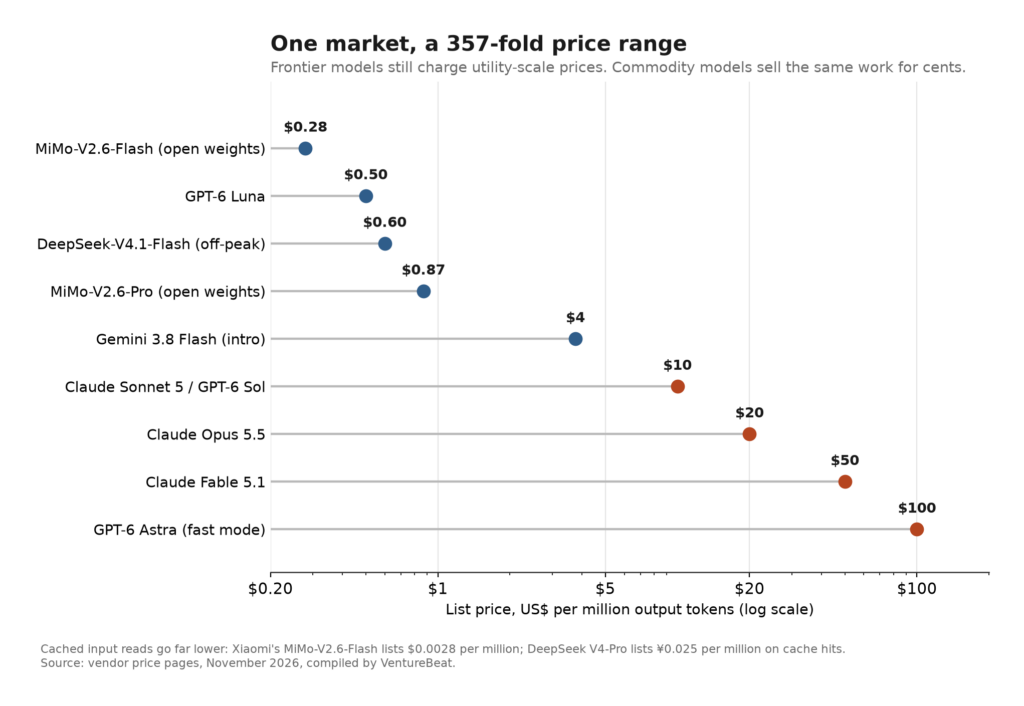
The important observation is not that the cheap end is cheap. It is that the cheap end and the expensive end are not converging. Cached input reads have gone lower still: Xiaomi quotes $0.0028 per million, DeepSeek lists 2.5 fen per million on a cache hit. Meanwhile the frontier price for a hard reasoning task has held between $10 and $100 per million output tokens all year. The deflation is real, and it is happening almost entirely on the commoditized tier.
That tells you what the price cuts are for. They are a land-grab instrument, not a cost curve. The firms cutting hardest are buying a specific asset: the habit of routing work through their API. A workflow that ships with a vendor’s SDK, evaluation harness and prompt library is expensive to move. Lock that in at 30 cents a million, and you can reprice later.
There is a second wrinkle that most procurement spreadsheets miss. The cheapest token is frequently not the cheapest task. In one November benchmark run, GPT-6 Sol in extra-high thinking mode completed a standardized agentic task for 27 cents. Claude Opus 5 cost 11.1 times as much. Fable 5.1 cost 8.9 times. Astra at minimal effort was still 3.9 times as costly. Unit price and unit cost of work are related, but they are not the same variable.
The inference paradox: cheaper units, bigger bills
Here is where the two stories collide in a way that flatters nobody.
Token prices are in free fall. Total spending on tokens is not. By one count, enterprise spending on language models roughly doubled between late 2025 and late 2026, even as the price of a token fell by half. Google disclosed that its models were processing about 3,200 trillion tokens a month, roughly seven times the volume of a year earlier.
That is not a paradox. It is arithmetic. Price times quantity. The quantity is exploding faster than the price is falling, because the workload changed shape. A chatbot answers once. An agent plans, calls a tool, reads the result, notices the result was wrong, retries, and then summarizes. Every loop multiplies tokens.
Gartner put a number on the shape change in August: routing a task to an agentic reasoning model raises a provider’s inference cost by at least a factor of five compared with a basic chatbot exchange, and inference cost per agentic workflow will rise more than fivefold through 2028 — even as the per-token price keeps improving.
Independent measurement of the loop penalty is worse than intuition suggests. A recent evaluation found that naive multi-hop prompting multiplies token consumption 4.25 times, and path-dependent sequential tasks can inflate it by a factor of 17.9. One widely cited cost-optimization technique, FrugalGPT, underestimates those economies by more than a factor of two.
So when a vendor tells you tokens are cheap, they are telling you the truth about the numerator and nothing about the denominator. The number that decides whether your AI program has a margin is not cost per token. It is cost per completed unit of work.
The $107,000 employee
Anthropic’s filing contains a line that has been widely misread, including in the early drafts of this piece, so it is worth slowing down for.
The company’s third-quarter personnel expense was $1.711 billion. Spread across roughly 5,300 people over three months, that is about $107,000 per employee per month. Roughly two-thirds of it is stock-based compensation, and the company carries tens of billions in unrecognized equity awards.
That figure is a people cost. It is not a compute cost. The two get conflated constantly, and the confusion matters, because they tell opposite stories.
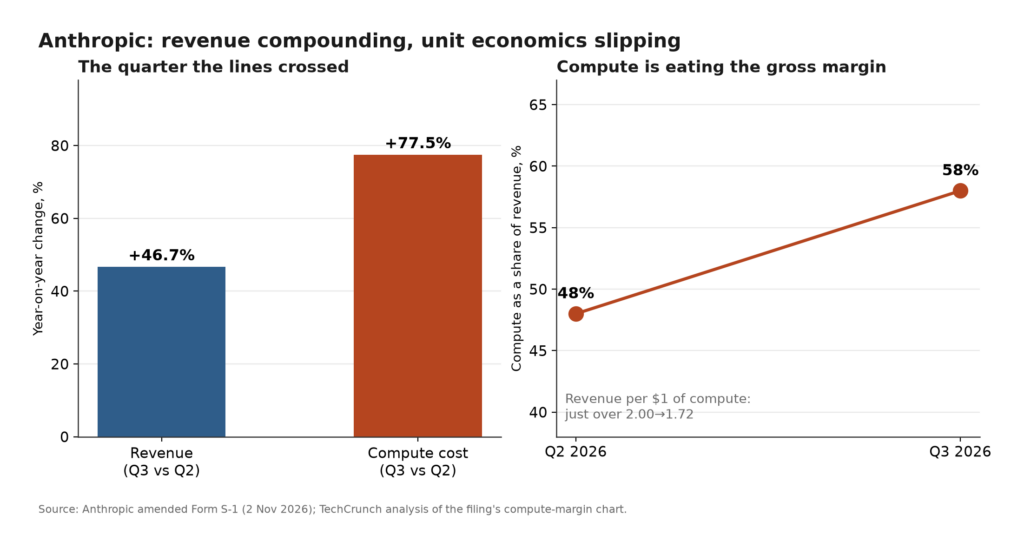
Compute is disclosed separately, and it is the scarier line. Anthropic spent about $10 billion on compute and infrastructure in the third quarter. About $5.0 billion of that was bought on short-term contracts that cost significantly more than multi-year ones did. Compute consumed roughly 58 percent of revenue, up from 48 percent the quarter before. Revenue per dollar of compute, which had peaked just above $2.00, slipped to $1.72.
So why does a company pay a fully loaded $107,000 a month for a person, and $10 billion a quarter for the machines they use?
Because the expensive thing is the research, not the replication. Training a frontier model is a fixed cost you pay once against an uncertain outcome. Serving it is a variable cost that approaches zero per copy. That is the entire economic logic of the frontier price. A model that cost a few billion dollars to build can be sold at $10 per million tokens only if enough buyers exist to amortize the build. Cut the price to 30 cents and the amortization never happens.
This is also why the industry is simultaneously deflationary and a capital sink. Copies deflate. Capability inflates. The firm in the middle pays for capability and sells copies.
The S-1 is the hinge
Anthropic’s registration statement, amended on November 2, is the single most useful document in this story, because it puts both price systems on the same page in the same font.
Read it as a bull. Nine-month revenue of $33.24 billion. Third-quarter revenue of $16.96 billion, up 47 percent sequentially and 1,127 percent year over year. An implied gross margin around 85 percent, up from 12 percent a year earlier. Net revenue retention of 900 percent. Nearly 12,000 customers spending more than $100,000 a year, 1,900 above $1 million and 250 above $10 million. That is not a company in trouble. That is a company compounding faster than almost any enterprise software business in history.
Read it as a bear. A nine-month net loss of about $104 billion, driven mostly by fair-value moves on convertible notes, but real enough in accounting terms. A third-quarter net loss of $23.29 billion. Five customers accounting for roughly a quarter of revenue in the first nine months. A single quarter in which the company swung from an operating profit to a $567 million operating loss. And the number that should stop you: $895.4 billion of purchase commitments and lease obligations, substantially all of it for compute and infrastructure.
Read it the way an operator would, and the two readings stop being contradictory.
Sequential growth ran 132 percent, then 144 percent, then 47 percent. In the same third quarter, compute cost rose 77.5 percent. When your cost line grows faster than your revenue line, you have not reached a plateau. You have reached a crossing.
And the structural fact underneath the crossing is this: the costs are contracted; the revenue is not. Commitments of $895.4 billion stretch years into the future, against a revenue base that annualizes to roughly $68 billion at the current quarterly rate. That is more than 13 years of today’s revenue already spoken for. Enterprise customers, meanwhile, sign annually, sometimes monthly, and can leave with 30 days’ notice when the renewal conversation gets difficult.
That asymmetry is the whole story of the next eight quarters, and it is why the IPO price matters more than the IPO narrative. The company was marked at $965 billion in May. It is now seeking something between $1.5 trillion and $2 trillion. The gap between those numbers is a bet that the revenue line catches the cost line before the contracts come due.
Goldman’s whitelist is a demand-side event
In October, Goldman Sachs did something that reads as a footnote and is not.
The bank pulled Claude Code and Microsoft’s GitHub coding tools from roughly 10,000 bankers and traders, and concentrated access among about 12,000 engineers and quantitative specialists. A carve-out survived for the strats — the engineers who sit inside trading desks. The stated reason was an internal review of productivity and risk.
You can read that as a technology judgment. It is better read as an ROI audit.
Goldman is the buyer every AI vendor wants: sophisticated, deep-pocketed, willing to pilot early, and capable of measuring what it gets. When that buyer narrows access after a review, the message is not that the tools failed. The message is that the tools did not clear the bar uniformly across job families. For a coder with a well-specified task, the return is obvious. For a vice president preparing a client memo, the return was not obvious enough to justify the seat.
The contrast inside the same industry is instructive. BNY has gone the other way, rolling out agent-building tools to non-engineers and reporting more than 400 AI solutions in production, with roughly 40 percent of its code now written by AI. Deutsche Bank has roughly 15,000 developers on coding assistants and measures savings in hours per week, not headcount. MUFG licensed Claude Code but rebuilt it as an internal, compliance-wrapped clone before letting anyone near it.
Three banks. Three different answers. All three are asking the same question, and none of them is “how cheap is a token?”
That reframes what is actually being sold. The unit is not the seat, and it is not the token. The unit is authorized execution: a system permitted to touch production data, under audit, inside a regulated perimeter, with a named human accountable. That is not a commodity, and it is not priced per million tokens. It is priced per risk reduced, and it is bought by people who cannot afford to be wrong.
The $3.2 trillion nobody put on the balance sheet
Now back to Nikkei’s number, because it deserves more than a shocked reaction.
Five companies — Alphabet, Microsoft, Amazon, Meta and Oracle — carry roughly $3.2 trillion of AI-related obligations that sit outside the figures most investors quote when they describe net debt. Six months ago the same measure was about $1.65 trillion.
Meta is the clearest illustration. Its reported long-term debt is around $58.7 billion, a modest figure for a company of its size. Its off-balance-sheet AI commitments are in the vicinity of $420 billion. The Hyperion campus in Louisiana is financed through a joint venture in which Blue Owl holds 80 percent and Meta holds 20 percent, on a $50 billion, 5-gigawatt project backed by more than $27 billion of financing and a 20-year lease that starts charging rent only when operations begin.
None of this is hidden in any meaningful sense. It is disclosed, in footnotes, in the language accountants use. But the arithmetic of the build-out lives off the first page, and the first page is what gets quoted.
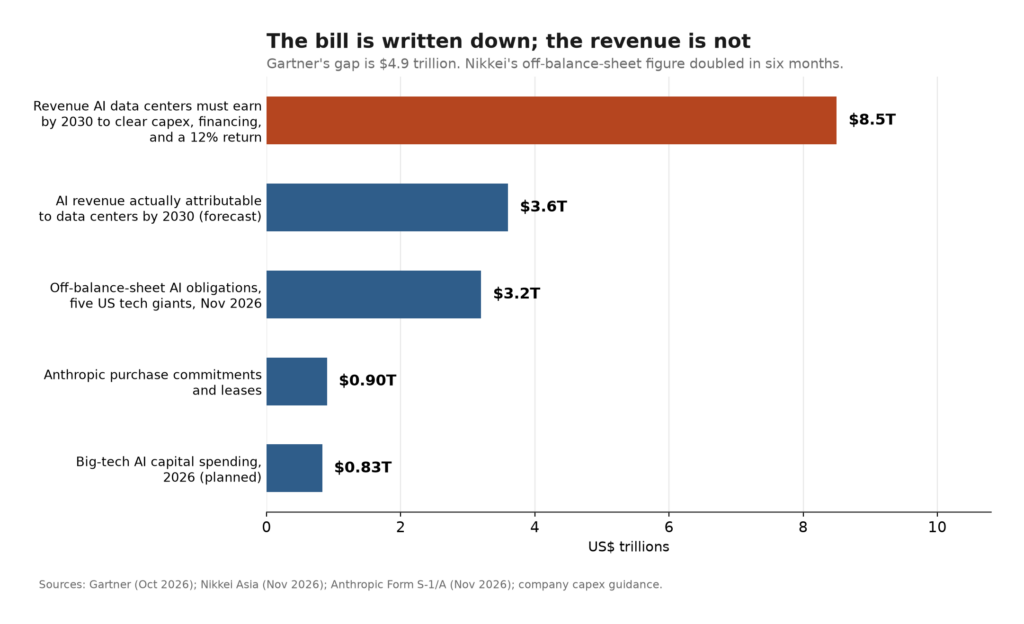
Gartner’s version of the arithmetic is the one that should keep a CFO awake. Data-center owners will need to generate about $8.5 trillion of revenue through 2030 to cover announced capital spending, financing costs and an expected return. Total enterprise and consumer AI revenue attributable to those data centers is forecast to reach no more than $3.6 trillion. That is a $4.9 trillion hole, and Gartner expects it to force more than 80 percent of neocloud providers to stop operating independently.
Bain reaches a similar place from the other direction: AI infrastructure spending could hit $1.5 trillion a year by 2031, and the AI services market would need to exceed $6 trillion a year to pay for it.
Here is the part that connects to the cheap tokens. You cannot earn a 12 percent return on capital, sell output at 97 cents a million tokens, and expect the two to meet. Something has to give, and the thing that gives is whichever layer has the least pricing power. That is not the layer that owns the buildings. It is not the layer that owns the model weights. It is the layer in between.
Who actually pays: a four-layer pass-through
Picture the money as a chain with four links.
Layer one: the hyperscalers. Amazon plans about $220 billion of capital spending for 2026, and the five biggest spenders together are on track for roughly $830 billion. AWS grew 39.3 percent year over year in the third quarter. Andy Jassy said in late October that AWS capacity for 2027 is largely sold out, with a good chunk of 2028 already committed. Scarcity has a price: on Bedrock, the Priority tier costs 75 percent more than standard, while Flex and Batch sit about 50 percent below standard. When you can charge a 75 percent premium for queue position, you are not in a price war. You are allocating.
Layer two: the labs. Anthropic has $895.4 billion of commitments against a business annualizing near $68 billion. It is buying capacity at scarcity prices and reselling intelligence at deflationary prices. That works only while the spread is positive and the capital markets stay open.
Layer three: the enterprise. This is where the chain is breaking. Gartner’s October survey found that only 13 percent of CIOs report their enterprise having realized significant or transformational value from AI. Software buyers have already voted with their valuations: the February “SaaSpocalypse” erased roughly $285 billion from software stocks in about two days, and multiples sit near 15-year lows, on the theory that if agents do the work, per-seat pricing dies. ServiceNow now writes about half of its new business on non-seat terms. That is not a pricing tweak. That is an industry rewriting its own meter.
Layer four: the end user. They mostly win, in the form of cheaper software and free features. They are also the least able to pay for the build-out, which is why the chain does not close here.
The break is at layer three, and the reason is timing. Layer one’s scarcity pricing arrives now, in the form of 75 percent premiums and sold-out 2027 capacity. Layer three’s willingness to pay arrives later, if it arrives at all, because it depends on ROI that only 13 percent of CIOs claim to have seen. The middle layer lives entirely inside that gap. It buys at layer two’s contracted prices and sells into layer three’s budget scrutiny, with no ability to do either on its own terms.
The squeeze, quantified
Vague warnings about margin pressure are useless. So here is the arithmetic, with assumptions you can argue with.
Take a mid-sized application company: 10,000 paying units at $100 of revenue each, a $250,000 annual commitment to an inference provider, and $15 of variable cost per sale. Gross margin before anything goes wrong: 70 percent. Comfortable, boring, the kind of business a founder can defend in a board meeting.
Now apply two shocks that are already in the market. The price of equivalent functionality falls, because a competitor is running on a model that costs a fifth as much. And the workload gets more expensive per unit, because the product becomes agentic and agents loop. In the model below, per-unit variable cost rises by a factor of 1.8 — mid-range for the measured penalties.
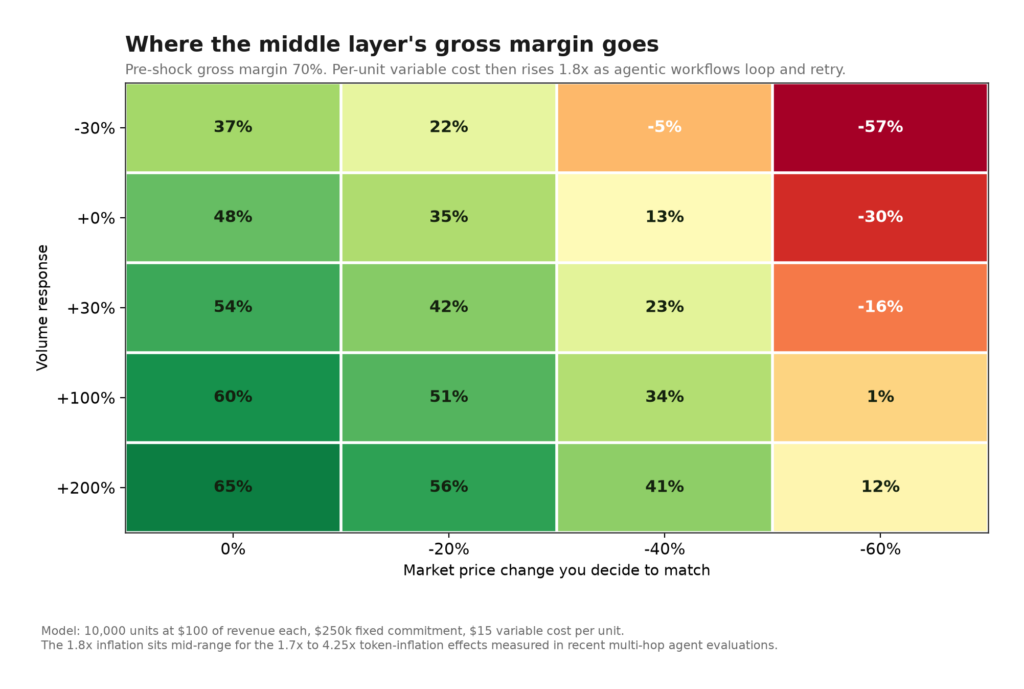
Read the grid by column. At a 20 percent price cut, you need volume to double just to hold a 50 percent margin. At 40 percent, doubling volume gets you 34 percent, and you are already running harder than most sales teams can. At 60 percent, even tripling volume leaves you at 12 percent, which is a business that exists to pay its own bills.
Then read the row where you refuse to cut price. Margin holds at 48 percent only if volume holds flat; let volume slip 30 percent and it falls to 37 percent, because the token inflation is doing the damage on its own. Nowhere in this grid does the margin get back to 70 percent.
The structural point: your upstream is a contract and your downstream is a comparison. Your supplier’s price to you is fixed for a year or more. Your customer’s alternative is two clicks away and public. That is not a competitive disadvantage you can out-execute. It is a position.
Where margin actually survives
If the middle is structurally short the spread, the useful question is not “how do I compete on price?” It is “what can I own that the price of a token cannot touch?” Three answers survive scrutiny.
Physics. Power, optics, advanced packaging, memory supply. These are the parts of the stack where demand outruns supply for reasons that cannot be fixed by writing better software. When Jassy says 2027 is sold out, he is describing a physical constraint with a price attached. Anything with a lead time measured in quarters is defensible, because capital cannot will it into existence faster than the fabs can.
Proprietary workflow, not proprietary model. Gartner’s November finding is the important one here: open-weight models can handle about 90 percent of agentic work at roughly one-twentieth the cost of a frontier model. If that is true, model access is not a moat. It is a utility bill. What is not commoditized is everything around the model: the evaluation suite, the permission graph, the retrieval corpus, the failure playbooks, the institutional memory of what this specific company means by “done.” That is data no one else can license.
Trust as a product. Regulated buyers do not purchase intelligence. They purchase defensible intelligence: zero data retention, audit trails, residency, a named human accountable when the agent does something stupid. MUFG rebuilding Claude Code as an internal compliance-wrapped clone is the tell. The wrapper was the product.
And one test cuts through all three. Ask whether a competent competitor could replace you in 90 days. If the answer is yes, you are a reseller with better branding, and the grid above is your future.
Steelman the bulls
The strongest counterargument deserves a fair hearing, because it is not stupid.
Electricity is priced exactly the way AI is being priced now: near-zero marginal cost, enormous fixed capital, and prices that tend toward the cost of the next unit of capacity. Nobody calls the power industry schizophrenic. Utilities borrow heavily, lock in long contracts, earn a regulated return, and the whole thing works because demand is inelastic and the regulator guarantees the spread. If AI is becoming a utility, then 85 percent gross margins are a temporary artifact of scarcity, the debt is investment-grade for a reason, and the $3.2 trillion is simply what infrastructure costs.
There is real evidence for this. Demand is not imaginary: 3,200 trillion tokens a month and 39 percent growth at AWS are not vanity metrics. Gartner expects worldwide AI spending to reach about $2.7 trillion in 2026, up nearly 50 percent. The debt is being placed, not rejected. And every utility in history looked insane during its build-out.
Concede all of it. Then notice what follows. Utility economics do not rescue the middle layer. They abolish it. Regulated utilities have no room for a reseller between the generator and the socket, because the regulator sets the price and the meter settles the bill. If AI becomes a utility, the companies that own generation and transmission survive. The companies that were adding a margin on top of somebody else’s kilowatt-hours do not. They become meter readers, and meter readers do not get 70 percent gross margins.
So the bull case and the bear case agree on the thing that matters to anyone building in the middle. The only disagreement is whether the transition takes two years or five.
Five numbers to watch for the next two quarters
Not predictions. Instruments. Each comes with the observation that would prove the thesis wrong.
Depreciation life on AI servers. Most hyperscalers depreciate GPU fleets over five to six years. A shorter life is an admission that the asset earns for less time than the contract that financed it. Wrong if: useful lives lengthen, which would mean the hardware is holding value better than assumed.
The token price floor. Watch cached and off-peak reads, currently around 0.28 cents per million at the Western open-weight floor and 2.5 fen at the Chinese one. If that floor stops falling for two consecutive quarters, the price war is over and pricing power has moved back upstream. Wrong if: the floor keeps sliding as open-weight models absorb the commodity tier.
Cost per completed task, not per token. The metric that decides whether enterprise AI has a business model. Watch whether vendors begin publishing it voluntarily. Silence is information. Wrong if: per-task costs fall faster than per-token prices, which would flip the whole squeeze.
Capacity sell-out signals. AWS says 2027 is largely gone and part of 2028 is committed, with a 75 percent premium for priority access. Wrong if: sell-outs turn into discounts, which would mean demand was pulled forward rather than real.
The IPO clearing price. Anthropic was marked at $965 billion in May and is seeking $1.5 trillion to $2 trillion. A strong print validates the arbitrage and finances another two years of it. A weak one reprices the cost of capital for every lab and every neocloud at once. Wrong if: the deal clears at the top of the range and holds there for six months.
One arbitrage, and arbitrages close
Two prices are not evidence that the industry has lost its mind. They are evidence that it is running a trade.
Borrow against capacity, which is priced by capital structure and rising. Sell output, which is priced by marginal cost and falling. Keep the spread for as long as the capital markets let you roll the position. That trade is available to maybe a dozen balance sheets on earth, and it is closed to everyone else — which is why the middle layer is not suffering from a temporary margin problem but from a structural position.
Arbitrages close in one of two ways. Either the two prices converge, which here means capacity gets cheaper or output gets more expensive, and both of those are painful in public. Or the financing stops rolling, and the position unwinds at whatever price the market will pay that week.
For anyone buying AI, the practical instruction is short and unglamorous: price your contracts to the half-life of the model, not the length of the lease, and measure cost per finished task rather than cost per million tokens. For anyone selling it, the question is narrower. Do you own something the price of a token cannot reach? If not, you are not in the AI business. You are in the spread business, and somebody else is holding the other side.
Frequently asked questions
If tokens are nearly free, does that mean my total AI cost goes down?
Not automatically, and often not at all. Token prices fall, but token consumption per task rises faster, because agents plan, call tools, check their own work, and retry. Gartner expects inference cost per agentic workflow to rise more than fivefold through 2028 even as per-token prices keep improving. Measured loop penalties run from 4.25 times for naive multi-hop prompting to 17.9 times for path-dependent sequential tasks. Track cost per completed task. It is the only number that behaves like a bill.
What exactly is off-balance-sheet AI debt, and why should a buyer care?
It is the gap between what a company has promised and what appears in the debt line of its headline financials: operating leases, multi-year purchase commitments for compute, joint-venture stakes in data-center projects, and the special-purpose vehicles that hold the buildings. Nikkei puts the figure at about $3.2 trillion across five companies, roughly double six months earlier. A buyer should care because these obligations set a floor under future pricing. A supplier with $895.4 billion of contracted cost cannot cut prices forever, no matter how cheap the marginal token gets.
Why would a company spend $107,000 a month on one employee?
It does not spend that on compute. That figure is fully loaded personnel cost, and roughly two-thirds of it is stock-based compensation in a very small, very expensive workforce. The compute line is separate and larger in aggregate: about $10 billion in a single quarter, or 58 percent of revenue.
If gross margins are 85 percent, why is the company losing billions?
Because gross margin measures the cost of delivering a dollar of revenue, not the cost of building the thing that makes delivery possible. Anthropic’s implied 85 percent margin sits on top of research spending, sales, and the fair-value swings on convertible notes that produced most of the $104 billion nine-month net loss. The more interesting number is the trend: compute went from 48 to 58 percent of revenue in one quarter, and revenue per dollar of compute fell from just over $2.00 to $1.72.
Is there any route for a mid-sized AI company other than cutting price?
Three, and each comes with a test. Own a physical bottleneck with a lead time measured in quarters, such as power, optics or advanced packaging. Own workflow data nobody can license, which matters more now that open-weight models handle roughly 90 percent of agentic work at about a twentieth of frontier cost. Or own trust in a regulated perimeter, where the product is a compliance-wrapped system with audit trails and a named accountable human. The test is the same for all three: could a competent competitor replace you in 90 days? If yes, you are a reseller, and the margin grid above is your forecast.