Why 700 Million Chinese Use AI and Almost None Pay for It
The best AI model in China is not the one most Chinese people use. That sentence sounds like a complaint about taste. It is really a description of plumbing.
In June 2026, Doubao, ByteDance’s assistant, had roughly 382 million monthly users. DeepSeek’s models were still trading blows at the top of the coding and reasoning leaderboards, and Qwen’s open weights had become the most downloaded model family in the world. Alibaba’s own assistant app reached 158 million monthly users in September, whose users spent less than half an hour a month with it, a fraction of Doubao’s engagement. Four products, four kinds of success, one market.
If model quality decided adoption, those numbers would line up. They do not. The gap between the strongest American and Chinese models has narrowed to about three index points on the composite leaderboards that rank them, and the best open-weight models trail the closed frontier by about the same margin while costing about 40 percent as much per token. Quality converged. Adoption did not. Something else is sorting users.
That something is distribution, and in China it has three moving parts: the operating system default, the price tag, and the electronics market in Shenzhen where hardware gets its price. Call them doors. Each removes a different cost of adoption, and they multiply.
Two winners, one market
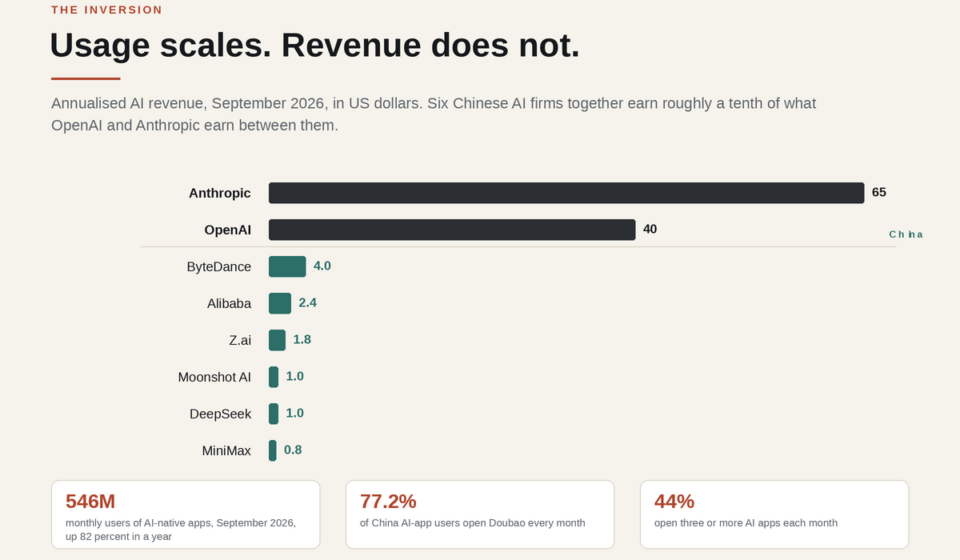
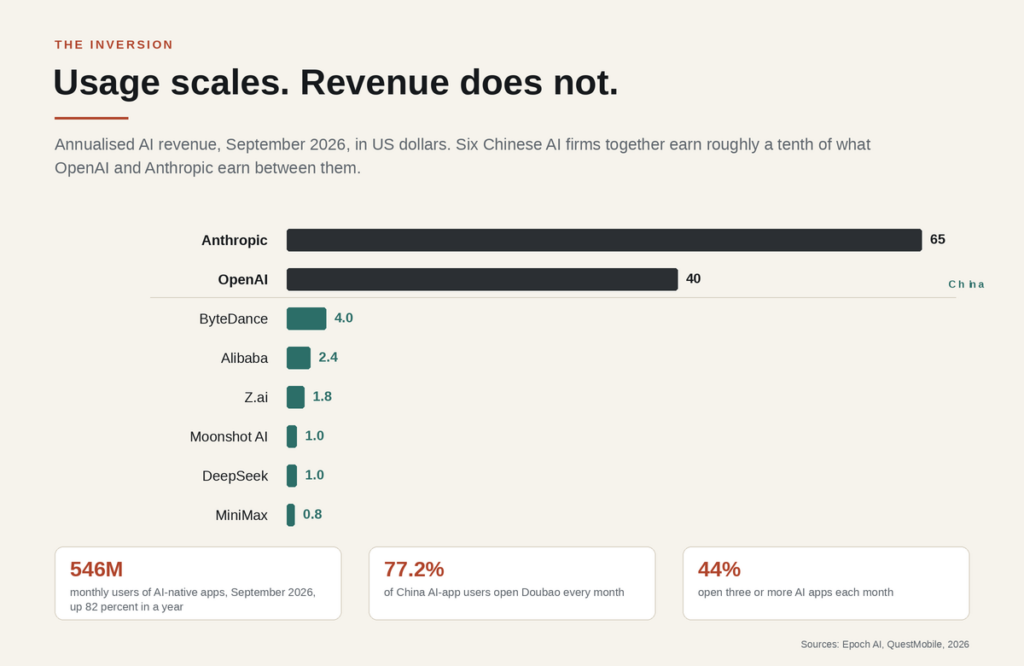
Start with the size of the prize. China had more than 700 million generative AI users by the end of June 2026, or more than half the online population, up from 602 million six months earlier. AI-native apps reached 546 million monthly users in September, up 82 percent year on year.
Then look at how lopsided the attention is inside that base. QuestMobile puts Doubao’s reach among AI-app users at 77.2 percent in August 2026, up from 54.9 percent a year earlier. Qwen sits at 29.4 percent, DeepSeek at 22.8 percent, Tencent’s Yuanbao at 8.2 percent. These are overlapping audiences, not a winner-takes-all market: 44 percent of AI-app users opened at least three AI apps that month, against 32.5 percent a year before.
So the market is concentrated and fragmented at once, which is exactly what a default-dominated market looks like. One product gets the first question. Several products split the follow-ups.
Three doors, and why they multiply
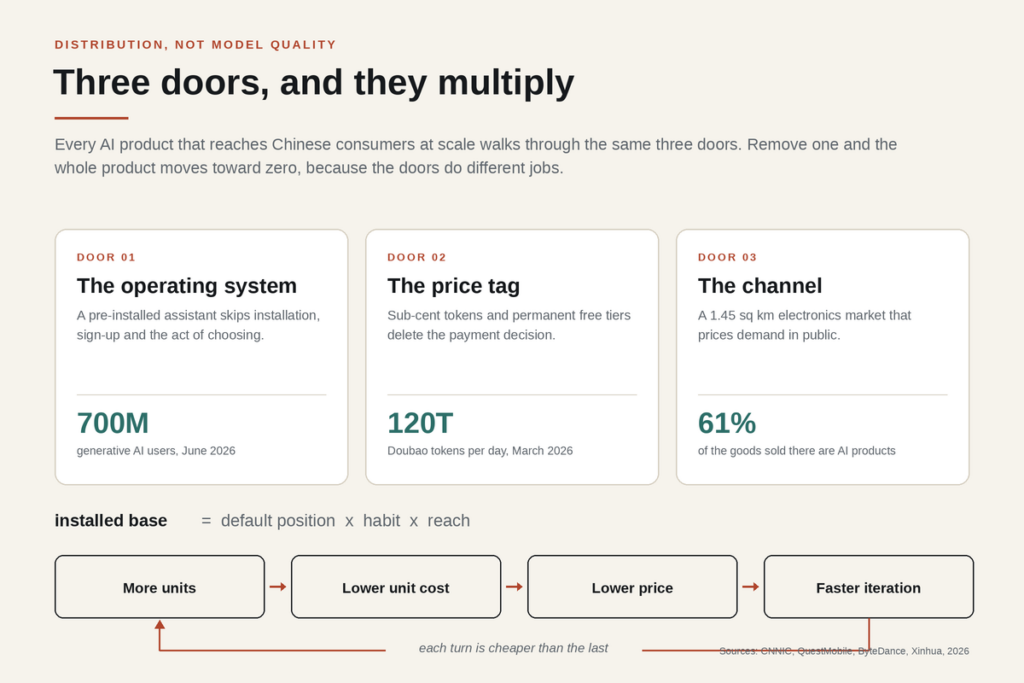
Each door removes a decision the user would otherwise have to make.
The operating system removes the decision to install. No download, no account creation, no permission dialog, no moment when a person picks an assistant over the one already on the phone. The assistant is simply there, in the same place as the clock.
The price tag removes the decision to pay. When a million tokens cost less than a cent and the free tier is permanent, nobody has to justify the expense to themselves or to anyone else.
The channel removes the search cost, and it also removes the price ceiling. When a device category can be built, priced and revised inside one square kilometer of Shenzhen, the question stops being whether a product is affordable and becomes how fast it can be made cheaper.
Addition would mean these three advantages add up. They do not. A strong model with no default slot has to buy every user. A default slot priced wrong gets abandoned in the first week. A cheap model with no channel has no device to live in. Each term can be large and the product still be small, because multiplication punishes the zero.
Door one: the only default that matters
An assistant shipped inside a phone’s operating system is not a product competing in a market. It is the market’s floor. Everything else gets chosen against it.
That is why the slowest-moving AI story in China has also been the most consequential. Apple Intelligence launched in the United States in October 2024. It reached mainland China about two years later: the service was registered with Chinese regulators on July 15, 2026, appeared in developer beta with iOS 27.3 in early November, and was set for public release in December, with Alibaba’s Qwen model handling Siri handoffs, writing tools and visual intelligence.
Two years is not a supply chain problem. It is a gate problem. A foreign AI service in China needs a domestic partner willing to carry the model, a registration filing for the service itself, and compliance with labeling rules that apply to generated text, images and audio. Each requirement is a queue with its own gatekeeper. Queues do not reward better models. They reward earlier applications.
And even when the door opens, it opens partially. The China build ships without the Siri AI features and the deeper system capabilities that define the product elsewhere. The default slot was granted feature by feature.
Here is the part that should worry anyone building a consumer AI brand: when the assistant lives inside the system, the brand a user remembers is the handset. The model becomes an ingredient, like a camera sensor. It is chosen by the manufacturer, invisible on the box, and replaceable in the next generation. Domestic phone makers have their own assistants to fill that slot, which is precisely why a foreign model cannot buy its way in.
Why default beats quality
The default effect is one of the most reliably replicated findings in behavioral economics. In the organ donation literature, countries that require citizens to opt out produce consent rates an order of magnitude higher than countries that require them to opt in, with no meaningful difference in public attitudes. Richard Thaler and Cass Sunstein turned that finding into a policy program, but the underlying mechanism is older and simpler: people treat the pre-set option as the reference point, and changing the reference point is work.
Choice overload points the same way. In the well-known jam experiment, a display of 24 varieties attracted more browsing than a display of 6 and sold far less: about 3 percent of browsers bought from the large table, about 30 percent from the small one. More options did not improve decisions. They postponed them.
An AI assistant sitting on the home screen is the jam table with one jar.
Three costs vanish at once. There is no installation, so there is no moment of commitment. There is no learning curve, because the interaction model is the one the phone already taught. There is no payment setup, because the assistant inherits an account that is already signed in. What remains is the smallest possible step from intention to use, and most technology adoption is a story about the size of that step.
That produces the counterintuitive instruction for product teams: a default does not need to be preferred. It needs to arrive before preference exists. Preference then forms through comparison, and the comparison set is whatever the user already has.
The limit is worth stating plainly. Forty-four percent of Chinese AI-app users now keep three or more apps open, so defaults win the first question, not every question. Door one gets you into the habit. It does not keep you there.
Door two: price as habit formation
ByteDance disclosed that Doubao processed about 120 trillion tokens a day in March 2026. In December 2025 the figure was 60 trillion. In May 2025 it was 120 billion. That is a thousandfold increase in ten months, on a user base that grew far more slowly, which means the average user went from dabbling to leaning on it.
Volume like that is expensive to serve, and Chinese labs spent 2025 and 2026 making it cheaper rather than charging for it. DeepSeek’s V4.1 Flash was priced at under one cent per million tokens in September 2026, with cached input at three-tenths of a cent per million. When the frontier is that close and the floor is that low, price stops being a signal of quality and becomes a tool for installing behavior.
That is the honest way to read the subsidies. Free tokens do not buy revenue. They buy the second week of use, and the second week is where habits are made or lost. Someone who has asked an assistant to summarize a meeting twice will ask a third time without being prompted, and the cost of serving that third request is the price of a customer who no longer needs to be acquired.
The bill does arrive, though, and the Chinese market is now sending out invoices. Morgan Stanley estimates that 0.3 to 3 percent of Chinese AI users pay for anything, against about 5 percent in the United States in 2025. At one listed Chinese lab, 1.77 million people paid out of 27.6 million monthly users, about 6 percent, and the consumer apps still ran a gross margin of 4.7 percent against 69.4 percent on enterprise services. ByteDance has started selling Doubao tiers at 68, 200 and 500 yuan a month while keeping the free version free, which is the politest possible admission that the old arithmetic had stopped working. Baidu tried charging for Ernie in 2023, then made it free again.
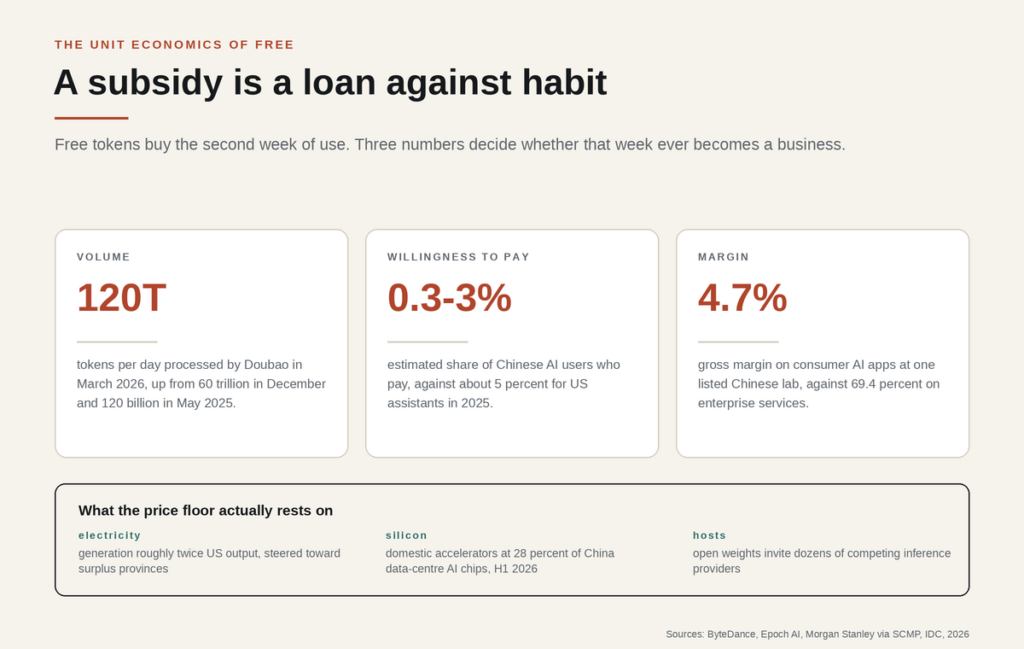
So the subsidy is a loan against habit, and the repayment schedule is a paywall most users walk around. The interesting question is not whether the loan gets repaid. It is what happens to the price floor when the lending stops.
The next phase is already visible. Bank of America’s analysts argue that Chinese competition has moved from the token price to the cost of finishing a task, which is a different unit entirely: an agent that needs 40,000 tokens to complete a booking can be more expensive than a model that needs 4,000. Whoever wins that comparison wins the enterprise renewal, and the token price becomes an input rather than the pitch.
The structural cost floor
A price war can be a marketing decision. In China it is closer to an engineering condition, because the three inputs that set inference cost are all cheaper there, for reasons that predate the AI boom.
Electricity comes first. China generates about twice as much electricity as the United States and has spent a decade building transmission to carry it. The Eastern Data, Western Computing program pushes data centers toward provinces with surplus generation, which lowers the marginal cost of a kilowatt-hour at exactly the point where AI workloads are most price-sensitive. Cheap power is not a subsidy a finance ministry can withdraw. It is a grid.
Silicon comes second, and the story is usually told as a weakness. Export controls did slow China’s access to the best accelerators. They also made domestic chips the default for new capacity: IDC puts Nvidia at 34 percent and Huawei at 28 percent of China’s data-center AI accelerator market in the first half of 2026, with Huawei shipping 572,000 Ascend chips in six months. Per-chip performance still trails. Per-token cost does not have to trail, especially when the workload is inference rather than training and the chip needs no foreign license. DeepSeek is reportedly preparing to pre-train its next model on 160,000 domestic accelerators, which is less a patriotic gesture than a statement about what can be bought at scale.
Utilization comes third, and it is the lever outsiders miss. When model weights are published, dozens of providers can serve the same model, and they compete with each other rather than with the lab. That competition pushes the market price of a token toward the marginal cost of the cheapest competent host, not toward the lab’s cost of invention.
Put the three together and the asymmetry becomes clear. In the United States, a price cut is a margin decision a CFO can reverse. In China, the price floor is set by the cost of power, the cost of domestic silicon and the number of hosts willing to serve a public model. You can discount your way into that market. You cannot discount your way out of it.
Door three: Huaqiangbei
The third door is a 1.45-square-kilometer district of Shenzhen that holds 35 specialized markets, more than 115,000 registered businesses and over a million distinct parts and finished goods. About 750,000 people pass through on a typical day, including more than 8,000 overseas business visitors. If you want to know what a Chinese consumer will pay for a gadget in six weeks, this is where the answer is already being printed.
The merchandise mix has changed faster than most market reports admit. AI-related products made up 61 percent of the electronics sold there in July 2026, up from 41 percent in 2025. Sales of AI products rose more than 55 percent year on year in the first seven months of 2026, with AI glasses doubling.
What Huaqiangbei does that no advertising platform can is price demand in public. A vendor learns in two weeks whether a handheld translator with a 40-minute battery sells at 199 yuan, because the cost of finding out is a tooling run rather than a brand campaign. Design changes travel by foot between suppliers inside the district, so the iteration loop is measured in days. Failure is cheap, which means the market produces a lot of it, which means the survivors are priced correctly.
AI glasses are the current test of that machine. China’s retail market moved 909,000 units and 1.88 billion yuan in the first half of 2026, at about 2,070 yuan a pair. Globally, AI glasses reached 8.7 million units in 2025, up 322 percent, and Counterpoint recorded 263 percent growth in the first half of 2026, with display-less models accounting for 96 percent of shipments and China supplying 45 percent of the display-equipped segment. Beijing has added a 15 percent consumer subsidy of up to 500 yuan a pair, which is a demand policy dressed as an industrial one.
The honest caveat: part of that volume is policy rather than preference. A consumer subsidy is a demand lever that can be switched off, and the same channel that discovers a price in two weeks can discover the ceiling in two months.
The compounding loop
Read the three doors separately and they look like three advantages. Read them together and they look like a flywheel with an unusually short cycle.
A larger installed base lowers the unit cost of serving a token and the unit cost of building a device. Lower costs allow lower prices. Lower prices expand the installed base again. A larger base produces more usage data and more channel feedback. More feedback shortens the next iteration. A shorter iteration widens the price gap.
Each turn is cheaper than the last, not because anyone is getting smarter, but because the constraint keeps moving: from silicon to power to distribution to price and back to silicon. That is what compounding looks like in a market where the product is close to free and the bottleneck is access.
Three lessons that transfer
Most of this does not travel. The parts that do are worth stating precisely, because they are the parts Western B2B teams keep getting wrong.
Design for the default, not the demo. A product that requires a new tab, a new login and a new mental model competes with the user’s habit, not with a rival’s feature list. The counterexample is the standalone copilot sold to an enterprise that already has the same capability inside the tools its staff use all day. The copilot may be better. It is also the second place people look.
Price for habit, not for margin. Per-seat pricing assumes the buyer is making a purchase decision. Where the substitute is free, the buyer is making a usage decision, and usage decisions are won by removing friction in the first month. The counterexample is the premium seat sold into a team that has already normalized a free assistant for the same task.
Win at the commodity layer by distributing, not differentiating. When the intelligence layer commoditizes, value migrates to whoever controls the moment of use. The counterexample is premium hardware with a rented brain: excellent margins until the model becomes a line item anyone can buy.
What doesn’t transfer
Three conditions in China cannot be copied by policy memo.
The first is regulatory posture. A filing regime with a domestic partner requirement slows foreign entrants and, as a side effect, hands incumbents a moat made of paperwork. Companies outside China usually read this as a barrier to entry. It is also a barrier to exit, because once a service is registered, the registration becomes an asset.
The second is the open-weight ecosystem. China’s AI Plus initiative, issued in August 2025, and the fifteenth Five-Year Plan both treat open model release as industrial policy rather than charity. That choice made weights a distribution channel, which is why Chinese labs compete on being embedded rather than on being exclusive.
The third is capital structure. A consumer app running at 4.7 percent gross margin survives because the same company sells enterprise deployments at 69 percent, or because advertising and cloud revenue absorb the loss. China’s six leading AI firms earn about a tenth of what OpenAI and Anthropic earn combined. That number is either a warning about the business or a description of the subsidy, depending on which side of it you stand.
Open is a distribution strategy, not an ideology
The 2026 World Internet Conference in Wuzhen, held in the first week of November, was built around open source in a way that would have seemed eccentric five years ago. Alibaba’s chairman, Joe Tsai, used the stage to argue that open systems are the only sustainable path for the industry. Premier Li Qiang framed the same agenda as people-centric development and warned against a digital iron curtain.
Read those speeches as distribution strategy rather than philosophy and they become coherent. A lab that cannot own the home screen can still own the layer every other product ships. Publishing weights puts a model inside other people’s phones, laptops, robots and cars without asking an operating system vendor for permission, and without a serving bill in the country that downloads it.
The evidence sits in download counts and routing data. Qwen overtook Llama as the most-downloaded model family on Hugging Face in February 2026, at 942 million downloads against 476 million. Eight of the ten most-used models on OpenRouter by token volume in August 2026 were open-weight, and seven of those eight were Chinese. Chinese open models went from under 2 percent of weekly OpenRouter tokens in late 2024 to a peak of 46 percent in April 2026.
Then comes the part that keeps the strategy honest: open-weight providers captured about 4 percent of model-layer revenue, against about 96 percent for closed providers. Distribution without pricing power is a position, not a business. When one lab published a new model and its weights on the same day, 26 hosts were serving it within three weeks, eight of them at a lower price, and the lab’s share of traffic on its own model fell from 88 percent to 22 percent. That is what winning the distribution war looks like from the inside.
The steelman: every door can close
It would be careless to end on the flywheel. Each door has a failure mode, and the failure modes are already visible.
Subsidies end. ByteDance’s subscription tiers are the first public admission that serving 345 million users for free is not a durable equation, and token prices cannot fall forever while the capital behind them needs a return. When the free tier narrows, the habit has to survive on its own merits, and the paying ratios suggest most of it will not.
Exclusivity is a contract, not a moat. Apple’s China build took two years, still ships without its flagship assistant features, and depends on a partner that competes in the same category. A default slot that can be granted can be renegotiated.
Hardware channels build volume, not brands. White-label glasses make a margin and leave no memory, and the privacy backlash against cheap camera-equipped eyewear has already produced a regulatory investigation in at least one export market. A channel that can make a category cheap can also make it disposable.
Which is why the fourth door matters. Social and content distribution (the feed, the group chat, the mini-program) is where Chinese consumers already spend their attention, and AI is being poured into it rather than offered beside it. If the default slot, the price floor and the hardware channel all soften, the entry point that survives may be the one inside an app people open fifty times a day. That door is already open. It is simply harder to measure, which is why it gets less attention than the other three.
The moat is in the doors
Models are converging. The gap between the best and the almost-best is now measured in months and index points, and every lab can buy the same electricity and the same silicon at roughly the same price.
Doors do not converge. A default position takes years and a counterparty. A price floor takes a grid and a supply chain. A channel takes a district where a hundred thousand businesses already know how to make the thing you have not designed yet.
That is the lesson from the Chinese market, and it is a less comfortable one than the usual story about model quality. The winner is not the model that answers best. It is the model that is already there when the question is asked. The moat is in the doors, not in the model.
FAQ
Why isn’t the most-used AI model in China the strongest one?
Because usage is decided before quality can be evaluated. Some 700 million Chinese users met generative AI through a phone assistant, a free app or a subsidized device, and none of those routes required a benchmark comparison. With the top models within about three index points of each other and open-weight models priced near 40 percent of closed ones, the quality gap is too small to overcome a distribution gap. Doubao’s 382 million monthly users and DeepSeek’s leaderboard position are both accurate measurements of different things.
How much do Chinese consumers actually pay for AI?
Very little, and rarely for the assistant itself. Estimates put paying users at 0.3 to 3 percent of the base, against about 5 percent in the United States. Entry tiers such as Doubao’s 68 yuan a month exist, but free tiers stay broad and most monetization runs through advertising, enterprise contracts and cloud. One listed lab reported a 4.7 percent gross margin on its consumer apps across the first nine months of 2025.
What role does Huaqiangbei actually play in AI hardware?
It works as a pricing instrument. With 35 markets, more than 115,000 businesses and about 750,000 daily visitors inside 1.45 square kilometers, the district compresses design, tooling, assembly and export into walking distance. AI products were 61 percent of electronics sold there by July 2026, and AI product sales grew more than 55 percent in seven months. Vendors learn the price ceiling in weeks rather than quarters, which makes the district a leading indicator rather than a discount outlet.
Why did Apple Intelligence take so long to reach China?
Because the gate is regulatory, not technical. A foreign generative AI service needs a domestic model partner, a registration filing, and compliance with content labeling rules. Apple’s service was registered in July 2026, entered developer beta with iOS 27.3 in November, and was scheduled for a December release with Qwen handling several core features. The launch also excludes the flagship assistant features available in other markets.
Can Western companies copy the three-door playbook?
Partly, and selectively. Designing for the default position, pricing for habit rather than margin, and distributing at the commodity layer are transferable disciplines. The regulatory gate, the open-weight policy and the willingness to fund consumer apps at single-digit gross margins are not, because they rest on institutional choices and capital structures a marketing team cannot assemble. Copy the discipline, not the balance sheet.