Apple Intelligence Finally Lands in China — and It Redraws How Apps Get Found
On 3 November 2026, iOS 27.3 beta 1 arrived, and two things happened inside the same build. Apple opened Siri AI to every third-party developer on earth. And Apple Intelligence began its first rollout in mainland China, without Siri AI in it at all.
Most coverage collapsed those into one story. They are not one story. The gap between them is where the marketing opportunity actually sits, and it is narrower than the headlines suggest in one direction and much wider in the other.
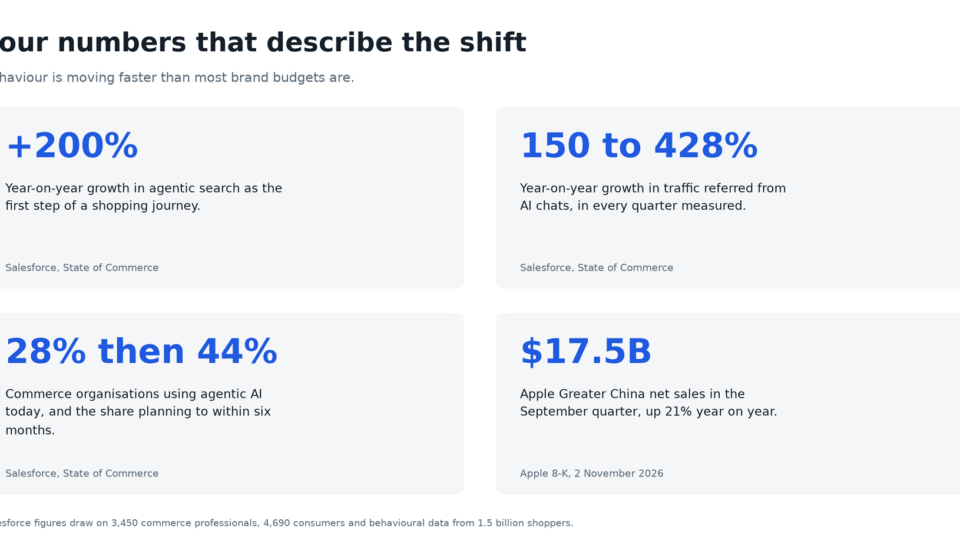
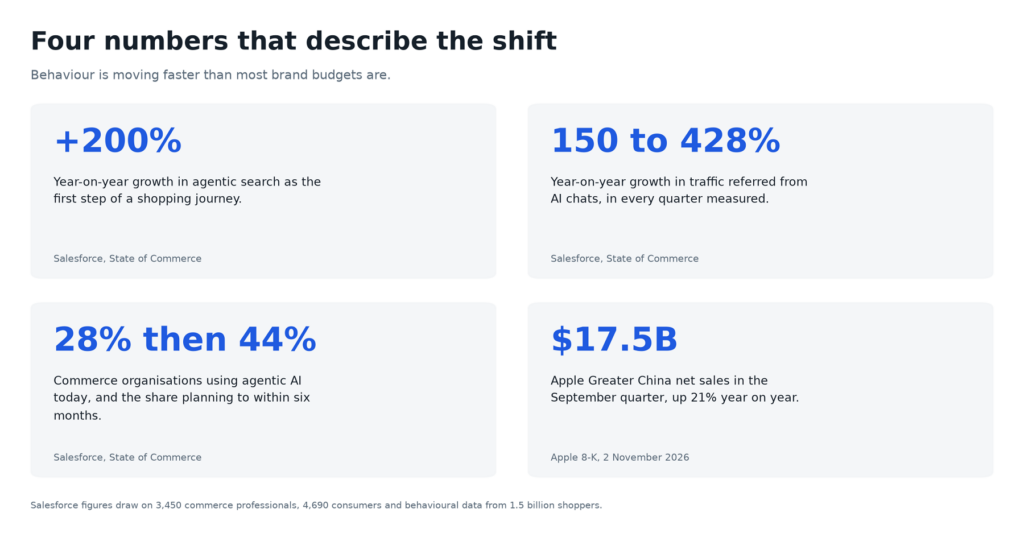
Apple has been selling iPhones in China for a very long time. Its Greater China net sales reached $17.5 billion in the September quarter, up 21 percent year on year, on an installed base the company describes as a record. That is an enormous, wealthy, upgrade-cycled audience. What changed this week is not how many of them own an iPhone. It is what the phone is willing to do when they speak to it.
The short version
- Apple Intelligence is live in China in developer beta from 4 November 2026, and goes public in December with iOS 27.3.
- Alibaba’s Qwen is inside it, named by Apple, handling Siri answers, document questions and drafting.
- Siri AI, Apple’s rebuilt agentic assistant, is explicitly excluded from the China release, along with the rest of the WWDC 2026 feature set.
- Globally, Siri AI is now open to any developer through App Intents. The App Store starts accepting those integrations in the spring.
- Behaviour is already moving faster than budgets: agentic search as the first step in a purchase grew 200 percent year on year.
If you take one sentence from this piece, take this one: China got the utility layer of Apple Intelligence, the world got the agentic layer, and those two things change marketing in completely different ways.
Two launches, running on separate clocks
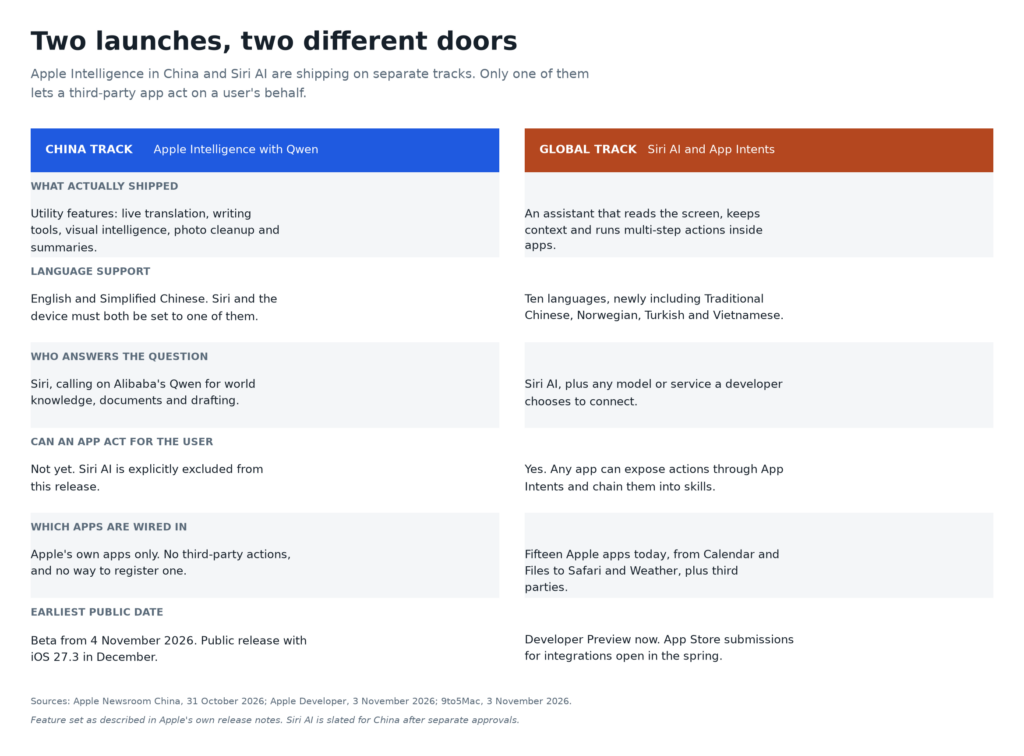
Apple’s release notes are unusually candid about the split. The China feature set is a list of things that make the phone easier to use: live translation across Messages, FaceTime and Phone, writing tools, visual intelligence through the camera, photo cleanup, Genmoji, natural-language photo search, memory movies, priority mail, email summaries, smart replies, notification summaries, a Reduce Distractions focus mode, transcription summaries in Notes, call summaries, and a Siri that holds context across a conversation and accepts typed input.
Every item on that list was built for iOS 18 or iOS 26. Nothing from iOS 27 is in it. Apple says so directly: Siri AI and the other next-generation features announced at WWDC 2026 are not included.
Then there is the other track. Siri AI now accepts integrations from any app, through a Developer Preview shipping in the 27.3 betas. Apps expose their actions using App Intents. They can bundle several actions into a skill so the assistant can handle a request that needs more than one step. Apple has already wired fifteen of its own apps this way: Calendar, Files, Finder, Journal, Mail, Maps, Messages, Music, Notes, Photos, Preview, Reminders, Safari, Shortcuts and Weather.
Same release number. Two entirely different products.
Why Apple split the release
Three forces explain the shape of this launch, and none of them is about product ambition.
The first is approval. Apple states that support on other platforms will follow once the necessary approvals come through, which is the language of a regulated roll-in rather than a global switch. The second is the model partner. A generative assistant answering in Chinese needs a model that satisfies local requirements, and Apple solved that with Alibaba rather than by shipping its own. The third is sequencing. Apple chose the features that carry the least regulatory surface area and the most obvious everyday usefulness, then held back the assistant that takes actions.
Read those three together and the China release stops looking like a downgrade. It looks like the only version Apple could ship now.
What Qwen actually does inside Siri
This deserves more attention than it is getting, because Apple named a competitor’s model inside its own assistant, in public, in a press release.
Qwen does three jobs. It supplies world knowledge when Siri needs an answer it cannot construct itself. It reads documents, including PDFs and presentation files, so users can ask about a file rather than about the web. And it drafts original text from scratch inside the system-wide writing tools.
The commercial detail buried in that is the sign-in. Users reach Qwen either with a Qwen account or through Sign in with Apple. A third-party model now has an identity layer inside the operating system’s answer surface. Not a plug-in. Not a browser tab. A first-class destination inside Siri.
For anyone who has spent a decade optimising for a results page, that should feel familiar and alarming at once. There is a new answer surface, it belongs to somebody else, and it has its own opinion about what counts as a good source.
What is missing is the interesting part
Here is where I would push back on most of this week’s commentary.
The China launch does not change how apps get discovered. Not yet. Without Siri AI there are no App Intents, no app actions, no agent placing an order or checking a delivery. This is a capability upgrade, not a distribution shift. Anyone telling you Chinese iPhone users are now booking restaurants by talking to their phone is describing a product that has not shipped there.
What it does change is consideration. Live translation on AirPods, visual intelligence aimed at a shelf, writing tools inside every text field. Those sit earlier in the funnel than a download. They shape whether a brand gets understood, pronounced correctly, or recognised at all in a language the buyer does not speak.
So the honest framing is this: China gets a twelve-month window in which AI changes how people understand products, before it changes how they find and buy them. That window is a gift to anyone selling across a language border, and a trap for anyone who assumes the Chinese and global roadmaps are the same roadmap.
The entrance moved from the icon to the sentence
Apple’s developer announcement contains the sentence that matters most, and it is not technical: “more customers can discover and use apps just by asking.”
That is Apple, not an analyst, describing a change in the front door. The old entrance was a grid of icons plus a search bar. The new entrance is a sentence, spoken or typed, handed to an assistant that decides which app can satisfy it. Apple’s examples are deliberately dull, which is what makes them credible: checking a delivery, booking a reservation, placing an order.
A second detail carries more commercial weight than it first appears. In many situations users no longer need to name the app. If a ride is already in progress, a request to change the address resolves to whichever app is driving the Live Activity. Brand recall stops being the moat. Context becomes the moat.
Fifteen apps is a list of verbs, not a feature list
Read Apple’s fifteen apps as jobs rather than products and the pattern is obvious. Schedule. Store. Find. Remember. Send. Navigate. Play. Edit. Recall.
Calendar, Reminders, Notes, Files. Mail, Messages. Maps. Music. Photos, Preview. Safari, Shortcuts, Weather, Journal, Finder.
These are the tasks people are willing to hand over, because they are repetitive, low-stakes and easy to describe out loud. Apple picked them first for exactly that reason, and it tells you a great deal about which categories get absorbed next. If your app’s core job is one of those verbs, you are on the front line. If your app’s core job is browsing, entertaining or open-ended discovery, you are more likely to be disintermediated than automated.
The other half of the release deserves equal weight. Siri AI can now surface any entity in the Spotlight semantic index, not just entities that match an existing schema. For publishers, content businesses and marketplaces, that is the quieter but larger opening. Your thing can become answerable before you have written a single App Intent.
The App Store has quietly become a semantic index
Apple publishes how App Store search ranks. Text relevance covers your title, your keyword field and your primary category. Customer behaviour covers downloads and the number and quality of ratings and reviews. That has been the contract for a decade, and a whole discipline grew up around it.
A third layer is now being added on top. Not whether your listing matches a query, but whether your actions are legible to a model that has already decided what the user wants. Those are different optimisation problems. One rewards keyword density and review velocity. The other rewards clarity of interface: can this app accept this intent without a human choosing it?
Behaviour is already ahead of the budget
The uncomfortable part for planners is that consumers moved before the product did. Salesforce’s fourth State of Commerce report, drawing on 3,450 commerce professionals, 4,690 consumers and behavioural data from 1.5 billion shoppers, found that agentic search as the first step in a shopping journey grew 200 percent year on year. Traffic referred from AI chats grew between 150 and 428 percent year on year in every quarter it measured.
The same study found 86 percent of commerce leaders saying AI is raising customer expectations, and 61 percent saying meeting those expectations is harder than ever. Adoption lags badly: 28 percent of commerce organisations use agentic AI today, with another 44 percent planning to within six months. Among those who have started, only 4 percent are still piloting. The largest group, 35 percent, is trying to scale.
From ranking a listing to being the plausible answer
Strip away the jargon and the economics are simple, and slightly brutal.
In a results page you compete on position. Position can be bought with media or earned with relevance, and it is visible, so it can be reported on. In an answer you compete on being chosen once, by a system that has already narrowed the field before your brand is mentioned. There is no second page. There is no position four.
Three consequences follow. Coverage matters more than rank, because the assistant needs a reason to consider you at all. Structured intent matters more than copy, because an action either binds to the request or it does not. And trust becomes a distribution asset, because a model will not route a transaction through a source it cannot resolve.
What to do in the next two quarters
Five things, ordered by how soon they bite.
Audit your intent surface. Write down the five verbs your users actually want to hand over. Then check which of them your app can accept today without a human tapping a screen. Most teams discover they can accept one.
Put your entity into the semantic index. Consistent naming, structured data, a clear canonical description of what you sell. Unglamorous, and the cheapest item on this list.
Treat your documents as model input. In China this matters immediately, because Siri can answer questions about PDFs and presentation files. If your spec sheets and help centre read like marketing, a model will extract nothing useful. Write for a reader with no patience and no context.
Instrument AI referrals separately now. You will not get clean attribution from inside an assistant, and Apple has published no reporting surface for it. Separate those sessions, measure assisted conversion rather than last click, accept a wider error bar than you are used to.
Pick your place on the China calendar deliberately. Selling across a language border? The translation and visual intelligence features are live in December and change consideration immediately. Selling locally? The agentic shift is not yours to plan for until Siri AI clears Chinese approval, and nobody has given a date.
China’s slow lane is a window, not a delay
There is a lazy reading of this week that says China got a consolation prize. I think the opposite is closer to true.
China is the only major market where Apple has launched an AI layer with a named local model partner, a local identity system and a sequenced feature set. That sequencing gives marketers something rare: a rehearsed opening. You can watch how users respond to a system-level assistant before the agentic layer lands, and fix your entity, your documents and your measurement while the stakes are still low.
Cross-border sellers, travel, education and luxury should be moving now. The features shipping in December are precisely the ones that remove language friction, and language friction is the tax those categories pay every single day.
The measurement problem nobody has solved
It would be dishonest to write this without naming the hole.
Apple has shipped a new answer surface and no reporting to go with it. When someone asks Siri to place an order and it resolves to your app, you will see a transaction. You will not see the sentence that caused it. Salesforce’s numbers describe a shift that is happening; they do not tell you which brand won, or why.
Until somebody builds that layer, the teams that win will be the ones instrumenting proxies: intent coverage, branded query volume on assistant-adjacent surfaces, and assisted conversion on AI-referred sessions treated as a cohort rather than a channel.
What to watch
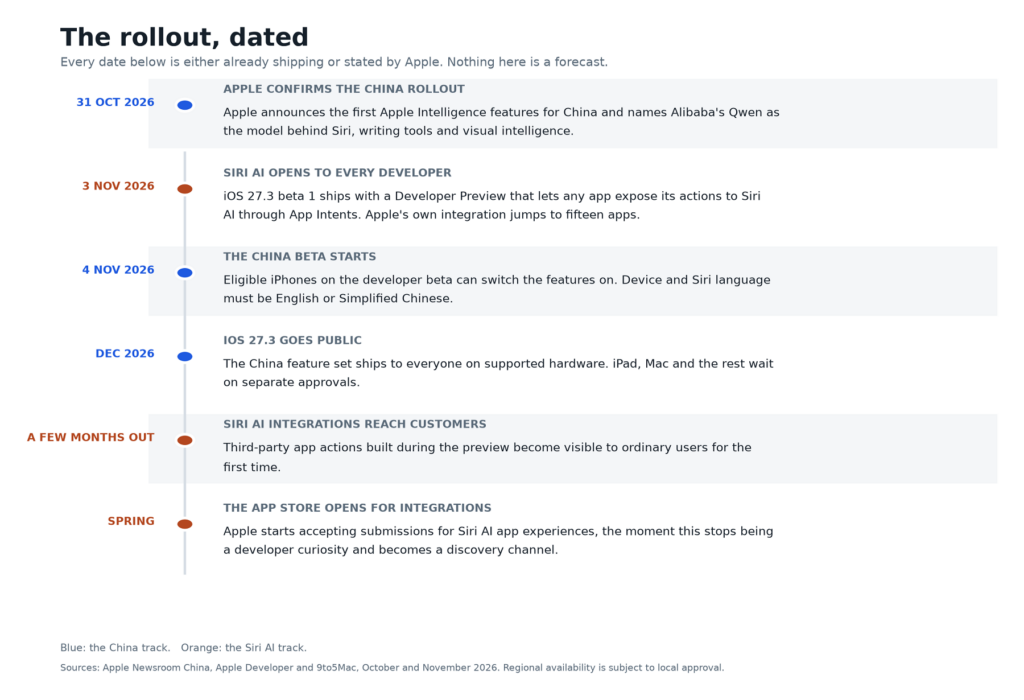
Three signals deserve a calendar reminder. Whether Apple gives Siri AI a China date, and which approvals it clears. What App Store review actually requires of an App Intent integration when submissions open in the spring, because policy will decide who can participate. And whether Google follows with an equivalent developer surface on Android, which would turn a platform feature into an industry standard inside two release cycles.
Bottom line
Apple did not change how apps are found in China this week. It changed how apps will be found everywhere else, opened the door for developers to compete on that surface, and handed China a carefully limited first cut that is mostly about language and comprehension.
The strategic read is not that AI assistants are coming for app discovery. It is that they are already there in one market and deliberately absent in another, and the distance between those two facts is the most useful planning variable a marketer has right now.
FAQ
Did Apple Intelligence actually launch in China?
Yes, in developer beta from 4 November 2026, with public availability in December alongside iOS 27.3. It is the first time Apple has shipped these features in mainland China, more than two years after the US launch.
Is Siri AI available in China?
No. Apple states plainly that Siri AI and the other next-generation Apple Intelligence features announced at WWDC 2026 are not part of this release. China receives the utility features built for iOS 18 and iOS 26.
What does Alibaba’s Qwen do inside Apple Intelligence?
Qwen supplies world knowledge to Siri, answers questions about documents including PDFs and presentations, and drafts original text inside the writing tools. Users sign in with a Qwen account or through Sign in with Apple.
Which iPhones support it?
iPhone 16 and later, iPhone Duo, iPhone 15 Pro, iPhone 15 Pro Max and iPhone Air, with both the device language and Siri set to English or Simplified Chinese. Live translation through AirPods requires AirPods 5, AirPods 4 with active noise cancellation, AirPods Pro 2 or later, or AirPods Max 2.
Can any app integrate with Siri AI, and when?
Any developer can start now through the Developer Preview in the iOS 27.3 betas, using App Intents and the new skills for multi-step actions. Apple says integrations will reach customers in a few months, and App Store submissions open in the spring.