From Hot Lists to Answer Gaps: Product Selection for Chinese E-commerce
Ask a merchant in Guangzhou how last season’s winner got picked, and the honest answer rarely involves research. It involves a chart somebody screenshotted, a competitor’s link, and a purchase order placed on a Thursday night. That method made sense when demand was rising faster than anyone could supply it. It stops making sense when it stops.
Here is the arithmetic merchants are working with in the back half of 2026. China’s online retail sales of goods and services reached ¥15.15 trillion in the first nine months of the year, up 4.4% year on year. Online goods retail alone came to ¥9.51 trillion, up 3.8%, within a total retail market of ¥37.0 trillion that grew 1.1%. Online channels still carried 45.4% of the year’s retail growth, so this is not a collapse. But 3.8% is not a tide. It is weather.
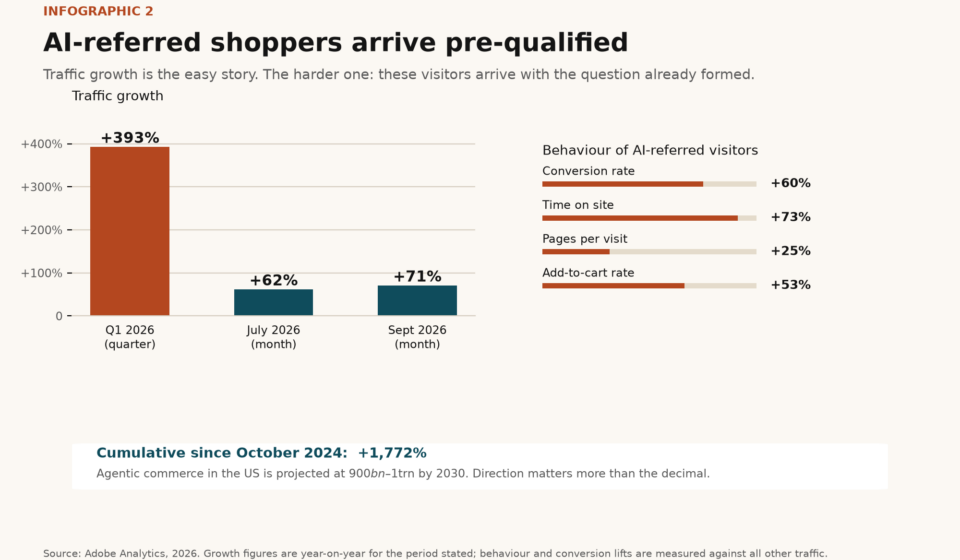
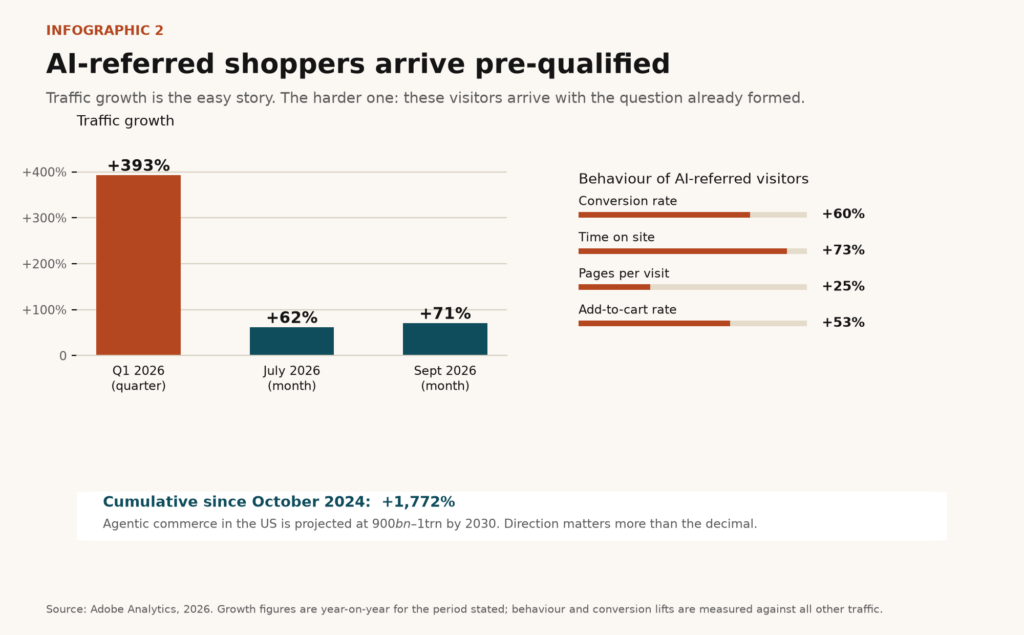
On the demand side, something stranger is happening. Adobe Analytics clocked a 393% year-on-year rise in AI-driven traffic to US retail sites in the first quarter of 2026, and the flow was still running 71% higher in September — roughly 1,772% above where it sat in October 2024. Those visitors do not browse like the rest. They stay 73% longer, open 25% more pages, and add to cart 53% more often. In July, AI-referred shoppers converted at a rate 60% higher than everyone else.
Read those two paragraphs together and the job changes shape. Supply is crowded, and demand is increasingly filtered by software before a human ever sees a shelf. Which means the oldest question in commerce — what do I sell next? — has quietly acquired a new answer key.
The argument here is narrow. Merchants are no longer guessing, and they are no longer simply copying. They read platform signals and generative demand, and the specific advantage they are competing for is the SKU an AI can describe clearly.
The old method worked because information moved slowly
Hot lists and copy-selling were not stupid. They were efficient in a market where ranking boards took days to circulate and where almost any competent product could be absorbed by a growing market. A merchant who saw a spike early enough could buy inventory, list it, and ride the remainder of the curve.
Three things broke that. First, the boards became instant. Within hours of a spike, thousands of sellers see the same number and bid for the same factory capacity, which converts an information advantage into a margin problem in a single cycle. Second, ranking boards are lagging by construction: they rank what already sold. By the time a product appears, its best weeks are behind it. Third, and least discussed, the boards in 2026 are contaminated by policy. Communication equipment retail rose 18.1% year on year in the first nine months, largely on the back of trade-in subsidies. A merchant who reads that as consumer preference and stocks accordingly is buying a spike that ends when the subsidy does.
Copy-selling also carries a second, hidden cost. The product you copy arrives with someone else’s review profile, someone else’s price anchor, and someone else’s return behaviour. You inherit the demand and the defects at the same time.
The new inputs: the long tail of questions
The replacement is not a better dashboard. It is a different class of evidence, and most of it is free.
Search suggestions are the cheapest honest signal available. When a platform autocompletes a phrase, it is telling you that enough people type it for the phrase to exist. The value is never in the head term. “Phone case” is a market. “Phone case that does not yellow” is a specification, and specifications are what a small merchant can actually win.
The second input is less familiar, so it needs a name. Call it the answer gap. Ask a generative assistant which product to buy for a specific situation and listen for the hedge. When an answer contains “it depends”, “check whether” or “some users find”, the model is describing a specification nobody has published clearly. That hedge is a product brief with the commercial part removed. A merchant who fills the gap does not just get a listing; they get the answer that the assistant will quote.
The third input sits inside your own operations. Return reasons, pre-purchase questions, and the three sentences customers repeat in reviews are the only demand research that describes your SKU rather than the category. Most merchants treat this as after-sales admin. It is the most precise product feedback they will ever receive.
The fourth comes from content. Creators demonstrate products that do not exist yet, and the clips that pile up comments asking “where do I buy this” are demand forming ahead of any listing. The catch is that this signal is unusually easy to fake, which is why it should never be the only one.
One discipline holds all four together. Signals show direction, not volume. Use them to generate candidates and to write specifications. Never use them to size a purchase order.
Reading 1688 and Pinduoduo without getting fooled
Most merchants read platform announcements as marketing. They read better as cost structures.
On 13 January 2026, 1688 launched a programme for new sellers that guarantees 50,000 visitors, 500 inquiries, and 300 orders, with ¥6,688 in advertising credit if the targets are missed by the end of the year. The same announcement put GMV growth for AI-version memberships at 73%.
Notice what is being guaranteed. Not demand fit, not margin, not repeat purchase — exposure and inquiry flow. When a platform underwrites traffic, traffic has stopped being the scarce input. The constraint moves downstream, to whether the product converts the inquiries it receives. That is a product-specificity problem, and no platform can solve it for you.
Pinduoduo’s first-quarter 2026 numbers tell a similar story from the revenue side. Total revenue reached ¥106.2 billion, up 11%. Transaction services brought in ¥56.29 billion, up 20%, and became the largest revenue line at 53% of the total. Online marketing services grew 2.5% to ¥49.94 billion. Net income fell 15% to ¥12.5 billion as the company kept funding merchant support programmes.
Translation for a seller: the auction is maturing. Advertising revenue is flattening because bidding has become expensive enough that incremental spend no longer pays, while platform money is shifting towards fulfilment, supply and merchant retention. If the platform is investing in keeping good merchants, then being a good merchant is worth more than being a loud one. That is a different competitive posture, and it changes what you optimise.
Douyin’s Double 11 opening data points the same way. On day one of the 2026 shopping festival, the number of merchants passing ¥1 million in sales rose 74% year on year, the number of store-broadcast merchants passing ¥10 million rose 96%, and the number of first-time creators passing ¥1 million rose 30%. Growth accrued to operators who could run content and shelf together — which in product terms means a SKU with something to demonstrate and something to search for.
Outside China the same instrument exists in a plainer form. Amazon’s Product Opportunity Explorer, inside Seller Central, groups demand into niches and publishes search volume, pricing, reviews and return activity — and flags “unmet demand” where a cluster of search terms converts below the benchmark, meaning people are looking and not finding. That is the answer gap with a dashboard attached: high demand, low conversion, missing specification.
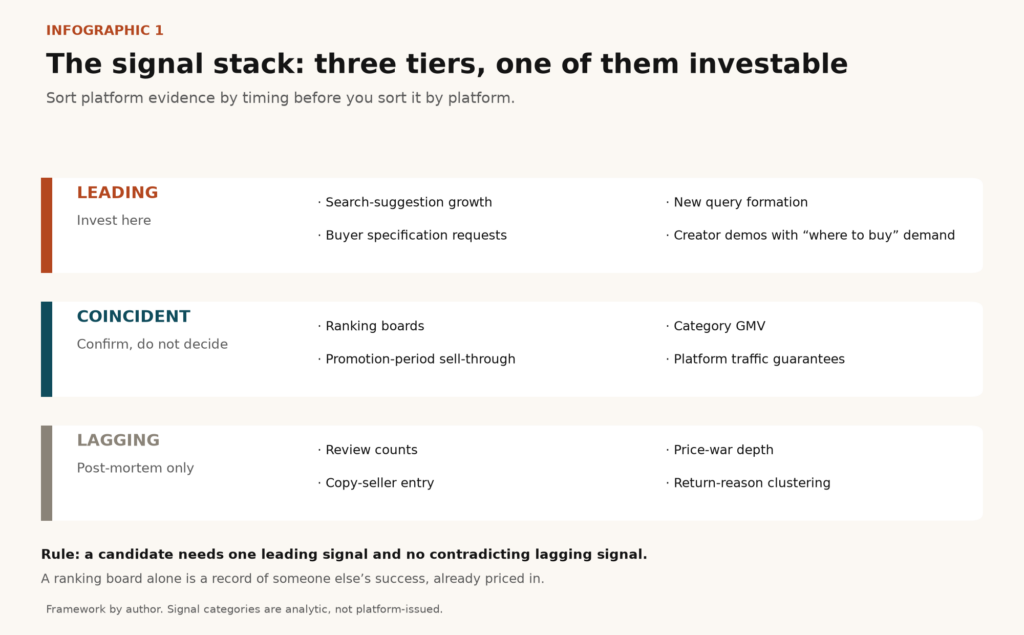
To use these signals, sort them by timing rather than by platform. Search-suggestion growth and new-query formation are leading. Ranking boards and GMV are coincident. Review counts and price wars are lagging. Only the leading tier is investable; the other two are for confirming that you were right, weeks after it stopped mattering.
The describability test
This is the part most merchants skip, and it is where the advantage now lives.
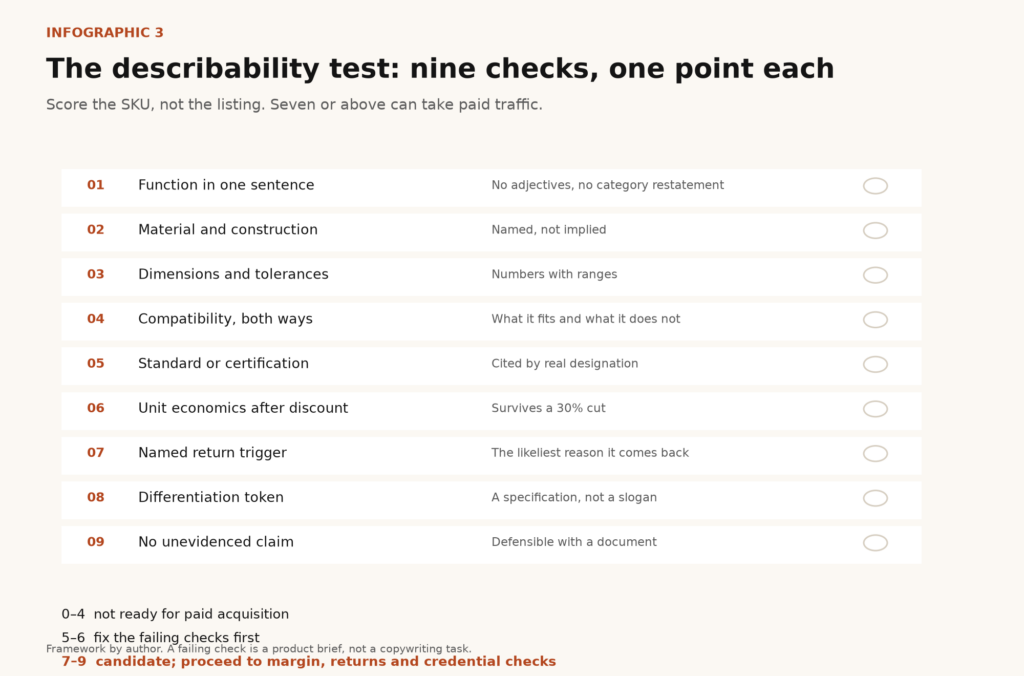
A SKU passes the describability test when software — a platform’s ranking model, a shopping assistant, an agent that transacts on someone’s behalf — can answer three questions from your listing data alone, without hedging. What problem does this solve? Who is it not for? What changes in a specific use case?
Nine checks, scored one point each. Function stated in one sentence with no adjectives. Material and construction named. Dimensions and tolerances given as numbers. Compatibility stated both ways — what it fits and what it does not. A standard or certification cited by its real designation. Unit economics that survive a 30% discount. A named return trigger, meaning the single most likely reason this comes back. A differentiation token that is a specification rather than a slogan. And nothing you could not support with paperwork on request.
Seven or above is a listing you can push traffic to. Below five, the product is not ready for paid acquisition, no matter how good the margin looks.
Why weight this so heavily? Because AI-referred visitors arrive with a narrowed question already formed. Adobe’s behavioural data — longer sessions, more pages, higher add-to-cart — reads like the behaviour of people who have done their browsing inside a chat window and are now checking one candidate. That traffic converts well when the listing answers the question and badly when it restates the category. The same logic explains why so much AI-generated listing copy fails: a model given vague attributes can only produce fluent vagueness.
There is a second, colder reason. Describability is what makes a product legible to an assistant at the moment of recommendation, and recommendation is becoming a distribution channel. The projection Adobe published alongside its traffic data put US agentic commerce in the range of $900 billion to $1 trillion by 2030. Whether that number lands exactly is less important than the direction: the SKU that a machine can specify is the SKU that a machine can sell.
Margin versus turnover, with returns inside the maths
Every merchant knows the margin-versus-turnover trade-off. Fewer run it on current numbers.
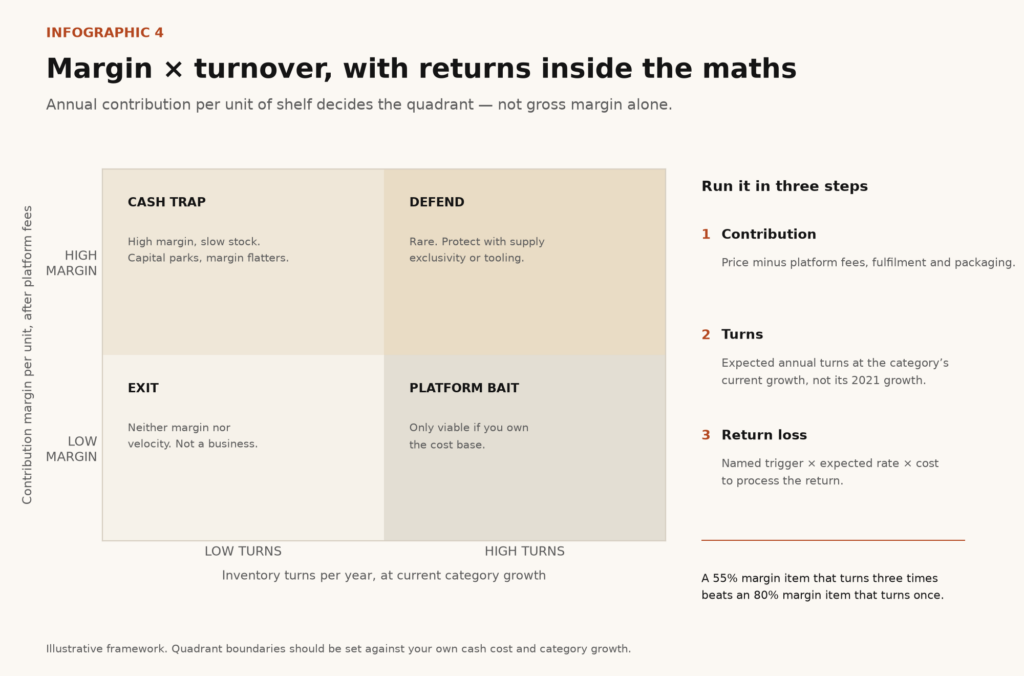
Four quadrants. High margin, high turnover: rare, worth defending with supply exclusivity. High margin, low turnover: a cash trap wearing a nice gross margin. Low margin, high turnover: platform bait, viable only if you own the cost base. Low margin, low turnover: not a business.
The number that matters is annual contribution per unit of shelf, not gross margin percentage. A 55% margin item that turns three times a year beats an 80% margin item that turns once, as soon as you include carrying cost and the capital tied up in slow stock. The trap is that merchants import their turnover assumptions from 2021. With online goods retail growing 3.8%, a turns assumption built on a double-digit market is fiction, and it quietly converts the first quadrant into the second on paper while the warehouse tells a different story.
So run the maths in three steps. Contribution per unit after platform fees and fulfilment. Expected turns at the category’s current growth rate, not the rate you remember. Then subtract the return-adjusted loss, which is the part almost everyone leaves out.
The returns trap
Returns are not a percentage. They are four different failures wearing one number.
Fit ambiguity is the size and dimension problem. Expectation failure is the gap between the photograph and the object. Defect is a manufacturing or packaging issue. Regret is a purchase decision that was never really made. Each has a different fix and a different cost, and the only dataset that separates them is your own return-reason log.
You will not get that separation from public figures, and it is worth saying plainly why. In February 2026, Shanghai police broke a case in which someone paid others to spread a fabricated claim that a major platform’s women’s apparel return rate had reached 90%; the city’s police force reported handling 50 cases of corporate-related online rumour during the period and clearing more than 4,600 posts. Return-rate statistics circulate because they are emotionally satisfying and commercially useful to whoever publishes them. Treat category-level return numbers as noise and your own reason codes as signal.
The rules on returns moved too — partly in the merchant’s favour, partly against. The “refund without return” practice was dismantled across platforms: 1688 ended it from late March 2025, and Pinduoduo, Taobao, JD, Douyin and Kuaishou followed on 22 April 2025, with the market regulator subsequently confirming the change across platforms. That removes a category of loss that had nothing to do with product quality. It also removes the cushion that made some thin SKUs look viable.
What replaced it is procedural. The Measures for Supervision of Online Trading Platform Rules, issued as Order No. 116 by the State Administration for Market Regulation and the Cyberspace Administration and effective 1 February 2026, subjects platform rule-making to supervision, with requirements on disclosure, public consultation, transition periods, appeal channels and limits on arbitrary penalties. The practical consequence for selection is that the cost of a bad SKU now lands more directly on the merchant, and the merchant’s protection is documentation. Keep the listing version, the attribute sheet, the certification, and the pre-sale chat. That file is what converts a dispute into a reviewable case.
Small batches, with the decision written first
Small-batch testing is widely preached and rarely designed. The difference between the two is whether you write the kill criteria before you spend.
Three rungs. A sample rung, where you handle the product and check packaging, documentation and photography feasibility. A pilot rung, sized to your cash and to what the factory will actually run, where the question is not “does it sell” but “does it sell for the reason I predicted”. A scale rung, where you are no longer testing the product but the supply chain’s ability to repeat it.
The discipline that makes this work is deciding in advance what would make you stop. A return-reason concentration above a threshold you set. An add-to-cart-to-order ratio that says the offer is understood but the price is not. An inquiry-to-order ratio on a B2B listing that says the specification is wrong. Fix one variable per rung, fix the observation window, and refuse to read conversion rates off twenty sessions.
Two failure modes are worth naming. Merchants test products when they should be testing specifications — three versions of the same phone case at different thicknesses make one hypothesis, not three. And merchants treat a pilot as a small version of a launch, which means they buy the traffic, get the sales, and learn nothing about whether the product would have sold on its own.
AI-generated listing variants, treated as an experiment
The productive use of generated copy is not volume. It is variant testing with one hypothesis per variant.
Four hypotheses worth separating. Specificity, where the variant names a measurement instead of an adjective. Compatibility, where the variant states fit and non-fit explicitly. Use case, where the variant describes the situation rather than the object. Objection handling, where the variant answers the return trigger before purchase.
Two guardrails are non-negotiable. First, a claim audit: generative models will produce a certification, a test result or a comparative claim that nobody verified, and in a regulated category that is not a copy error but a liability. Second, keep the machine-readable core separate from the prose — attributes, dimensions, materials, compatibility and standards in structured fields, marketing language in a container that can be rewritten without touching the data. Assistants retrieve attributes. Adjectives do not survive retrieval.
The test design matters more than the tool. Hold the traffic constant, change one block of the listing, and measure the return-reason mix as well as the conversion rate. A variant that lifts orders and worsens returns has not worked; it has borrowed from next month.
Compliance is a selection filter, not a final check
Most merchants treat compliance as the last gate before publishing. It is far more useful earlier, because it eliminates candidates.
Start with language. China’s Advertising Law, Article 9(3), prohibits superlatives such as “national level”, “highest grade” and “best”, and the market regulator’s 2023 Enforcement Guide on Absolute Terms (No. 6 of 2023) sets out how those terms are assessed in context, with later provincial guidance refining when leniency applies. The safe operating rule is simple: replace every comparative adjective with an evidenced measurement.
Then category credentials. Cosmetics are the clearest example. The Measures for the Supervision and Administration of Online Cosmetics Business, issued by the National Medical Products Administration and effective 1 September 2023, require platform operators to verify the identity, address and contact details of cosmetics sellers, keep a registration file, and re-verify at least every six months; product registration or filing information has to be displayed. Food, medical devices and certain electrical goods carry their own regimes, and livestream selling now sits under the Live Commerce Supervision and Administration Measures, Order No. 117, which took effect on the same February 2026 date as the platform-rules order.
For selection purposes, add one field to every candidate: credential lead time. A SKU that needs a registration taking three months is not a product for this quarter, however good the signal looks. Merchants who skip this step do not fail at compliance; they fail at cash flow, because they buy the inventory before they can legally list it.
The one-page decision sheet
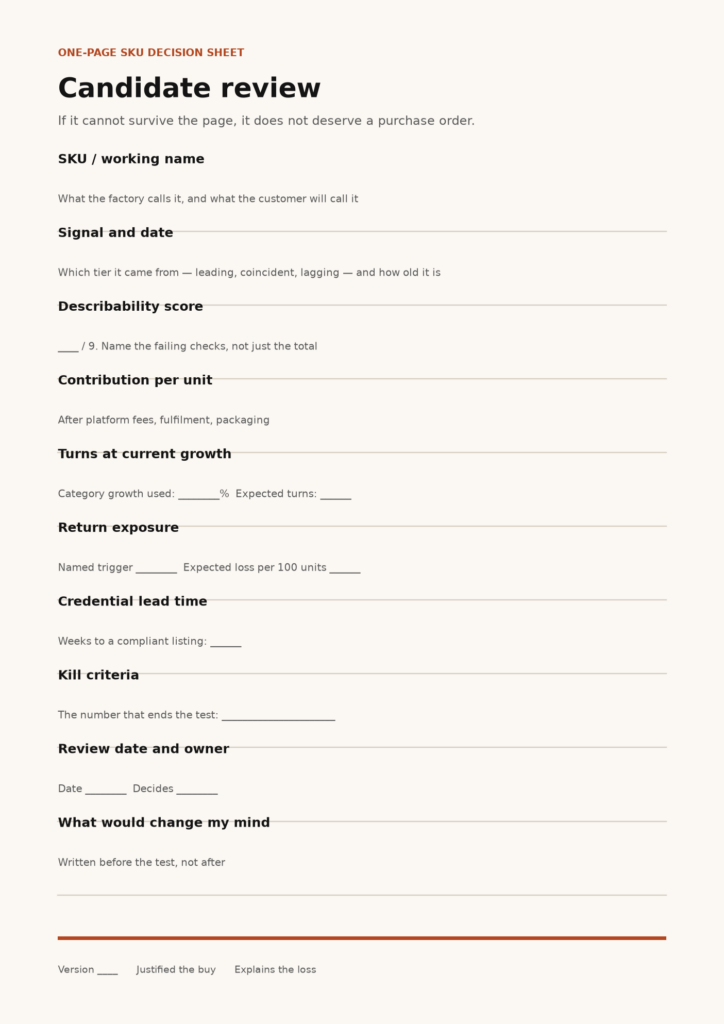
Everything above collapses into a single page, and the page is the deliverable. If a candidate cannot survive the page, it does not deserve a purchase order.
| Field | What goes in it |
|---|---|
| Signal and date | Which tier the evidence came from, and how old it is |
| Describability | Score out of nine, with the failing checks named |
| Contribution | Per unit, after platform fees and fulfilment |
| Turns | Expected annual turns at current category growth |
| Return exposure | The named return trigger and expected loss per hundred units |
| Credential lead time | Weeks to a compliant listing |
| Kill criteria and review date | The number that ends the test, and who decides |
Two additions make it work in practice. A “what would change my mind” line, written before the test, which converts optimism into a falsifiable claim. And a version number, because the sheet that justified the buy is also the document that explains the loss.
Three merchant profiles
Not companies — positions in the market, because the same playbook produces different results depending on what you can actually see.
The factory with capacity and no demand data. It has a cost advantage, sample speed and the ability to run small lots, and it has almost no view of end demand. Its usable signals are the inquiries it receives, the specifications buyers keep requesting, and the categories its existing customers are expanding into. Its failure mode is capacity-led selection: making what the line does well rather than what the market can describe. For this profile the describability test is not a marketing exercise but the product brief.
The content-led operator with demand signal and no supply moat. It sees demand forming earlier than anyone, through comments and saves, and it can manufacture attention on demand. Its weakness is that the product is usually someone else’s, which means the margin goes to whoever owns the tooling. Its failure mode is scaling a signal it cannot defend. The fix is boring: convert one winning specification into an exclusive, and treat every other SKU as content rather than inventory.
The cross-border seller trading on rule differences. It profits from gaps between regulatory regimes, platform policies and consumer expectations. Its signal advantage is comparative — it can see which specification is standard in one market and absent in another. Its failure mode is assuming those gaps are stable, when the 2026 pattern has been convergence: platform rules under supervision, livestream rules standardised, return practices converging downward. For this profile, the describability test doubles as a translation exercise, because the specification has to survive the move between markets.
What will break this playbook
Six things, roughly in order of when they will bite.
Signal decay. Search tails are public. Once a tail is widely read, it fills within a season, and the specification advantage evaporates. The response is not to read faster but to own the evidence behind the specification.
Taxonomy drift. Platforms recategorise, rename attributes and change required fields. Every merchant who built a mapping to the old schema discovers it in the middle of a campaign. Keep the source-of-truth attribute sheet in your own system, not in the platform’s.
Rule reversal. Platform rules are now supervised, which makes them more predictable but not permanent. Categories lifted by subsidy — the 18.1% growth in communication equipment is the obvious example — will revert. Build the reversion into the plan rather than treating it as a surprise.
Description inflation. When every listing is machine-optimised, describability stops differentiating. The moat then moves from description to proof: test reports, certifications, tolerances, warranty terms. Merchants who treated the scorecard as a copywriting trick will find it worthless; merchants who treated it as an engineering checklist will find it compounding.
Agentic intermediation. If assistants transact, price becomes legible at the level of the attribute, and margin migrates to whoever controls the specification and the supply. That is a supply-chain contest, not an advertising contest, and it favours the merchant with a factory relationship over the merchant with a good creative team.
Data pollution. Fabricated return rates, invented sales screenshots, paid-for reviews. The countermeasure is unglamorous: first-party data, versioned listings, and a refusal to benchmark against numbers whose provenance you cannot name.
The signal is the product
The shift described here is smaller than it sounds and harder than it looks. Merchants still buy inventory and still lose money on the wrong SKU. What changed is where the decision comes from: not a chart of what already sold, but a reading of what is being asked, what an assistant cannot answer, and what your own returns are trying to tell you.
The advantage is not access to AI. Everyone has that. The advantage is a product a machine can describe without hedging — specified, evidenced, and honest about who it is not for.
That is a less exciting sentence than “AI picks your products”. It is also the one that survives contact with a purchase order.
Five questions merchants keep asking
Does this mean hot lists are useless now?
No. They are useful for confirming demand exists, which is a different question from whether you should buy it. Use them as a sanity check on size, never as the trigger.
How small can a pilot realistically be?
Small enough that losing the whole lot does not change your month, and large enough that you can distinguish a specification failure from noise. The number is a function of your cash and the factory’s minimum, not a rule of thumb borrowed from someone else.
If AI traffic converts better, should I just buy more ads?
The causal order is the other way around. AI-referred visitors convert better because they arrive with a narrowed question. Push paid traffic at a listing that cannot answer it and you buy expensive bounces.
Which compliance issue kills the most SKUs?
Credential lead time, not language. Superlatives are fixable in an afternoon; a registration that takes a quarter is a decision about whether the product belongs in this year’s plan at all.
What is the single best dataset a small merchant can build?
Return reasons, coded consistently, by SKU, with the listing version attached. It is the only dataset that describes the gap between what you said and what arrived.