The Four Assets Every Brand Forgets to Publish
From Push to Pull: Building a Content Pipeline That AI Assistants Can Cite
Most content teams have the same artifact buried in a shared drive: a spreadsheet with twelve columns, one per month, each cell holding a topic and a due date. The calendar is the plan, the plan is the calendar, and the number that gets reported is posts shipped.
Then someone in your category asks an assistant which tool is worth paying for. Four sentences come back. Three competitors are named. At least one of them published less than you did last quarter.
That gap is the subject of this article. A pipeline built for AI assistants is not a publishing schedule with extra steps. It is a corpus — pages written so a machine can lift a fact out of them without you in the room. Format beats frequency, and format is decided once per asset, not once per week.
1. Push asks how often. Pull asks what can be lifted.
The two models look similar from a distance, because both start with publishing and both end with someone reading. The difference sits in the middle, at the point where a machine decides.
Under push, a page enters an index, competes for a position, and earns a click. Under pull, a page is retrieved for a sub-question, survives reranking, and is either cited or absorbed into someone else’s sentence. There is no position. There is no page one. There is a paragraph, and either your number is in it or it isn’t.
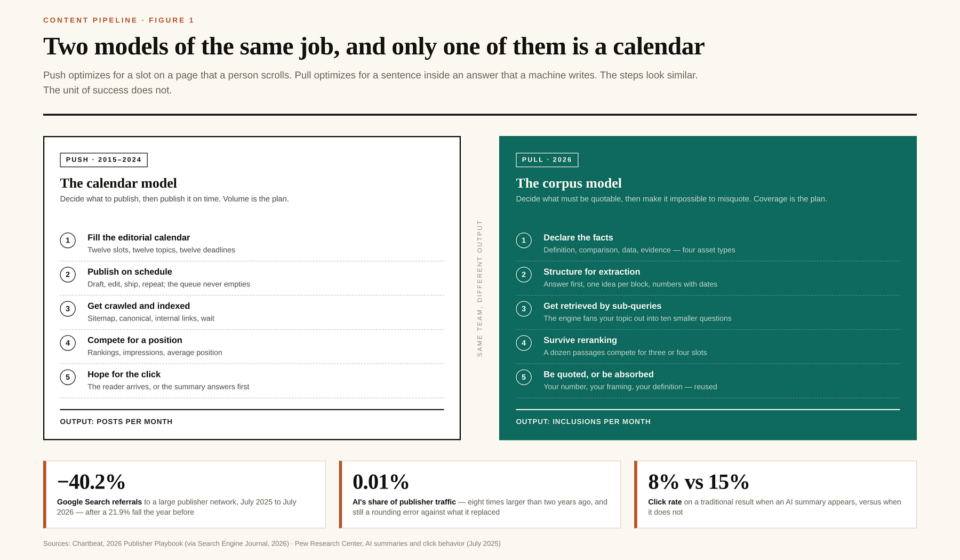
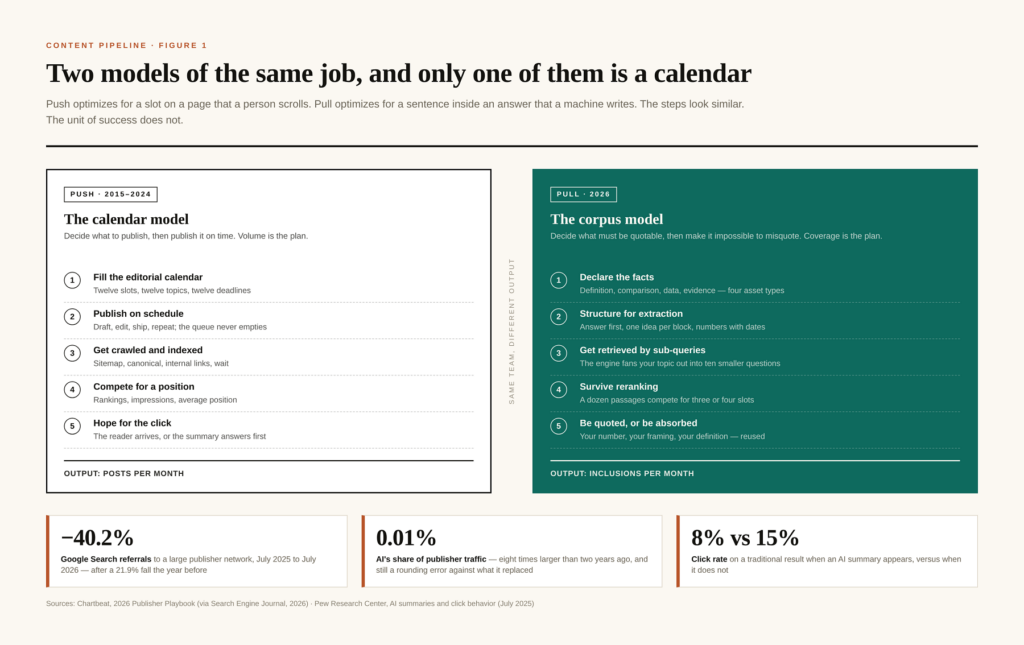
The arithmetic of that shift is not subtle. Chartbeat’s 2026 publisher data recorded a 40.2 percent year-over-year fall in Google Search referrals across its network between July 2025 and July 2026, after a 21.9 percent fall the year before; Google’s share of pageviews slid from roughly 9 percent to 5 percent. Gartner had forecast a 25 percent decline in traditional search volume by 2026. The forecast looks directionally right — and, for publishers at least, conservative.
And yet the replacement is tiny. AI referrals grew eightfold in two years and still accounted for 0.01 percent of traffic across the same network. Pew Research Center found that when an AI summary appears, users click a traditional result in about 8 percent of visits, down from 15 percent when no summary appears.
Small channel, large influence, collapsing clicks. Build accordingly.
2. Every brand is missing the same four assets
“We publish every week” is the objection that ends most of these conversations, and it is not an answer. Weekly output is a cadence. A corpus is a coverage map, and coverage is measured in questions closed, not posts shipped.
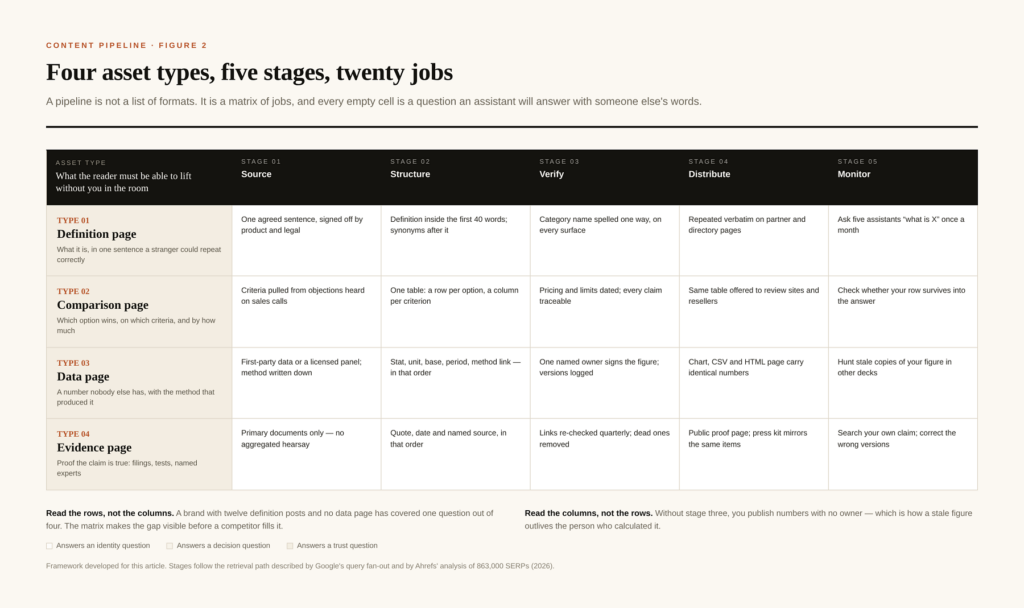
Four asset types close almost all of those questions:
| Asset | The question it settles | How it usually fails |
|---|---|---|
| Definition page | “What is this category, exactly?” | It opens with a mission statement |
| Comparison page | “Which one, and on what criteria?” | Every row ends in “it depends” |
| Data page | “How big, how fast, compared with what?” | A number with no base and no period |
| Evidence page | “Why should I believe any of this?” | It quotes your own brochure |
The logic behind the list is mechanical. Retrieval runs on sub-questions: the engine splits a prompt into a fan of narrower queries, then hunts for pages that answer each one. Identity questions land on definitions. Decision questions land on comparisons. Scale questions land on data. Trust questions land on third-party evidence.
Publish twelve definition posts and you have answered one of four question types — and the other three are being answered, right now, by whoever bothered to write them down.
A definition page is the cheapest asset you will ever build and the one most often wasted. One sentence, agreed with product and legal, repeated identically on your site, your directories, your partner pages and your press kit. That sentence is the thing a model either learns correctly or garbles.
3. Write for extraction, starting with the first paragraph
Here is the test I use, and it takes ten seconds. Copy the first paragraph of a page into an empty document and delete everything else. Does it still answer the question in the heading?
If not, the page has not been written for retrieval. It has been written for a reader who arrived with context, which is the one reader an assistant does not have.
Adobe’s measurement of what it calls citation readability puts a number on the problem. Across more than a trillion visits to US retail sites, the average homepage exposed only 63 percent of its content to AI systems in a form they could understand and cite. Electronics sites scored 79 percent, largely on the strength of spec sheets, setup guides and support pages. General merchandise homepages scored 40 percent, because navigation and promotional tiles crowd out sentences.
The lesson is not that everyone needs a blog. It is that a page built from buttons has nothing to quote.
Two smaller signals point the same way. In an analysis of 1.4 million ChatGPT prompts, pages with natural-language URL slugs were cited at 89.8 percent versus 81.1 percent for opaque ones, and titles that matched the engine’s own sub-queries were markedly more likely to be selected. That selection starts before the page is ever opened — title, URL and snippet do the gatekeeping, and roughly half of retrieved URLs never make it into an answer at all.
Write the title for the sub-question. Write the slug in words. Put the answer in the first 40 words.
4. Every number needs a date and a name attached
A statistic without a date is a rumor with a font. A statistic without an owner is a rumor nobody will correct.
Freshness is a real but specific signal. Ahrefs measured roughly 17 million citations and found AI-referenced pages averaging 1,064 days old against 1,432 days for pages in Google’s organic results — 25.7 percent fresher. Within a single retrieval set, though, the pattern reverses: the newest pages are often retrieved and then discarded in favor of more established ones, and the median cited page in its ChatGPT sample sat around 500 days old. Freshness breaks ties. It does not create relevance.
Which means the operational rule is not “publish more.” It is “make recency checkable where recency decides the answer” — pricing, regulation, product limits, market data.
So keep a fact ledger, and keep it boring: figure, unit, base, period, method link, owner, next review date. Seven columns. Every number on every page traces to one row. When the figure changes, the row changes first, and the pages follow within the week.
The pages that rot are almost never the ones with bad writers. They are the ones where nobody’s name was on the number.
5. Reuse without duplicating: one canonical copy of every fact
Derivatives are cheap. Forks are expensive.
A chart, a video script, a conference slide, a partner one-pager and a sales deck can all carry the same figure. The moment one of them carries a slightly different figure, you have handed a model two versions of your own reality and asked it to choose. It will choose, and it will not tell you which.
The fix is architectural. One canonical page owns each fact and each definition. Everything else points at it. Syndicated copies carry a canonical tag pointing home. A public facts page lists the numbers with their dates, so a journalist, a partner and a crawler all pick up the same text.
This matters more in AI Mode than in a chat assistant. Ahrefs’ correlation study across 75,000 brands found branded anchors carrying a 0.628 correlation with visibility in AI Mode, against 0.511 in ChatGPT — the signature of a consensus engine that rewards deliberate, repeated, third-party endorsement. Consensus is built from repetition. Contradiction is how you lose it.
6. Internal links are citation routes, not navigation
The old mental model treats internal links as plumbing: spreading authority, helping a crawler find pages. Under pull, they do something more specific. They route a retrieval system from the question it received to the page that answers it.
The reason is query fan-out. Google has documented splitting a search into related sub-queries, and the pages that win those sub-queries get pulled into the answer. Ahrefs’ analysis of 863,000 search results and 4 million AI Overview URLs found only 38 percent of cited pages also ranked in the top ten for the original query, down from about 76 percent in July 2025. Another 31 percent ranked between 11 and 100. Another 31 percent did not rank in the top 100 at all.
Read that again. Two-thirds of what gets quoted never wins the keyword. It is answering a question nobody typed.
So build one page per sub-question, each opening with an 80-word answer, and link the hub to every spoke. The spoke restates the hub’s number in identical wording. That is not padding; it is redundancy by design, so that whichever page the engine picks, it picks up the same fact.
7. Make the PDFs and the gated assets quotable
Reports are where most brands hide their best material behind a form. A form is precisely what a crawler cannot fill in.
The honest compromise is hybrid gating. Publish the summary, the method and the headline findings as an HTML page with real text. Gate the dataset, the model or the full appendix. Add a “cite this as” block with the report title, authors, date and a stable URL, so that anyone quoting you — human or otherwise — has an easy, consistent format to copy.
PDFs deserve their own warning. They index, but they parse badly: tables lose their structure, columns merge, footnotes detach. A 60-page report can survive as a file and still fail as a source. Give every PDF an HTML twin with the same numbers in the same order, and let the PDF be the download rather than the destination.
Ungating a summary costs you a few email addresses. Gating the summary costs you the citation, and the citation is the thing that compounds.
8. Hand off between PR and content, or lose both
PR earns the mention. Content makes the mention quotable. Split those functions and each one undoes the other.
The correlation data is uncomfortably clear about where visibility comes from. Across 75,000 brands, branded web mentions correlated 0.66 to 0.71 with AI visibility, YouTube mentions about 0.74, and domain rating 0.266 in ChatGPT. The number of pages on a site correlated at 0.194. That is close enough to nothing that “we doubled our blog output” should never appear in a strategy deck again.
Practically, that means one shared fact sheet per quarter: three numbers, one definition, one sentence under 25 words that a spokesperson can repeat without editing. When a story lands, the owned page carrying those same facts goes live within 48 hours, with a visible as-of date. When the fact sheet changes, PR and content change together.
Otherwise you get the familiar outcome: a great interview, a spike, and a model that still describes your product using last year’s language.
9. Measure pull with prompts, not keywords
Keyword tracking answers a question about a list that no longer exists. Prompt tracking answers the question you actually have: when a buyer asks, does our name survive?
Do it like an experiment, not a dashboard. Fix a set of 60 to 100 decision-stage prompts. Write four paraphrases of each, because one phrasing measures one string, not a topic. Run the set monthly, on the same day, and log five fields: platform, whether any retrieval happened, who was cited, whether your fact survived into the wording, and whether the answer linked out.
A 2026 paper on measuring generative visibility makes the methodological point bluntly: answers vary across runs, prompts and time, so a single observation is not a measurement. Visibility is a distribution. Report the distribution.
Four numbers come out of this, and they fail in order — each one upstream of the next. Activation tells you whether your category triggers retrieval at all. Citation share tells you whether you are named. Absorption tells you whether your framing survives. Referral conversion tells you whether any of it pays — and treat that last one carefully. An analysis drawing on 1,200-plus publisher sites put AI-referred sign-ups at 1.66 percent against 0.15 percent for search, an elevenfold gap, while Adobe’s retail data shows conversion 90 percent higher. Same direction, wildly different magnitude, because the funnels differ. Quote the ratio with its denominator or don’t quote it.
10. Someone has to own the corpus
A corpus without an owner decays into a website. Pages accumulate, numbers drift, definitions fork, and the archive becomes a liability that a competitor’s cleaner page will happily replace.
Name the owner. Not the team — the person. Give them three powers that content teams rarely hold: the right to say no to a new page, the right to delete an old one, and the right to freeze a number until it is verified.
Then set two rituals. Monthly, the fact ledger gets reviewed against the live pages, and anything unowned gets an owner or gets retired. Quarterly, the kill list gets executed: pages that answer nothing, duplicate a better page, or carry figures nobody can source. Ten to twenty percent of a mature library is usually dead weight.
Governance is the section everyone skips. It is also the only section that decides whether the other eleven survive contact with a busy quarter.
11. The toolbox is boring, and that is the point
You do not need a new platform. You need four fields in the CMS you are already paying for:
- Canonical figure — the value, with unit and base
- As-of date — when the figure was last verified, visible on the page
- Owner — a named human, not a department
- Method URL — the page that explains how the number was produced
Add schema markup for Organization, Product, FAQPage and Dataset. It will not win you a citation on its own; it removes ambiguity for systems parsing entities and dates, which is a different and more modest job than most vendors imply.
Then a public changelog: a dated list of what changed on the page. It is the cheapest recency signal you can publish, and the only one a journalist can check.
One thing to skip: llms.txt. Server-log studies have found the overwhelming majority of published files receive no requests, and a 300,000-domain analysis found no relationship between having one and being cited. Ship it if a stakeholder insists. Do not put it on the roadmap ahead of the four fields above.
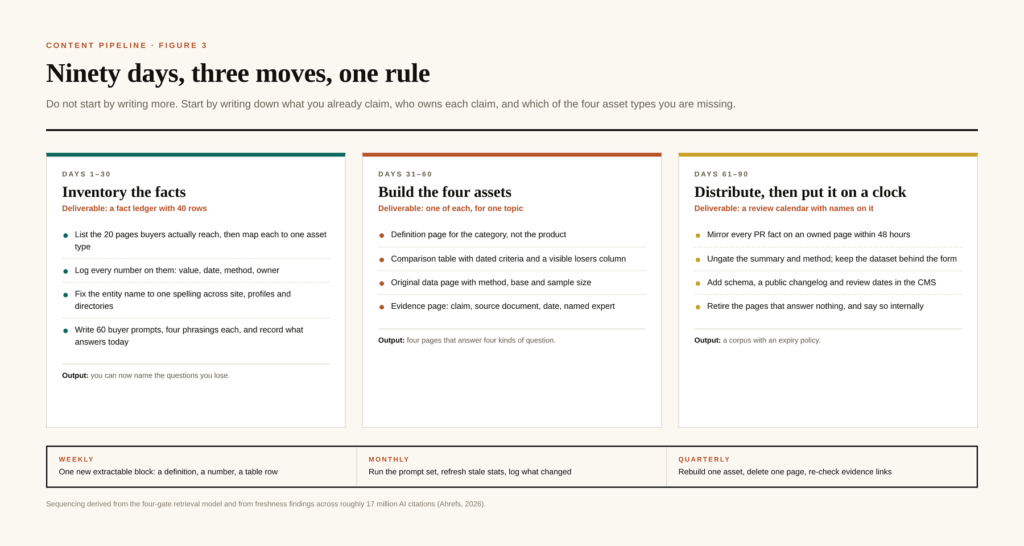
12. Thirty, sixty, ninety
Days 1–30 — inventory. Map your twenty most-visited pages to the four asset types. Log every number on them. Fix your category name to one spelling everywhere. Write the 60 prompts and record what answers today, before you change anything.
Days 31–60 — build one of each. Definition, comparison, data, evidence, all on the same topic, so you can see how the four interact. This is the slowest month and the one that decides the next two years.
Days 61–90 — distribute and put it on a clock. Mirror every PR fact on an owned page within 48 hours. Ungate summaries and methods. Add schema, a changelog and review dates. Delete the pages that answer nothing, and say so in the meeting.
What the numbers actually say
Three findings survive scrutiny, and they should reset the brief.
Coverage is high, and disputed. Depending on whose panel you trust, AI Overviews appear on anywhere from 43 percent of Google queries to more than 80 percent of tracked ones; seoClarity’s own average is 62 percent, ranging from 55 to 84 percent by industry. The disagreement is methodological, not ideological. Plan for the middle of that range.
Citation is not a ranking. Two-thirds of AI Overview citations come from pages outside the top ten, and a third from outside the top hundred. Depth wins sub-questions that breadth never enters.
Volume is not a lever. The number of pages published correlates at 0.194 with AI visibility. Mentions correlate three times as strongly. One well-sourced data page outperforms three months of competent filler, and it keeps outperforming it after the filler goes stale.
The bottom line
A calendar produces posts. A corpus produces citable facts. Those are different products, and the second one is cheaper to run once you stop measuring the first.
Start with the four assets and one topic. Write the answer in the first 40 words. Attach a date and a name to every number. Route sub-questions with internal links. Ungate the summary. Put the review on a calendar with a person’s name next to it.
Then wait, and measure answer share rather than sessions. The clicks may never come back. The sentences will.
Five questions people actually ask
Does this mean we should stop publishing weekly?
No. It means weekly output has to land inside the corpus. A post that closes no sub-question is a post that will be retrieved, skimmed and dropped in favor of someone else’s page. Publish as often as you can while keeping every asset dated, sourced and linked to a canonical fact.
How is this different from the SEO content strategy we already have?
The unit of success changes. SEO competes for a position in a list a person scans; AEO competes for inclusion and phrasing inside an answer a person reads once. The inputs overlap — crawlability, structure, relevance — but the failure modes do not. A page can rank third and never be quoted.
We’re a team of three. What is the minimum viable version?
One topic, four assets, one fact ledger, sixty prompts. That is roughly six weeks of work for one writer and one part-time editor, and it will tell you more about your category than another year of blog posts.
How do we show ROI when AI sends almost no traffic?
Stop trying to prove traffic you were never going to get. Report citation share and absorption share monthly, and ask new customers one question at the point of sale: where did you first hear about us? Self-reported attribution is unfashionable and, at this volume, more accurate than a referrer string.
Does ungating everything mean we lose leads?
Ungate the summary, the method and the headline findings. Gate the dataset, the model and the appendix. In practice you lose very few form fills and gain a page that other people can quote, which is the only marketing asset that appreciates while you sleep.