The Incentive Behind the Report Nobody Reads
Somewhere in your company there is a report nobody opens. It is not abandoned; it is maintained. Someone refreshes it every Monday. Someone adjusts the filters when the campaign names change. It has survived three reorganisations and two agency changes. Nobody has ever made a decision because of it.
Why does it persist? Because it is not failing at its job. We have simply misidentified the job.
Two audiences, opposite demands
A report can serve two people, and they want opposite things. The decision maker wants a number sharp enough to force a choice. The defender wants a number broad enough to survive a question.
Those are not the same document. The second is what most stacks actually produce: an archive of what was known at the time, ready to be produced again in a review six months later when someone asks why the budget went where it went. Its function is not decision input. It is retrospective justification.
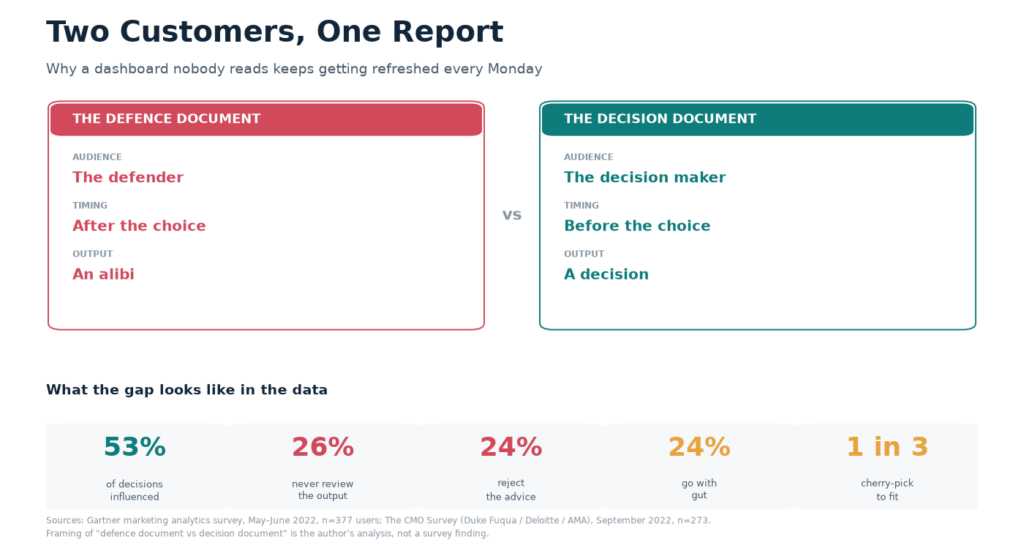
Gartner’s May–June 2022 survey of 377 marketing-analytics users shows the tell. A third of respondents said decision makers cherry-pick data to support a decision already made. Read that again — cherry-picking is not a data-quality problem. It is evidence of what the report is for. A tool that arrives after the decision is not informing it. It is blessing it.
That also explains why the headline number has been so stubborn: analytics influenced 53% of marketing decisions, while 26% of respondents said decision makers never review the output, 24% said the advice gets rejected, and 24% said gut wins. The bottleneck was never the quality of the number. It was the moment the report enters the room.
The asymmetry that keeps it stuck
Now the part that makes the loop self-sustaining. Producing a report is visible, immediate and low-risk. Acting on one is delayed, personal and hard to attribute.
Produce a dashboard and the work is seen this week: the effort is legible, and nobody can fault you for having data ready. Act on it and the payoff arrives next quarter, your name is on the decision, and if it fails the failure is yours alone. Two activities with opposite risk profiles — and only one of them accumulates.
The budget follows the visible side. The September 2022 CMO Survey of 273 U.S. marketing leaders put analytics at 8.9% of the marketing budget, yet analytics were used before a decision in only 48.9% of projects. We are funding production and waiting for consumption.
The test that ends it
The fix is not more analysis. It is deciding who the report is for.
Before you build one, write the sentence a defender would never write: “If this number crosses X, [named person] will do Y by [date].” A defence document cannot produce that sentence — its value depends on being vague enough to survive scrutiny. A decision document cannot survive without it.
Anything that fails the sentence is not a bad report. It is a different product: an archive. File it as one, keep it, and skip it on Monday morning. Naming it honestly is most of the fix.
MIT CISR researchers draw the same line at the financial level: creating value and realizing value are different things, and the discipline separating a real return from applause is tracing created value to a specific line on the income statement. Applause, it turns out, is exactly what a report nobody reads produces — very reliably, every Monday.