Marketing Didn’t Shrink — It Re-Priced Itself: The 2026 AI Spending Shift
Marketing Budgets Are Flat at 7.8% of Revenue. So Where Did the Money Go?
A tight budget did not shrink marketing. It changed what marketing buys.
Ask a CMO in 2026 whether budgets are growing and you will get a shrug. Ask what the money is being spent on and the conversation gets interesting.
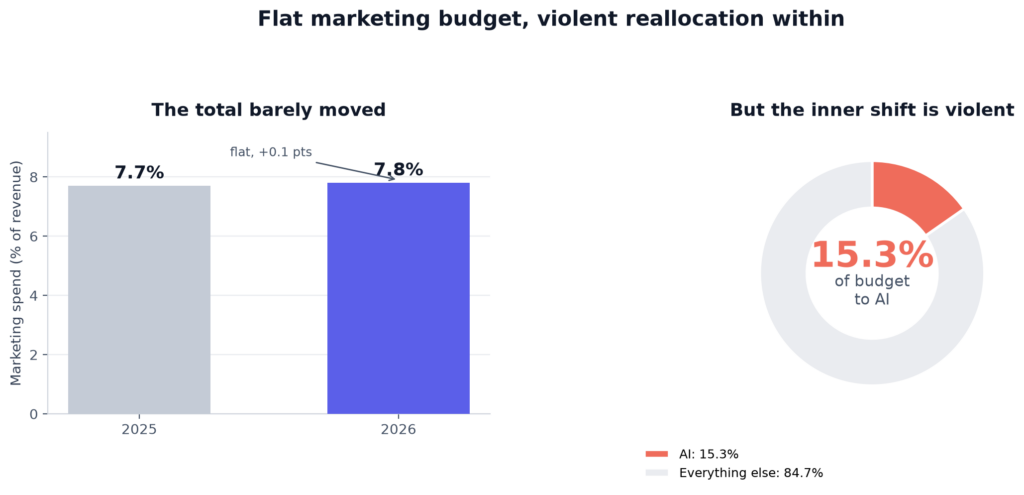
The total has barely moved. Gartner’s 2026 CMO Spend Survey, drawn from 401 CMOs and other marketing leaders, puts average marketing spend at 7.8% of company revenue — up a hair from 7.7% the year before. The CMO Survey, Duke University’s long-running barometer fielded with 308 US marketing leaders in early 2026, lands higher at 9.0%. The gap between the two numbers is itself a warning about how loosely “marketing budget” is defined these days.
But flat totals hide a violent reallocation underneath. Inside that 7.8%, an average of 15.3% of the budget is now earmarked for AI — and the money had to come from somewhere.
At a glance
- Marketing spend: 7.8% of revenue, essentially flat year over year
- Share of budget allocated to AI: 15.3%
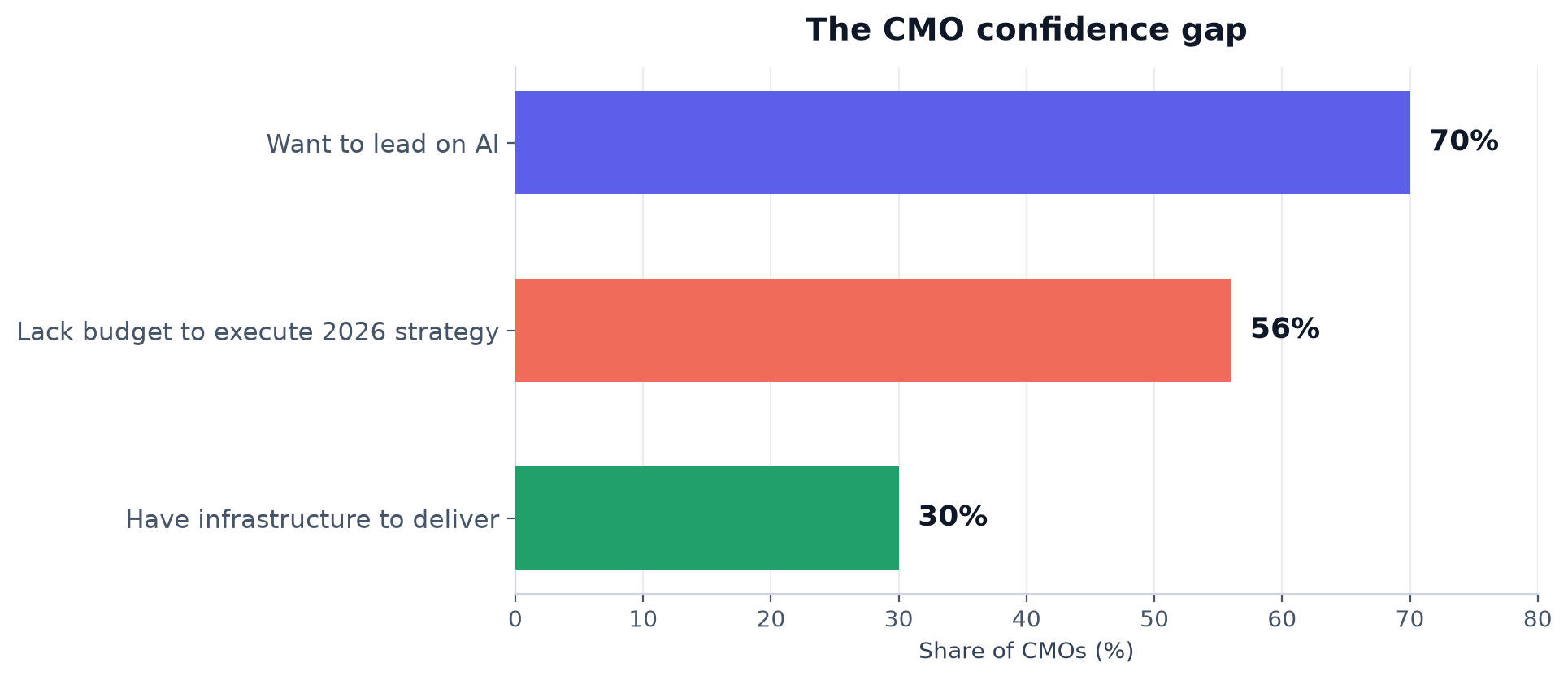
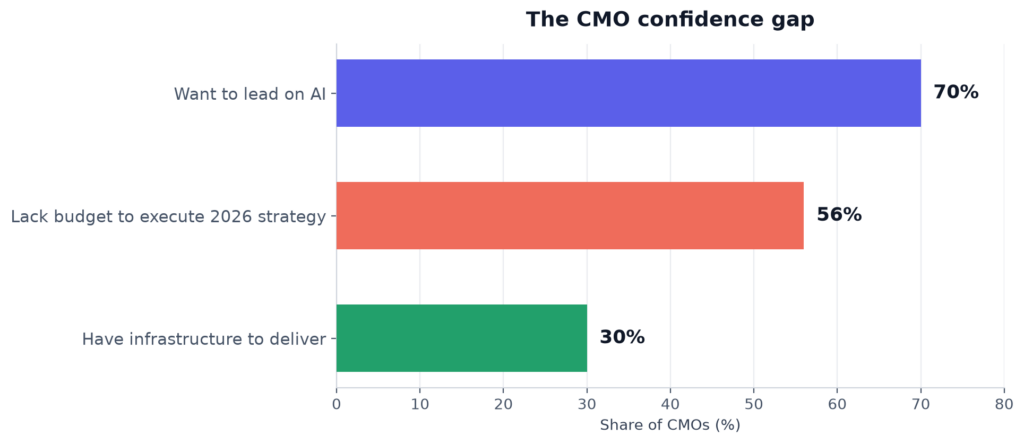
- CMOs who name AI leadership as a top 2026 priority: 70%
- CMOs who say their organization has the infrastructure to deliver: 30%
- CMOs who say they lack the budget to execute their 2026 strategy: 56%
The three new line items
One: compute
Marketing now buys inference the way it used to buy impressions. Generated video, generated copy, and generated creative variants all bill by the token or the GPU-second. This is not a traditional media line — analysts track AI infrastructure as its own multi-hundred-billion-dollar market — but marketing is quietly becoming a volume buyer of it. The fastest-growing line items in a modern plan do not look like media buys at all; they look like cloud invoices.
Two: AI media
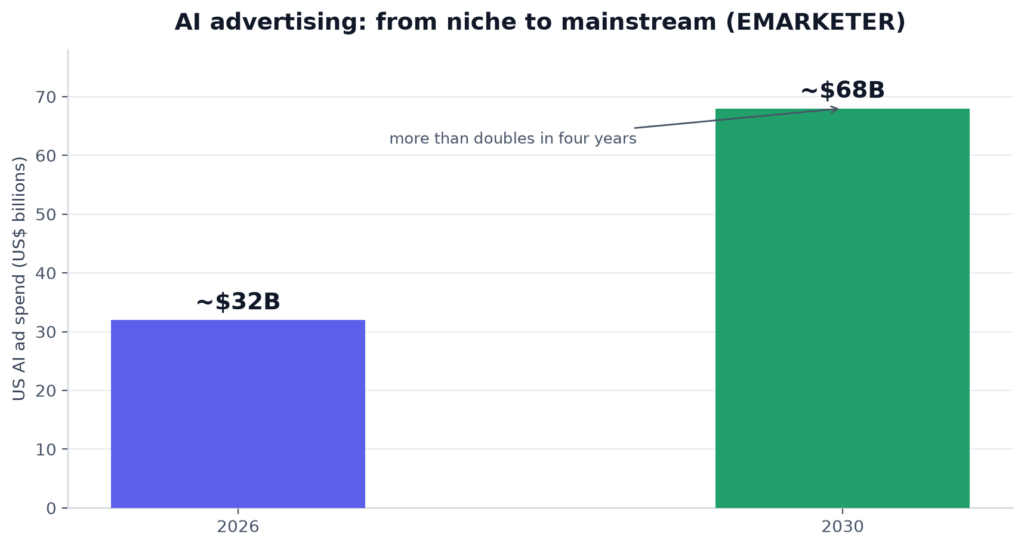
This one looks more like a media line, which makes it easier to spot and easier to underestimate. EMARKETER forecasts US AI ad spending at more than $32 billion in 2026, on a path to roughly $68 billion by 2030. The narrower category of AI search advertising looks steeper still in relative terms — it barely existed three years ago and is now among the fastest-growing inventory classes in the plan. Sponsored answers, brand placements inside AI responses, and paid inclusion in assistant recommendations are all inventory that did not exist in a media plan three years ago.
Three: the answer layer
Call it GEO, AEO, or answer-engine visibility — the underlying purchase is different from anything in a traditional plan. You are not buying reach. You are buying the probability that a model names you when a buyer asks a question you never get to see. It is the newest line item, it has no agreed-upon CPM or CPA, and it is the one most CMOs are still learning how to cost.
The confidence gap
Look at the spread between the headline numbers and you will see the year’s real story. Seventy percent of CMOs name AI leadership as a top priority for 2026. Only thirty percent say their organization has the infrastructure to deliver on that ambition. And fifty-six percent say they lack the budget to execute their strategy at all.
That is not a gap between wanting and doing. It is a gap between aspiration and arithmetic. The ambition is nearly universal; the readiness is not — which is precisely what you would expect in a year where every new line item has to be funded by an old one.
The line item that did not get cut
Here is the part most budget commentary misses. If AI were simply replacing labor, marketing headcount would be falling. In practice, the pattern agencies and in-house teams describe is different: seats are holding, and shifting toward the tasks AI is worst at.
The plausible reading is unglamorous. AI did not remove people; it removed production bottlenecks. Teams that used to spend weeks on asset variants now spend days, and the saved hours went into strategy, briefing, and review — which are still human work. What got cut was agency production volume and low-yield media, not the people who decide what to make.
Why the 7.8% number matters more than the growth number
A flat budget in a year of aggressive AI allocation means one thing: every new line item was funded by cannibalizing an old one. That is a zero-sum planning environment, and it explains the tone of this year’s planning cycles far better than any growth statistic.
Fifty-six percent of CMOs saying they lack the budget is not a complaint about the economy. It is an accurate description of arithmetic. If an average of 15.3% — and more among the AI-mature — must go to AI while the total stays flat, something with a long track record of returns has to give.
The 15.3% average is a lagging indicator
Here is a nuance worth holding onto: 15.3% is the average, and averages hide the leading edge. Among organizations already scaling AI — those with the talent, data pipelines, and model access in place — AI’s share of the budget runs meaningfully higher, at 21.3%.
That gap matters. It tells you the 15.3% is not a ceiling. It is a weighted average held down by companies that have not yet figured out how to make AI pay, and it points to where the rest of the market is heading. When the laggards catch up, the average will rise without any growth in the total — which is exactly why the reallocation feels so much more violent than the top-line number suggests.
What to watch next
The clearest signal is not in the survey data. It is in retail. During China’s 2026 Double 11 shopping festival, Tmall introduced AI tokens as a standalone promotion category for the first time. Model providers — Alibaba Cloud’s Bailian, MiniMax, Zhipu, and others — sold subscription token packages with monthly tiers priced for individual developers, some discounted low enough that a month of inference costs less than a coffee.
Compute became a consumer product with a discount window.
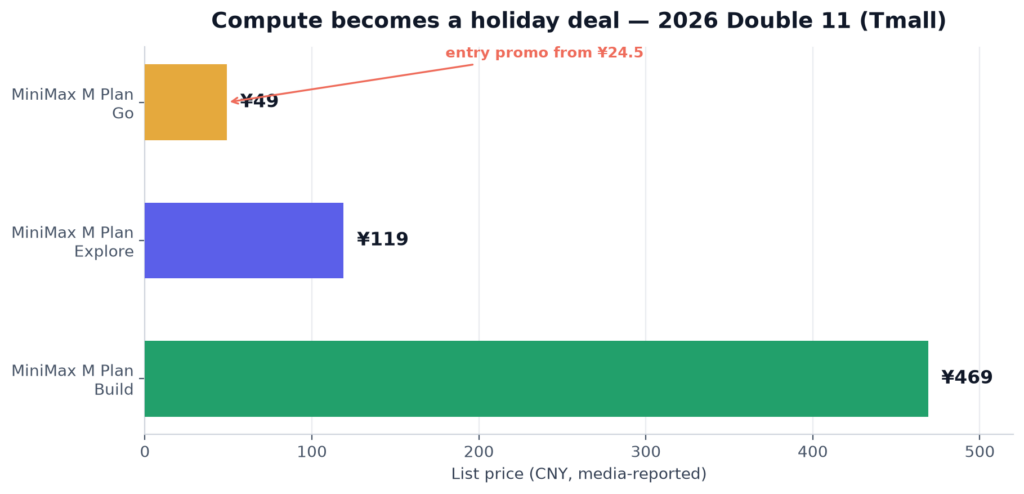
Once inference is merchandised, the marketing budget conversation stops being about percentages of revenue. It becomes a conversation about unit economics — and every CMO will be asked to justify a cost per generated asset the way they once justified cost per acquisition.
The planning takeaway
Three things follow from the reallocation, and they are worth writing down before the next planning cycle.
- Treat compute as a media line. If generated assets bill by the token, the CMO owns a cost curve that did not exist two years ago. Budget for it explicitly instead of letting it hide inside “tools” or “software.”
- Price the answer layer like media, not PR. GEO and AEO invite the same questions performance marketers already know how to ask: what does a qualified mention cost, and how does it convert against a paid impression?
- Defend the human line. The work that did not get cut — strategy, briefing, review — is precisely what determines whether the AI output is worth anything. Starve it, and the 15.3% stops compounding.
Conclusion
A flat number can be the most honest number in the room. The 7.8% is not a story of stagnation; it is a story of migration. Marketing did not shrink. It re-priced itself — from buying reach and production hours to buying inference, answer-engine visibility, and the human judgment that still decides which generated asset ships.