Eight Jobs, Two Architectures: A Practitioner’s Map of China’s Martech Landscape
Here is a thought experiment that tends to unsettle Western marketing teams. Take your stack, put it on a plane to Shanghai, and switch it on. Salesforce opens. HubSpot opens. Marketo opens. And then nothing happens, because the thing all of them were built to talk to — an email list attached to an open web — does not meaningfully exist in the market you just entered.
China’s martech is not a translated version of yours. It is a different machine that solves the same problems. The customer record lives in a chat thread instead of a CRM object. The transaction happens inside a mini-program instead of a checkout page. The media buy happens inside a walled garden instead of an auction across the open web. Once you see that, the question of why Salesforce does not work here answers itself.
What follows is a ranked map of the twenty tools that actually carry weight in China’s marketing stack — ranked by how much structurally depends on them, not by revenue — plus an honest account of where the whole model is fragile.
The market stopped being a rounding error years ago
Start with scale, because scale is what makes the parallel-universe framing more than a rhetorical flourish.
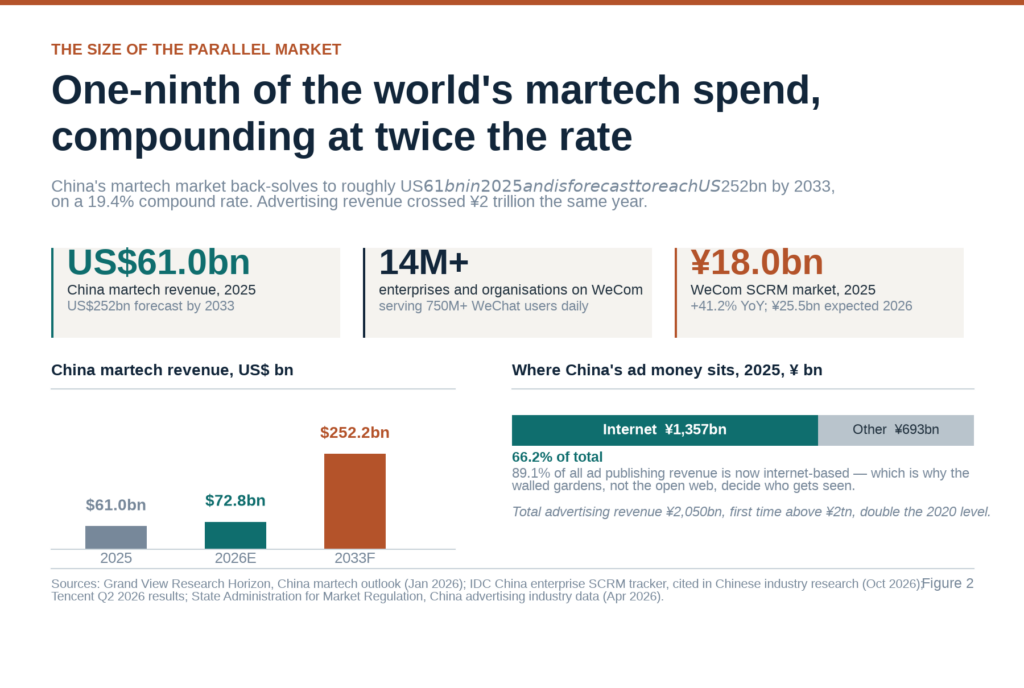
Grand View Research pegs China’s marketing technology market at roughly US$61.0 billion in 2025 — about 11.1% of global martech spend — compounding at 19.4% annually through 2033 to reach near US$252 billion. China is already the largest martech market in Asia-Pacific by revenue.
Now place that inside the advertising market it serves. The State Administration for Market Regulation reported China’s total advertising revenue at ¥2,050.2 billion in 2025, doubling the 2020 figure on a 16.8% five-year compound rate. Internet advertising alone hit ¥1,357.4 billion, up 34.6% year on year, which is 66.2% of all ad revenue — and 89.1% of all ad publishing revenue. Head platform ad revenue grew faster still, above 36%.
Those are regulator-published numbers rather than vendor estimates, which makes them unusually solid ground: enormous, growing faster than the global average, and concentrated in a handful of platforms that own both the audience and the inventory. That last clause is the whole story.
Eight jobs, eight substitutions
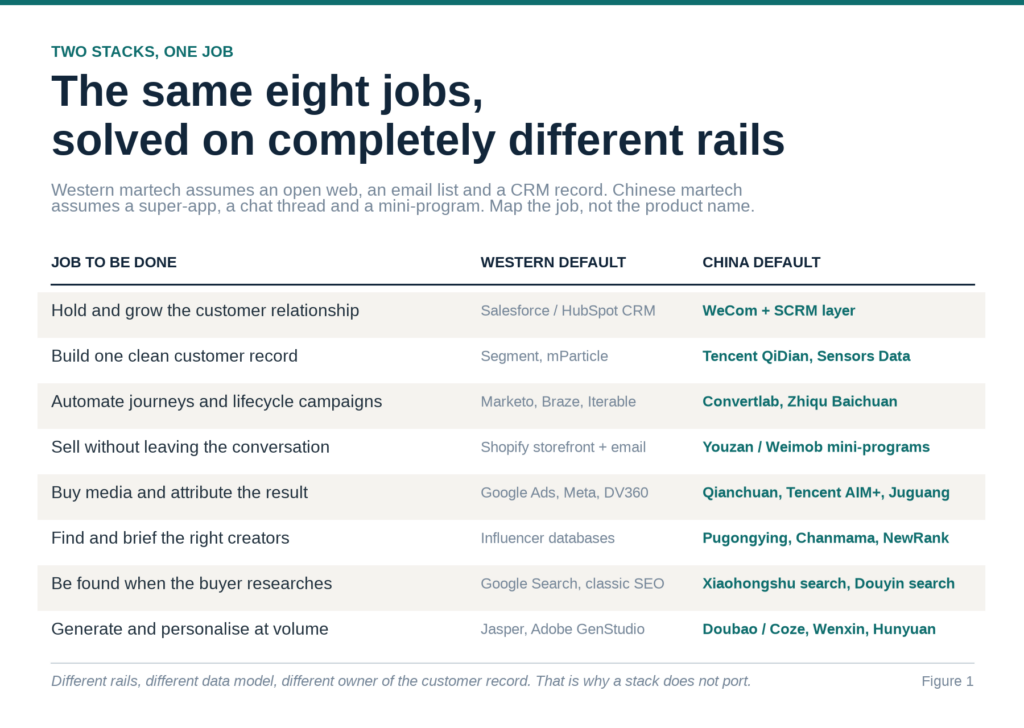
Strip away brand names and martech is just a list of jobs to be done. Here is the mapping that matters — the single most useful slide you can put in front of a leadership team planning a China entry.
Read down the middle column, then the right one. Notice what changes: not the job, but the rail. “Hold and grow the customer relationship” is CRM in the West and a WeCom-plus-SCRM stack in China. “Sell without leaving the conversation” is a storefront and email in the West and a mini-program inside the chat app in China. Identical verbs. Incompatible plumbing.
Tier 1 — the foundation is a conversation, not a record
1. WeCom . The most load-bearing piece of software in Chinese marketing. Tencent’s Q2 2026 results put it at more than 14 million real enterprises and organisations, serving over 750 million WeChat users every day, with its own MAU near 100 million and roughly 23.4% of China’s collaboration-software market. But WeCom is not a chat app with a CRM bolt-on; it is a customer-record system shaped like a chat app, with official APIs for contact management, conversation archiving, and — the quiet killer feature — handover when a salesperson leaves. The customer belongs to the company, not to an employee’s personal account.
2. Weisheng QiWei Guanjia . A Tencent-backed WeCom service provider reporting 150,000-plus enterprise customers, including 160-plus Fortune Global 500 accounts. Vendor-disclosed, so discount accordingly, but the position is real.
3. Chenfeng and 4. Tanma . The independent SCRM challengers, strongest in sales-process management and lead routing. Less ecosystem privilege, more product flexibility.
5. Tencent QiDian . Tencent’s marketing cloud and the leader in China’s CDP market at 21.5% share in H2 2025, up 36.7% year on year, per IDC’s China customer data platform tracker. Its edge is not feature breadth; it sits inside the same ecosystem as WeCom, WeChat Pay, and Mini Programs, so data never crosses a wall.
6. Sensors Data . The independent analytics and CDP player, 2,500-plus paying customers across 30-plus industries as of 2025, built on a $200 million Series D, heavily weighted toward financial services and retail where private deployment is non-negotiable.
This tier matters more than the rest because of where the money already went: the WeCom SCRM market alone was worth more than ¥18 billion in 2025, up 41.2%, with ¥25.5 billion expected in 2026, per IDC data cited in Chinese industry research published in October 2026. And 78% of mid-to-large enterprises now treat SCRM as the central system for private-domain operations. The foundation is not a nice-to-have.
Tier 2 — execution happens inside the walled garden
7. GrowingIO. Behavioural analytics and CDP, now part of the StartDT group after a 2022 merger, with roughly 1,500 enterprise customers claimed. Strong in retail and consumer brands; the differentiator is bundling implementation consulting into the software, which tells you how immature self-serve analytics still is here.
8. Convertlab. The closest thing China has to a Western-style integrated marketing cloud — data hub, automation engine, ad hub, AI layer, backed by Tencent’s industry fund. Company-disclosed customers number in the 300–400 range, concentrated in retail, FMCG, and financial services.
9. Zhiqu Baichuan . The B2B specialist, claiming 700-plus B2B customers across technology, industrial, and healthcare. If you sell high-consideration B2B into China, this is the reference implementation for content-led lead nurture.
Tier 3 — commerce and marketing are the same system
This is the structural difference Western teams underestimate most. In China, the store and the marketing tool are frequently one product.
10. Youzan . FY2025: revenue ¥1.487 billion (+3.1%), GMV ¥103 billion, 52,809 paying merchants, ARPU ¥28,159 (+9%), first full-year net profit of ¥163 million, renewal rate up from 40% in 2021 to 57%. Its AI agent ran nearly 2,000 campaigns for hundreds of merchants, reaching 10 million users and generating ¥120 million in GMV; an AI customer-service function cut service costs by roughly 80% while producing ¥16.56 million in GMV across 248,000 served customers.
11. Weimob . FY2025 revenue ¥1.592 billion (+18.9%), gross margin up from 44.5% to 75.1%, adjusted net profit of ¥42.4 million — its first annual profit since 2021. Merchant solutions revenue jumped 65.1% to ¥695 million even as ad gross billing fell 7.3% to ¥16.69 billion: a deliberate trade of volume for margin, dropping low-margin, high-advance, long-payment-cycle clients. AI-related revenue was disclosed for the first time at ¥116 million, 7.3% of the total. Note the other side of that coin: subscription merchants fell 7.2% to 58,396, with churn rising from 24.3% to 26.1%, and the company still posted a net loss of ¥241 million.
12. Xiaoe-tech . The knowledge-commerce and paid-content rail. Worth knowing if your category touches education, training, or creator monetisation.
Notice the shape of these businesses: they monetise transactions and value-added services, not seats. When your CRM charges per user and your commerce platform charges per order, you build entirely different organisations around them.
Tier 4 — media buying, without a DSP in sight
13. Qianchuan . ByteDance’s Douyin e-commerce ad platform. In 2025 it was organisationally folded into Douyin’s e-commerce unit, ending years of separate ad-revenue and GMV targets running on parallel tracks. That merger is the clearest signal of where Chinese ad tech is heading: ad efficiency and transaction efficiency now sit on one P&L.
14. Tencent AIM+. Tencent’s AI-driven bidding matrix, and the reason marketing services revenue reached ¥145 billion in 2025, up 19%, with gross margin climbing from 55% to 58%. The mechanism matters: AI-driven targeting plus a rising share of closed-loop ads that land users directly in a mini-program, a WeChat Store, or a mini-game. The ad does not hand you to a landing page. It hands you to a checkout.
15. Xiaohongshu Juguang . The ad platform for China’s discovery engine. Xiaohongshu reported 350 million-plus MAU and 170 million users per month actively seeking purchase advice, with under-25s making up 70% of them. Search-led, intent-rich, and nothing like feed advertising.
16. Baidu Fengchao . Still the search rail, still large — but read the next section before allocating budget here.
Tier 5 — content intelligence is a real software category
17. NewRank . Cross-platform content and account analytics; the reference layer for what is trending and who is producing it.
18. Chanmama . Douyin livestream, product, and creator data. If you run Douyin commerce, this is not optional.
19. Qiangua . The Xiaohongshu specialist — creator discovery, note-level performance, brand-investment tracking.
20. Pugongying . Xiaohongshu’s official creator marketplace, where brand-creator invitations happen on-platform: brand invitations exceeded 27 million in 2025, with commercial creators past 1.5 million.
These are not nice dashboards. In a market where creator selection is the primary media-buying decision, the analytics layer is the buying desk.
The AI tier is native, not bolted on
Here is where China diverges most sharply from the Western pattern, and the difference is architectural rather than one of ambition.
Western martech is busy bolting AI onto existing products. In China, AI arrived inside the platforms first. WeCom shipped 5.0.9 in June 2026 with a service-summary feature that reads a salesperson’s entire chat history with a customer, produces a daily brief on intent level and deal blockers, and recommends who to follow up with each morning. By late 2026, further releases added an in-app AI assistant operating across messages, documents, meetings, and cloud files within authorisation scope.
Meanwhile CNNIC’s 57th statistical report puts China’s generative-AI user base at 602 million as of December 2025 — 42.8% penetration, up 141.7% in a year. QuestMobile’s mid-2026 ranking has Doubao at 382 million MAU, Qwen at 167 million, and DeepSeek at 130 million. Tencent is embedding generative models directly into ad creative production, and reports that AI-assisted creative selection lifts creative supply roughly fivefold.
The practical consequence: you will not buy an “AI marketing platform” in China as a separate line item. You will buy a platform that already has AI inside it, and the differentiation will be how well that AI is wired to your own data.
Where the model breaks — Baidu as the cautionary tale
If you want to understand the risk in this whole architecture, watch what happened to China’s original search monopoly.
Baidu’s 2025 revenue fell 3% to ¥129.1 billion, and net profit dropped 76% to ¥5.59 billion. Online marketing revenue declined for six straight quarters, from ¥19.2 billion in Q2 2024 to ¥15.3 billion in Q3 2025, and by Q4 the company stopped disclosing it. Q4 advertising revenue came in at ¥12.3 billion against ¥17.9 billion a year earlier. Baidu app MAU slid from 724 million in March 2025 to 679 million by December.
Except the market was not the problem. China’s internet advertising revenue grew 34.6% that year. Baidu’s problem was that search behaviour migrated to places where search is a by-product: Xiaohongshu for purchase research, Douyin for product discovery, WeChat for everything social. Its own AI transformation made the near term worse, because an AI answer satisfies the query that used to generate the ad click.
The lesson generalises. In this market, ownership of distribution beats product quality. Any tool whose value depends on users behaving the way they did five years ago is a depreciating asset.
Four risks that never make the pitch deck
Platform dependence is a rental agreement, not a purchase. When WeChat banned the third-party group-management tool Wetool in 2020, thousands of businesses lost customer access overnight — not because their software was bad, but because it was built on interfaces the platform had never authorised. Every SCRM vendor in China is one policy change away from a very bad quarter. Ask any vendor you shortlist which official APIs it actually calls, and what happens to your data when the rules change.
Compliance is a product constraint, not a legal afterthought. China’s Personal Information Protection Law carries fines up to ¥50 million or 5% of prior-year turnover, and the compliance-audit rules effective from May 2025 require large-scale data handlers to audit every two years. In August 2025 the Supreme People’s Court issued a guiding case holding that mandatory user-profiling questions at registration were not necessary for performing the contract — a ruling that directly constrains how much profiling your onboarding flow may demand. Design the consent architecture before the journey map.
Idle software is the default outcome. Chinese industry research is blunt about it: more than 62% of enterprises that bought SCRM ended up with idle tools, at an average direct loss above ¥150,000, with 65% reporting that deployment underdelivered. That is not a technology failure. It is a sequencing failure — buying the tool before building the operating routine.
The map decays. Vendors consolidate, get acquired, or shut down. Weimob’s subscription churn rising to 26.1% while the category grew 41% is the pattern to internalise: category growth does not rescue a weak vendor relationship. Treat any top-20 list as a starting point for diligence, not a shopping list.
So what should a global brand actually do?
Three moves, in order.
Start with the relationship layer, not the media layer. The Western instinct is to launch with a performance campaign and worry about retention later. That inverts the economics here. iResearch’s private-domain research has the market compounding 48% a year across 2020–2024 and 20.4% across 2025–2027, reaching nearly a billion users and more than ¥3 trillion in transaction value by 2027 — at roughly 67% penetration. Nearly 90% of surveyed merchants have already started private-domain operations, and 9.4% of the top players generate over ¥100 million a year from it. Buy attention you cannot hold, and you are renting. Field research consistently puts private-domain conversion several multiples above public-domain conversion for the same category — which is the whole argument for building the destination first.
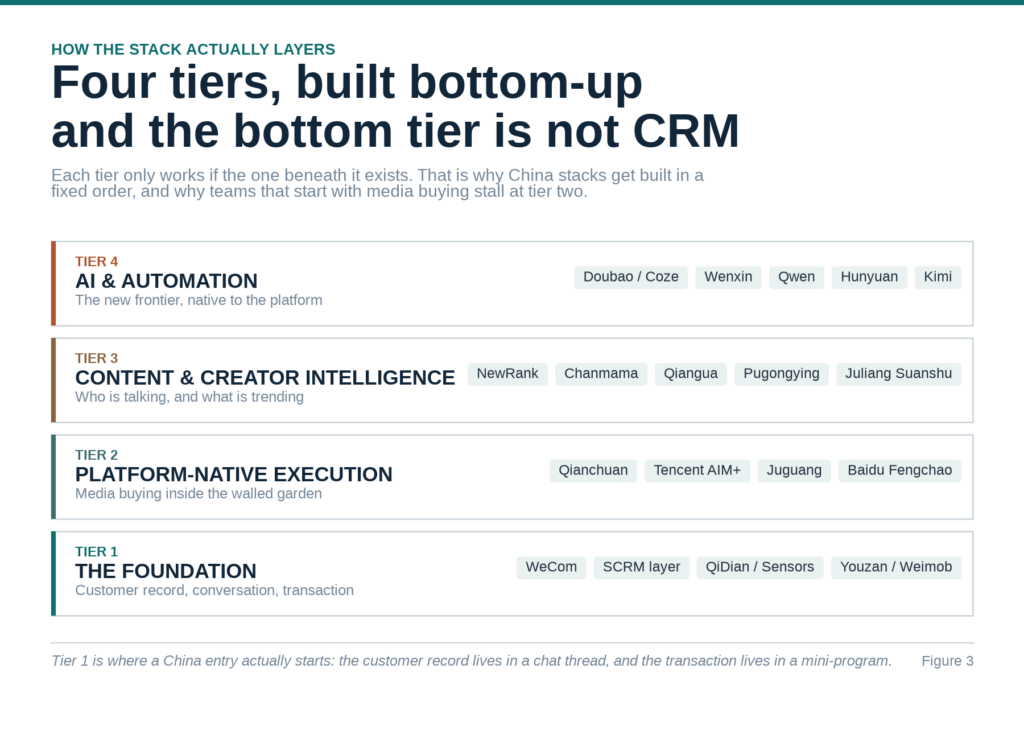
Map each tool by job, then accept the parallel stack. You will run two stacks. Your global CDP will not cleanly ingest WeCom conversation data, and your global attribution model will not survive contact with closed-loop mini-program commerce. Budget for a second integration layer instead of pretending one will do.
Wire AI to your own data before buying AI as a feature. The models are commoditising fast. What will not commoditise is a clean, consented, identity-resolved customer record underneath them. In a market where 78% of mid-to-large enterprises already treat SCRM as their central operating system, the data foundation is the durable advantage — and everything above it is replaceable.
The short version
China’s martech stack is a different architecture, not a different language. Its foundation is a conversation, its execution layer is platform-native, its commerce and marketing are fused, and its AI arrived embedded rather than appended. The twenty tools above carry that architecture. Import your Western stack and you will spend a year discovering that the rails do not connect.