The Independent-Site Dream, Deferred: Why China Cannot Quit the Platforms
May 2021, Shenzhen. Amazon suspends a wave of Chinese seller accounts — the Shenzhen Cross-border E-commerce Association later puts the damage at more than 50,000 stores and roughly ¥100 billion in losses, while Amazon says the true figure was nearer 3,000 accounts across 600 brands. Argue over the count if you like. The lesson survives either number: the shop was never yours, and the landlord could change the locks on a Tuesday.
Within a month, every agency deck in the city carried the same slide. 独立站 — the independent site. Buy your own domain. Keep your own customer list. Stop paying rent. It was the Western direct-to-consumer playbook, translated, laminated and handed to a room of sellers who had just watched a year of revenue disappear overnight.
Five years later, that slide is still a slide.
Chinese sellers have not stopped wanting independence. They have stopped believing that a URL delivers it. What sits between the desire and the revenue mix is not culture, or nerve, or sophistication. It is architecture — and architecture is very hard to argue with.
The dream arrived as an import, and it is not naive
Western DTC logic is tidy: own the store, and you own the customer relationship; own the relationship, and you own the first-party data; own the data, and every subsequent sale gets cheaper. Independence compounds. That is a genuinely good idea, and Chinese sellers imported it wholesale, with the Shopify stack, the Meta funnel and the brand-voice memo to prove it.
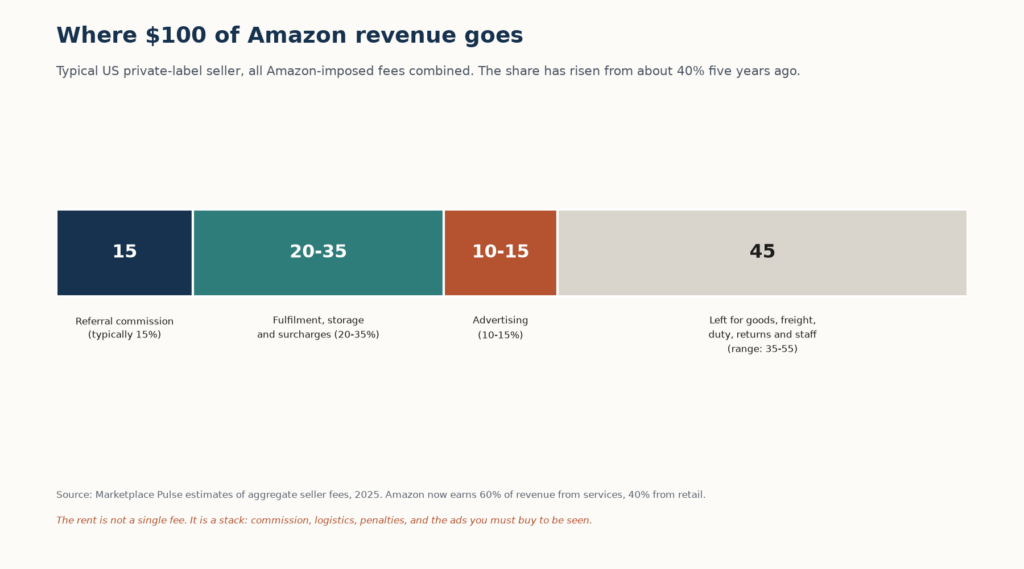
Their reasons were concrete rather than fashionable. When the platform takes a commission, charges for fulfilment, and then charges again for the advertising you need to be seen at all, the seller keeps the remainder and calls it a margin. When the algorithm changes, the seller relearns the business. When the account is suspended, the seller discovers that a decade of customers existed only as a row in someone else’s database.
So the desire is rational. Hold that thought, because the next part is where the arithmetic gets rude.
A number that fails arithmetic
Before we go further, one widely circulated figure needs to be taken out of the room. Chinese marketing decks routinely state that the country’s cross-border independent-site market reached ¥5.5 trillion in 2025, growing 62%, and that independent sites now account for more than 35% of cross-border exports. The same decks, sometimes on the same page, quote China Customs: cross-border e-commerce exports of ¥2.27 trillion in 2025.
A channel cannot be two and a half times the entire trade flow it belongs to. The ¥5.5 trillion figure also replicates word for word across dozens of content farms, which is usually the signature of a number that was manufactured for decks rather than measured in a survey. It has been left out of this piece, and so has every other statistic that could not be traced to a named publisher with a stated method.
That leaves an uncomfortable gap, and it is worth naming: nobody publishes a credible independent-site share for China. Customs tracks trade modes, not storefronts. The platforms do not report it. The agencies that quote it are selling site-building. The absence is itself a finding — the thing everyone claims to be measuring is the thing nobody can measure.
Barrier one: the traffic has no road
Here is the part Western DTC founders consistently underestimate. In the West, demand begins with a query. Someone types a problem into Google, and a website is a legitimate answer. Search created the road, and brands only had to build the shop at the end of it.
In China, demand begins with a feed. People scroll Douyin, they browse Xiaohongshu, they search inside Taobao, they get a link in a WeChat group from a friend who already bought the thing. Discovery is social and algorithmic, and it happens inside applications that are designed to keep the journey inside. There is no national layer of open web search standing between the consumer and the purchase.
An independent site in that landscape is a destination with no road to it. Not a bad shop — an unreachable one. You can build the most elegant storefront in Shenzhen and still watch a customer base scroll past the entrance without ever knowing it exists.
Cross-border tells the same story in numbers. Industry research published by Flywheel puts 80% of cross-border shoppers buying through marketplaces, with Amazon at 24%, Temu at 21%, AliExpress at 10% and SHEIN at 9%. Those figures come from a vendor with an interest in the independent-site narrative, which makes the direction of the finding, rather than the decimal, the useful part.
Building the road means buying the asphalt
You can build your own road. You just have to pay for it by the impression, and the price has been climbing.
Across 2023 to 2025, blended customer acquisition costs rose somewhere between 40% and 60% — a range compiled by SimplicityDX and echoed in most agency benchmarks. Meta’s CPM hit an all-time high of $22.98 in Q4 2025, peaking at $25.22 in November. Google Shopping cost-per-click jumped 33.72% in a single year. SimplicityDX’s own modelling has brands losing about $29 on every new customer bought through paid channels, a loss recovered only if that customer comes back.
Put those numbers next to a platform. The platform charges you for access to traffic it already aggregated. The independent site charges you for traffic you must aggregate yourself, at retail, with a team, before you have any brand to convert on. Both are rent. One is rent with a landlord who also handles the plumbing.
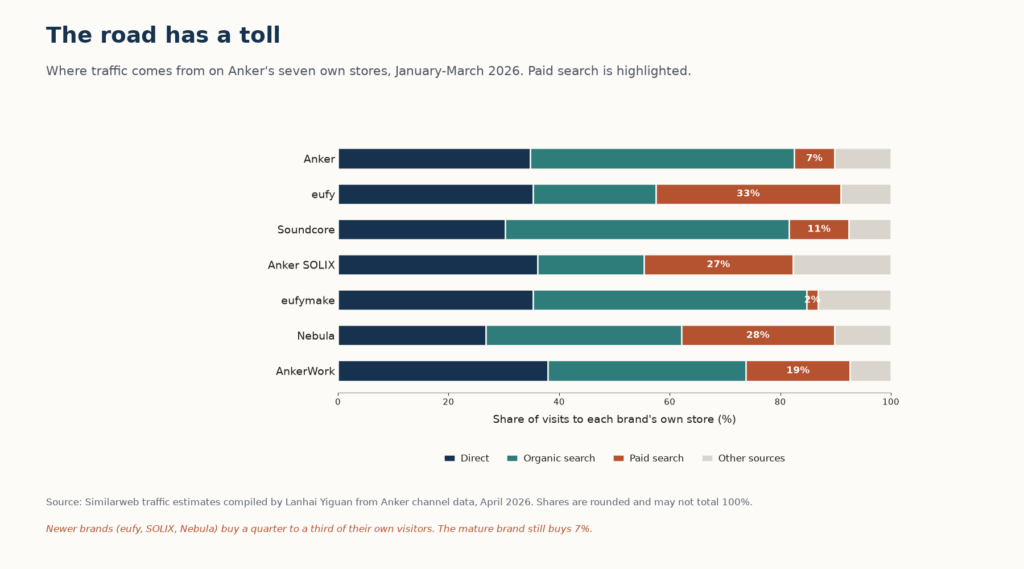
The traffic mix on Anker’s own stores makes the point better than any argument. Across seven brand sites and roughly 41 million visits in the first quarter of 2026, the mature Anker store draws 7% of its visitors from paid search; the newer brands — eufy, Anker SOLIX, Nebula — buy between 27% and 33%. Independence, for a young brand, is a media budget with a website attached.
Barrier two: trust and payment are borrowed, not owned
The second barrier is softer and much harder to fix. On a platform, trust is an infrastructure, not a feeling. Escrow holds the money until delivery. Returns are one tap. Disputes go to a mediator with the power to move funds. Refund-without-return policies, however brutal for sellers, taught a hundred million people that the platform will take their side.
Take the transaction off the platform and all of that evaporates. The consumer is now asked to wire money to a company they have never heard of, on a site with no third-party guarantee, and to hope. In a market where mobile payment sits inside two super-apps, the payment rail itself is the platform’s property.
China’s complaint data shows what happens at the edge of that trust perimeter. The China Consumers Association recorded just over 2.01 million complaints in 2025, up 14.45%, after 995,971 in the first half alone — a 27.23% jump. Private-domain marketing was named a new hot spot, and the association’s own diagnosis reads like a specification for everything an independent channel lacks: information opacity, scattered payment paths, no complete transaction record, sellers who go silent or block the buyer.
Its四难 shorthand — you cannot reach a human, you cannot prove what happened, you cannot identify who is liable, and you cannot get paid — is the trust layer described from the outside. Consumers are not being irrational when they prefer the mall. They are pricing the guarantee.
Barrier three: the super-app owns the whole journey
In China the purchase is not a moment, it is a route. Discover in a feed, compare inside the same app, pay with the wallet already on the phone, track the parcel in the same notification tray, complain in the same chat window, get wooed again by the same account next month. One application, zero handoffs.
An independent site can only ever be one segment of that route. Every hop it demands — leaving the feed, opening a browser, creating an account, entering card details — is a leak, and the leak is measurable in the only currency that matters, which is abandoned carts.
So the market improvised a workaround, and it is the most interesting thing in this story. The independent store did not appear as a website. It appeared as a mini-program, a shop card, a group chat with a customer service agent who remembers your daughter’s name. WeChat’s own disclosures show where that energy went: WeChat Shop volume more than doubled in 2025, with an estimated ¥420–440 billion in actual GMV according to Yibang Power’s tracking, while transactions through mini-programs rose more than 70% year on year in the second half. Between August and December, visits to the shop-and-wallet entry rose 132% and its transaction value rose 320%.
None of that is a website. All of it is a store the merchant can re-open tomorrow morning without paying for the click again.
The tool layer’s quiet retreat is the tell. China’s two flagship commerce SaaS vendors, whose software exists to help merchants run exactly this kind of owned storefront, spent 2025 recovering profitability by shrinking, not growing. Youzan ended the year with 52,809 paying merchants, down from more than 100,000 at its peak, on revenue of ¥1.49 billion — up 3.1%. Weimeng’s subscription revenue fell 2.3% and its paying merchant count fell 7.2%; the company’s own commentary concedes that native WeChat Shop features are displacing the third-party tools smaller merchants used to rent.
If independent-store demand were exploding, the companies selling the shovels would be the first to know. They are not.
Barrier four: going abroad does not escape gravity
The instinct is to leave. If the domestic architecture is hostile to owned stores, cross the border and sell where search still works. Except the border crossing lands you somewhere with the same shape.
On Amazon, Chinese sellers became the majority of the global active seller base in 2025 — 50.03%, the first time the line has been crossed — and they filed 59.9% of new listings. They also capture about 39% of third-party revenue worldwide. The average Chinese seller turns over roughly $393,557 a year against $884,958 for a US seller. A majority of the shopfronts, a minority of the till.
And the door is narrowing while the rent rises. New seller launches fell to 165,000 in 2025, down 44% and the lowest since tracking began in 2015; active sellers dropped from about 2.4 million in 2021 to 1.65 million. The sellers who remain are larger and more professional, which is another way of saying the platform has finished subsidising experimentation.
Then the cheap route closed. De minimis treatment ended for China and Hong Kong in May 2025 and for every origin on 29 August 2025, with a statutory permanent end scheduled for July 2027. In fiscal 2024, $64.6 billion of goods arrived in 1.36 billion low-value shipments; by volume, such parcels were about 92% of all US import entries. Trade-press trackers recorded Temu’s US daily active users falling by more than half and SHEIN’s by about a quarter, with SHEIN raising prices roughly 23%.
The fix for all of this is local inventory: bulk import, bonded warehousing, domestic fulfilment. Which is capital, compliance staff, and a customs broker — the three things a platform can amortise across a million sellers and an individual merchant cannot. The wall did not just stay up. It got taller.
The exceptions price the rule
Two companies are always produced as proof that the dream is achievable. Look closely at what they paid.
SHEIN built its own site and app, and it worked — but not because a website is magic. It worked because SHEIN bought the road. When US tariffs made that market expensive in 2025, SHEIN cut US ad spend by roughly 35% in March; when it pivoted budget to Australia, its Australian ad spend rose about 50% in the June quarter and its traffic ranking climbed into the top twenty retail sites. The asset was never the domain. The asset was the ability to redeploy tens of millions in media at will, at a scale where a market pivot is a line item.
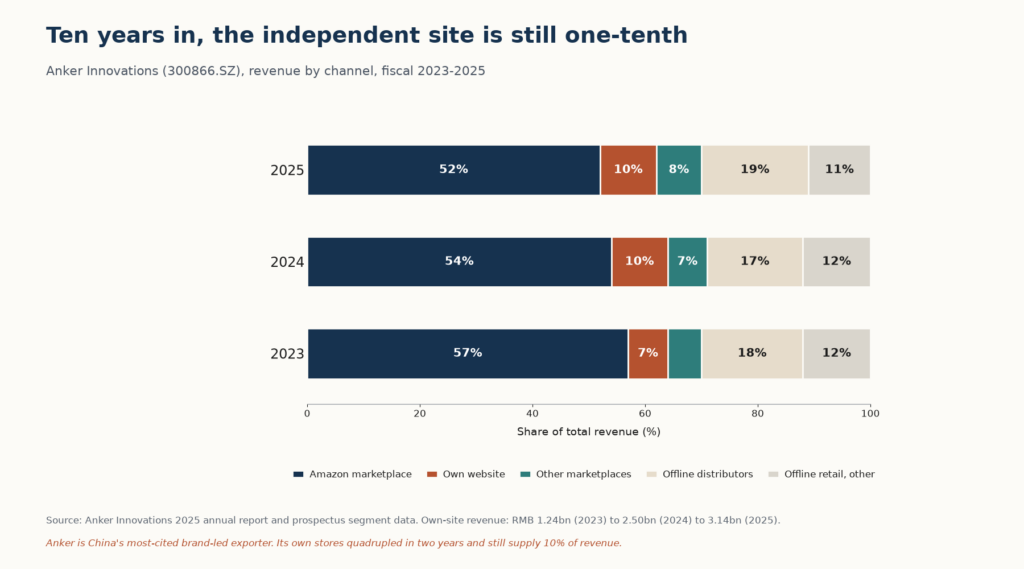
Anker is the more instructive case, because it is the honest one. After more than a decade of brand-building, nine-figure annual marketing spend and a product line that genuinely earns its reviews, its own stores generated ¥3.135 billion in 2025 — up 25.2%, and 10.3% of group revenue. Amazon still supplied 52.3%. Sales and distribution expenses ran to ¥6.83 billion, or 22.4% of revenue, a figure that includes platform commissions, fulfilment and the advertising that keeps both channels visible.
Ten years. One-tenth. That is not failure — it is the realistic ceiling in a market where traffic must be purchased rather than inherited. If China’s best-known consumer brand lands at 10%, a merchant with a good product and a thin balance sheet should probably plan for less.
The workaround: independence inside the walls
Which brings us to the quiet substitution nobody put on a slide. Chinese sellers did not abandon the goal of owning the customer. They abandoned the URL as the way to do it.
Private domain — 私域 — is the machinery: WeChat groups, mini-programs, membership tiers, one-to-one service, the ability to send a message to someone who has already bought from you without paying an algorithm for the privilege. Research firm Wangjing She puts private-domain commerce at ¥6.4 trillion in 2025, up 28%, with 680 million users. Note the definition, because it is revealing: the category includes storefronts on WeChat, Douyin, Kuaishou and Xiaohongshu. Even the “private” channel is, on paper, counted inside the platforms.
That is not a flaw in the data. It is the point. The functional independence Chinese merchants actually achieved is a re-engageable audience living inside an application they do not control — a rented flat with excellent furniture and a very good lock on the door.
Two landlords, in fact. WeChat owns the distribution. And since 2026, private-domain livestreaming has been pulled into the same regulatory perimeter as public livestreaming, with enforcement actions and fines following. Independence inside the walls is real, and it is conditional.
What sellers should do differently
Four moves, in descending order of how much they will change your P&L.
Stop shopping for a domain; shop for a re-engagement mechanism. The question is not “do I have a site?” but “can I reach the same person next month at zero marginal cost?” If the answer is no, a Shopify subscription will not fix it. A group, a membership, a subscription or an app-level follow might.
Price the traffic before you build. Model the site as a paid channel with a fixed cost. Take your category’s realistic CPC, multiply by the conversion rate you have actually earned — not the one in the pitch — and check whether the resulting CAC clears your gross margin. For most Chinese consumer categories in 2026, it does not, which is why the paid-search share on young brand sites sits near a third.
Run two speeds deliberately. Platform for reach and trust, private layer for repetition. The platform is where strangers become customers; the private layer is where customers become a margin. Treat the site as the third-speed support surface — brand home, warranty, content, recruiting — not as the growth engine.
If you do build, build where direct traffic exists. Repeat-purchase categories, high-ticket items with research tails, spare parts, consumables, B2B accounts, and anything with a searchable specification sheet. Where nobody types a query, nobody types your domain either.
What Western brands should unlearn
The reflex that fails hardest in China is brand-dot-com. Global teams arrive with a site, a CRM and a media plan, and discover that their Chinese customer is not looking for a website — she is looking for a shop card inside an app she already has open.
The workable version is the inverse of the DTC playbook: build owned presence inside the platforms your customers actually inhabit, then use the private layer to convert a one-time transaction into a relationship. Treat the website as the credibility annex, not the storefront. Budget for the platform’s commission as a customer-acquisition cost, because that is what it is, and stop pretending it is a tax you can someday escape.
The caveats that keep this honest
Three, and they matter.
Platform dependence is durable, not a phase. The fees, the algorithmic precarity and the customer-data gap are structural features of an architecture, not symptoms of a platform’s bad mood. Sellers waiting for the moment the independent site becomes easy will wait a long time.
Private domain is a hedge, not an exit. It is owned within WeChat and rented from WeChat, and now regulated by the state. When the landlord changes the terms, the furniture does not save you.
And the survivors distort the picture. SHEIN and Anker are cited because they are rare, not because they are typical. Both spent enormously to get where they are; neither offers a template a mid-sized merchant can copy, and treating their outcomes as evidence of a general trend is how decks get built and balance sheets get ruined.
What to watch between now and 2027
Four signals will tell you whether the shape of the dream is shifting, and none of them are press releases.
Watch the platform take rate. If Amazon’s fee load holds near 50–60% of seller revenue while its service mix keeps climbing, the economic motive for independence strengthens — and so does the cost of acting on it.
Watch July 2027, when the de minimis repeal becomes statute rather than executive order. Local inventory stops being an advantage and becomes a licence to operate, which consolidates volume into fewer, better-capitalised sellers and into the platforms that warehouse for them.
Watch the merchant counts at Youzan and Weimeng. They are the closest thing to a demand index for owned storefronts in China. If those numbers turn, something real has changed; until they do, the decks are ahead of the market.
Watch cross-border growth. Exports rose 5.4% in 2025 to ¥2.27 trillion, or 8.4% of goods exports, and the pace decelerated sharply from a 14.0% final-basis gain in 2024; the first three quarters of 2026 came in around ¥2.18 trillion, up 4.4%. Slower growth plus higher compliance costs equals fewer experiments, and the independent site is usually the first experiment cut.
Conclusion
The independent site was never really about the site. It was about three things a merchant could hold onto when the platform changed the rules: the customer, the data, and the ability to speak to them again without paying for the privilege.
In a market where discovery lives in feeds, trust lives in escrow, payment lives in super-apps and the whole journey lives in one application, the standalone URL delivers none of those three. What delivers them is a re-engageable audience — built inside the platform, reinforced by service, and defended by the only asset that compounds in either architecture: a customer who comes back.
So the dream is not dead. It changed shape. Chinese sellers stopped asking for a domain and started asking for a relationship, which is what the domain was always a proxy for. The ones who understood that early are not mourning the missing website. They are counting the repeat orders.