Why Chinese Sellers Now Live or Die at 4.6 Stars
Open a product page in China and a verdict lands before you read a word. The page either clears or it does not, and clever copy never reopens the question.
The verdict arrives faster than a sentence
Perception research puts the window at about a tenth of a second. In a 2006 study in Psychological Science, Janine Willis and Alexander Todorov flashed unfamiliar faces for 100 milliseconds. Judgments made at that speed matched those made with no time limit, and trustworthiness was the trait observers converged on most. A product page gives you roughly three seconds: long enough to read a surface, short enough to skip the reading.
What the scan reads, and in what order
The sequence is remarkably stable. First the flag: an official shop, a flagship badge, or nothing. Then the score sitting under the shop name. Then the review wall: not the average star, but whether reviews are numerous, recent, and carry photographs someone actually took. Then price logic: a figure far below the category floor reads as counterfeit, not as a bargain. Then tenure, the only one of the five that cannot be bought quickly.
Each signal can veto the next. A missing flag ends the scan. A strong flag buys attention for the score; the score buys attention for the reviews. You never get to argue with the order, because you are not present for it.
Why the glance exists at all
Not because Chinese shoppers are shallow, but because verification is expensive and attention is scarce. China had 937 million online shoppers in December 2025, according to CNNIC, in a market that also generated 26.46 million consumer complaints in one year and sent 3,683 tonnes of counterfeit goods to destruction, per its market regulator. At that scale nobody can audit every seller, so shoppers swap cheap proxies for costly checking.
The logic is textbook signalling: a signal is believed only when it is expensive to fake. A verified badge costs paperwork and a qualification review. A thousand photo reviews cost a thousand real orders. Five years of tenure cost five years.
The part foreign brands miss: the glance became a number
In June 2025 Taobao and Tmall replaced their old store rating with a “true experience score” built from product quality, delivery speed and service. Search now lets a shopper filter stores at 5.0, at 4.8 and above, or at 4.6 and above — so anything below 4.6 disappears from the filtered results. By launch, 1.2 million merchants already sat at 4.8 or higher.
That is the real mechanism. The three-second test did not stay a private instinct; it was industrialised into a threshold. What looks like a snap judgment is now a ranking rule with a decimal point, enforced by search.
Engineer the surface, but know its limit
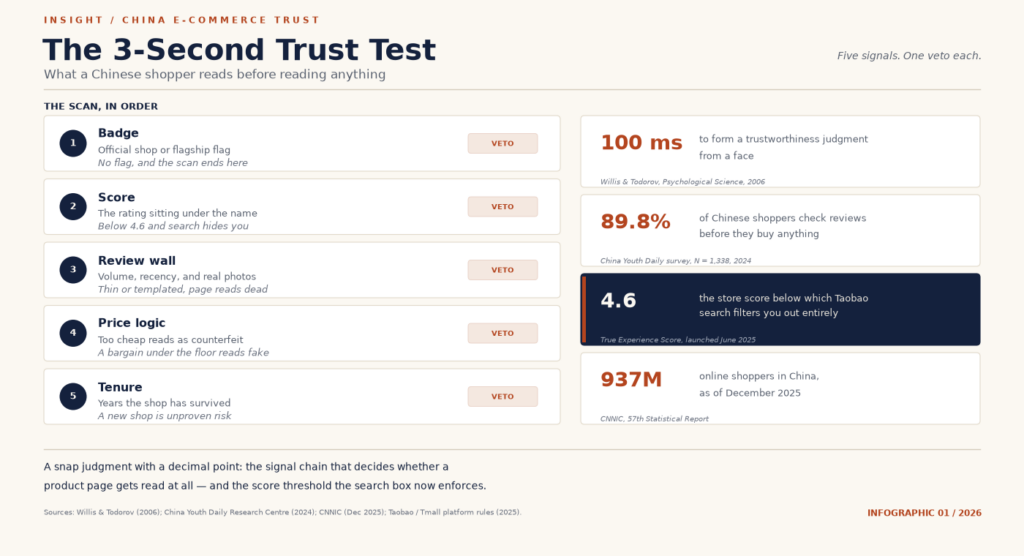
The audit is finite and unglamorous: badge, score, review depth with real photographs, price logic, tenure. Fix the weakest link first; it is ending your scan.
Then be honest about what passing buys. In a 2024 China Youth Daily survey of 1,338 shoppers, 89.8 percent said they check reviews before buying, and 68.5 percent said they had done exactly that — dug through third-party reviews to plan a purchase — and still been burned. Asked to rate how much they trusted those reviews, they averaged 6.6 out of 10.
The glance gets you evaluated. It does not get you believed.
In China, the first three seconds are not a first impression. They are a filter — and the filter has a number on it.