The 4-Point Commission Gap That Explains China’s AI Boom
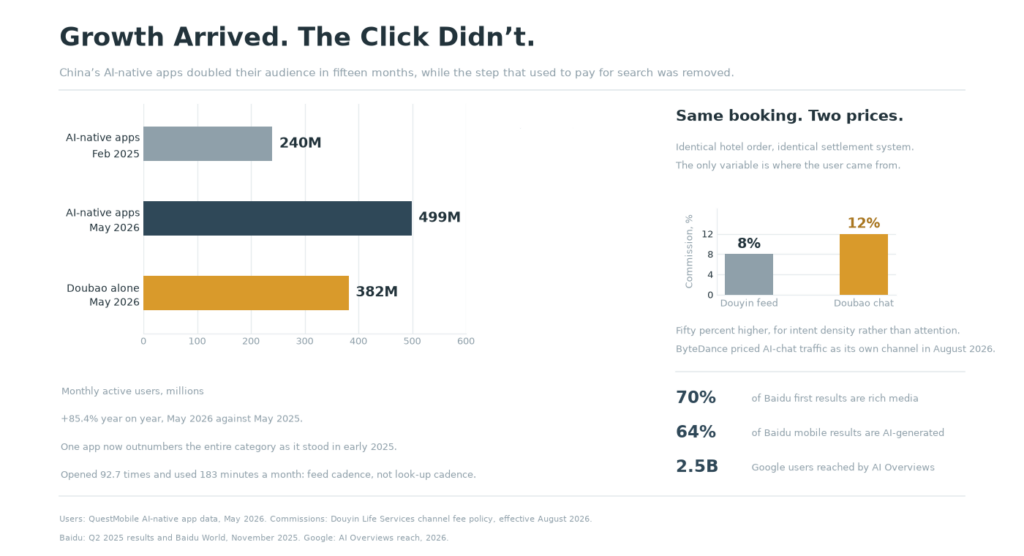
Two weeks ago, I ran the same hotel, the same room type and the same settlement system through two front doors: Douyin’s feed and Doubao’s chat box. The rate differed. Eight percent on the feed, twelve percent in the chat.
Four points, with only one variable — where the user came from. ByteDance did not subsidise a new channel to buy share. It priced it at the top of the market on day one, because merchants have no option to wait.
That gap is the most honest number we have about answer-first discovery.
The growth sits in answers, not queries
By May 2026, China’s AI-native apps carried 499 million monthly active users, up 85.4% year on year. Doubao alone held 382 million, more than the whole category managed in February 2025.
The audience is the smaller story. The cadence is the real one: 92.7 opens a month, 183 minutes of use. That is a feed rhythm, not a look-up rhythm. People are not asking. They are being served.
What got deleted was the step after the box
Chinese headlines claim that AI search killed the search box. That reads the change wrong.
Baidu spent July 2025 on its largest redesign in a decade, enlarging the box into a smart box that swallows a thousand characters, files, voice and photographs. By November, Robin Li had a cleaner number: ask ten questions, and seven answers are no longer links. Rich media covers 70% of first results; AI-generated content accounts for 64% of mobile results.
The box survived. What vanished is the step after it — scrolling, filtering, comparing, clicking. People still search. The search simply stops on the page it lands on.
The contrast is the point. Google wrapped AI around the box, and AI Mode queries now run three times longer than traditional ones, with AI Overviews reaching 2.5 billion monthly users. Western users are growing more verbose, more deliberative, more reliant on conversation to narrow what they mean. China put the AI inside the box and let intent close there.
One model lengthens the journey. The other deletes it.
Why removing a step beats adding a feature
A search box charges an articulation tax. You have to know what you want, then say it accurately. But the most valuable discovery is usually the thing you never knew to ask for.
Answer-first products waive that tax. Content arrives, intent catches up. That is easier to fall into than a tool you have to operate. A tool needs use; an environment only needs presence.
The cost is observation. Anticipation requires watching behaviour, location and history, and every served answer produces more of the same. The flywheel burns attention instead of keywords.
Attention, it turns out, can be invoiced.
What this does to brands
If nobody turns the page, ranking first and being named become different games.
Baidu’s AI summaries absorb 820 million calls a day. Users read them and leave. Your link still sits on page one, and nobody touches it. The surface SEO was built for is no longer the entrance.
Three positions matter now: mentioned by default, quoted as the answer, recommended as the only option. The first two are earned through content and structure. The third runs through a commission schedule, and that schedule has started charging for intent.
Doubao costing half again as much as the main feed is the market saying out loud that a user who arrives with a budget is worth more than one interrupted by a video.
The honest counterargument
This does not mean that search is finished.
Invoices, flight times, spec sheets — those still start in a box, and will do so more often, because the answer is faster. Search has not died. It has been demoted to fallback.
The exposure sits in the middle: categories where buyers used to browse, compare and be persuaded. Compress the journey into one answer, and the room for persuasion closes. Budgets spent making people hesitate lose their effect before they lose their line item.
So the question is not whether to keep doing SEO. It is whether your category still lives inside the step that got deleted.